Portable ultraviolet irradiation device as a teaching tool to improve handwashing in nursing students
DOI:
https://doi.org/10.23938/ASSN.1139Keywords:
Hand Disinfection, Students, Nursing, Simulation Exercise, Ultraviolet rays, Qualitative ResearchAbstract
Background. This study aims to evaluate hand hygiene performance among nursing students and to explore their reflections following an innovative educational intervention.
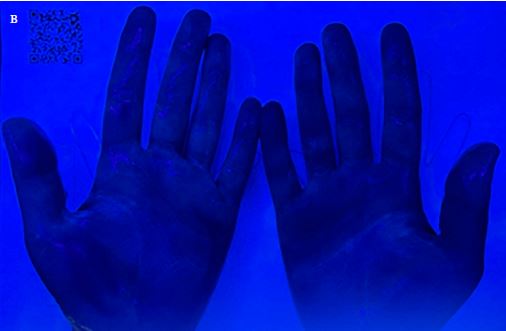
Methodology. A simulation-based study was conducted with undergraduate nursing students using a mixed-methods design: a quantitative cross-sectional component to evaluate the effectiveness of the intervention and a qualitative exploratory component using reflective writing. Hand hygiene was performed with a hydroalcoholic solution containing ionizing agent that fluoresce under ultraviolet light. A portable ultraviolet device was used to visualize clean and missed areas. The time spent and the percentage of clean surface area were recorded. After reviewing the initial results, the handwashing procedure was repeated, and both time and clean surface area were compared. Participants then answered open-ended written questions about their experience.
Results. Thirty students participated in the quantitative component and sixty in the qualitative component. The most difficult areas to clean were the fingertips, palms, and thumbs. The second handwashing attempt was 2.6 seconds longer (p=0.012), increased the median clean surface area by 9% (p=0.006), and raised the proportion of students achieving ≥70% cleanliness from 36.7% to 66.7%. Students reported notable benefits, including heightened awareness of personal errors, visual learning, and reinforced understanding of proper technique.
Conclusions. This visual and hands-on educational strategy effectively increases student awareness of key aspects of hand hygiene and may contribute to reducing iatrogenic nosocomial infections.
Downloads
References
1. RODRÍGUEZ-VILLAR S, GIL CONESA M, RODRÍGUEZ VILLAR D, GIL DE MIGUEL A. Importancia de las aportaciones de Ignaz Semmelweis en la higiene de manos y contexto histórico-científico. Revista Española de Medicina Preventiva y Salud Pública 2020; 21(1/2): 34-38. https://sempspgs.es/wp-content/uploads/2025/05/Vol-25_2020_1-y-2.pdf
2. LUPIÓN C, LÓPEZ-CORTÉS LE, RODRÍGUEZ-BANO J. Medidas de prevención de la transmisión de microorganismos entre pacientes hospitalizados. Higiene de manos. Enferm Infecc Microbiol Clin 2014; 32(9): 603-609. https://doi.org/10.1016/j.eimc.2014.02.003
3. SÁNCHEZ GARCÍA ZT, MORA PÉREZ Y, GONZÁLEZ RICARDO LL, TORRES ESPERÓN JM, MARRERO RODRÍGUEZ JN, CAMBIL MARTÍN J. Fundamentos teóricos de Florencia Nightingale sobre higiene de manos. Apuntes para una reflexión en tiempos de COVID-19. MediSur 2021; 19(5): 845-851.
4. WEBER N, MARTINSEN AL, SANI A, ASSIGBLEY EKE, AZZOUZ C, HAYTER A et al. Strengthening healthcare facilities through water, sanitation, and hygiene (WASH) improvements: a pilot evaluation of “WASH FIT” in Togo. Health Secur 2018; 16(S1): S54-S65. https://doi.org/10.1089/hs.2018.0042
5. VILLEGAS ARENAS OA, GÓMEZ J, LÓPEZ JU, ROMÁN RN, VILLA JE, BOTERO J et al. Medición de la adherencia al lavado de manos, según los cinco momentos de la OMS. Duazary 2017; 14(2): 169-178. https://doi.org/10.21676/2389783X.1967
6. DE ARRIBA FERNÁNDEZ A, MOLINA-CABRILLANA J, SERRA-MAJEM L. Application of the self-evaluation questionnaire of the WHO multimodal strategy to improve the practice of hand hygiene in a tertiary hospital. Arch Prev Riesgos Labor 2021; 24(4): 355-569. https://doi.org/10.12961/aprl.2021.24.04.03
7. CASAS I, CASTELLÀ L, GIMENEZ M, PULIDO A, SOPENA N, CIÉRCOLES A et al. Impact of a multimodal intervention on compliance with hand hygiene among health care workers of a tertiary hospital. Med Clin (Barc) 2022; 159(9): 426-431. https://doi.org/10.1016/j.medcle.2021.12.015
8. ALLEGRANZI B, PITTET D. Role of hand hygiene in healthcare-associated infection prevention. J Hosp Infect 2009; 73(4): 305-315. https://doi.org/10.1016/j.jhin.2009.04.019
9. FREEMAN MC, STOCKS ME, CUMMING O, JEANDRON A, HIGGINS JPT, WOLF J et al. Systematic review: hygiene and health: systematic review of handwashing practices worldwide and update of health effects. Trop Med Int Health 2014; 19(8): 906-916. https://doi.org/10.1111/tmi.12339
10. RAMÓN-CANTÓN C, BOADA-SANMARTÍN N, PAGESPETIT-CASAS L. Evaluación de la técnica de higiene de manos en profesionales asistenciales. Rev Calid Asist 2011; 26(6): 376-379. https://doi.org/10.1016/j.cali.2011.09.002
11. LORENTE L. Antiseptic measures during the insertion and manipulation of vascular catheters. Med Intensiva (Eng Ed) 2018; 43(Suppl 1): 39-43. https://doi.org/10.1016/j.medin.2018.09.012
12. MOLINA ÁGUILA N, OQUENDO DE LA CRUZ Y. Conocimientos, actitudes y prácticas sobre la adherencia al lavado de manos en personal de salud. Rev Cubana Pediatr 2020; 92(2): e938. https://revpediatria.sld.cu/index.php/ped/article/view/938/525
13. CUZA AA, BEJERANO-GIL N, RODRÍGUEZ-SOTOLONGO A, GONZÁLEZ DG, SUÁREZ-LÓPEZ J. Higiene de manos: el tesoro escondido. Investigaciones Medicoquirúrgicas 2019; 11(2). https://revcimeq.sld.cu/index.php/imq/article/view/477/549
14. OKUROĞLU GK, ŞIMŞEK AK, PAZAR N, ALPAR ŞE. The effect of video-assisted training and visual feedback with UV germ technology on nursing students’ hand hygiene beliefs, practices, and compliance: A randomized controlled study. J Nurs Care Qual 2023; 38(4): 335-340. https://doi.org/10.1097/NCQ.0000000000000710
Downloads
Published
How to Cite
Issue
Section
License
Copyright (c) 2025 Anales del Sistema Sanitario de Navarra

This work is licensed under a Creative Commons Attribution-ShareAlike 4.0 International License.
La revista Anales del Sistema Sanitario de Navarra es publicada por el Departamento de Salud del Gobierno de Navarra (España), quien conserva los derechos patrimoniales (copyright ) sobre el artículo publicado y favorece y permite la difusión del mismo bajo licencia Creative Commons Reconocimiento-CompartirIgual 4.0 Internacional (CC BY-SA 4.0). Esta licencia permite copiar, usar, difundir, transmitir y exponer públicamente el artículo, siempre que siempre que se cite la autoría y la publicación inicial en Anales del Sistema Sanitario de Navarra, y se distinga la existencia de esta licencia de uso.