Translation and cross-cultural adaptation to the Iceland-Family Perceived Support Questionnaire to the Spanish context
DOI:
https://doi.org/10.23938/ASSN.1144Keywords:
Translation, Cross-Cultural Adaptation, Family Support, Nursing, QuestionnairesAbstract
Background. Nurses play a crucial role in providing family support to families of hospitalized patients, particularly in the context of chronic diseases. To enhance the quality of care validated tools are needed to assess perceived family support. The Iceland-Family Perceived Support Questionnaire (ICE-FPSQ) measures families´ perceptions of support provided by nurses; however, no culturally adapted Spanish version exists. The objectives of the study are: i) to develop a version of the ICE-FPSQ suitable for nurses; and ii) to translate and adapt both instruments conceptually and linguistically to the Spanish context.
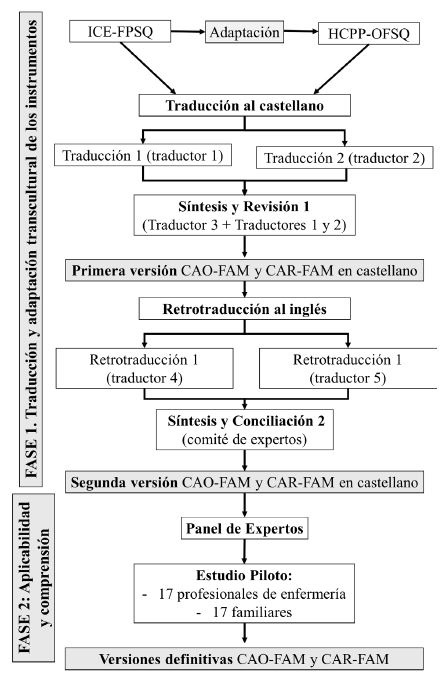
Methodology. The study followed four phases: I) adaptation of the ICE-FPSQ for nurses; II) translation, back-translation, and linguistic adaptation of both scales; III) content validation by an expert panel; and IV) a pilot study with cognitive interview techniques to assess the applicability and comprehension.
Results. Translated and adapted versions were obtained: one for family members and another for nurses. In terms of relevance, content validity was excellent for both instruments (S-CVI/AVE = 1). In terms of clarity, the family version achieved a content validity index of 0.77, while the nurses´ version reached 0.88. Pilot study participants highlighted the clarity of the items and the speed of completion.
Conclusions. Two culturally adapted tools for the Spanish context have been developed, demonstrating adequate clarity and relevance for assessing perceived support from both family and nurse perspectives. These findings indicate that both instruments are suitable for their future psychometric validation in Spain.
Downloads
References
1. SHAJANI Z, SNELL D. Wright & Leahey's Nurses and Families: A Guide to Family Assessment and Intervention. 8th ed. Chicago: FA Davis Company, 2023.
2. GOLICS CJ, BASRA MK, FINLAY AY, SALEK S. The impact of disease on family members: A critical aspect of medical care. J R Soc Med 2013; 106(10): 399-407. https://doi.org/10.1177/0141076812472616
3. FUENTES GUEVARA I. Desafíos y adaptación de las dinámicas familiares con un hijo hospitalizado en una UCI. Cambios emocionales y socioeconómicos. Tesis de Maestría, Universidad Simón Bolívar. Barranquilla, Colombia, 2023. https://bonga.unisimon.edu.co/server/api/core/bitstreams/ffe79236-2a5b-4920-ac7e-c83dee2675ff/content
4. KOKORELIAS KM, GIGNAC MA, NAGLIE G, CAMERON JI. Towards a universal model of family centered care: A scoping review. BMC Health Serv Res 2019; 19(1): 564. https://doi.org/10.1186/s12913-019-4394-5
5. DIEPERINK KB, COYNE E, CREEDY DK, ØSTERGAARD B. Family functioning and perceived support from nurses during cancer treatment among Danish and Australian patients and their families. J Clin Nurs 2018; 27(1-2): e154-e161. https://doi.org/10.1111/jocn.13894
6. MILLWARD D, MCGRAW ME, AITKEN LM. The expressed support needs of families of adults who have survived critical illness: a thematic synthesis. Int Jour Nur Stud 2021; 122: 104048. https://doi.org/10.1016/j.ijnurstu.2021.104048
7. ROJAS VERDUGO EP, CAJAMARCA NAULA RS, ANDRADE ENCALADA HA, Ochoa Maldonado KM. Rol de la enfermería en la salud familiar: Revisión sistemática. Pro Sci Rev Prod Cienc Investig. 2022; 6(42): 225-238. Disponible en: https://journalprosciences.com/index.php/ps/article/view/481
8. PÉREZ PETRONILA E. Atención psicológica de la enfermera a la familia en los cuidados paliativos. NPunto 2023; 6(62):4–26. https://www.npunto.es/content/src/pdf-articulo/64775356b9a39art1.pdf
9. SHIELDS L, ZHOU H, TAYLOR M, HUNTER J, MUNNS A, WATTS R. Family-centred care for hospitalised children aged 0-12 years. Cochrane Database Syst Rev 2012; 10(10): CD004811. https://doi.org/10.1002/14651858.cd004811.pub3
10. .EMMAMALLY W, BRYSIEWICZ P. Family-centred practices of healthcare professionals in three emergency departments in KwaZulu-Natal, South Africa. South Afr J Crit Care 2018; 34(2): 38-43.
11. MILES MS, CARLSON J, BRUNSSEN S. The Nurse Parent Support Tool. J Pediatr Nurs. 1999; 14(1): 44-50. https://doi.org/10.1016/S0882-5963(99)80059-1
12. JAFARPOOR H, VASLI P, MANOOCHEHRI H, ZAYERI F. Measuring family-centered care in intensive care units: Developing and testing psychometric properties. Signa Vitae 2020; 16(2): 82-91. https://doi.org/10.22514/sv.2020.16.0047
13. SVEINBJARNARDOTTIR EK, SVAVARSDOTTIR EK, HRAFNKELSSON B. Psychometric development of the Iceland-Family Perceived Support Questionnaire (ICE-FPSQ). J Fam Nurs 2012; 18(3): 328-352. https://doi.org/10.1177/1074840712449203
14. EGGENBERGER SK, SANDERS M. A family nursing educational intervention supports nurses and families in an adult intensive care unit. Aust Crit Care 2016; 29(4): 217-223. https://doi.org/10.1016/j.aucc.2016.09.002
15. LEMOS S, ANDRADE L, BARBIERI-FIGUEIREDO MDC, MARTINS T, LIMA L. Psychometric properties of the Portuguese version of the Iceland-family perceived support questionnaire in parents of children and adolescents with chronic condition. Int J Environ Res Public Health 2023; 20(1): 247. https://doi.org/10.3390/ijerph20010247
16. FREUDIGER K, VERWEIJ L, NAEF R. Translation and psychometric validation of the German version of the Iceland-family perceived support questionnaire (ICE-FPSQ): A Cross-Sectional Study. J Fam Nurs. 2024; 30(2): 114-126. https://doi.org/10.1177/10748407241234262
17. BRUCE E, DORELL Å, LINDH V, ERLINGSSON C, LINDKVIST M, SUNDIN K. Translation and testing of the Swedish version of Iceland-family perceived support questionnaire with parents of children with congenital heart defects. J Fam Nurs 2016;;22(3): 298-320. https://doi.org/10.1177/1074840716656343
18. KONRADSEN H, DIEPERINK KB, LAURIDSEN J, SORKNAES AD, OSTERGAARD B. Validity and reliability of the Danish version of the ICE expressive family functioning and ICE family perceived support questionnaires. Scand J Caring Sci 2018; 32(4): 1447-1457. https://doi.org/10.1111/scs.12591
19. SHIELDS L. What is “family-centred care”? Eur J Pers Cent Healthc 2015; 3(2): 139-144. file:///C:/Users/x041079/Downloads/993-3209-1-PB.pdf
20. WRIGHT LM, LEAHEY M. Nurses and families: A guide to family assessment and intervention. Philadelphia: FA Davis, 2009. https://www.minams.edu.pk/cPanel/ebooks/miscellaneous/11.Nurses%20and%20Families%20A%20Guide%20to%20Family%20Assessment%20and%20Intervention.pdf
21. Mileski M, McClay R, Heinemann K, DRAY G. EFFICACY OF THE USE OF THE CALGARY FAMILY Intervention Model in bedside nursing education: A systematic review. J Multidiscip Healthc 2022; 15: 1323-1347. https://doi.org/10.2147/JMDH.S370053
22. SOUSA VD, ROJJANASRIRAT W. Translation, adaptation and validation of instruments or scales for use in cross-cultural health care research: a clear and user-friendly guideline. J Eval Clin Pract 2011; 17(2): 268-274. https://doi.org/10.1111/j.1365-2753.2010.01434.x
23. Organización Mundial de la Salud. Guidelines on translation. Process of translation and adaptation of instruments. Ginebra: WHO. https://www.scribd.com/document/533869240/WHO-Guidelines-on-Translation-and-Adaptation-of-Instruments
24. POLIT DF, BECK CT. The content validity index: Are you sure you know what’s being reported? Critique and recommendations. Res Nurs Health 2006; 29(5): 489-497. https://doi.org/10.1002/nur.20147
25. DRENNAN J. Cognitive interviewing verbal data in the design and pretesting of questionnaires. J Adv Nurs 2003; 42(1): 57-63. https://doi.org/10.1046/j.1365-2648.2003.02579.x
26. JACOBS C, WHEELER J, WILLIAMS M, JOINER R. Cognitive interviewing as a method to inform questionnaire design and validity-Immersive Technology Evaluation Measure (ITEM) for healthcare education. Computers&Education X Reality 2023. https://doi.org/10.1016/j.cexr.2023.100027
27. FOSTER M, WHITEHEAD L. Family centred care in the paediatric high dependency unit: Parents’ and Staff's perceptions. Contemp Nurse 2017; 53(4): 489-502. https://doi.org/10.1080/10376178.2017.1410067
28. JEMES CAMPAÑA IC, ROMERO-GALISTEO RP, LABAJOS MANZANARES MT, MORENO MORALES N. Evaluación de la calidad de servicio en Atención Temprana: revisión sistemática. An Pediatr (Barc) 2018; 90(5): 301-309. https://riuma.uma.es/xmlui/handle/10630/24642
29. MUÑIZ J, ELOSUA P, HAMBLETON RK. Directrices para la traducción y adaptación de los tests: segunda edición. Psicothema 2013; 25(2): 151-157. https://www.redalyc.org/pdf/727/72726347014.pdf
30. EPSTEIN J, SANTO RM, GUILLEMIN F. A review of guidelines for cross-cultural adaptation of questionnaires could not bring out a consensus. J Clin Epidemiol 2015; 68(4): 435-441. https://doi.10.1016/j.jclinepi.2014.11.021
Downloads
Published
How to Cite
Issue
Section
License
Copyright (c) 2025 Anales del Sistema Sanitario de Navarra

This work is licensed under a Creative Commons Attribution-ShareAlike 4.0 International License.
La revista Anales del Sistema Sanitario de Navarra es publicada por el Departamento de Salud del Gobierno de Navarra (España), quien conserva los derechos patrimoniales (copyright ) sobre el artículo publicado y favorece y permite la difusión del mismo bajo licencia Creative Commons Reconocimiento-CompartirIgual 4.0 Internacional (CC BY-SA 4.0). Esta licencia permite copiar, usar, difundir, transmitir y exponer públicamente el artículo, siempre que siempre que se cite la autoría y la publicación inicial en Anales del Sistema Sanitario de Navarra, y se distinga la existencia de esta licencia de uso.