A case report of severe hypocalcemia secondary to Fahr’s syndrome
DOI:
https://doi.org/10.23938/ASSN.1138Keywords:
Hypocalcemia, Hypoparathyroidism, Brain calcifications, Rare Diseases, Fahr´s SyndromeAbstract
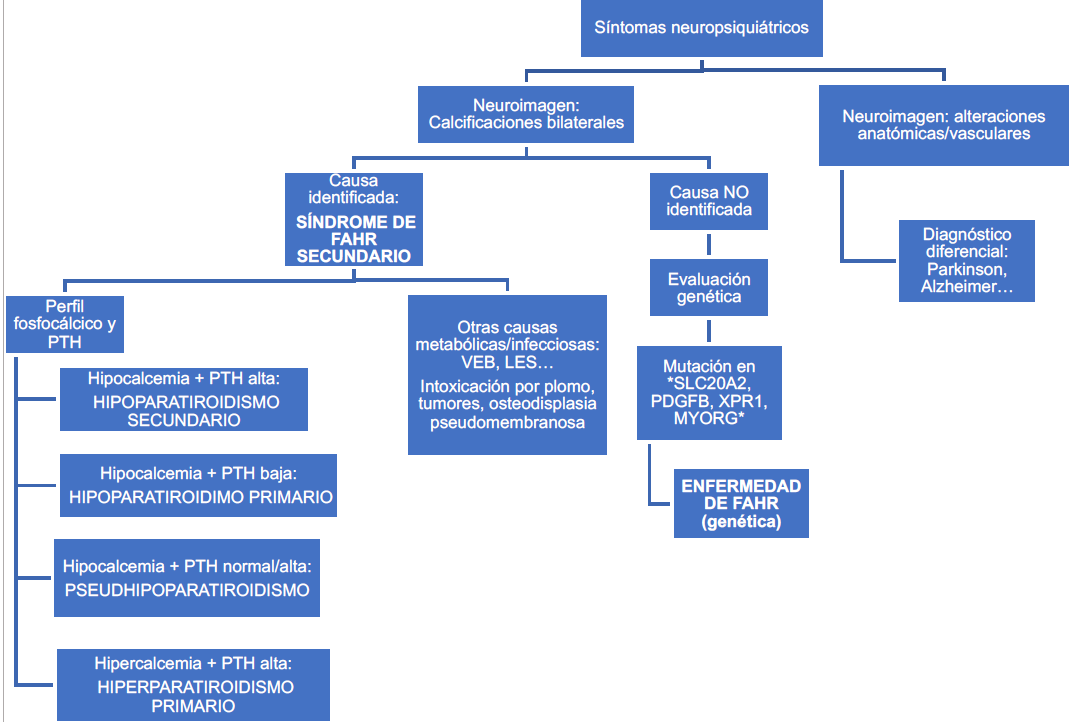
Fahr's syndrome is a rare neurological disease characterized by bilateral intracranial calcifications associated with disturbances in calcium-phosphate metabolism, most commonly due to hypoparathyroidism.
We report a 56-year-old man presenting with generalized seizures and behavioral changes. Laboratory evaluation revealed severe hypocalcemia, hyperphosphatemia, and low parathyroid hormone levels. Brain computed tomography demonstrated symmetrical calcifications involving the basal ganglia and other subcortical structures, consistent with Fahr's syndrome. Diagnosis was established through the integration of clinical features, biochemical abnormalities, and neurological findings, after excluding alternative causes of intracranial calcifications, including infectious, autoimmune, and genetic conditions. Management focused on prompt correction of hypocalcemia and long-term metabolic control with close biochemical monitoring.
Early recognition of hypoparathyroidism is essential to prevent neurological complications and improve outcomes. This case highlights the pivotal role of laboratory assessment in the diagnosis and management of Fahr´s syndrome.
Downloads
References
1. SALEEM S, ASLAM HM, ANWAR M, ANWAR S, SALEEM M, SALEEM A et al. Fahr's syndrome: Literature review of current evidence. Orphanet J Rare Dis 2013;8:156. https://doi.org/10.1186/1750-1172-8-156
2. MOSKOWITZ MA, WINICKOFF RN, HEINZ ER. Familial calcification of the basal ganglions: A metabolic and genetic study. N Engl J Med 1971;285(2):72-77. https://doi.org/10.1056/NEJM197107082850202
3. AMISHA F, MUNAKOMI S. Fahr Syndrome [Updated 2023 Aug 13]. Treasure Island (FL): StatPearls Publishing; 2025. https://www.ncbi.nlm.nih.gov/books/NBK560857/
4. PISTACCHI M, GIOULIS M, SANSON F, MARSALA SM. Fahr’s syndrome and clinical correlation: a case series and literature review. Folia Neuropathol 2016;54(3):282-294. https://doi.org/10.5114/fn.2016.62538
5. COOPER MS, GITTOES NJ. Diagnosis and management of hypocalcemia. BMJ. 2008;336(7656):1298-1302. https://doi.org/10.1136/bmj.39582.589433.BE
6. CLARKE BL. Hypoparathyroidism: update of guidelines from the 2022 International Task Force. Arch Endocrinol Metab 2022;66(5):604–610. https://doi.org/10.20945/2359-3997000000549
7. KALAMPOKINI S, GEORGOULI D, DADOULI K, NTELLAS P, RALLI S, VALOTASSIOU V, et al. Fahr’s syndrome due to hypoparathyroidism revisited: A case of parkinsonism and a review of all published cases. Clin Neurol Neurosurg 2021;202:106514. https://doi.org/10.1016/j.clineuro.2021.106514
8. TRAORÉ M, DAO A, KONÉ A, CISSÉ BS, TRAORÉ N, DIARRA O et al. [Fahr’s Syndrome with Hyperparathyroidism: A Case Report]. Health Res Afr 2025;3(11):7117. https://www.hsd-fmsb.org/index.php/hra/article/view/7117/5444
9. ALAM ST, ASWANI Y, ANANDPARA KJ, HIRA P. CT findings in Fahr's disease. BMJ Case Rep 2015;2015:bcr2014208812. https://doi.org/10.1136/bcr-2014-208812
10. DONZUSO G, MOSTILE G, NICOLETTI A, ZAPPIA M. Basal ganglia calcifications (Fahr’s syndrome): Related conditions and clinical features. Neurol Sci 2019;40(11):2251- 2263. https://doi.org/10.1007/s10072-019-03998-x
11. MANYAM BV. What is and what is not ‘Fahr’s disease’. Parkinsonism Relat Disord 2005;11(2):73–80. https://doi.org/10.1016/j.parkreldis.2004.12.001
12. GESCHWIND DH, LOGINOV M, STERN JM. Identification of a locus on chromosome 14q for idiopathic basal ganglia calcification (Fahr disease). Am J Hum Genet 1999;65(3):764-772. https://doi.org/10.1086/302558
13. PETERS MEM, DE BROUWER EJM, BARTSTRA JW, MALI WPTM, KOEK HL, ROZEMULLER AJM et al. Mechanisms of calcification in Fahr disease and exposure of potential therapeutic targets. Neurol Clin Pract 2020;10(5):449–457. https://doi.org/10.1212/CPJ.0000000000000782
14. ELLIE E, JULIEN J, FERRER X. Familial idiopathic striopallidodentate calcifications. Neurology 1989;39(3):381-385. https://doi.org/10.1212/wnl.39.3.381
15. ALMUTAIRI MM, AHMED ZJ, AHMED MY, ALSHALAN SM, AHMED AE. Progressive motor and cognitive dysfunction in Fahr’s disease: a clinical case report. Cureus 2025;17(1):e77969. https://doi.org/10.7759/cureus.77969
16. BILEZIKIAN JP, BRANDI ML, CUSANO NE, MANNSTADT M, REJNMARK L, RIZZOLI R et al. Management of hypoparathyroidism: present and future. J Clin Endocrinol Metab 2016;101(6):2313–2324. https://doi.org/10.1210/jc.2015-3910
Downloads
Published
How to Cite
Issue
Section
License
Copyright (c) 2026 Anales del Sistema Sanitario de Navarra

This work is licensed under a Creative Commons Attribution-ShareAlike 4.0 International License.
La revista Anales del Sistema Sanitario de Navarra es publicada por el Departamento de Salud del Gobierno de Navarra (España), quien conserva los derechos patrimoniales (copyright ) sobre el artículo publicado y favorece y permite la difusión del mismo bajo licencia Creative Commons Reconocimiento-CompartirIgual 4.0 Internacional (CC BY-SA 4.0). Esta licencia permite copiar, usar, difundir, transmitir y exponer públicamente el artículo, siempre que siempre que se cite la autoría y la publicación inicial en Anales del Sistema Sanitario de Navarra, y se distinga la existencia de esta licencia de uso.