Differences by sex and determinants in undertaking colorectal cancer screening in Spain (2009-2023)
DOI:
https://doi.org/10.23938/ASSN.1143Keywords:
Mass Screenings, Colorectal Cancer, Social Determinants of Health, Health SurveyAbstract
Background. This study aimed to examine sex differences and the influence of social determinants of health on the uptake of colorectal screening in Spain from 2009 to 2023.
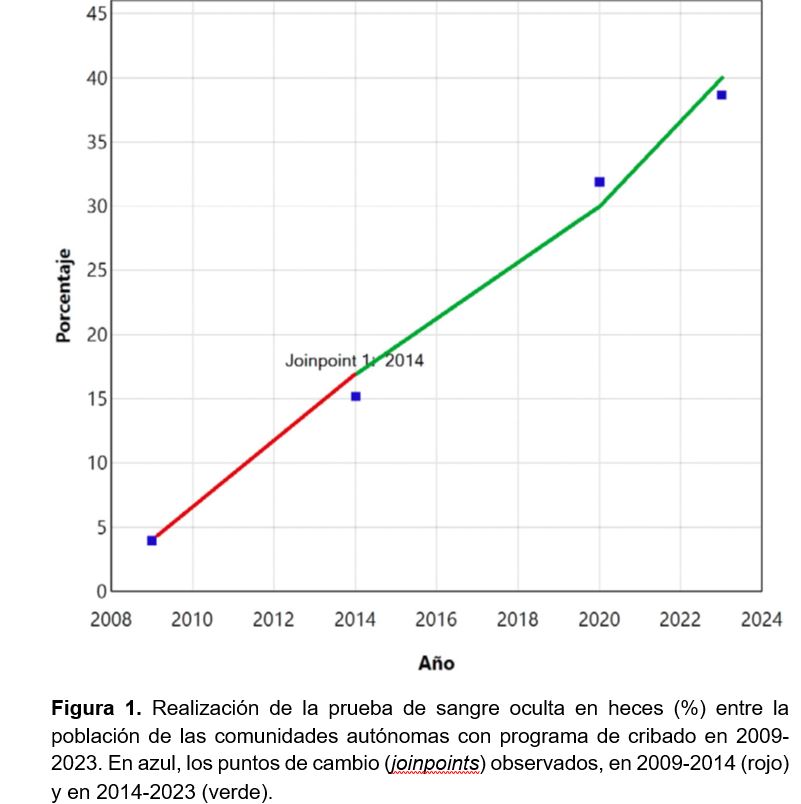
Methods. A cross-sectional analysis was conducted using data from the European Health Interview Survey in Spain (2009, 2014, 2020) and the Spanish Health Survey 2023. The frequency of faecal occult blood test use among individuals aged 50 to 69 was analysed by autonomous community and by variables related to social determinants of health using Chi-square tests. Temporal trends were assessed through joinpoint regression.
Results. Overall, faecal occult blood test uptake increased during the study period, with significant variation across autonomous communities (p<0.005). In 2023, some communities with longer-standing screening programs showed a decline in participation. A joinpoint was identified in 2014, with the annual percentage change decreasing from 33.6% to 10.0% (p<0.005). Higher test utilization was associated with the presence of a screening program, male sex, older age, higher education and income levels, cohabitation, healthy lifestyle behaviours, poorer health status, and urban residence.
Conclusions. The COVID-19 pandemic may have substantially affected screening participation. If the observed annual percentage of change is maintained, participation targets may be reached by the end of this decade. Further analyses incorporating an intersectional gender perspective are essential to understand and address the observed differences in participation between women and men.
Downloads
References
1. European Cancer Inequalities Registry. Perfiles Nacionales de Cáncer 2025. España. OCDE. Unión Europea; 2025. https://www.sanidad.gob.es/areas/calidadAsistencial/estrategias/cancer/docs/PERFILES_NACIONALES_DE_CANCER_2025_ESPANA.pdf
2. Red Española de Registros de Cáncer (REDECAN). Estimaciones de la incidencia del cáncer en España, 2025. https://redecan.org/storage/documentation/442e1d1a-4040-4674-81cf-5e6a67af6458.pdf
3. Sociedad Española de Oncología Médica (SEOM). Las cifras del cáncer en España 2024. https://seom.org/images/publicaciones/informes-seom-de-evaluacion-de-farmacos/LAS_CIFRAS_2024.pdf
4. MARZO-CASTILLEJO M, BARTOLOMÉ-MORENO C, BELLAS-BECEIRO B, MELÚS-PALAZÓN E, VELA-VALLESPÍN C. Recomendaciones de Prevención del Cáncer. Actualización PAPPS 2022. Aten Primaria 2022; 54(Suppl 1): 102440. https://doi.org/10.1016/j.aprim.2022.102440
5. Organización Mundial de la Salud, Agencia Internacional de Investigación sobre el Cáncer. Código Europeo contra el Cáncer. Doce formas de reducir el riesgo de cáncer. https://cancer-code-europe.iarc.fr/images/doc/ecac_es.pdf
6. Sociedad Española de Oncología Médica (SEOM). Situación del cribado de cáncer de colon en España. Marzo 2024. https://seom.org/images/SITUACION_ACTUAL_DEL_CRIBADO_EN_ESPANA_2023_colon.pdf
7. Ministerio de Sanidad. Estrategia en cáncer del Sistema Nacional de Salud. Actualización aprobada por el Consejo Interterritorial del Sistema Nacional de Salud, el 24 de febrero de 2021. https://www.sanidad.gob.es/areas/calidadAsistencial/estrategias/cancer/docs/ESTRATEGIA_EN_CANCER_DEL_SNS.pdf
8. World Health Organization. A conceptual framework for action on the social determinants of health. Social Determinants of Health Discussion Paper 2. Geneva: World Health Organization, 2010; 76. https://iris.who.int/server/api/core/bitstreams/ca294183-3263-470f-a5fe-8e124ec48c72/content
9. PEDRÓS BARNILS N, GUSTAFSSON PE. Intersectional inequities in colorectal cancer screening attendance in Sweden: Using decision trees for intersectional matrix reduction. Soc Sci Med 2025; 365: 117583. https://doi.org/10.1016/j.socscimed.2024.117583
10. OLA I, CARDOSO R, HOFFMEISTER M, BRENNER H. Utilization of colorectal cancer screening tests across European countries: A cross-sectional analysis of the European Health Interview Survey 2018-2020. Lancet Reg Health Eur 2024; 41: 100920. https://doi.org/10.1016/j.lanepe.2024.100920
11. CARDOSO R, GUO F, HEISSER T, HOFFMEISTER M, BRENNER H. Utilisation of colorectal cancer screening tests in European countries by type of screening offer: Results from the European Health Interview Survey. Cancers (Basel) 2020; 12(6): 10.3390. https://doi.org/10.3390/cancers12061409
12. ZENG-ZHANG L, DE MIGUEL-DIEZ J, LÓPEZ-DE-ANDRÉS A, JIMÉNEZ-GARCÍA R, JI Z, MEIZOSO-PITO O et al. Adherence to screening tests for gynaecological and colorectal cancer in patients with diabetes in Spain: A Population-Based Study (2014-2020). J Clin Med 2024; 13(11): 3047. https://doi.org/10.3390/jcm13113047
13. PORTERO DE LA CRUZ S, CEBRINO J. Uptake patterns and predictors of colorectal cancer screening among adults resident in Spain: A population-based study from 2017 to 2020. Front Public Health 2023; 11: 1151225. https://doi.org/10.3389/fpubh.2023.1151225
14. NOUNI-GARCÍA R, LARA-LÓPEZ Á, CARRATALÁ-MUNUERA C, GIL-GUILLE VF, LÓPEZ-PINEDA A, OROZCO_BELTRÁN D et al. Factors associated with colorectal cancer screening in Spain: Results of the 2017 national health survey. Int J Environ Res Public Health 2022; 19(9): 5460. https://doi.org/10.3390/ijerph19095460
15. ZAMORANO-LEON JJ, LÓPEZ-DE-ANDRES A, ÁLVAREZ-GONZÁLEZ A,MAESTRE_MIQUEL C, ASTASIO_ARBIZA P, LÓPEZ_FARREE A et al. Trends and predictors for the uptake of colon cancer screening using the fecal occult blood test in Spain from 2011 to 2017. Int J Environ Res Public Health 2020; 17(17): 6222. https://doi.org/10.3390/ijerph17176222
16. COBO-CUENCA AI, LAREDO-AGUILERA JA, RODRÍGUEZ-BORREGO MA, SANTACRUZ-SALAS E, CARMONA-TORRES JM. Temporal trends in fecal occult blood test: Associated factors (2009-2017). Int J Environ Res Public Health 2019; 16(12): 2120. https://doi.org/10.3390/ijerph16122120
17. BACIGALUPE A, CABEZAS A, BUENO MB, MARTÍN U. El género como determinante de la salud mental y su medicalización. Informe SESPAS 2020. Gac Sanit 2020; 34(Suppl 1): 61-67. https://doi.org/10.1016/j.gaceta.2020.06.013
18. CABANILLAS-MONTFERRER T, GIMÉNEZ-BONAFÉ P. El sesgo de género en la asistencia sanitaria: definición, causas y consecuencias en los pacientes. MUSAS Revistas Investigación en Mujer Salud y Sociedad 2022; 7(1): 106-129. https://doi.org/10.1344/musas2022.vol7.num1.6
19. BERNER AM, LUND J, SAUNDERS CL. Tackling the complexity of gender bias in primary care. Br J Gen Pract 2021; 71(708): 296-297. https://doi.org/10.3399/bjgp21X716177
20. Instituto Nacional de Estadística. Encuesta Europea de Salud en España 2020. Metodología. https://www.ine.es/metodologia/t15/t153042020.pdf
21. Instituto Nacional de Estadística. Encuesta de Salud de España 2023. Metodología. https://www.ine.es/metodologia/t15/esde23_meto.pdf
22. Instituto Nacional de Estadística. Encuesta Europea de Salud en España 2014. Metodología. https://www.ine.es/metodologia/t15/t153042014.pdf
23. Instituto Nacional de Estadística. Encuesta Europea de Salud en España 2009. Metodología. https://www.ine.es/metodologia/t15/t153042009.pdf
24. Instituto Nacional de Estadística. Encuesta Europea de Salud en España. Resultados. Consultado el 27 de Mayo de 2025. https://www.ine.es/dyngs/INEbase/es/operacion.htm?c=Estadistica_C&cid=1254736176784&menu=resultados&idp=1254735573175#_tabs-1254736195298
25. Ministerio de Sanidad y Política Social. Estrategia en Cáncer del Sistema Nacional de Salud. Actualización aprobada por el Consejo Interterritorial del Sistema Nacional de Salud, el 22 de octubre de 2009. https://www.sanidad.gob.es/areas/calidadAsistencial/estrategias/cancer/docs/ActualizacionEstrategiaCancer.pdf
26. US Preventive Services Task Force, DAVINSON KW, BARRY MJ, MANGIONE CM, CABANA M, CAUGHEY AB et al. Screening for colorectal cancer: US Preventive Services Task Force recommendation statement. JAMA 2021; 325(19): 1965-1977. https://doi.org/10.1001/jama.2021.6238
27. United Nations, Department of Economic and Social Affairs. World Urbanization Prospects. The 2018 Revision. New York: United Nations, 2019. https://population.un.org/wup/assets/WUP2018-Report.pdf
28. DIAZ T, STRONG KL, CAO B, GUTHOLD R, MORAN AC, MOLLER A et al. A call for standardised age-disaggregated health data. Lancet Healthy Longev 2021; 2(7): e436-e443. https://doi.org/10.1016/S2666-7568(21)00115-X
29. DOMINGO-SALVANY A, BACIGALUPE A, CARRASCO JM, ESPELT A, FERRANDO J, BORRELL C. Propuestas de clase social neoweberiana y neomarxista a partir de la Clasificación Nacional de Ocupaciones 2011. Gac Sanit 2013; 27(3): 263-272. https://doi.org/10.1016/j.gaceta.2012.12.009
30. KOCALEVENT RD, BERG L, BEUTEL ME, HINZ A, ZENGER M, HÄRTER M et al. Social support in the general population: standardization of the Oslo social support scale (OSSS-3). BMC Psychol 2018; 6: 31. https://doi.org/10.1186/s40359-018-0249-9
31. IPAQ Research Committee. Guidelines for data processing and analysis of the International Physical Activity Questionnaire (IPAQ). April 2004. https://www.physio-pedia.com/images/c/c7/Quidelines_for_interpreting_the_IPAQ.pdf
32. FERNANDEZ-NAVARRO P, ARAGONES MT, LEY V. Leisure-time physical activity and prevalence of non-communicable pathologies and prescription medication in Spain. PLos One 2018; 13(1): e0191542. https://doi.org/10.1371/journal.pone.0191542
33. FINGER JD, TAFFOREAU J, GISLE L, ZIESE T, THELEN J, MENSINK GBM et al. Development of the European Health Interview Survey - Physical Activity Questionnaire (EHIS-PAQ) to monitor physical activity in the European Union. Arch Public Health 2015; 73(1): 59. https://doi.org/10.1186/s13690-015-0110-z
34. National Cancer Institute. Division of Cancer Control & Population Sciences. Surveillance Research Program. Joinpoint Trend Analysis Software. April 16, 2025. https://surveillance.cancer.gov/joinpoint
35. Ministerio de Sanidad, Estrategia en Cáncer del Sistema Nacional de Salud. Estudio de impacto de la pandemia por COVID-19 sobre la prevención y el control del cáncer en el Sistema Nacional de Salud 2022. Madrid: Ministerio de Sanidad Centro de Publicaciones, 2023. https://www.sanidad.gob.es/areas/calidadAsistencial/estrategias/cancer/docs/Estudio_impacto_publicado.pdf
36. MUSCHOL J, STRAUSS C, GISSEL C. COVID-19 related decline in cancer screenings most pronounced for elderly patients and women in Germany: a claims data analysis. J Cancer Res Clin Oncol 2023; 149(8): 5345-5367. https://doi.org/10.1007/s00432-022-04433-z
37. GARRIDO-CANTERO G, LONGO F, HERNÁNDEZ-GONZÁLEZ J, PUEYO A, FERNÁNDEZ-APARICIO T, DORADO JF et al. Impact of the COVID-19 pandemic on cancer diagnosis in Madrid (Spain) based on the RTMAD tumor registry (2019–2021). Cancers (Basel) 2023; 15(6): 1753. https://doi.org/10.3390/cancers15061753
38. Orden SSI/2065/2014, de 31 de octubre, por la que se modifican los anexos I, II y III del Real Decreto 1030/2006, de 15 de septiembre, por el que se establece la cartera de servicios comunes del Sistema Nacional de Salud y el procedimiento para su actualización. Boletín Oficial del Estado 269, de 6 de noviembre de 2014, 91369-91382. https://www.boe.es/eli/es/o/2014/10/31/ssi2065/dof/spa/pdf
39. Unión Europea. Recomendación Del Consejo de 2 de diciembre de 2003 sobre el cribado del cáncer. Diario oficial de la Unión Europea 327, de 16 de diciembre de 2003, 34-38. https://eur-lex.europa.eu/legal-content/ES/TXT/PDF/?uri=CELEX:32003H0878&from=FR
40. Organisation for Economic Co-operation and Development (OECD). EU Country Cancer Profile: Italy 2023. https://www.oecd.org/content/dam/oecd/en/publications/reports/2023/02/eu-country-cancer-profile-italy-2023_771850d8/a0a66c1d-en.pdf
41. Unión Europea. Recomendación del Consejo de 9 de diciembre de 2022 relativa a la mejora de la prevención mediante la detección precoz: Un nuevo enfoque de la UE para el cribado del cáncer en sustitución de la Recomendación 2003/878/CE. Diario Oficial de la Unión Europea 473, de 13 de diciembre de 2022, 1-10. https://eur-lex.europa.eu/legal-content/ES/TXT/PDF/?uri=CELEX:32022H1213(01)
42. KRIEGER N. Advancing gender transformative intersectional science for health justice: An ecosocial analysis. Soc Sci Med 2024; 351: 116151. https://doi.org/10.1016/j.socscimed.2023.116151
43. Red de Programas de Cribado de Cáncer. Programas de cribado de cáncer colorrectal. Informe de Evaluación 2021. https://cribadocancer.es/indicadores-cancer-colorrectal/#
44. LÓPEZ SALAS M, DE HARO GÁZQUEZ D, FERNÁNDEZ SÁNCHEZ B, AMADOR MUÑOZ ML. Knowledge, compliance, and inequities in colon cancer screening in Spain: An exploratory study. Healthcare (Basel) 2023; 11(18): 2475. https://doi.org/10.3390/healthcare11182475
45. WOOD GER, PYKETT J, DAW P, AGYAPONG-BADU S, BANCHOFF A, KING AC et al. The role of urban environments in promoting active and healthy aging: A systematic scoping review of citizen science approaches. J Urban Health 2022; 99(3): 427-456. https://doi.org/10.1007/s11524-022-00622-w
46. INGRAM DD, MALEC DJ, MAKUC DM, KRUSZON-MORAN D, GINDI RM, ALBERT M et al. National Center for Health Statistics Guidelines for Analysis of Trends. Vital Health Stat 2 2018; 17: 1-71. https://www.cdc.gov/nchs/data/series/sr_02/sr02_179.pdf
Downloads
Published
How to Cite
Issue
Section
License
Copyright (c) 2025 Anales del Sistema Sanitario de Navarra

This work is licensed under a Creative Commons Attribution-ShareAlike 4.0 International License.
La revista Anales del Sistema Sanitario de Navarra es publicada por el Departamento de Salud del Gobierno de Navarra (España), quien conserva los derechos patrimoniales (copyright ) sobre el artículo publicado y favorece y permite la difusión del mismo bajo licencia Creative Commons Reconocimiento-CompartirIgual 4.0 Internacional (CC BY-SA 4.0). Esta licencia permite copiar, usar, difundir, transmitir y exponer públicamente el artículo, siempre que siempre que se cite la autoría y la publicación inicial en Anales del Sistema Sanitario de Navarra, y se distinga la existencia de esta licencia de uso.
Funding data
-
Generalitat Valenciana
Grant numbers CIACIF/2023/338 -
European Social Fund Plus
Grant numbers CIACIF/2023/338