Clasificación de las anomalías vasculares (tumores y malformaciones). Características clínicas e historia natural
Palabras clave:
Hemangioma. Malformación vascular. Clasificación.Resumen
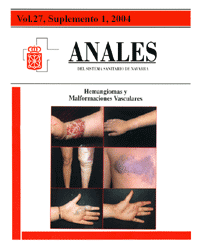
Las anomalías vasculares se dividen en tumores y malformaciones. Dentro de los primeros, los más frecuentes son los hemangiomas, habitualmente no presentes, aunque sí de forma premonitoria en el nacimiento, que durante 10-12 meses crecen por hiperplasia, para posteriormente involucionar de forma progresiva durante un período que puede llegar a durar entre 10 y 12 años. Su incidencia es de hasta un 12% de los recién nacidos, ocurre más en las niñas y se dividen en superficiales, profundos y compuestos. Los hemangiomas congénitos y aquéllos que no involucionan, se consideran entidades raras. Por otra parte, están las malformaciones vasculares con una incidencia menor que los hemangiomas, siempre presentes en el nacimiento, que característicamente crecen por hipertrofia y nunca involucionan. Según la clasificación de la ISSVA, las malformaciones vasculares se dividen en función del vaso afectado en capilares o venulares (mancha en vino de Oporto), venosas, linfáticas, arteriovenosas y combinadas o complejas. Cada una de ellas, con unas peculiaridades clínicas y hemodinámicas definitorias. Dentro del último grupo, se incluyen algunas de bajo flujo, como el síndrome de Klippel-Trenaunay (malformación vascular venular linfática y venosa asociada a hipertrofia músculo-esquelética de una extremidad) y otras de alto flujo como el síndrome de Parkes-Weber.Descargas
Los datos de descargas todavía no están disponibles.
Descargas
Publicado
22-12-2008
Cómo citar
1.
Redondo P. Clasificación de las anomalías vasculares (tumores y malformaciones). Características clínicas e historia natural. An Sist Sanit Navar [Internet]. 22 de diciembre de 2008 [citado 22 de febrero de 2026];27:9-25. Disponible en: https://recyt.fecyt.es/index.php/ASSN/article/view/5032
Número
Sección
Artículos originales
Licencia
La revista Anales del Sistema Sanitario de Navarra es publicada por el Departamento de Salud del Gobierno de Navarra (España), quien conserva los derechos patrimoniales (copyright ) sobre el artículo publicado y favorece y permite la difusión del mismo bajo licencia Creative Commons Reconocimiento-CompartirIgual 4.0 Internacional (CC BY-SA 4.0). Esta licencia permite copiar, usar, difundir, transmitir y exponer públicamente el artículo, siempre que siempre que se cite la autoría y la publicación inicial en Anales del Sistema Sanitario de Navarra, y se distinga la existencia de esta licencia de uso.