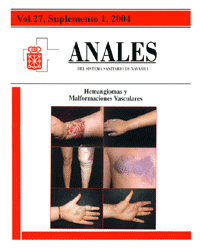
Láser y luz pulsada intensa en el tratamiento de hemangiomas infantiles y malformaciones vasculares
Palabras clave:
Láser de colorante pulsado. Mancha en vino de Oporto. Hemangioma. Láser Nd, YAG. Malformación vascular.Resumen
El uso de las indicaciones del láser en el manejo de las malformaciones vasculares y los hemangiomas infantiles se fundamenta en la teoría de la fototermolisis selectiva, siendo la oxihemoglobina el cromóforo diana sobre el cual actúa la luz del láser, evitándose así el daño a tejidos vecinos. El láser de colorante pulsado es el más utilizado y es, actualmente, el tratamiento de elección en las malformaciones capilares (mancha en vino de Oporto). La respuesta obtenida es variable, alcanzándose un aclaramiento sustancial del color de la lesión, tras varias sesiones. La aplicación en edades tempranas parece mejorar los resultados. Las malformaciones venosas, especialmente las localizadas en la mucosa, responden mejor al láser de Nd:YAG; las malformaciones linfáticas al láser de CO2. Las malformaciones arteriovenosas raramente responden. El uso del láser de colorante pulsado en la fase proliferativa de los hemangiomas es controvertido, excepto si existe ulceración. En estos casos se obtiene una reepitelización rápida tras su empleo. En la fase involutiva, los pacientes con lesiones residuales vasculares pueden beneficiarse de otros láseres como KTP o Nd:YAG. Si presentan superficie atrófica y cicatrices mejoran con láser de CO2 o Er:YAG. Están emergiendo nuevas modalidades como la terapia fotodinámica cuya eficacia y seguridad, tanto en el tratamiento de los hemangiomas como de las malformaciones vasculares, está aún por confirmar.Descargas
Los datos de descargas todavía no están disponibles.
Descargas
Publicado
22-12-2008
Cómo citar
1.
Sánchez-Carpintero I, Mihm M, Waner M. Láser y luz pulsada intensa en el tratamiento de hemangiomas infantiles y malformaciones vasculares. An Sist Sanit Navar [Internet]. 22 de diciembre de 2008 [citado 21 de febrero de 2026];27:103-15. Disponible en: https://recyt.fecyt.es/index.php/ASSN/article/view/5040
Número
Sección
Artículos originales
Licencia
La revista Anales del Sistema Sanitario de Navarra es publicada por el Departamento de Salud del Gobierno de Navarra (España), quien conserva los derechos patrimoniales (copyright ) sobre el artículo publicado y favorece y permite la difusión del mismo bajo licencia Creative Commons Reconocimiento-CompartirIgual 4.0 Internacional (CC BY-SA 4.0). Esta licencia permite copiar, usar, difundir, transmitir y exponer públicamente el artículo, siempre que siempre que se cite la autoría y la publicación inicial en Anales del Sistema Sanitario de Navarra, y se distinga la existencia de esta licencia de uso.