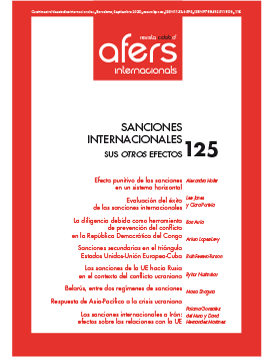
Las sanciones internacionales a Irán: efectos sobre las relaciones con la Unión Europea
Palabras clave:
Irán, sanciones internacionales, Unión Europea, estrategia regional, programa nuclearResumen
Revista CIDOB d’Afers Internacionals, nº 125
Cuatrimestral (mayo-septiembre 2020)
ISSN:1133-6595 | E-ISSN:2013-035X
DOI: doi.org/10.24241/rcai.2020.125.2.165
Las sanciones internacionales ponen de nuevo en el centro del debate internacional a Irán. El interés del presidente Donald Trump por implementar nuevas sanciones económicas, políticas y militares a este país está obligando a los ejecutivos europeos a redefinir su estrategia regional, ya que habían retomado fluidas relaciones comerciales y diplomáticas con Teherán. Este trabajo analiza las relaciones de Irán con los miembros de la Unión Europa, especialmente con Francia, Alemania y Reino Unido, examinando la respuesta europea dada en 2006 y las posiciones planteadas en el actual contexto. Asimismo, estudia los efectos de las sanciones aplicadas en el pasado sobre las bilateralidades iranoeuropeas. Además, la investigación aborda las diferentes posturas de los actores europeos ante la decisión de imponer nuevas sanciones y discute las posibles consecuencias que ello puede tener sobre el país receptor y terceros.
Citas
Adebahr, Cornelius. «The nuclear deal turns two: barely alive o already dead?». Global Policy, vol. 9, n.°1 (2018), p. 151-152. https://doi.org/10.1111/1758-5899.12536
Alcaro, Riccardo. Europe and Iran’s nuclear crisis. Lead Groups and EU foreign policy-making. Cham: Palgrave Macmillan, 2018.
Amuzegar, Jahangir. The Islamic Republic of Iran. Reflections on an emerging economy. Londres: Routledge, Taylor & Francis Group, 2014.
Arce, Natalia. «La cuestión nuclear en las relaciones entre la Unión Europea y la República Islámica de Irán (2003-2006): de la “Política Negociadora” al Consejo de Seguridad de Naciones Unidas». Revista de Estudios Internacionales Mediterráneos, n.° 3 (2007), p. 73-89.
Barnett, Michael. «Institutions, roles and disorder: the case of the arab system». International studies quarterly, n.° 37 (1993), p. 271-296. https://doi.org/10.2307/2600809
Bernabeu, Queren. «El problema de la no proliferación: Irán y su derecho a la energía nuclear». El Orden Mundial. (1 de julio de 2015) (en línea) [Fecha de consulta: 05.11.19] https://elordenmundial.com/iran-y-su-derecho-laenergia-nuclear/
Björkdahl, Annika. «Norms in International Relations: some conceptual and methodological reflections». Cambridge Review of International Affairs, vol. 15, n.° 1 (2002), p. 9-23. https://doi.org/10.1080/09557570220126216
Blavaoukos, Spyros; y Bourantonis, Dimitris. «Do sanctions strenghten the International Presence of the EU?». European Foreign Affairs Reviw, vol. 19, n.° 3 (2014), p. 393-410.
Castro, José Ignacio. «El resurgimiento de Irán como potencia tras el levantamiento de las sanciones internacionales». Revista de Estudios en Seguridad Internacional, vol. 2, n.° 2 (2016), p. 11-30. https://doi.org/10.18847/1.4.2
Chekel, Jeffrey T. «The constructivist turn in international relations theory». International Security, vol. 23, n.° 1 (1998), p. 171-200. https://doi.org/10.1162/isec.23.1.171
Dueck, Colin y Takeyh, Ray. «Iran’s nuclear challenge». Political Science Quarterly, vol. 122, n.° 2 (2007), p. 189-205. https://doi.org/10.1002/j.1538-165X.2007.tb00596.x
Ehteshami, Anoushiravan. «The foreign policy of Iran». En: Ehteshami, Anoushiravan y Hinnebusch, Raymond A. Syria and Iran. Middle powers in a penetrated regional system. Boulder, Co. Lynne Rienner, 2002, p. 283-309.
Fair, Christine y Shellman, Stephen. «Determinants of Popular Support for Iran’s Nuclear Program: Insights from a Nationally Representative Survey».
Contemporary Security Policy, vol. 29, n.° 3 (2008), p. 538-558. https://doi.org/10.1080/13523260802514688
Farrell, Theo. «Constructivist security studies: portrait of a research program». International Studies Review, vol. 4, n.° 1 (2002), p. 49-72.
Fitzpatrick, Mark. (2017): «Assessing the JCPOA». Adelphi Series, vol. 57, n.° 466-467 (2017), p. 19-60. https://doi.org/10.1080/19445571.2017.1555914
Garcés de los Fayos, Fernando. «In search of an effective EU policy for Iran». En Blockmans, Steven; Ehteshami, Anoushiravan y Bahgat, Gawdat (eds.). EUIran relations after the nuclear deal. Bruselas: CEPS, 2016, p. 33-37.
Garduño, Moises. «La crisis de confianza y el balance de poder entre Irán y las Grandes Potencias en la “cuestión nuclear”». Revista de Estudios Internacionales Mediterráneos, n.° 10 (2011), p. 72-81.
Gordon, Philip. «A visión of Trump at war». Foreign Affaris, vol. 96, n.° 3 (2017), p. 10-19.
Harnisch, Sebastian. «Iran and European Union politics». Politics, Oxford Research Encyclopedia, (agosto de 2019) (en línea) https://doi.org/10.1093/acrefore/9780190228637.013.1483
Hernández, David. (2018): «La Guardia Revolucionaria de Irán, defensora de la república islámica». El Orden Mundial, (23 de agosto de 2018) (en línea) [Fecha de consulta: 06.11.19] https://elordenmundial.com/guardia-revolucionaria-de-iran/
Hopf, Ted. «The promise of constructivism in International Relations Theory». International Security, vol. 23, n.° 1 (1998), p. 171-200. https://doi.org/10.1162/isec.23.1.171
Izewicz, Paulina. (2018): «The Iran nuclear deal two years on: future unclear and getting worse». Med Agenda - Special Issue [What Future for the Iran Nuclear Deal?]: MEDAC Publications in Mediterranean IR and Diplomacy, (2018), p. 20-32.
Katzman, Kenneth. The Persian Gulf States. Post-war issues. Nueva York: Novinka Books, 2004.
Kaussler, Bernd. «From engagement to containment: EU-Iran relations and the nuclear programme, 1992-2011». Journal of Balkan and Near Eastern Studies, vol. 14, n.° 1 (2012), p. 53-76. https://doi.org/10.1080/19448953.2012.656935
Khan, Mehreen. «Federica Mogherini, Europe’s diplomat taking on Donald Trump». Financial Times, (18 de agosto de 2018) (en línea) [Fecha de consulta: 11.11.19] https://www.ft.com/content/ab3d31dc-9c7d-11e8-9702-5946bae86e6d
Kienzle, Benjamin. «Between human rights and non-proliferation: norm competition in the EU’s Iran policy». UNISCI Discussion Papers, n.° 30 (2012), p. 77-91.
Kreutz, Joakim. Hard measure by a soft power? Sanctions policy of the European Union 1981-2004 [Paper 45]. Bonn: BICC, 2005.
Lamont, Christopher. Research methods in international relations. Londres: SAGE, 2015.
Lynch, Marc. «Obama and the Middle East. Rightsizing the U.S. Role». Foreign Affairs, vol. 94, n.° 5 (2015), p. 18-27.
Maloney, Suzanne. «Sanctioning Iran: if only it were so simple». The Washington Quarterly, vol. 33, n.° 1 (2010), p. 131-147. https://doi.
org/10.1080/01636600903430673
Nasr, Vali y Takeyh, Ray. «The Costs of Containing Iran - Washington’s Misguided NewMiddle East Policy». Foreign Affairs, vol. 87, n.° 1 (2008), p. 85-94.
Nugroho, Ganjar. «Constructivism and International Relations Theories». Global & Strategies, vol. 2, n.° 1, (2008), p. 85-98.
Onuf, Nicholas. «Constructivism: a user’s manual». En: Kubálková, Vendulka; Onuf, Nicholas y Kower, Paul (ed.). International relations in a constructed world. Londres: Routledge, Taylor & Francis Group, 1998, p. 58-78.
Portela, Clara. «EU strategies to tackle the Iranian and North Korean nuclear issues». En: Blavoukos, Spyros; Bourantonis, Dimitris y Portela, Clara (eds.).
The EU and the non-proliferation of nuclear weapons. Strategies, policies, actions. Nueva York: Palgrave Macmillan, 2015, p. 188-204.
Portela, Clara. «Are European Union sanctions targeted?». Cambridge Review of International Affaris, vol. 29, n.° 3 (2016), p. 912-929. https://doi.org/10.1080/09557571.2016.1231660
Ramazani, Ruhi. K. «Ideology and pragmatism in Iran’s foreign policy». The Middle East Journal. vol. 58, n.° 4 (2004), p. 549-559. https://doi.org/10.3751/194034604783997123
Rodríguez, Javier. «La política exterior de la Unión Europea y el programa nuclear de Irán». Análisis GESI, (15 de diciembre de 2014) (en línea) [Fecha de consulta: 15.11.19] http://www.seguridadinternacional.es/?q=es/content/la-pol%C3%ADtica-exterior-de-la-uni%C3%B3n-europea-y-el-programanuclear-de-ir%C3%A1n
Shirazi, Homayoun; Azarbaiejani, Karim y Sameti, Morteza. «The effect of Economic sanctions on Iran’s export». Iranian Economic Review, vol. 20, n.° 1 (2016), p. 111-124.
Shirvani, Tara y Vuković, Siniša. «After the Iran nuclear deal: Europe’s pain and gain». The Washington Quarterly, vol. 38, n.° 3 (2015), p. 79-92. https://doi.org/10.1080/0163660X.2015.1099026
Soltani, Fakhreddin y Amiri, Reza, E. «Foreign policy of Iran after Islamic Revolution». Journal of Politics and Law, vol. 3, n.° 2 (2010), p. 199-206. https://doi.org/10.5539/jpl.v3n2p199
Thompson, Jack y Thränert, Oliver. «Trump preparing to end Iran nuke deal». ETH Zürich, Research Collection, (agosto de 2017) (en línea) [Fecha de consulta: 06.11.19] https://www.research-collection.ethz.ch/handle/20.500.11850/181637
Ünver Noi, Aylin. «Iran’s Nuclear Programme: The EU Approach to Iran in Comparison to the US’ Approach». Perceptions, (2005), p. 79-101.
Vakil, Sanam. «Iran: balancing east against west». The Washington Quarterly, vol. 29, n.° 4 (2006), p. 51-65. https://doi.org/10.1162/wash.2006.29.4.51
Wendt, Alexander. «Collective identity formation and the international state». The American Political Science Review, vol. 88, n.° 2 (1994), p. 384-396. https://doi.org/10.2307/2944711
Zaccara, Luciano. «La comunidad internacional ante la cuestión iraní». Cuadernos de Estrategia, n.° 144 (2010), p. 123-155.
Zaccara, Luciano. «Irán: política interior, economía y sociedad». Anuario Internacional CIDOB (2016) (en línea) [Fecha de consulta: 06.11.19] http://anuariocidob.org/iran-perfil-de-pais-politica-interior-economia-y-sociedad/