South America in a new world
Keywords:
South America, international relations, foreign policy, United States, Europe, AsiaAbstract
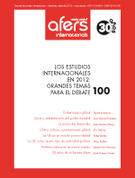
Revista CIDOB d’Afers Internacionals, nº 100
Quadrimestral (December 2012)
ISSN:1133-6595 | E-ISSN:2013-035X
South American countries participate on the new international stage in very diverse ways, reflecting their different political models and preferences. The big changes that have seriously affected the international system have had a profound impact on South America. The United States are no longer the dominant power in the world, nor in their old backyard, South America. Europe retains a certain role in the area, but the crisis it is undergoing is limiting its influence in the region. Relations between South American counties are increasing, but not within the framework of a single, coherent integration process. China, India, Korea, and other Asian countries are joining Japan’s traditional and always discreet presence in the area, but up to now Asia has confined itself to economic exchanges with South America. In general, South America is consolidating itself as the second-largest emerging region on the planet, after Asia, and is projecting that reality in its international relations.
>> The full text articles of this issue are available only in Spanish language
References
Antón Pérez, José Ignacio et al. «Pobreza y desigualdad en América Latina». Revista CIDOB d’Afers Internacionals, n.º 85-86 (2009). Barcelona: Fundació CIDOB, p. 157-183.
Blaney, David L. e Inayatullah, Naeem. «International Relations from Below», en: Reus-Smith, Christian y Snidal, Duncan (eds.). The Oxford handbook of International Relations. Oxford: Oxford University Press, 2008, p. 663-674.
CEPAL (Comisión Económica para América Latina y el Caribe). Panorama social de América Latina 2011. Santiago de Chile: CEPAL, 2012a.
– Panorama de la inserción internacional de América Latina y el Caribe 2011-2012. Santiago de Chile: CEPAL, 2012b.
Escudé, Carlos. Realismo Periférico: Bases Teóricas para una Nueva Política Exterior Argentina. Buenos Aires: Planeta 1992.
– Principios de realismo periférico: vigencia de una teoría argentina ante el ascenso de China. Buenos Aires: Lumière, 2012.
Fukuyama, Francis. The End of History and the Last Man. New York: Free Press, 1992.
Gratius, Susanne. «La UE y América Latina ante la crisis económica y la nueva arquitectura financiera global: ¿podemos construir una agenda común?».Nuevas bases para las relaciones entre la Unión Europea y América Latina y el Caribe. Madrid: FIIAP, 2010, p. 131-141.
Heine, Jorge. «Playing the India Card», en: Cooper, Andrew F. y Heine, Jorge (eds.). Which Way Latin America? Tokyo: United Nations University Press, 2009, p. 122-139.
Hornbeck, «U.S.-Latin America Trade: Recent Trends and Policy Issues». Congressional Research Service, 8 de febrero de 2011 (en línea) [Fecha de consulta 3.9.2012]. http://www.fas.org/sgp/crs/row/98-840.pdf.
Ikenberry, G. John. Liberal Leviathan. The Origins, Crisis, and Transformation of the American World Order. Princeton: Princeton University Press, 2011.
Kacowicz, Arie M. The Impact of Norms in International Society. The Latin American Experience 1881-2001. Notre Dame: University of Notre Dame Press, 2005.
Kupchan, Charles A. No One’s World. The West, the rising rest, and the coming global turn. Oxford: Oxford University Press, 2012.
Maxfield, Sylvia. «International Development», en: Carlsnaes, Walter; Risse, Thomas y Simmons, Beth A. (eds). Handbook of International Relations. London: Sage, 2002, p. 462-479.
Muñoz, Heraldo y Tulchin, Joseph S. (eds.). Entre la autonomía y la subordinación. Política exterior de los países latinoamericanos. Buenos Aires: Grupo Editor Latinoamericano, 1984, 2 vol.
Rosales, Osvaldo. «Relaciones económicas de América Latina con China y Asia Pacífico». Ponencia presentada en la Conferencia Internacional Las relaciones económicas entre Chile y Asia. CIEPLAN, 29 de marzo de 2012 (en línea) [Fecha de consulta 7.9. 2012] http://www.cieplan.org/media/actividades/archivos/16/Relaciones_Economicas_de_America_Latina_con_China_y_Asia_Pacifico.pdf.
Shifter, Michael. «Managing disarray: The search for a new consensus», en: Cooper, Andrew F. y Heine, Jorge (eds.). Which Way Latin America? Tokyo: United Nations University Press, 2009, p. 50-63.
Smith, Peter. Talons of the Eagle. Latin America, the United States, and the World [3rd ed.]. Oxford: Oxford University Press, 2008.
The Economist. «So near and yet so far. A special report on Latin America». 11 September 2010.
Zakaria, Fareed. The Post-American World. New York: W.W. Norton, 2009.