La investigación en Six Sigma sobre salud se asocia con indicadores de salud global, investigación y desarrollo: Estudio cienciométrico por países según grupos de ingresos
DOI:
https://doi.org/10.23938/ASSN.1124Palabras clave:
Gestión de la Calidad, Calidad de la Atención de Salud, Bibliometría, Publicaciones, Meta-InvestigaciónResumen
Fundamento. Six Sigma se ha implementado ampliamente en el ámbito de la salud para mejorar la eficiencia, reducir los errores médicos y fortalecer la seguridad del paciente. Sin embargo, la distribución global y el impacto de la investigación sobre Six Sigma son poco explorados. El objetivo es analizar la investigación en Six Sigma aplicada a la salud, y su relación con indicadores globales de salud, investigación y desarrollo según los niveles de ingreso.
Métodos. Estudio cienciométrico de métodos mixtos, basado en datos obtenidos de Scopus, PubMed y otras bases de datos. Se aplicaron modelos de regresión y meta-análisis para examinar la relación entre la productividad en investigación sobre Six Sigma y los indicadores globales de salud, investigación y desarrollo en países de ingresos altos (PAI), ingresos medio-altos (PIMA) y bajos (PBI).
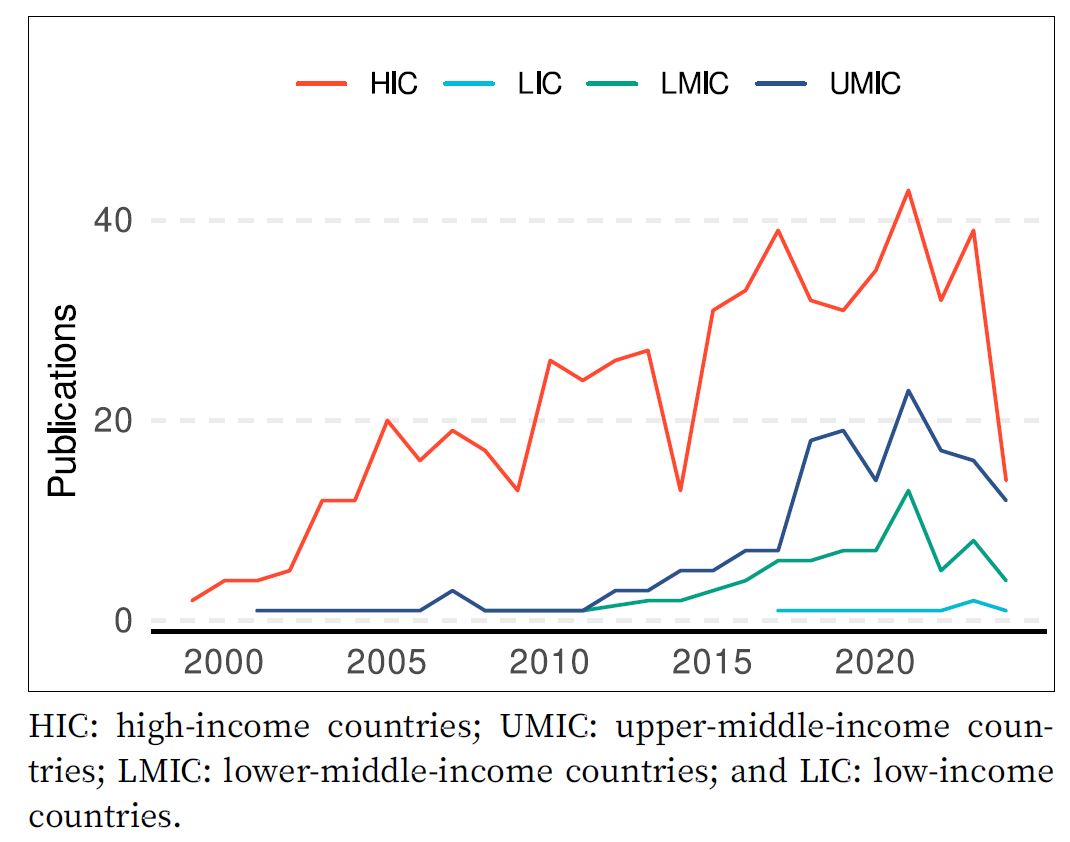
Resultados. Se identificaron 804 publicaciones relacionadas con Six Sigma en el ámbito de la salud, 70,8% aportadas por PAI. El número de publicaciones se asoció con la reducción de mortalidad en adultos en PAI y PIMA (p<0,01). El gasto en investigación y desarrollo mostró una fuerte correlación positiva con la producción científica en Six Sigma en todos los grupos de ingresos. Los PBI registraron una actividad investigativa mínima, sin detectarse asociaciones significativas.
Conclusiones. La investigación sobre Six Sigma en salud se concentra predominantemente en los PAI, con un crecimiento progresivo pero desigual en los PIMA y países de bajos y medianos ingresos. La escasa participación de los PBIs evidencia una brecha crítica en la investigación.
Descargas
Citas
1. World Health Organization. Quality of care. Consulted February 4, 2025. https://www.who.int/health-topics/quality-of-care#tab=tab_1
2. Agency for Healthcare Research and Quality. Six Domains of Healthcare Quality. Consulted February 4, 2025. https://www.ahrq.gov/talkingquality/measures/six-domains.html
3. CHO J, SHIN S, JEONG Y, LEE E, AHN S, WON S, et al. Healthcare quality improvement analytics: an example using computerized provider order entry. Healthcare (Basel) 2021; 9(9): 1187. https://doi.org/10.3390/healthcare9091187
4. ILIN M, BOHLEN J. Six Sigma Method. [Updated January 9, 2023]. In: StatPearls. Treasure Island (FL): StatPearls Publishing; 2024. https://www.ncbi.nlm.nih.gov/books/NBK589666/
5. AL-QATAWNEH L, ABDALLAH AAA, ZALLOUM SSZ. Six Sigma application in healthcare logistics: A. J Healthc Eng 2019; 2019: 9691568. https://doi.org/10.1155/2019/9691568
6. LOZADA-MARTINEZ ID, HERNANDEZ-PAZ DA, FIORILLO-MORENO O, PICÓN-JAIMES YA, BERMÚDEZ V. Meta-research in biomedical investigation: gaps and opportunities based on meta-research publications and global indicators in health, science, and human development. Publications 2025; 13(1): 7. https://doi.org/10.3390/publications13010007
7. WONG EC, MAHER AR, MOTALA A, ROSS R, AKINNIRANYE O, LARKIN J, et al. Methods for identifying health research gaps, needs, and priorities: a scoping review. J Gen Intern Med 2022; 37(1): 198-205. https://doi.org/10.1007/s11606-021-07064-1
8. LOZADA-MARTINEZ ID, LOZADA-MARTINEZ LM, FIORILLO-Moreno O. Leiden manifesto and evidence-based research: Are the appropriate standards being used for the correct evaluation of pluralism, gaps and relevance in medical research? J R Coll Physicians Edinb 2024; 54(1): 4-6. https://doi.org/10.1177/14782715241227991
9. NAAL H, EL KOUSSA M, EL HAMOUCH M, HNEINY L, SALEH S. Evaluation of global health capacity building initiatives in low-and middle-income countries: A systematic review. J Glob Health 2020; 10(2): 020412. https://doi.org/10.7189/jogh.10.020412
10. LEDESMA JR, ISAAC CR, DOWELL SF, BLAZES DL, ESSIX GV, BUDESKI K et al. Evaluation of the Global Health Security Index as a predictor of COVID-19 excess mortality standardised for under-reporting and age structure. BMJ Glob Health 2023; 8(7): e012203. https://doi.org/10.1136/bmjgh-2023-012203
11. SHORTEN A, SMITH J. Mixed methods research: expanding the evidence base. Evid Based Nurs 2017; 20(3): 74-75. https://doi.org/10.1136/eb-2017-102699
12. MONTAZERI A, MOHAMMADI S, M HESARI P, GHAEMI M, RIAZI H, SHEIKHI-MOBARAKEH Z. Preliminary guideline for reporting bibliometric reviews of the biomedical literature 417 (BIBLIO): a minimum requirements. Syst Rev 2023; 12(1): 239. https://doi.org/10.1186/s13643-023-02410-2
13. WEN Y, LI Y, ZHANG Y, LIU B. Comprehensive evaluation of global health cities development levels. Front Public Health 2024; 12: 1437647. https://doi.org/10.3389/fpubh.2024.1437647
14. CHURRUCA K, POMARE C, ELLIS LA, LONG JC, BRAITHWAITE J. The influence of complexity: a bibliometric analysis of complexity science in healthcare. BMJ Open 2019; 9: e027308. https://doi.org/10.1136/bmjopen-2018-027308
15. ÜNAL A, SEREN INTEPELER Ş. Scientific view of the global literature on medical error reporting and reporting systems from 1977 to 2021: A bibliometric analysis. J Patient Saf 2022; 18(7): e1102-e1108. https://doi.org/10.1097/pts.0000000000001025
16. BHULANI N, MIAO TL, NORBASH A, CASTILLO M, KHOSA F. Leadership in healthcare: a bibliometric analysis of 100 most influential publications. BMJ Leader 2021; 5: 65-68. https://doi.org/10.1136/leader-2019-000207
17. LOZADA-MARTINEZ ID, LOZADA-MARTINEZ LM, CABARCAS-MARTINEZ A, RUIZ-GUTIERREZ FK, ARISTIZABAL VANEGAS JG, AMOROCHO LOZADA KJ, et al. Historical evolution of cancer genomics research in Latin America: a comprehensive visual and bibliometric analysis until 2023. Front Gene 2024; 15: 1327243. https://doi.org/10.3389/fgene.2024.1327243
18. ÖZTÜRK O, KOCAMAN R, KANBACH DK. How to design bibliometric research: an overview and a framework proposal. Rev Manag Sci 2024; 18: 3333-3361. http://doi.org/10.1007/s11846-024-00738-0
19. The World Bank. World Bank Country and Lending Groups. February 4, 2025. https://datahelpdesk.worldbank.org/knowledgebase/articles/906519-world-bank-country-and-lending-groups
20. The World Bank. Indicators. Consulted February 4, 2025. https://data.worldbank.org/indicator
21. PIBURN J. wbstats: Programmatic access to the World Bank API [software]. Oak Ridge, Tennessee: Oak Ridge National Laboratory; 2020.
22. R Core Team. R: A language and environment for statistical computing [software]. Vienna, Austria: R Foundation for Statistical Computing; 2024.
23. World Health Organization. Global Observatory on Health Research and Development. Consulted February 4, 2025. https://www.who.int/observatories/global-observatory-on-health-research-and-development
24. CHAN BKC. Data analysis using R programming. Adv Exp Med Biol 2018; 1082: 47-122. https://doi.org/10.1007/978-3-319-93791-5_2
25. ADAM T, RALAIDOVY AH, ROSS AL, REEDER JC, SWAMINATHAN S. Tracking global resources and capacity for health research: time to reassess strategies and investment decisions. Health Res Policy Sys 2023; 21(1): 93. https://doi.org/10.1186/s12961-023-00979-7
26. ROTTINGEN JA, CHAMAS C. A new deal for global health research and development? The recommendations of the Consultative Expert Working Group on Research and Development (CEWG). PLoS Med 2012; 9(5): e1001219. https://doi.org/10.1371/journal.pmed.1001219
27. SWAMINATHAN S, PÉCOUL B, ABDULLAH H, CHRISTOU C, GRAY G, IJSSELMUIDEN C et al. Reboot biomedical research and development in the global public interest. Nature 2022; 602(7896): 207-210. https://doi.org/10.1038/d41586-022-00324-y
28. YEGROS-YEGROS A, VAN DE KLIPPE W, ABAD-GARCIA MF, RAFOLS I. Exploring why global health needs are unmet by research efforts: the potential influences of geography, industry and publication incentives. Health Res Policy Syst 2020; 18(1): 47. https://doi.org/10.1186/s12961-020-00560-6
29. NIÑEROLA A, SÁNCHEZ-REBULL MV, HERNÁNDEZ-LARA AB. Quality improvement in healthcare: Six Sigma systematic review. Health Policy 2020; 124(4): 438-445. https://doi.org/10.1016/j.healthpol.2020.01.002
30. JACA A, MALINGA T, IWU-JAJA CJ, NNAJI CA, OKEIBUNOR JC, KAMUYA D et al. Strengthening the health system as a strategy to achieving a universal health coverage in underprivileged communities in Africa: A. Int J Environ Res Public Health 2022; 19(1): 587. https://doi.org/10.3390/ijerph19010587
Descargas
Publicado
Cómo citar
Número
Sección
Licencia
Derechos de autor 2025 Anales del Sistema Sanitario de Navarra

Esta obra está bajo una licencia internacional Creative Commons Atribución-CompartirIgual 4.0.
La revista Anales del Sistema Sanitario de Navarra es publicada por el Departamento de Salud del Gobierno de Navarra (España), quien conserva los derechos patrimoniales (copyright ) sobre el artículo publicado y favorece y permite la difusión del mismo bajo licencia Creative Commons Reconocimiento-CompartirIgual 4.0 Internacional (CC BY-SA 4.0). Esta licencia permite copiar, usar, difundir, transmitir y exponer públicamente el artículo, siempre que siempre que se cite la autoría y la publicación inicial en Anales del Sistema Sanitario de Navarra, y se distinga la existencia de esta licencia de uso.