La UE frente a la emergencia de un mundo posoccidental: en busca del prestigio perdido
Paraules clau:
Unión Europea, instituciones internacionales, orden mundial, estructura de poder internacional, rechazo normativoResum
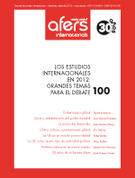
Revista CIDOB d’Afers Internacionals, nº 100
Cuatrimestral (diciembre 2012)
ISSN:1133-6595 | E-ISSN:2013-035X
La influencia de la UE en las instituciones internacionales ha disminuido. Esta constatación es paradójica si tenemos en cuenta que la entrada en vigor del Tratado de Lisboa la ha dotado de mayor autoridad para actuar internacionalmente (instrumentos, instituciones, representación). La ha dotado de una «voz única». El artículo aborda la paradoja que vive hoy en día la UE; esto es, a mayor coherencia interna, menor influencia externa. Mediante tres casos de estudio, el artículo argumenta que para explicar la influencia de la UE en las instituciones internacionales hay que ir más allá del análisis de su voz única (necesaria, pero no suficiente, e, incluso, contraproducente) y tomar en consideración el cambio de la estructura de poder y el rechazo normativo que sufre la UE en un mundo cada vez más soberanista y menos occidentalocéntrico.
Referències
Alexandroff, Alan S. y Cooper, Andrew F. (eds.). Rising states, rising institutions. Challenges for global governance. Washington: Brookings Institution, 2010.
Asthon, Catherine. Remarks at the Munich Security Conference. A 12/10, (6.2.2010).
– «EU HR Ashton pleased with Adoption of UN General Assembly Resolution on the EU’s participation in the work of the UN» (3.5.2011) http://www.europaeu-un.org/articles/en/article_10995_en.htm.
Barbé, Esther. «Multilateralismo: adaptación a un mundo con potencias emergentes». Revista Española de Derecho Internacional, vol. lxii, n.º 2 (2010), p. 21-50.
– (dir.). Cambio mundial y gobernanza global. La interacción entre la Unión Europea y las instituciones internacionales. Madrid: Tecnos, 2012.
Barbe, Esther; Kienzle, Benjamin y Vlaskamp, Martijn. «One voice, few influence? The European Union in Global Institutions». Paper presentado en ISA Annual Convention, San Diego (Estados Unidos), 1-4 de abril de 2012.
Blavoukos, Spyros y Bourantonis, Dimitris. The EU presence in international organizations. London: Routledge, 2011a.
– «Do UN Sanctions Strenghten the International Presence of the EU ?». Paper presentado en la Eighteenth International Conference of Europeanists, Barcelona, 20-22 de junio de 2011b.
Cooper, Robert. The postmodern state and the world order. London: Demos, The Foreign Policy Centre, 2000 (original 1996).
Duchêne, François. «Europe’s Role in World Peace», en: Mayne, Richard J. (ed.). Europe Tomorrow: Sixteen Europeans Look Ahead. London: Fontant, 1972, p. 31-47.
Durão Barroso, José Manuel. European Union and Global Order. Conferencia 08/272, Bruselas, 26 de mayo de 2008.
– Leading by Example: The EU and Global Governance. Conferencia 09/239, Bruselas, 12 de mayo de 2009.
Elgström, Ole. «The European Union as a Leader in International Multilateral Negotiations- a Problematic Aspiration?». International Relations, vol. 21, n.º 4 (2007), p. 445-458.
Fioramonti, Lorenzo. «Is the EU a “Better” Global Player? An Analysis of Emerging Powers’s Perceptions», en: Renard, Thomas y Biscop, Sven (eds.). op. cit., (2012), p. 147-164.
Gilpin, Robert. War and Change in World Politics. New York: Cambridge University Press, 1981.
Ginsberg, Roy. The European Union in International Politics: Baptism by Fire. Lanham: Rowman & Littlefield, 2001.
Gowan, Richard y Brantner, Franciska. A Global Force for Human Rights? An Audit of European Power at UN. European Council on Foreign Relations Policy Paper, 2008.
– The EU and Human Rights at the UN: 2011 Review. European Council on Foreign Relations Policy Memo, 2011.
Grevi, Giovanni. «The interpolar world: a new scenario». EUISS Occasional Papers, n.º 79 (junio de 2009).
– «Geo-economics and global governance», en: Martiningui, Ana y Youngs, Richard (eds.). Challenges for European Foreign Policy in 2012. What kind of geo-economic Europe. Madrid: FRIDE, 2011, p. 27-36.
Groom, John. «Multilateralism as a way of life in Europe», en: Newman, Edward; Thakur, Rhames; Tirman, John (eds.). Multilateralism under Challenge: Power, International Order and Structural Change. Tokio: United Nations University Press, 2006, p. 460-480.
Hettne, Björn y Söderbaum, Fredrik. «Civilian Power or Soft Imperialism? The EU as a Global Actor and the Role of Interregionalism». European Foreign Affairs Review, vol. 10, n.º 4 (2005), p. 535-552.
Hurrell, Andrew. On Global Order. Power, Values and the Constitution of International Society. Oxford: Oxford University Press, 2007.
Jorgensen, Knud Erik (ed.). The European Union and International Organisations. London: Routledge, 2009a.
– «The European Union in Multilateral Diplomacy». The Hague Journal of Diplomacy, n.º 4 (2009b), p. 189-209.
Kissack, Robert. «The EU in the Negotiations of a UN General Assembly Resolution on a Moratorium on the Use of the Death Penalty», en: Wouters, et al., op. cit. (2012), p. 103-121.
Ladefoged Mortensen. «The World Trade Organization and the European Union», en: Jorgensen, op. cit. (2009a), p. 80-101.
Lucarelli, Sonia y Fioramonti, Lorenzo (eds.). External Perceptions of the European Union as a Global Actor. London: Routledge, 2009.
Manners, Ian. «Normative Power Europe: A Contradiction in Terms?». Journal of Common Market Studies, vol. 40, n.º 2 (2002), p. 235-258.
Martin, Lisa y Simmons, Beth (eds.). International Institutions. An International Organization Reader. Cambridge: The MIT Press, 2001.
Missiroli, Antonio (ed.). Coherence for European Security Policy: Debates, Cases, Assessments. Paris: The Institute for Security Studies-Western European Union, 2001.
Natorski, Michal. «El reconocimiento social de la UE en los marcos multilaterales: una potencia sui géneris en un mundo de estados», en: Barbé, Esther (dir.). op.cit., 2012.
Oberthür, Sebastian. «The European Union’s performance in the international climate change regime». European Integration. vol. 33, n.º 6 (2011), p. 667-682.
Prins, Daniel. «Engineering Progress: A Diplomat’s Perspective on Multilateral Disarmament». Thinking outside the box in multilateral disarmament and arms control. New York, United Nations Publications, 2006.
Renard, Thomas. «Coping with the Copenhagen syndrome». E-Sharp (10 de marzo de 2010), cit. por Fioramonti, Lorenzo. «Is the EU a “better” global player? An analysis of emerging powers’ perceptions», en: Renard, Thomas; Biscop, Sven (eds.). The European Union and Emerging Powers in the 21st Century. How Europe can shape a new global order. Farnham: Ashgate, 2012, p. 147-164.
Smillie, Ian. Blood on the Stone: Greed, Corruption and War in the Global Diamond Trade. London: Anthem Press, 2010.
Smith, Karen E. «Speaking with One Voice? European Union Co-ordination on Human Right Issues at the United Nations». Journal of Common Market Studies, vol. 44, n.º 1 (2006), p. 113-137.
– «The European Union at the Human Rights Council: speaking with one voice but having little influence». Journal of European Public Policy, vol. 17, n.º 2 (2010), p. 224-241.
Tammen, Ronald L. et al. Power Transition. Strategies for the 21st century. London: Chatham House, 2000.
Thomas, Daniel. «Still Punching below Its Weight? Coherence and Effectiveness in European Union Foreign Policy». Journal of Common Market Studies, vol. 5, n.º 3 (2012), p. 457-474.
Torreblanca, José Ignacio. La fragmentación del poder europeo. Barcelona: Icaria, 2011.
Vlaskamp, Martijn. «The Role of the European Union in the Processes to Ban Cluster Munitions». Working Papers Observatori de Política Exterior Europea (IUEE), n.º 84 (octubre de 2010).
Wouters, Jan et al. The European Union and multilateral governance. Assessing EU Participation in United Nations Human Rights and Environmental Fora. London: Palgrave, 2012.
Youngs, Richard. Europe’s decline and fall. The struggle against global irrelevance, London: Profile Books, 2010.
Zürn, Michael y Stephen, Matthew. «The view of old and new powers on legitimacy of international institutions». Politics, vol. 30, n.º S1 (2010), p. 91-101.