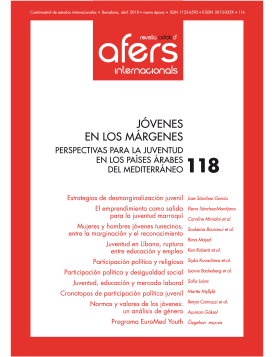
¿Es el emprendimiento una salida para la juventud marroquí?
Palabras clave:
jóvenes, emprendedores, Marruecos, marginaciónResumen
Revista CIDOB d’Afers Internacionals, nº 118
Cuatrimestral (enero-abril 2018)
ISSN:1133-6595 | E-ISSN:2013-035X
DOI: doi.org/10.24241/rcai.2018.118.1.35
Este artículo examina el comportamiento emprendedor de los jóvenes de entornos urbanos y rurales en Marruecos. A partir del proyecto europeo de investigación SAHWA (2013-2016), y con un enfoque metodológico mixto –encuesta y trabajo de campo etnográfico–, se intenta comprender las estrategias a las que recurren los jóvenes marroquíes para convertir su situación de «marginación» en la sociedad en iniciativas emprendedoras. ¿Qué significa el emprendimiento para los jóvenes en Marruecos, y cómo estos forjan y emplean las estrategias emprendedoras para vivir y sobrevivir? Tanto la encuesta como los tres estudios de caso que se exponen en este artículo muestran que los jóvenes marroquíes, a pesar de que son capaces de lanzar y desarrollar sus negocios –tanto agrícolas como culturales o comerciales–, siguen siendo extremadamente vulnerables
La investigación académica cuyos resultados han permitido la elaboración de este artículo ha recibido financiación del Séptimo Programa Marco de la Unión Europea FP7/2007-2013. Número del proyecto: 613174 (proyecto SAHWA: www.sahwa.eu).
Este artículo refleja únicamente el punto de vista de las autoras. La Unión Europea no es responsable del uso que se pueda hacer de la información contenida en este estudio.
Citas
Aït Mous, Fadma. L’entreprenariat féminin au Maroc: typologies, ressources familiales et nouveaux rôles féminin. Manuscrito no publicado, 2005.
Belshaw, Cyril S. «The Cultural Milieu of the Entrepreneur: A Critical Essay». Explorations in Entrepreneurial History, vol. 7, n.º 3 (1955), p. 146-163.
Bensghir, Afaf y Reghioui, Anouar. «La culture entrepreneuriale: étude comparative entre les étudiants marocains et mauritaniens». Dossiers de Recherches en Economie et Gestion, vol. 2, n.º 4 (2015), p. 63-89.
Binkkour, Mohamed y Messaoudi, Abdelaziz. «La promotion de l’entrepreneuriat au Maroc: rôle de l’Etat et perception des entrepreneurs». En: Proceedings of the Colloquium Business and Entrepreneurship in Africa. Quebec: Université Laval, 2012, p. 242-278.
Bossenbroek, Lisa; van der Ploeg, Jan Douwe y Zwarteveen, Margreet. «Broken dreams? Youth experiences of agrarian change in Morocco´s Saïss region». Cahiers Agricultures, vol. 24, n.º 6 (2015), p. 342-348.
Bossenbroek, Lisa y Kadiri, Zakaria. «Quête identitaire des jeunes et avenir du monde rural». Revue Economia, n.º 27 (2016), p. 46-50.
Boz, Anil y Ergeneli, Azize. «Women Entrepreneurs’ Personality Characteristics and Parents’ Parenting Style Profile in Turkey». Procedia-Social and Behavioral Sciences, vol. 109 (2014), p. 92-97.
Bruni, Attila; Gherardi, Silvia y Poggio, Barbara. Gender and entrepreneurship: an ethnographical approach. Nueva York y Oxon: Routledge, 2005.
Caracelli, Valerie J. y Greene, Jennifer C. «Crafting mixed-methods evaluation designs». En: Greene, J.C. y Caracelli, Valerie (eds.). Advances in mixed-methods evaluation: the challenges and benefits of integrating diverse paradigms (New Directions for Evaluation, n.º 74). San Francisco: Jossey-Bass, 1997, p. 19-32.
Cherubini, Daniela; Rivetti, Paola y Leccardi Carmen. «European Public Policies for Gender Equality in the Arab Mediterranean Region». SAHWA Project Policy Paper, n.º 12 (2016) (en línea) http://www.sahwa.eu/OUTPUTS/SAHWAPolicy-Papers-ISSN-2564-9167/SAHWA-Policy-Paper-on-gender-policies-inthe-Arab-Mediterranean-region
Cooper, Arnold C. y Dunkelberg, William C. Influences upon entrepreneurship — a large scale study. San Diego, CA: Academy of Management Meetings, 1981.
Fayolle Alain. Entrepreneuriat. Apprendre à apprendre. París: Dunod, 2012.
Fayolle Alain y Liñán Francisco. «The future of research on entrepreneurial intentions». Journal of Business Research, vol. 67, n.º 5 (2014), p. 663-666.
Gomolka Eugene. «Characteristics of minority entrepreneurs and small business enterprises». American Journal of Small Business, vol. 2, n.º 1 (1977), p. 12-21.
Gurung, Ghana S. y Kollmair, Michael. «Marginality: concepts and their limitations». NCCR North-South, IP6 Working paper, n.º 4 (2005) (en línea) https://pdfs.semanticscholar.org/4973/d37d23c01540dabaae13bbc122eeb3fcc0ad.pdf
Habibov, Nazim; Afandi, Elvin y Cheung, Alex. «What is the effect of university education on chances to be self-employed in transitional countries?: Instrumental variable analysis of cross-sectional sample of 29 nations». International Entrepreneurship Management Journal, vol. 13, n.º 2 (2017), p. 487-500.
Kamal, Abdelhak. «Policy Paper on National Youth Policies in Morocco». SAHWA Project, Policy Paper (2016) (en línea) http://www.sahwa.eu/OUTPUTS/SAHWA-Policy-Papers-ISSN-2564-9167/Policy-Paper-onNational-Youth-Policies-in-Morocco
Klotz, Anthony y Neubaum, Donald. «Research on the dark side of personality traits in entrepreneurship: observations from an organizational behaviour perspective». Entrepreneurship Theory and Practice, vol. 40, n.º 1 (2016), p. 7-17.
Kouba, Salah y Sahib Eddine, Abdelhak. «L’intention entrepreneuriale des étudiants au Maroc : une analyse PLS de la méthode des équations structurelles». Actes du 11ème CIFEPME, Brest, 2012.
Minialai, Caroline y Sqalli, Hammad. «How to improve the governance of support for entrepreneurship initiatives». SAHWA Policy Paper, nº. 3 (2016) (en línea) https://www.cidob.org/en/publications/publication_series/sahwa_papers/policy_paper/how_to_improve_the_governance_of_support_for_entrepreneurship_initiatives
Rachdi, Fatimaezzahra. «L’entreprenariat féminin au Maroc: une étude exploratoire». Actes du 8e CIFEPME, Friburgo, Suiza, 2006.
Sánchez-Montijano, Elena; Martínez, Irene; Bourekba, Moussa y Dal Zotto, Elena. SAHWA Youth Survey 2016 Descriptive Report. Barcelona: CIDOB, 2017.
Stewart, Alex. «The Bigman Metaphor for Entrepreneurship: A “Library Tale” with Morals on Alternatives for Further Research». Organization Science, vol. 1, n.º 2 (1990), p.143-159.
Tholen, Jochen. «Employment, Education and Social Inclusion in Algeria, Morocco, Tunisia, Egypt and Lebanon». SAHWA Background Paper, BP01 (2015). Barcelona: Barcelona Centre for International Affairs (CIDOB).
Tounés, Azzedine. L’intention entrepreneuriale: une recherche comparative entre des étudiants suivant des formations en entrepreneuriat (bac + 5) et des étudiants en DESS CAAE. Tesis de doctorado en Ciencias de gestión, Université de Rouen, 2003.
Turker, Duygu y Sönmez-Selçuk, Senem. «Which factors affect entrepreneurial intention of university students?». Journal of European Industrial Training, vol. 33, n.º 2 (2009), p. 142-159.
White, Ben. «Agriculture and the generation problem: Rural youth, employment and the future of farming». IDS Bulletin, vol. 43, n.º 6 (2012), p. 9-19.
World Bank. «Kingdom of Morocco Promoting Youth Opportunities and Participation». Report n.º 68731-MOR. Washington, D.C.: World Bank, 2012.
World Bank «World Development Indicators: Unemployment». World Bank, 2014 (en línea) http://wdi.worldbank.org/table/2.5