La criminalidad organizada en la Unión Europea: estado de la cuestión y respuestas institucionales
Paraules clau:
Unión Europea, criminalidad organizada, cooperaciónResum
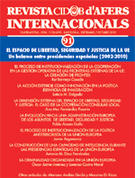
Revista CIDOB d’Afers Internacionals, nº 91
Cuatrimestral (octubre- diciembre 2010)
ISSN:1133-6595 | E-ISSN:2013-035X
A lo largo de las últimas décadas, la criminalidad organizada se ha desarrollado de forma considerable como consecuencia de las transformaciones políticas y económicas globales. Los países de la Unión Europea son muy conscientes de esta realidad y están realizando esfuerzos por coordinar estrategias e impulsar la cooperación en la lucha contra esta problemática. El presente texto plantea, como primer objetivo, comprender el fenómeno en su dimensión actual y en aquellas facetas que más afectan a los Estados Miembros de la UE. Posteriormente, aborda los aspectos relativos a la cooperación, en sus diferentes áreas, dentro del ámbito de la Unión para, finalmente, desarrollar un enfoque prospectivo y propositivo respecto a la previsible evolución del fenómeno y a las medidas necesarias para afrontarlo en toda su magnitud.
Referències
BLOCK, Ludo. “International policing in Russia: Police co-operation between the European Union member-states and the Russian Federation”. Policing and Society. Vol. 17, No. 4 (diciembre 2007).
BRADY, Hugo. “The EU and the fight against organised crime”. Centre for European Reform. Working Paper (abril 2007). CARRAPIÇO, Helena. “The Evolution of the European Union’s Understanding of Organized Crime and its Embedment in EU Discourse”. 50th International Studies Association Annual Convention (15-18 de febrero de 2009). Nueva York.
COMISIÓN EUROPEA. Standard Eurobarometer 65 (julio de 2006): http://ec.europa.eu/public_opinion/archives/eb/eb65/eb65_en.htm
DEN BOER, Monica (ed.) Organised Crime. A Catalyst in the Europeanisation of National Police and Prosecution Agencies? Mastricht: European Institute of Public Administration, 2002.
DÍAZ, Antonio. “España corre el riesgo de convertirse en el paraíso de las mafias”. Tiempo (11 de septiembre de 2009). EL PAÍS. “Paraísos para el fraude”. El País (27 de septiembre de 2009). EUROPOL. Organized Crime Threat Assesment 2006: http://www.europol.europa.eu/publications/ European_Organised_Crime_Threat_Assessment_%28OCTA%29/OCTA2006.pdf
FIJNAUT, Cyrille y PAOLI, Letizia (ed.) Organised Crime in Europe: Concepts, Patterns and Control Policies in the European Union and Beyond. Dordrecht: Springer, 2004. P. 1-19. HERLIN-KARNELL, Ester. “The Lisbon Treaty and the Area of Criminal Law and Justice”. European Policy Analysis. Swedish Institute for European Policy Studies. No. 3 (2008).
HOUSE OF LORDS. “Behind closed doors: the meeting of the G6 Interior Ministers at Heiligendamm”. UK House of Lords. 40th Report of Session 2005–06 (julio 2006): http://www.publications.parliament. uk/pa/ld200506/ldselect/ldeucom/221/221.pdf.
KEGÖ, Walter. “Internationally Organized Crime. The Escalation of Crime within the Global Economy”. Institute for Security & Development Policy. Policy Paper (marzo 2009). LONGO, Francesca. “The European Union and the Fight against Transnational Organized Crime: towards a new shape of common policy” (2002) [en línea] [Consulta: 24 de abril de 2010]: http://members.lycos.co.uk/ocnewsletter/SGOC0503/longo.pdf
MORA, Miguel. “Dinamita para los fiscales”. El País (10 de enero de 2010). — “Una segunda Tangentopolis se cierne sobre Italia”. El País (28 de febrero de 2010).
NÚÑEZ, Maribel. “La CE, en una decisión inédita, corta fondos a Bulgaria por la corrupción”. ABC (24 de julio de 2008).
REES, Wyn. “Transnacional Organizaed Crime, Security and the European Union”. En: Allum, Felia; Siebert, Renate. Organized Crime and the Challenge to Democracy. Nueva York: Routledge y ECPR, 2003. P. 112-125.
SAVIANO, Roberto. “Italia tiene que pedir ayuda”. El País (26 de marzo de 2010).
THE ECONOMIST. “Bullets in the post”. The Economist (17 de junio de 2006). — “Treating, not punishing”. The Economist (27 de agosto de 2009). VILÀ, Blanca. “Los paraísos fiscales y la Unión Europea: reflexiones para la Presidencia española”. Real Instituto Elcano, ARI. No. 105 (2009).