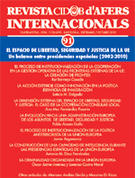
El proceso de institucionalización de la cooperación en la gestión operativa de las fronteras externas de la UE: la creación de Frontex
Keywords:
Unión Europea, Espacio de Libertad, Seguridad y Justicia (ELSJ), FrontexAbstract
Revista CIDOB d’Afers Internacionals, nº 91
Cuatrimestral (octubre- diciembre 2010)
ISSN:1133-6595 | E-ISSN:2013-035X
Este artículo revisa la configuración y progresos que, a través de los diferentes tratados y programas puestos en marcha en el seno de la Unión Europea, han llevado a la creación del denominado Espacio de Libertad, Seguridad y Justicia (ELSJ). En concreto esta revisión presta especial atención a las cuestiones del ELSJ relacionadas con la vigilancia y control de las fronteras exteriores del espacio de la Unión, uno de los puntos clave en los avances de las dos últimas décadas. Desde una perspectiva analítica neoinstitucional, las instituciones se configuran en el centro de esa evolución desde la cooperación intergubernamental hacia la creación de un espacio de políticas o ámbito de gobernanza y hasta la supranacionalización e institucionalización de la actividad inicial. Esos procesos han dado lugar a nuevas instituciones como la Agencia Europea para la Gestión de la Cooperación Operativa en las Fronteras Exteriores (Frontex). Así, la última parte del artículo se centra en la creación de Frontex y en los debates acerca de su futuro; su reglamento ha estado en fase de revisión durante la Presidencia española de la Unión Europea en el primer semestre de 2010.
References
Bermejo , R. “Avances en el control de fronteras: cooperación, información y tecnología”. Revista ARI. No. 41 (marzo 2007). Madrid: Real Instituto Elcano. P. 10-15.
CORTÉS MÁRQUEZ, Ramón. “La gestión de las fronteras exteriores de la Unión Europea”. Boletín 15, doc. 43, IUISI (2006) [en línea] [Consulta: 20 de abril de 2010]. http://www.iuisi.es/15_boletines/15_2006/doc043-2006.pdf
DÜVELL, Franck y VOLLMER, Bastian. Irregular Migration in and from the Neighbourhood of the EU. A comparison of Morocco, Turkey and Ukraine. (2009) [en línea] [Consulta: 5 de mayo de 2010] http://clandestino.eliamep.gr/wpcontent/uploads/2009/11/transit_report_compas_sept091.pdf
Fouse , Matthew J. “An assessment of European Union Immigration Cooperation: The Tampere Program, the Determinants of Progress, and Prospects for Future European Union Immigration Cooperation” Paper delivered at the 2004 Annual Meeting of the American Political Science Association, (2-5 de septiembre de 2004).
GABELLA Maroto , Francisco. “Control de Fronteras”. Boletín 15, doc. 028. Instituto Universitario de Investigación sobre seguridad Interior (2005).
Geddes , Andrew. Immigration and European Integration. Towards fortress Europe?. Manchester: Manchester University Press, 2000.
Guild , Elspeth. “Free movement of persons in Europe: the Amsterdam Treaty and its implications for the UK”. Immigration and Nationality Law and Practice. Vol. 13, No. 4 (1999). P. 128-132
Hall , Peter, A. y Taylor , Rosemary C.R. “Political Science and the Three New Institutionalisms”. Political Studies, XLIV (1996). P. 936-957.
Hernández i SAGRERA, Raul. “FRONTEX: ¿Proyección a nivel europeo de la visión de España sobre el control de fronteras?”. En: Barbé, Esther (coord.) España en Europa 2004-2008 (2008). Monografías del Observatorio de Política Exterior Europea, No. 4. Bellaterra: Institut Universitari d’Estudis Europeus, 2008. P. 1-5.
Hobbing , P. “Management of external EU Borders: Enlargement and the European Border Guard Issue”. Paper presented at the Workshop “Managing International and Inter-Agency Cooperation at the Border”, Ginebra, 13-15 marzo de 2003. Geneva Centre for the Democratic Control of Armed Forces. House of Lords . European Union Select Committee. “29th Report, session 2002-2003”. HL Paper. No. 133 (2003). P. 10.
MONAR, Jörg. “The Dynamics of Justice and Home Affairs: Laboratories, Driving Factors and CostsOSTS”. Journal of Common Market Studies. Vol. 39 (4) (2001). P. 747-764.
– “The project of a European Border Guard: Origins, Models and Prospects in the Context of the EU’s Integrated External Border Management”. En: Caparini, M. y Marenin, O. (ed.) Borders in a Globalised World. Ginebra: Geneva Centre for the Democratic Control of Armed Forces, 2006. Capítulo 10.
Neal , Andrew W. “Securitization and risk at the EU Border: The origins of Frontex”. Journal of Common Market Studies. Vol.47, No. 2 (2009). P. 333-356.
Pallis , Athanasios A. “Institutional Dynamism in EU Policy-Making: The Evolution of the EU Maritime Safety Policy”. European Integration. Vol. 28, No.2 (2006). P. 137-157.
Peers , S. “Key Legislative Developments on Migration in the European Union”. European Journal of Migration and Law 5 (2003). P. 387-410.
– “Key Legislative Developments on Migration in the European Union”. European Journal of Migration and Law 6 (2004a). P. 67-91.
– “Key Legislative Developments on Migration in the European Union”. European Journal of Migration and Law 6 (2004b). P. 243-276.
Peters , Guy. The New Institutionalism. London: Cassells, 1999.
Pierson , Paul. “Incresing returns, path dependence and the study of politics”. The American political science review, 94 (2) (2000). P. 251-267.
Sie Dhian Ho, M. “Enlarging and Deepening the EU/Schengen Regime on Border Controls”. En: Caparini, M. y Marenin, O. (ed.) Borders in a Globalised World. Ginebra: Geneva Centre for the Democratic Control of Armed Forces, 2006. Capítulo 7.
WALTER , Neil. “In search of the Area of Freedom, Security and Justice: A Constitutional Odyssey”. Europe’s Area of Freedom Security and Justice. Oxford: Oxford University Press, 2004. P. 3-37.
WOLFF, Sarah; WICHMANN, Nicole y MOUNIER, Gregory. “The External Dimension of Justice and Home Affairs: A Different Security Agenda for the EU?”. Journal of European Integration. Vol. 31, No. 1 (2009). P. 9-23.
YLI-Vakkuri , Laura. “Schengen and Enlargement. Enlarging the Area without Internal Border Controls”. En: Faria, Cláudia (ed.) Enlarging the Area of Freedom, Security and Justice. Maastricht: European Institute of Public Administration, 2004. P. 1-8.