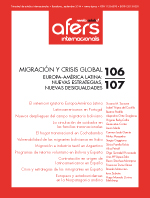
Contratación en origen de latinoamericanos en España: un marco flexible de gestión
Paraules clau:
trabajadores estacionales, circularidad migratoria, América LatinaResum
Revista CIDOB d’Afers Internacionals, nº 106-107
Cuatrimestral (septiembre 2014)
ISSN:1133-6595 | E-ISSN:2013-035X
En la primera década del siglo xxi, los países con mercados de trabajo necesitados de mano de obra estacional buscaron fórmulas para importar trabajadores extranjeros a través de programas de canalización y reclutamiento en origen. Este artículo busca mostrar que, en España, el desarrollo efectivo de esta vía solo ha sido posible en un marco flexible y dinámico de gestión, en el que han tenido un papel determinante los acuerdos bilaterales firmados con ciertos países, incluyendo algunos latinoamericanos. En definitiva, sobre la base de una legislación, unas instituciones y actores implicados, y unos inmigrantes que han sabido, o se han visto obligados, a adaptarse a los cambios que conlleva un mercado de trabajo condicionado por la globalización del trabajo y del capital.
Referències
Agunias, Dovelyn Rannveig y Newland, Kathleen. Circular Migration and Development: Trends, Policy, Routes, and Ways Forward. Nueva York: Migration Policy Institute, 2007.
Armstrong, Warwick y Anderson, James. Geopolitics of European Union enlargement: the fortress empire. Londres: Routledge, 2007.
Basok, Tanya. «Post-national Citizenship, Social Exclusion and Migrants Rights: Mexican Seasonal Workers in Canada». Citizenship Studies, vol. 8, n.º 1 (2004), p. 47-64.
Castles, Stephen. «Guestworkers in Europe? A Resurrection?». International Migration Review, vol. 40, n.º 4 (2006), p. 741-766.
Comisión Europea. «Directiva del Parlamento europeo y del Consejo sobre las condiciones de entrada y estancia de nacionales de terceros países para fines de empleo como trabajadores estacionales». Bruselas, 7 de febrero de 2014 (OR.en), 2010/0210 (COD), PE-CONS 113/13.
Comisión Europea. Mobility partnerships as a tool of the Global Approach to Migration. SEC (2009) 1240 final. Bruselas.
Comisión Europea. «On circular migration and mobility partnerships between the European Union and third countries». COM (2007) 248 final. Bruselas.
Fargues, Philip. «Circular Migration: Is it relevant for the South and East of the Mediterranean?». CARIM AS. Circular Migration Series, n.º 40 (2008).
Florencia: Robert Schuman Centre for Advanced Studies, European University Institute. Ferrero Turrión, Ruth y López-Sala, Ana. «Nuevas dinámicas de gestión de las migraciones en España: el caso de los acuerdos bilaterales de trabajadores con países de origen». Revista del Ministerio de Trabajo e Inmigración, vol. 80 (2009), p. 119-131.
Hellio, Emmanuelle. «Importer des femmes pour exporter des fraises (Huelva)». Études rurales, n.º 182 (2009), p. 185-200.
López-Sala, Ana. «Induced circularity for selective workers? The case of seasonal labor mobility schemes in Spain». Arbor (en prensa). CSIC.
López-Sala, Ana. «Seasonal Migrant Workers Programs in the Agriculture Sector in Spain» (2001-2011). Ponencia presentada en la 25th SASE Annual Conference. Immigration and Employment Policies Session. Milán, 2013.
López-Sala, Ana y Godenau, Dirk. «En torno a la circularidad migratoria: aproximaciones conceptuales, dimensiones teóricas y práctica política». Migraciones (en prensa). Instituto Universitario de Estudios sobre Migraciones. Universidad Pontificia de Comillas.
Martin, Philip y Ruhs, Martin. «Numbers vs. Rights: Trade-Offs and Guest Worker Programs». International Migration Review, vol. 42, n.º 1 (2008), p. 249-265.
Moreno Nieto, Juana. «Movilidad transnacional, trabajo y género: temporeras marroquíes en la agricultura onubense». Política y Sociedad, vol. 49, n.º 1 (2012), p. 123-140.
Moreno Nieto, Juana. «Los contratos en origen de temporada. Mujeres marroquíes en la agricultura onubense». Revista de Estudios Internacionales Mediterráneos, n.º 7 (2009), p. 58-78.Morice, Alain y Michalon, Bénédicte. «Les migrants dans l’agriculture: vers une crise de main-d’oeuvre?». Études rurales, n.° 182 (2009), p. 9-28.
Newland, Kathleen; Agunias, Dovelyn Rannveig y Terrazas, Aaron. Learning by doing. Experiences of Circular migration. Washington: Migration Policy Institute, 2008.
OIM-Organización Internacional para las Migraciones. Informe sobre las migraciones en el mundo 2013. El bienestar de los migrantes y el desarrollo. Suiza: OIM, 2013.
Parlamento Europeo. «Non-EU seasonal workers: EP/Council deal on better social rights and conditions». Nota de prensa. Committees on Civil Liberties, Justice and Home Affairs, 29 de octubre de 2013 (en línea) http://www.europarl.europa.eu/news/es/news-room/content/20131029IPR23320/html/Non-EU-seasonal-workers-EPCouncil-deal-on-better-social-rights-andconditions
Redondo, Dolores y Miedes, Blanca. «Trabajadoras extranjeras en los campos freseros. De la necesidad a la invisibilidad». Revista Andaluza de Relaciones Laborales, n.º 20 (2007), p. 183-205.
Sánchez-Montijano, Elena y Faúndez-García, Rocío. «Migración laboral temporal y circular y codesarrollo: estudio de caso de una articulación posible». Migraciones, n.º 30 (2011), p. 43-70.
Vertovec, Steven. «Circular Migration: the way forward in global policy?». IMI Working Papers, n.º 4 (2007). International Migration Institute (IMI).
Zapata-Barrero, Ricard; Faúndez-García, Rocío y Sánchez-Montijano, Elena. «Circular Temporary Labour Migration: Reassessing Established Public Policies». International Journal of Population Research, vol. 2012 (2012), article ID 498158, p. 1-13.
Zapata-Barrero, Ricard; Faúndez-García, Rocío y Sánchez-Montijano, Elena. Migración laboral, temporal y circular de trabajadores entre Colombia y España. Barcelona: GRITIM-UPF, 2009.