Construir la paz en Bosnia-Herzegovina Retos, límites y oportunidades de la reabilitación posbélica
Palabras clave:
Bosnia-Herzegovina, acuerdos políticos, peacebuilding, intervencionismoResumen
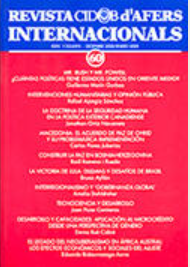
Revista CIDOB d'Afers Internacionals, nº. 60
Cuatrimestral (enero 2003)
ISSN:1133-6595
En el presente artículo se aborda la forma como la sociedad internacional, a través de sus instituciones, ha gestionado el conflicto de Bosnia-Herzegovina desde su fase prebélica hasta su actual situación de posguerra. El artículo pone de manifiesto dos ideas fuerza. La primera es que la conducta internacional a lo largo de las fases prebélica y bélica estuvo a menudo basada en análisis erróneos o directamente falsos de la situación, lo cual dejó importantes lastres que dificultan la construcción de la paz tras el fin de la guerra. La segunda idea, relacionada con la primera, es que si bien la implementación de los Acuerdos de Dayton de 1995 está avanzando rápidamente, el hecho de que Bosnia siga siendo un Estado frágil, afectado de una crisis económica grave, con un nivel de corrupción elevado, y dotado de unas instituciones públicas débiles, así como de una sociedad civil también débil, hace de Bosnia un Estado fuertemente dependiente de la ayuda internacional, y convierte a ese país en un protectorado de facto, más que en un Estado de Derecho. En otras palabras, en términos de rehabilitación posbélica y de construcción de la paz en Bosnia, la implementación de los Acuerdos de Paz de Dayton parece ser un marco necesario pero no suficiente.
Citas
APLON, J. y TANNER V. Civil Society in Bosnia: Obstacles and Opportunities for Building Peace. http://www.wf.org/aplontoc.htm. Washington DC: Winston Foundation for World Peace, 2000 .
BELLONI, R. “Civil Society and Peacebuilding in Bosnia Herzegovina”. Journal of peace Research. Vol 38. No. 2. Oslo: Prio, 2001.
CHANDLER, D. Bosnia: faking democracy after Dayton. Londres: Pluto Press, 2000.
COX, M. State Building and Post-Conflict Rehabilitation: the Lessons of Bosnia, 2001. http://www.casin.ch/gover/cluster/. Ginebra: Casin.
EUROPEAN STABILITY INITIATIVE (ESI) “International Power”, Reshaping International Priorities in Bosnia and Herzegovina (Part Two), 2000 [Consulta el 23/04/01] www.esiweb.org/reports.
EUROPEAN STABILITY INITIATIVE (ESI) (). “The End of the Nationalist regimes and the Future of the Bosnian State”,Reshaping International Priorities in Bosnia and Herzegovina (Part Three), ESI Publications (22/03/01), 2001a [Consulta el 23/04/01] www.esiweb.org/reports. ESI Bosnia Project.
EUROPEAN STABILITY INITIATIVE (ESI) “In search of politics: the evolving international role in Bosnia and Herzegovina”, Discussion Paper, ESI Bosnia, 2001b.
ICG. “Is Dayton Failing Bosnia Four Years After the Peace Agreement”, ICG Balkans Report ( 28/10/99), 1999. Sarajevo: ICG Balkans.
ICG “After Milosevic: A Practical Agenda for Lasting Balkans Peace”, ICG Balkans Report (02/04/01) 2001a. Bruselas: ICG Balkans.
ICG “Bosnia’s precarious Economy: Still not Open for Business”, ICG Balkans Report (07/08/01), 2001b. Sarajevo/Bruselas: ICG.
ICG “Bosnia: reshaping the international machinery”, ICG Balkans Report (29/11/01). 2001c. Sarajevo/Bruselas: ICG Balkans.
KALDOR, M. New and Old Wars. Organized Violence in Global Era, Stanford (California): Stanford University Press, 1999.
MCMAHON, P. C. What have we done? Evaluating International Involvement in Bosnia. Chicago: ISA, 2001 http://www.isanet.org/archive/mcmahon.htm.
PAPIC, Z. International Support Policies to see Countrie Lessons (not) Learned in Bosnia-Herzegovina. Sarajevo: Fond Otvoreno Drustvo Bosne i Hercegovine, 2002.
PUGH, M. “Protectorates and Spoils of Peace: Intermestic Manipulations of Political Economy in South- East Europe”, Working Paper. No. 36. Copenhague, 2000.
PUGH, M. “Post-conlict Rehabilitation: social and civil dimensions”, 1998 [consulta el 06/09/00], http://www.jha.ac//articles/a034.htm.
PUGH, M. y COBBLE, H. “Non nationalist Voting in Bosnian Municipal Elections: Implications for Democracy and Peacebuilding”, Journal of Peace Research. Vol. 38. No. 1,Oslo: PRIO, 2001, p. 27-49.
SOLIOZ, C. Prospects for Balkan Stability. Ownership, Transitioal Process and Regional Integration in Bosnia and Herzegovina (PSIO Occasional Paper). Geneva: Graduate Institute of International Studies, 2001.
STUBBS, P. “Social Work and Civil Society in Bosnia and Herzegovina: Globalization, neo-feudalism and the State”, International Perspectives on Social Work, 1999, p. 55-64 http://www.stakes.fi/gaspp/ps_cv.htm. p. 55-64.
TALENTINO, A. K. “Intervention as Nation-Building: Illusion or Possibility?” Journal Pof Peace Research. Vol. 33. No. 1. Oslo: PRIO, 2002, p. 27-43.
WESTERN, J. W. y SERWER, D. “Los próximos cinco años de Bosnia: más allá de Dayton”. En: AGUIRRE, MARIANO y GONZALEZ, MABEL (coord.). Anuario CIP 2001. Políticas mundiales, tendencias peligrosas. Madrid: Icaria/ CIP/Fuhem, 2001, p. 105-127.