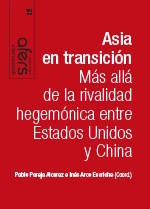
Introducción. Asia en transición: más allá de la rivalidad hegemónica entre Estados Unidos y China
DOI:
https://doi.org/10.24241/rcai.2025.141.3.7Palabras clave:
Asia, rivalidad hegemónica, orden regional asiático, autonomía estratégica, multilateralismoResumen
Revista CIDOB d'Afers Internacionals, nº. 141
Cuatrimestral (octubre-diciembre 2025)
ISSN:1133-6595 | E-ISSN:2013-035X
DOI: https://doi.org/10.24241/rcai.2025.141.3.7
Este artículo introductorio plantea la necesidad de comprender las dinámicas regionales en Asia desde una perspectiva que trascienda la tradicional rivalidad hegemónica entre Estados Unidos y China. Para ello, cuestiona la literatura que limita el análisis de esta área geográfica a perspectivas realistas y liberales institucionalistas, e identifica sus sesgos materialistas, eurocéntricos y binarios. Tras la revisión de la evolución y los principales pilares del orden regional asiático, se argumenta que Asia se encuentra en un proceso de transformación que muestra un sistema regional complejo, abierto y plural, caracterizado por nuevas dinámicas de competencia, cooperación multilateral y autonomía estratégica. El artículo, asimismo, introduce los artículos que componen este monográfico, los cuales ponen el foco en las estrategias y agencia de actores clave como Japón, Corea del Sur, Taiwán, Filipinas y ASEAN.
Citas
Acharya, Amitav. «Ideas, Identity, and Institution Building: From the ‘ASEAN Way’ to the ‘Asia-Pacific Way’?». Pacific Review, vol. 10, n.º 3 (1997), p. 3-46.
Acharya, Amitav. «Norm Subsidiarity and Regional Orders: Sovereignty, Regionalism and Rule-Making in the Third World». International Studies Quarterly, vol. 55, (2011), p. 95-123.
Allison, Graham. «The U.S.-China Strategic Competition: Clues from History», en: Bitounis, Leah y Price, Jonathon (eds.) The Struggle for Power: U.S.-China Relations in the 21st Century. Washington, D.C.: Aspen Institute, 2020, p. 79-95.
Bajpai, Kanti y Laksmana, Evan A. «Asian conceptions of international order: what Asia Wants». International Affairs, vol. 99, n.º 4 (2023), p. 1.371-1.381.
Beeson, Mark. «Rethinking Regionalism: Europe and East Asia in Comparative Historical Perspective». Journal of European Public Policy, vol. 12, n.º 6 (2005), p. 969-985.
Beeson, Mark. «Hegemonic transition in East Asia? The dynamics of Chinese and American power». Review of International Studies, vol. 35, n.º 1 (2009), p. 95-112.
Callahan, William A. «China’s ‘Asia Dream’: The Belt and Road Initiative and the new regional order». Asian Journal of Comparative Politics, vol. 1, n.º 3 (2016), p. 226-243.
Cha, Victor D. «Powerplay: Origins of the U.S. Alliance System in Asia». International Security, vol. 34, n.º 3 (2010), p. 158-196.
Curtis, Simon y Klaus, Ian. The Belt and Road City. New Haven: Yale University Press, 2024.
Fawcett, Louise. «Exploring Regional Domains: A Comparative History of Regionalism». International Affairs, vol. 80, n.º 3 (2004), p. 429-446.
Feigenbaum, Evan A. «Asia’s Future Beyond U.S.-China Competition». Carnegie Commentary, (9 de septiembre de 2020) (en línea) https://carnegieendowment.org/posts/2020/09/asias-future-beyond-us-china-competition?lang=en
Friedberg, Aaron L. «Will Europe’s Past Be Asia’s Future?». Survival, vol. 42, n.º 3 (2000), p. 147-160.
Goh, Evelyn. The Struggle for Order: Hegemony, Hierarchy, and Transition in Post-Cold War East Asia. Nueva York: Oxford Academic Books, 2013.
Goh, Evelyn. «New Mindsets Needed for an Era of Uncertainty». Global Asia, vol. 18, n.º 3 (2023) p. 20-24.
Gray, Kevin y Gills, Barry K. «South–South cooperation and the rise of the Global South». Thirld World Quarterly, vol. 37, (2015), p. 557-574.
Grover, Rohan; Jang, Kyooeun y Su, Li Wen. «Beyond Digital Protection(ism): Comparing Data Governance Frameworks in Asia». Journal of Information Policy, vol. 14, (2024), p. 161-195.
Hurrell, Andrew. «Hegemony, liberalism, and global order: what space for would-be great Powers?». International Affairs, vol. 82, n.º 1 (2006), p. 1-19.
Hurrell, Andrew y Fawcett, Louise. «Conclusion: Regionalism and International Order?», en: Fawcett, Louise y Hurrell, Andrew (eds.) Regionalism in World Politics. Oxford: Oxford University Press, 1995, p. 309-327.
Ikenberry, John G. «East Asia and Liberal International Order», en: Inoguchi, Takashi y Ikenberry, John G. (eds.) The Troubled Triangle: Economic and Security Concerns for the United States, Japan and China. Nueva York: Palgrave Macmillan, 2013, p. 13-33.
Insisa, Aurelio y Pugliese, Giulio. «The free and open Indo-Pacific versus the Belt and Road: Spheres of Influence and Sino-Japanese relations». The Pacific Review, vol. 35, n.º 3 (2022), p. 557-585.
Job, Brian L. «Track 2 Diplomacy: Ideational Contribution to the Evolving Asian Security Order», en: Alagappa, Muthiah (ed.) Asian Security Order: Instrumental and Normative Features. Stanford: Stanford University Press, 2003, p. 241-279.
Kang, David C. «Getting Asia Wrong». International Security, vol. 27, n.º 4 (2003), p. 57-85.
Katzenstein, Peter J. A World of Regions: Asia and Europe in the American Imperium. Ithaca, Nueva York: Cornell University Press, 2005.
Li, Mingjiang. «Introduction to the special issue: changing dynamics in Southeast Asia-China relations». International Journal of Asian Studies, vol. 22, n.º 1 (2025), p.1-4.
Loke, Beverley. «The United States, China, and the Politics of Hegemonic Ordering in Asia». International Studies Review, vol. 23, n.º 4 (2021), p. 1.208-1.229.
Mearsheimer, John J. «The Gathering Storm: China’s Challenge to US Power in Asia». Chinese Journal of International Politics, vol. 3, n.º 4 (2010), p. 381-396.
Moon, Chung-in. «Asia-Pacific vs Indo-Pacific: Paradigm Shift or False Choice?». Global Asia, vol. 18, n.º 3 (2023), p. 14-19.
Owen, John M. «Two emerging international orders? China and the United States». International Affairs, vol. 97, n.º 5 (2021), p. 1.415-1.431.
Pareja-Alcaraz, Pablo. «Unidad y pluralismo en el orden internacional: el carácter complementario de los órdenes regionales», en: Rodrigo, Ángel J. y García, Caterina (eds.) Unidad y Pluralismo en el Derecho Internacional Público y en la Comunidad Internacional. Madrid: Tecnos, 2011, p. 129-150.
Pugliese, Giulio. «The European Union and an ‘Indo-Pacific’ Alignment». Asia-Pacific Review, vol. 31, n.º 1 (2024), p. 17-44.
Ravenhill, John. «The new bilateralism in the Asia-Pacific». Third World Quarterly, vol. 24, (2003), p. 299-317.
Roberts, Kari y Bano, Saira (eds.) The Ascendancy of Regional Powers in Contemporary US-China Relations. Cham: Springter Nature, 2023.
Stubbs, Richard. «The Developmental State and Asian Regionalism», en: Beeson, Mark y Stubbs, Richard. Routledge Handbook of Asian Regionalism. Londres: Routledge, 2012, p. 90-100.
Subacchi, Paola. «New power centres and new power brokers: are they zapping a new economic order?». International Affairs, vol. 84, n.º 3 (2008), p. 485-498.
Weede, Erich. «Future Hegemonic Rivalry Between China and the West?». Journal of World-Systems Research, vol. 1, n.º 1 (1999), p. 523-542.
Winkler, Stephanie Christine. «Strategic Competition and US-China Relations: A Conceptual Analysis». Chinese Journal of International Politics, vol. 16, n.º 3 (2023), p. 333-356.
Wirth, Christian y Jenne, Nicole. «Filling the void: The Asia-Pacific problem of order and emerging Indo-Pacific regional multilateralism». Contemporary Security Policy, vol. 42, n.º 2 (2022), p. 213-242.
Yahuda, Michael. The International Politics of the Asia-Pacific, 1945-1995, Londres: Routledge, 1996.
Publicado
Cómo citar
Número
Sección
Licencia

Esta obra está bajo una licencia internacional Creative Commons Atribución-NoComercial-CompartirIgual 4.0.