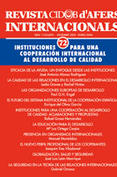
La calidad de las relaciones en el desarrollo internacional: implicaciones institucionales y personales
Palabras clave:
desarrollo, cooperación internacional, actores, ayuda, pobrezaResumen
Revista CIDOB d'Afers Internacionals, nº. 72
Cuatrimestral (enero 2006)
ISSN:1133-6595
En este artículo las autoras exploran algunas de las implicaciones personales y organizativas que supone satisfacer las nuevas demandas de mayor transparencia y rendición de cuentas en la ayuda al desarrollo. Ello exige cambios en las relaciones entre los diferentes actores del sistema de desarrollo internacional. La primera parte del trabajo se centra en cómo se conciben y comportan mutuamente los grupos de personas, es decir, en la dimensión “personal” de la construcción de la relación. En este sentido, se observa el papel que puede desempeñar el agente de desarrollo individual para apoyar el cambio de las relaciones que exige la nueva agenda del desarrollo. En la segunda parte se examina cómo están conectadas las personas a través de sus organizaciones, así como los mecanismos institucionales que puedan obstaculizar el desarrollo de unas relaciones de calidad, y también cómo éstas pueden transformarse para satisfacer mejor las necesidades de la nueva agenda de reducción de la pobreza.
Citas
BROCK, K. y McGEE, R. Knowing Poverty: Critical Reflections on Participatory Research and Policy. Londres: Earthscan, 2002.
BROWN, A.; FOSTER, M.; NORTON, A. y NASCHOLD, F. “The status of sector-wide approaches”. Working Paper 142. (2001). Londres: ODI.
CAD. Development Co-operation in Difficult Partnerships, DAC DCD/DAC 11.
CHAMBERS, R. y PETTIT, J. “Shifting power to make a difference”. En: GROVES, L. y HINTON, R. (eds.) Inclusive Aid: Power and Relationships in International Development. Londres: Earthscan, 2004.
CHAMBERS, R. Rural Development: Putting the Last First. Londres: Longman Books, 1983.
CHAMBERS, R. Whose Reality Counts: Putting the First Last. Londres: Intermediate Technology Publications, 1997.
CHAMBERS, R. “Immersions for Policy and Personal Change: Reflection and learning for development professionals”. IDS POLICY Briefing no. 22 (julio 2004).
CREWE, E. y HARRISON, E. Whose Development? An Ethnography of Aid. Londres y Nueva York: Zed Books, 1998.
DAVID, R. y MANCINI, A. “Going against the flow: making organizational systems part of the solution rather than part of the problem”. Lessons for Change in Policy & Organisations, No. 8. Brighton: Institute of Development Studies, 2004.
DFID. Poverty Reduction Budget Support (PRBS). London: Department for International Development, 2004.
DFID. Realising human rights for poor people. London: Department for International Development, 2000.
EYBEN, R. “Who owns a Poverty Reduction Strategy? A Case Study of Power, Instruments and Relationships in Bolivia”. En : GROVES, L. y HINTON, R. (eds.) Inclusive Aid: Power and Relationships in International Development. Londres: Earthscan, 2004.
EYBEN, R. y LEON, R. (en preparación) “Whose aid? The case of the Bolivian elections project”. En: LEWIS, D. y MOSSE, D. (eds.) Anthropology Upstream. Londres: Pluto Press (en preparación).
EYBEN, R. y FERGUSON, C. “How can donors become more accountable to poor people?”. En: GROVES, L. y HINTON, R. (eds.) Inclusive Aid: Power and Relationships in International Development. Londres: Earthscan, 2004.
FINEMAN, S. (ed.) Emotion in Organizations. Londres: Sage, 1993.
FOWLER, A. “Partnerships: Negotiating Relationships – A Resource for Non-Governmental Development Organisations”. Occasional Paper, no 32, International NGO Training and Research Centre, Oxford, 2002.
GAVENTA, J. “Assessing power relations in participatory spaces”. Extraído de comunicación presentada en el seminario Millennium Conference on Facets of Power in International Relations. London: School of Economics, Octubre 30-31, 2004.
GROVES, L. UNHCR’s age and gender mainstreaming pilot project 2004: Synthesis report. Ginebra: UNHCR. www.unhcr.ch/epau 2005.
GROVES, L. y HINTON R (eds.) Inclusive Aid: Power and Relationships in International Development. Londres: Earthscan, 2004.
HEWSTONE, M.; HOPKINS, N. y ROUTH, D. “Cognitive models of stereotype change (1): Generalisation and sub-typing in young people’s views of the police”. Journal of experimental psychology. Vol 22. (1992). P. 219-234.
HINTON, R. y GROVES, L. “Introduction”. En: GROVES, L. y HINTON, R. (eds.). Inclusive Aid: Power and Relationships in International Development. Londres: Earthscan, 2004.
HIRVONEN, P. Stingy Samaritans; Why Recent Increases in Development Aid Fail to Help the Poor, Global Policy Forum, agosto de 2005.
IDS http://www.ids.ac.uk/ids/particip/research/ppa.html, 2005.
LAWSON, A.; BOOTH, D.; HARDING, A. y NASCHOLD, F. “General Budget Support Evaluability Study Phase 1: Synthesis Report”. DFID Evaluation Report EV643, Department for International Development, East Kilbride, 2003.
NORTON, A., con la colaboración de BIRD, B., BROCK, K. KAKANDE, M. TURK, C. A manual for participatory poverty assessments. Londres: Department for International Development, 2001.
OWUSU, C. “An International NGO’s Staff Reflections on Power, Procedures and Relationships”. En: GROVES, L. y HINTON, R. (eds.) Inclusive Aid: Power and Relationships in International Development. Londres: Earthscan, 2004.
PASTEUR, K. y SCOTT-VILLIERS, P. If relationships matter, how can they be improved? Learning about relationships in development. Lessons for Change in Policy and Organisations, No. 9. Brighton: Institute of Development Studies, 2004. Participatory Learning and Action www.plannotes.org
PRAXIS, Participatory Assessment of Government of Orissa’s Delivery of Services that Impact at the Village Level, informe elaborado para el Grupo de Trabajo sobre la Pobreza [Poverty Task Force], Government of Orissa, India. 2002.
Putmam y Mumy….
SCHACTER, M. Sector Wide Approaches, Accountability and CIDA: issues and recommendations. Ottawa: CIDA, enero de 2001.
SCOTT-VILLIERS, PATTA. “Personal Change and Responsible Wellbeing”. En: GROVES, L. y HINTON, R. (eds.). Inclusive Aid: Power and Relationships in International Development. Londres: Earthscan, 2004.
WEBER, Max. Economy and Society: An Outline of Interpretive Sociology. Berkeley: University of California Press, 1978.
WHEATLEY, M. Leadership and the New Order: Discovering Order in a Chaotic World. San Francisco: Berrett and Koehler, 1994