El Estado en América Latina
Palabras clave:
América Latina, Estado, derecho, política fiscalResumen
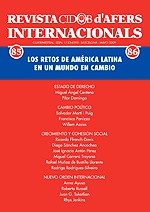
Revista CIDOB d’Afers Internacionals, nº 85-86
Cuatrimestral (mayo 2009)
ISSN:1133-6595 | E-ISSN:2013-035X
¿En qué medida es competente el Estado en América Latina? Este artículo analiza el sistema fiscal, la Administración pública y datos electorales, así como los indicadores de cambio en ámbitos como la seguridad pública, el derecho, las regulaciones económicas y los servicios sociales, a fin de poder comparar la región con otras partes del mundo y definir las disparidades intrarregionales. El Estado latinoamericano, en general, no es muy fuerte ni efectivo, pero los estados chileno y brasileño pueden ser el mejor ejemplo para la región.
Citas
ALDUANTE, Eduardo y MARTNER, Ricardo. “Fiscal Policy and Social Protection”. CEPAL Review. No. 90 (diciembre de 2006). P. 85-102
AMSDEN, Alice. The risc of “the rest”: challenges to the west from late-industrializing economies. New York: Oxford University Press, 2001.
ARTANA, D.; LÓPEZ MURPHY, R. y NAVAJA, F. “A Fiscal Policy Agenda”. En: Kuczynski, P.P. and Williamson, J. (eds.) After the Washington Consensus. Washington: Institute for International Economics, 2001.
BRAUTIGAM, Deborah; FJELDSTAD, Odd-Helge y MOORE, Mick (eds.) Taxation and State-Building in Developing Countries. Cambridge: Cambridge University Press, 2008.
CALLAGHY, Thomas. The state-society struggle: Zaire in comparative perspectiva. New York: Columbia University Press, 1984.
CENTENO, Miguel y PORTES, Alejandro. “The State and the Informal Economy”. En: Fernández-Kelly,Patricia (ed.) Out of the Shadows. Penn State Press, 2006.
CENTENO, Miguel. Blood and Debt. Penn State Press, 2002.
— “The Reinvention of Latin American Militaries”. America Quarterly (otoño de 2007).
DI JOHN, Jonathan. “Why is the Tax System so Ineffective and Regressive in Latin America?” Development Viewpoint, SOAS, Centre for Development Policy and Research (5 de junio de 2008).
ECHEBARRIA, Koldo (ed.) Red de Gestión y Transparencia de la Política Pública. Washington D.C.: IADB, 2003.
EDWARDS, Steven. “Murder Rate Highest in Latin America”. Canwest News Services, 26 de noviembre de 2008.
EVANS, Peter; RUESCHEMEYER, Dietrich y SKOCPOL, Theda (eds.) Bringing the state back in. New York: Cambridge University Press, 1985.
EVANS, Peter y RAUCH, James. “Bureaucracy and growth: A cross-national analysis of the effects of ‘Weberian’ state structures”. American Sociological Review. No. 64 (1999). P. 748-65.
EVANS, Peter. Embedded autonomy: states and industrial transformation. Princeton: Princeton University Press, 1995.
FAY, Marianne y MORRISO, Mary. Infrastructure in Latin America and the Caribbean: Recent Developments and Key Challenges. Washington: World Bank, 2002.
FITZGERALD, Valpy. “The Plato Index”. Presentación en la Universidad de Essex (6-7 de julio de 2006):
http://www.valpyfitzgerald.com
HARTLYN, J. y MCCOY, J. “Electoral Processes in Latin America”. Ponencia presentada en la conferencia del American Political Science Association, 2006.
HEREDIA, Blanca y SCHNEIDER, Benn Ross (eds.) The Political Economy of Administrative reform in Developing Countries. North South Center, 1997.
HEREDIA, Blanca. “The Political Economy of Reform of the Administrative Systems of Public Sector Personnel in Latin America”. Working Paper (2002). Inter-American Development Bank.
HOFFMAN, Kelly y CENTENO, Miguel. “The Lopside Continent: Inequality in Latin America”. Annual Review of Sociology (2003).
ILO. “Men and Women in the Informal Economy”, 2002.
INTER-AMERICAN DEVELOPMENT BANK. “The Business of Growth”. Washington: IADB, 2001.
— The Politics of Policies. Cap. 4: “Cabinets, the Bureaucracy, Subnational Governments and the Judiciary”. Washington: IADB, 2006.
JOHNSON, Chalmers. MITI and the Japanese miracle: the growth of industrial policy, 1925-1975. Stanford: Stanford University Press, 1982.
KOHLI, Atul. State-directed development: political power and industrialization in the global periphery. New York: Cambridge University Press, 2004.
LANGE, Matthew; MAHONEY, James y HAU, Matthias von. “Colonialism and Development: A Comparative Analysis of Spanish and British Colonies”. American Journal of Sociology. Vol. 111. No 5
(marzo de 2006). P. 1.412-1.462.
LÓPEZ-PINTOR, Rafael. Electoral Management Bodies as Institutions of Governance. New York: UNDP, 2000.
MAHONEY, James. “Long-Run Development and the Legacy of Colonialism in Spanish America”. American Journal of Sociology. Vol. 108. No. 1 (julio de 2003). P. 50-106.
MANRIQUE, Luis Esteban G. “A Parallel Power: Organized Crime in Latin America”. ARI. No. 84 (29 de setiembre de 2006). Real Instituto Elcano.
O’DONNELL, Guillermo. “On the State, Democratization and Some Conceptual Problems”. World Development. Vol. 21. No. 8 (1993). P. 1.355-1.369.
PÁSARA, Luis. “Justicia, régimen político y sociedad en América Latina”. Política y Gobierno. Vol. X. No. 2 (2003). P. 418.
PORTES, Alejandro y SMITH, Lori. “Institutions and Development in Latin America: A Comparative Analysis”. Studies in Comparative International Development. No. 43 (2008). P. 101-128.
RAMIÓ, Carlos y SALVADOR, Miquel. “Civil Service Reform in Latin America: External Referents vs. own Capacities”. Bulletin of Latin American Research. Vol. 27. No. 4 (2008). P. 562.
SCOTT, James. Seeing Like a State. New Haven: Yale University Press, 1998.
SKOCPOL, Theda. States and social revolutions. New York: Cambridge, 1979.
TILLY, Charles. Coercion, capital, and European states, AD 990-1990. Cambridge: Blackwell, 1990.
WADE, R. Governing the market: Economic theory and the role of government in East Asian industrialization. Princeton: Princeton University Press, 1990.