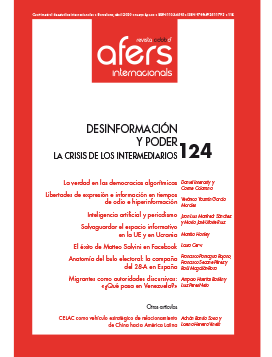
Migrants casting themselves as discourse leaders: "What’s happening in Venezuela?"
Keywords:
transnational communication, migrations, opinion leaders, disinformation, digital culture, Venezuela, influencersAbstract
Revista CIDOB d’Afers Internacionals, nº 124
Quadrimestral (January -April 2020)
ISSN:1133-6595 | E-ISSN:2013-035X
DOI: doi.org/10.24241/rcai.2020.124.1.147
Political crises caused by authoritarian governments encourage influencers to emerge in the emigrant population. In this regard, this paper addresses transnational communication linked to migration processes. Using a theoretical framework that revolves around the notion of an intermediary – based on classical communication theories – it delves into public opinion, pluralism and disinformation, and examines the reception of the disinformation in terms of moral systems and emotional responses. Specifically, a qualitative analysis is made of material posted on YouTube by two Venezuelan emigrant influencers about Juan Guaidó’s self-proclamation as acting president in January 2019. The focus is on the resources they use to establish themselves as discursive authorities about the political discussion from outside the country.
Keywords: transnational communication, migrations, opinion leaders, disinformation, digital culture, Venezuela, influencers.
>> The full text articles of this issue are available only in Spanish language
References
Albright, Jonathan. «Welcome to the era of fake news». Media and Communication, vol. 5, n.º 2 (2017), p. 87-89.
Aliaksandrau, Andrei. «There’s nothing new about fake news: It might be a new term, but the mechanisms of fake news have been in place in Belarus for decades». Index on Censorship, vol. 46, n.º 2 (2017), p. 52-54 (en línea) [Fecha de consulta: 09.12.2019] https://journals.sagepub.com/
doi/10.1177/0306422017716023
Bakshy, Eytan; Messing, Solomon y Adamic, Lada A. «Exposure to ideologically diverse news and opinion on Facebook». Science, vol. 348, n.º 6239 (2015), p. 1.130-1.132.
Blyth, Mark. «Institutions and ideas». En: Marsh, David; Stoker, Gerry (ed.). Theory and Methods in Political Science. Londres: Palgrave Macmillan, 2002, p. 292-310.
Bolaño, César R. S. «Organização em rede, capital e a regulação mercantil do elo social». Liinc em Revista, vol. 12, n.º 1 (2016), p. 6-16 (en línea). [Fecha de consulta: 09.12.2019] http://revista.ibict.br/liinc/article/view/3711
Burque, Peter. Hibridismo cultural. Madrid: Ediciones Akal, 2010.
Castells, Manuel. Comunicación y Poder. Madrid: Alianza, 2009.
Cogo, Denise; ElHaji, Mohammed y Huertas, Amparo. Diásporas, migraciones, tecnologías de la comunicación e identidades transnacionales. Bellaterra: InCom-UAB, 2012 (en línea) [Fecha de consulta: 09.12.2019] https://ddd.uab.cat/record/166682
Cogo, Denise; Gutiérrez, María y Huertas, Amparo. Migraciones transnacionales y medios de comunicación. Relatos desde Barcelona y Porto Alegre. Madrid: Los libros de la Catarata, 2008.
Crespi, Irvin. The public opinion process. How the people speak. Nueva York: Lawrence Erlbaum, 1997.
Curran, James. Medios de comunicación y poder en una sociedad democrática. Barcelona: Hacer, 2005.
Fernández, Carmen Beatriz. «Medios rojos y espectadores azules: cuando las audiencias deciden emigrar. Selectividad ideológica de las audiencias ante la estatización de la información en Venezuela». Contratexto, n.º 29 (2018), p. 181-198 (en línea) [Fecha de consulta: 09.12.2019] http://dx.doi.org/10.26439/contratexto2018.n029.1822
Folz, Olivier. «Hugo Chávez: le renouveau du populisme vénézuélien?». Amnis, n.º 5 (2005) (en línea) [Fecha de consulta: 09.12.2019] http://journals.openedition.org/amnis/988
Fontana, Josep. Historia: Análisis del pasado y proyecto social. Barcelona: Austral, 1982.
Fuchs, Christian. Culture and Economy in the Age of Social Media. Nueva York: Routledge, 2015.
Grossi, Giorgio. La opinión pública. Teoría del campo demoscópico. Madrid: CIS, 2007.
Habermas, Jürgen. Historia y crítica de la opinión pública. Barcelona: Gustavo Gili, 2002.
Han, Byung-Chul. La sociedad del cansancio. Barcelona: Herder, 2012.
Herman, Edward y Chomsky, Noam. Manufacturing Consent: The Political Economy of the Mass Media. Londres: Random House, 2010.
Huertas Bailén, Amparo. La audiencia investigada. Barcelona: Gedisa, 2002.
Huertas Bailén, Amparo. Yo soy audiencia. Ciudadanía, público y mercado. Barcelona: Editorial UOC, 2015.
Huertas Bailén, Amparo. «El estudio de las minorías como audiencia. El caso de la población migrante». Anuario Electrónico de Estudios en Comunicación Social «Disertaciones», vol. 11, n.º 1 (2018), p. 40-55 (en línea) [Fecha de consulta: 09.12.2019] http://dx.doi.org/10.12804/revistas.urosario.edu.co/disertaciones/a.6276
Jenkins, Henry. Convergence Culture: Where Old and New Media Collide. Nueva York: New York University Press, 2008.
Laclau, Ernesto. On Populist Reason. Londres: Verso, 2005.
Lang, Gladys E. y Lang, Kurt. The battle for public opinion: the president, the press, and the polls during Watergate. Nueva York: Columbia University Press, 1983.
Lazarsfeld, Paul F.; Berelson, Bernard y Gaudet, Hazel. The People’s Choice. How the Voter Makes Up his Mind in a Presidential Campaign. Nueva York: Columbia University Press, 1948.
Lazarsfeld, Paul y Katz, Elihu. Personal Influence. Londres: Transaction Publishers, 1968.
Martínez Meucci, Miguel Ángel y de Lustgarten, Rebeca Vaisberg. «La narrativa revolucionaria del Chavismo». POSTData: Revista de reflexión y análisis político, vol. 19, n.º 2 (2014), p. 463-506 (en línea) [Fecha de consulta: 09.12.2019] https://dialnet.unirioja.es/servlet/articulo?codigo=5118493
Murdock, Graham. «Political economies as moral economies: commodities, gifts, and public goods». En: Wasko, Janet; Murdock, Graham y Sousa, Helena (eds.). The handbook of political economy of communications. Oxford: Wiley-Blackwell, 2011, p. 13-40.
Napoli, Philip. Audience Evolution. New technologies and the Transformation of media audiences. Nueva York: Columbia University Press, 2010.
Pariser, Eli. El filtro Burbuja: cómo la red decide lo que leemos y lo que pensamos. Madrid: Taurus, 2017.
Pereira, David da Silva. «Populismo, construcción del caso venezolano». Revista Uruguaya de Antropología y Etnografía, vol. 3, n.º 2 (2018), p. 87-94 (en línea) [Fecha de consulta: 09.12.2019] http://ojs.fhuce.edu.uy/index.php/revantroetno/article/view/114
Rocco Lozano, Valerio (coord.). Éxodos y geopolíticas. Madrid: Editorial Dykinson, 2019.
Sampedro Blanco, Víctor. Opinión pública y democracia deliberativa. Medios, sondeos y urnas. Madrid: Istmo, 2000.
Sánchez Urribarrí, Raúl A. «Venezuela (2015): Un régimen híbrido en crisis». Revista de ciencia política (Santiago), vol. 36, n.º 1 (2016), p. 365-381 (en línea) [Fecha de consulta: 09.12.2019] https://dx.doi.org/10.4067/S0718-090X2016000100016
Sartori, Giovanni. ¿Qué es la democracia? Madrid: Taurus, 2007.
Scolari, Carlos A. (ed.). Ecología de medios: entornos, evoluciones e interpretaciones. Barcelona: Gedisa, 2015.
Thompson, John B. Ideologia e cultura moderna: teoria social crítica na era dos meios de comunicação de massa. Rio de Janeiro: Vozes, 2011.
Vallès, Josep Maria y Ballart, Xavier (eds.). Política para apolíticos. Contra la dimisión de los ciudadanos. Barcelona: Ariel, 2012.
Van Dijck, José. La cultura de la conectividad. Una historia crítica de las redes sociales. Madrid: Siglo veintiuno, 2016.
Wardle, Claire y Derakhshan, Hossein. Information disorder: Toward an interdisciplinary framework for research and policy making. Bruselas: Consejo de Europa, 2017 (en línea) [Fecha de consulta: 09.12.2019] https://rm.coe.int/information-disorder-toward-an-interdisciplinary-framework-forresearc/168076277c