Eficacia de la ayuda: un enfoque desde las instituciones
Palabras clave:
desarrollo, cooperación para el desarrollo, ayuda, instituciones, información, capacitaciónResumen
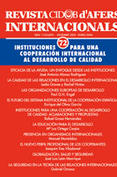
Revista CIDOB d'Afers Internacionals, nº. 72
Cuatrimestral (enero 2006)
ISSN:1133-6595
El presente trabajo pretende explorar algunas de las debilidades que presenta el sistema de ayuda internacional para operar con eficacia en la promoción del desarrollo. Para ello se adopta un enfoque institucional, tratando de indagar en los problemas de asimetría de información que se presentan tanto en las relaciones entre donante y receptor como en el seno de las organizaciones de ayuda. El análisis de estos aspectos le lleva al autor a subrayar la importancia que los procesos de aprendizaje tienen en el enriquecimiento de las intervenciones de desarrollo; así como la relevancia de las actitudes y aptitudes de los agentes para alentar esos procesos de mejora de la calidad de la ayuda.
Citas
ACHARYA, A.; FUZZO DE LIMA, A. y MOORE, M. “Aid proliferation: how responsible are the donors?”. IDS Working Paper 214 (2004) Sussex: Institute of Development Studies.
ADAM, J.P.; DEVARAJAN, S. y O´CONNELL, S.A. “Aid dependence reconsidered”. Policy Research Working Paper 2441 (1999). World Bank.
African Development Bank. Achieving the Millenium Development Goals in Africa: Progress, prospects and policy implications. Global Poverty Report, 2002.
ALONSO, J.A. “Globalización, desigualdad internacional y eficacia de la ayuda”. En: ALONSO, J.A. y FITZGERALD, V. (eds) Financiación del desarrollo y coherencia en las políticas de los donantes. Madrid: Editorial Catarata, 2003.
ALONSO, J.A. “El desarrollo como proceso abierto al aprendizaje”. European Journal of Development Research, 16, 4 (2004). P. 845-67.
ALONSO, J.A. “Objetivos de Desarrollo del Milenio: ¿Nueva agenda de desarrollo?”. Cuadernos de Información Económica, 187 (julio-agosto 2005). P. 49-57.
BANCO MUNDIAL. Assessing Aid. What works, what doesn´t and why. Nueva York: Oxford University Press, 1998.
BIRDSALL, N. y Deese, B. “Hard currency. Unilateralism doesn´t work for foreign aid either”. Washington Monthly (March 2004).
BLACK, R. y White, H. Targeting Development. Critical perspectives on the Millennium Development Goals. London: Routledge, 2004.
BROSSARD, M. y GACOUGNOLLE, L-Ch. Financing primary education for all: Yesterday, today and tomorrow. UNESCO, 2001.
BRAÜTIGAM, D. Aid dependence and governance. EGDI, Almquist and Wicksell Internacional, 2000.
BURNS, B.; MINGAT, A. y RAKOTOMALALA, R. Achieving universal primary education by 2015: A chance for every child. World Bank, 2003.
CARLSSON, J. y WOHLGEMUTH, L. Learning in development co-operation. Estocolmo: Almqvist and Wiksell International, 2002.
CLEMENS, M.; KENNY, Ch. y MOSS, T. “The trouble with the MDGs: Confronting expectations of aid and development success”. Working Paper No.40 (2004) Center for Global Development.
COMMISSION FOR AFRICA. Our Common Interest. An Argument. London: Penguin Books, 2005.
DAC. Harmonising donor practices for effective aid delivery. París: OECD, 2003.
DELAMONICA, E.; MEHROTRA, S. y VANDMOORTELE, J. “Is EFA Affordable? Estimating the Global Millenium Cost of “Education for All”. Innocenti Working Paper No. 87 (2001). UNICEF
DEVARAJAN, S.; MILLER, M. y SWANSON, E.V. “Goals for development: History, prospects and costs”. Policy Research Working Paper No. 2819 (2002). World Bank.
EASTERLY, W. “The ghost of financing gap, testing the growth model of the international financial institutions”. Journal of Development Economics 60, 2 (1999). P. 423-38.
EASTERLY, W. The elusive quest for growth: Economists´Adventures and Misadventures in the Tropics. MIT Press, Mass, 2001.
EASTERLY, W. “The cartel of good intentions: bureaucracy versus markets in foreign aid”. Working Paper No. 4 (2002). Center for Global Development.
FILMER, D. “Costing the goal of universal primary enrolments by 2015: Back of the (big) envelope calculations”. World Bank, 2002.
GREENHILL, R. “The unbreakable link-debt relief and the millennium development goals”. Report from Jubilee Research at the New Economics Foundation, 2002.
GOTTSCHALK, R. “How much external finance will be need to meet the poverty-reduction target by 2015?”. Institute of Development Studies, University of Sussex, 2004.
KNACK, S. y ARMAN, A. “Aid intensity, donor fragmentation and the quality of governance”. Washington: Mimeo, 2003.
MARTENS, B; MUMMERT, U.; MURRELL, P. y SEABRIGHT, P. The institutional economics of foreign aid. Cambridge: Cambridge University Press, 2002.
MAXWELL, S. “Heaven or hubris: reflections on the new “New Poverty Agenda”. En: Black, R. y White, H. Targeting Development. Critical perspectives on the Millennium Development Goals. London: Routledge, 2004.
MAXWELL, S. “The Africa Commission Big Push”. ODI Opinions, mayo, 2005.
MESSNER, D. y WOLFF, P. “The millennium Development Goals. Thinking Beyond the Sachs Report”. Briefing Paper No. 5 (2005). Deutsches Institute fur Entwicklungspolitik.
MINGAT, A.; RAKOTOMALALA, R. y TAN, J-P. “Financing education for all by 2015: Simulations for 33 African countries”. World Bank, 2002.
MORSS, E.R. “Institutional destruction resulting from donor and project proliferation in sub-Saharan African countries”. World Development, 12 (4) (1984). P. 465-70.
NASCHOLD, F. “Aid and the Millenium Development Goals”. ODI Opinions (2002).
O´CONNELL, S.A. y C.C. SOLUDO “Aid intensity in Africa”. World Development, 29 (9). (2001). P. 1.527-52.
OSTROM, E.; GIBSON, C.; SHIVAKUMAR, S. y ANDERSSON, K. “Aid, incentives and sustainability. An institutional analysis of development cooperation”. Sida Studies in Evaluation, 02/01 (2002). Estocolmo.
OXFAM “Last chance at Monterrey: Meeting the challenge of poverty reduction”. Briefing Paper No.17 (2002). Oxfam.
ROSESTEIN RODAN, P.N. “International aid for underdeveloped countries”. Review of Economic and Statistics, 43 (1961). P. 107-38.
SACHS, J. (dir.) Investing in development. A practical plan to achieve the Millenium Development Goals. Earthscan, UN Millenium Project, 2005.
VANDERMOORTELE, J. “Are the Millennium Development Goals feasible?”. En: Black, R. y White, H. Targeting Development. Critical perspectives on the Millennium Development Goals. London: Routledge, 2004.
WHITE, H. “Using development goals and targets for donor agency performance measurement”. En: Black, R. y White, H. Targeting Development. Critical perspectives on the Millennium Development Goals. London: Routledge, 2004.
WHITE, H. y Booth, D. “Using development goals to design country strategies”. En: Black, R. y White, H.
Targeting Development. Critical perspectives on the Millennium Development Goals. London: Routledge, 2004.
WORLD BANK. “Education for dynamic economies: Action Plan to accelerate progress towards education for all”. Paper for Spring Development Committee Meeting. (2002).
WORLD BANK. “Supporting sound policies with adequate and appropriate financing: implementing the Monterrey Consensus at the country level”. World Bank, 2003.