
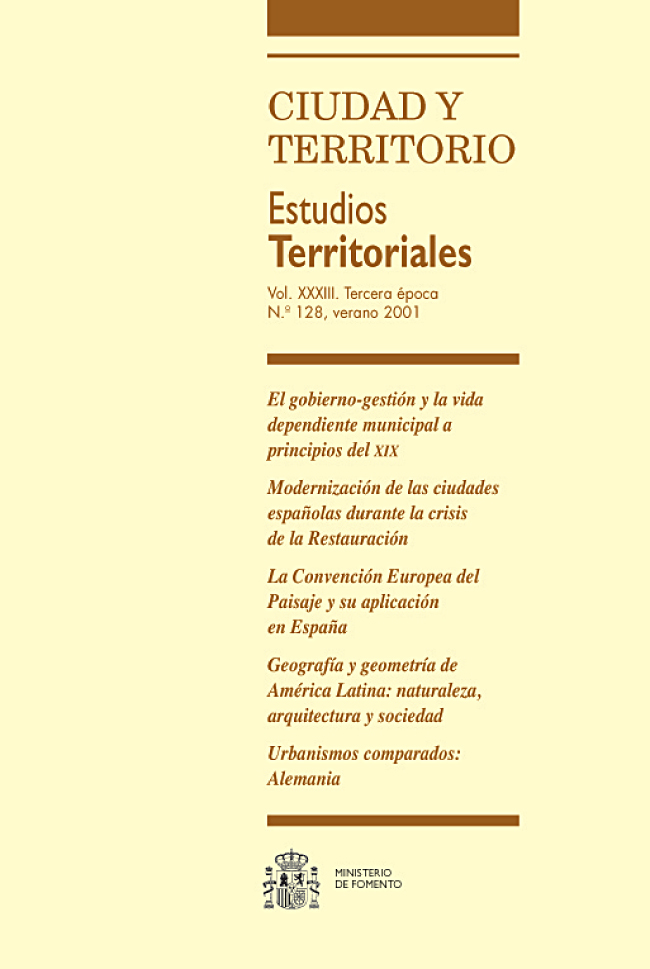
Modernización de las ciudades españolas durante la crisis política de la Restauración
Palabras clave:
Ciudades, Restauración, EspañaResumen
Bien que con notables disparidades entre sí y con evidentes limitaciones, ciertas ciudades españolas
de principios del siglo XX manifestaron capacidad de iniciativa y dispusieron de recursos, tanto financieros
como organizativos, como para enfrentarse a los nuevos problemas generados por el crecimiento
demográfico y a los cambios en los modos de vida que se estaban produciendo en el contexto de la segunda
industrialización. En estas páginas se estudia el complejo mundo de las inversiones promovidas por el conjunto
de los municipios españoles en dicha época tratando de determinar cómo se formaron y qué caracteres
tuvieron las estrategias colectivas seguidas en el proceso, muchas de las cuales han caracterizado —por
su presencia o por su ausencia— la historia de España a lo largo de todo el siglo XX y en particular la historia
de sus grandes ciudades.
Descargas
Descargas
Publicado
Cómo citar
Número
Sección
Licencia
Derechos de autor 2001 Gregorio Nüñez Romero-Balmas

Esta obra está bajo una licencia internacional Creative Commons Atribución-NoComercial-SinDerivadas 4.0.
Sin perjuicio de lo dispuesto en la legislación vigente sobre Propiedad Intelectual, y conforme a la misma, el/la los/las autor/a/es/as que publiquen en CyTET cede/n a título gratuito, de modo no exclusivo y sin límite temporal al Ministerio de Transportes, Movilidad y Agenda Urbana los derechos para difundir, reproducir, comunicar y distribuir en cualquier formato actual o futuro, en papel o electrónico, la versión original o derivada de su obra bajo licencia de Creative Commons Reconocimiento-NoComercial-SinObraDerivada 4.0 Internacional (CC BY-NC-ND 4.0), así como para incluir o ceder a terceros la inclusión de su contenido en índices, repositorios y bases de datos nacionales e internacionales, con referencia y reconocimiento en todo caso de la autoría del mismo.
Además, al realizar el envío, el/la los/las autor/a/es/as declara/n que se trata de un trabajo original en el que se reconocen las fuentes que han sido utilizadas en su estudio, comprometiéndose a respetar la evidencia científica y a no modificar los datos originales para verificar o refutar una hipótesis de partida; que el contenido esencial del mismo no ha sido publicado previamente ni se publicará en ninguna otra obra o revista mientras esté en proceso de evaluación en la revista CyTET; y que no se ha remitido simultáneamente a otra publicación.
Los autores deben firmar un Formulario de Cesión de Derechos, que les será enviado desde la Secretaría de CyTET una vez se acepte su artículo para ser publicado.
Con el objetivo de favorecer la difusión del conocimiento, CyTET se adhiere al movimiento de revistas de Open Access (OA) y entrega la totalidad de sus contenidos a diversos índices, repositorios y bases de datos nacionales e internacionales bajo este protocolo; por tanto, la remisión de un trabajo para ser publicado en la revista presupone la aceptación explícita por parte del autor/a de este método de distribución.
Se anima a las/os autoras/es a reproducir y alojar sus trabajos publicados en CyTET en repositorios institucionales, páginas web, etc. con la intención de contribuir a la mejora de la transferencia del conocimiento y de la citación de dichos trabajos.



 Enlace a CyTET en Linkedin
 Hashtag en Twitter: #RevistaCyTET