(Re)creando la comunidad: el uso de la autoridad consuetudinaria para resolver el conflicto de Casamance en Senegal
Palabras clave:
Senegal, Casamance, tradición, autoridades tradicionales, resolución de conflictosResumen
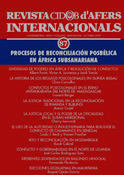
Revista CIDOB d’Afers Internacionals, nº 87
Cuatrimestral (octubre 2009)
ISSN:1133-6595 | E-ISSN:2013-035X
"Diversas aproximaciones a los métodos ""tradicionales"" han hecho importantes contribuciones en los esfuerzos para resolver el viejo y largo conflicto de Casamance (Senegal), aunque no siempre de la manera deseada o reclamada por sus defensores u observadores externos. En este trabajo se examinan tres de estas aproximaciones: los esfuerzos muy localizados de líderes y instituciones tradicionales (p. ej., el rey Jola-Huluf); los intentos para utilizar o expandir su autoridad (p. ej., la sacerdotisa Usana); así como los esfuerzos para (re)inventar una historia-mitología como una base de la tradición local a fin de armonizar la comunidad (p. ej., la Association Culturelle Aguène-Diambogne). Ofreciendo una evaluación combinada respecto a cómo estas aproximaciones podrían promover la resolución del conflicto en Casamance, los autores analizan el contexto en el cual las aproximaciones a los métodos ""tradicionales"" podrían promover la paz, al mismo tiempo que sostienen que estos están más cercanos a complementar los métodos convencionales de resolución de conflictos que a constituir una alternativa a ellos."
Citas
Amnesty INTERNATIONAL. Senegal: An Escalation in Human Rights Violations in Casamance Region. London, 1991.
APPADURAI, Arjun . Modernity at Large: Cultural Dimensions of Globalization. Minneapolis: University of Minnesota Press, 1996.
Awenengo , Séverine . “Les Joola, la Casamance et l’État (1890-2004). L’identisation joola au Sénégal”, doctorat, Université Paris-VII, 2005.
Avruch , Kevin . Culture and Conflict Resolution. Washington, DC: United States Institute for Peace, 1998.
BECK, LINDA. “Limited Brokers: Casamançais ‘Sons of the Soil’ in Southern Senegal”. Brokering Democracy in Africa. New York: Palgrave, 2008.
Beck , Linda ; Charlick , RobertOBERT; Gomis , Domini que ; Manga , Gene vie ve; Grey Johnson , Nana and CoulibalyOULIBALY, Cheiban . Conflict Prevention and Peace Building Case Study: The Casamance Conflict and Peace Process (1982-2001). Burlington, VT: Associates in Rural Development, 2001.
Boone , CathyATHY. Political Topographies of the African State: Territorial Authority and Institutional Choice. Cambridge: Cambridge University Press, 2003.
Bordonaro , Loren zo. Living at the Margins. Youth and Modernity in the Bijagó Islands (Guinea Bissau). PhD Dissertation, ISCTE, Lisboa, 2007.
Call , Charles . Building States and Building Peace. Boulder, CO: Lynne Rienner, 2008.
Chambaudouin , M. “Casamance : Ce que veut réellement Abbe Diamacoune”. Africa International. No. 265 (1993). P. 44-47.
CISSÉ, NOUHA, Ba, & MANÉ. La crise casamançaise: Les initiatives et propositions de sortie de crise. Ziguinchor: AJAC/APRAN, 2000.
COPANS, Jean . Les Marabouts de l’Arachide: la Confrérie Mouride et les Paysans du Sénégal. Paris: Le Sycomore, 1980.
Coulon , Christian . Le Marabout et Le Prince: Islam et Pouvoir au Sénégal. Paris: Editions A. Pédone, 1981.
Cruise O’Brien , Donal . The Mourides of Senegal. Oxford: Clarendon Press, 1971.
– “Langue et nationalité au Sénégal: L’enjeu politique de la wolofisation”. Année Africaine 1979 (1980). P. 319-335.
Darbon , Domini que . L’administration et le paysan en Casamance. Paris: Editions A. Pedone, 1988.
– “La voix de la Casamance”. Politique Africaine. No. 18 (1985). P. 127-140.
De Jong , F. “A Joking Nation: Conflict Resolution in Senegal”. Revue canadienne des études africaines. Vol. 9. No. 2 (2005). P. 389-413.
Diamacoune Senghor , Augustin . “Le message de la reine Alinsitowe”. COCARZI Conference organized at the Dakar Chamber of Commerce, 23 de agosto de 1980.
– Casamance-Pays du Refus: Réponse à Monsieur Jacques Charpy, 1995.
Diop , Momar Coumba & Diouf , Mamadou . Le Sénégal sous Abdou Diouf. Paris: Karthala, 1990.
– “Sénégal: la négritude n’est plus ce qu’elle était”. Autrement. No. 72 (1994). P. 129-138.
Eichelsheim , John Lucas . “Formation d’Etat et particularisme en Afrique: les relations des Diola au sud du Sénégal avec le pouvoir central à Dakar”. Afrika Focus. No. 7 (1991). P. 3.
Foucher , Vincent . “La guerre par d’autres moyens? La société civile dans le processus de paix en Casamance”, Raisons politiques (en prensa).
– “Senegal: The Resilient Weakness of Casamançais Separatists”. En: Dunn , K. & Boas , M. African Guerrillas. Raging against the Machine. Boulder: Lynne Rienner, 2007. P. 171-197
– “Church and Nation: The Catholic Contribution to war and peace in Casamance (Senegal)”. Social Sciences and Missions. No. 13 (October 2003). P. 11-40.
– “Cheated Pilgrims: Education, Migration and the Birth of Casamançais Nationalism (Senegal)”. Unpublished PhD, School of Oriental and African Studies, University of London, 2002.
Hesseling , GertiERTI. Pratiques foncières à l’ombre du droit: l’application du droit foncier urbain à Ziguinchor, Sénégal. Leiden: African Studies Center, 1992.
Hobsbawm, Eric & Ranger , Terence O. (eds.) The Invention of Tradition. Cambridge: Cambridge University Press, 1992.
Huyse , Luc & M. SalterALTER. “Conclusions and Recommendations”. En: Huyse, L. and Salter, M. Traditional Justice and Reconciliation after Violent Conflict: Learning from African Experiences. Stockholm: IDEA, 2008.
Marut , Jean -Claude . L’instrumentalisation d’un modèle: les mécanismes traditionnels de résolution des conflits africains. En prensa.
– “Le dessous des cartes casamançaises. Une approche géopolitique du conflit”. En : Barbier-Wiesser, F.-G. Comprendre la Casamance. Chronique d’une intégration contrastée. Paris : Karthala, 1994. P. 193-212.
Menkhaus , K. J. “Governance without Government in Somalia: Spoilers, State Building, and the Politics of Coping”. International Security. Vol. 31. No. 3 (2006). P. 74-106.
Nhema , Alfred & Zele za, Paul T.. The Resolution of African Conflicts: The Management of Conflict Resolution and Post-Conflict Reconstruction. Oxford: James Currey, 2008.
Osaghae , Eghosa E. Traditional Cures for Modern Conflicts: African Conflict “medicine”. En: Zartman, I.W. Boulder, CO.: Lynne Rienner, 2002. P. 201-217.
Pelissier , P. Les paysans du Sénégal. Saint-Yrieix : Imprimerie Fabrègue, 1966.
Ranger , Terence O. “The Invention of Tradition Revisited: The case of Colonial Africa”. En: Ranger , T. & VaughanvAUGHAN, O. Legitimacy and the State in Twentieth-Century Africa. London: Macmillan, 1993. P. 62-111.
Richards , Paul . “To fight or to farm? Agrarian dimensions of the Mano River conflicts (Liberia and Sierra Leone)”. African Affairs. Vol. 104. No. 417 (2005). P. 571–90.
Roche , C. “Portraits de chefs casamançais”. Revue francaise d’histoire d’outre-mer. No. 213 (1985). P. 451-467.
Smith , É. “La nation ‘par le côté’. Le récit des cousinages au Sénégal”. Cahiers d’Etudes Africaines. No. 184 (2006). P. 907-965.
Thomas , V. Les Diola. Essai d’analyse fonctionnelle sur une population de Basse-Casamance. Dakar: Institut Fondamental d’Afrique Noire, 1958-1959.
Tomàs, Jordi . “Religion, peace and conflict resolution: a sacred king among the Joola-húluf of Casamance in the 21st century”. Soronda - Revista de Estudos Guineenses (special issue Experiências Locais de Gestão de Conflitos - Local Experiences of Conflict Management, 2008). P. 329-348.
– “‘La parole de paix n’a jamais tort’: La paix et la tradition dans le royaume d’Oussouye (Casamance, Sénégal)”. Revue canadienne des études africaines. Vol. 39. No. 2 (2005). P. 414-441.
Trinca z, P.-X. Colonisation et régionalisme: Ziguinchor en Casamance. Paris: Orstom, 1984
Young , M. Crawford . “Self-Determination Revisited”. En: Nzongola-Ntalaja, G. Conflict in the Horn of Africa. Atlanta: African Studies Association Press, 1981. P. 41-66.
Zartman, I. wILLIAM. “Conclusion: Changes in the New World and the Place for the Old”. En: Traditional Cures for Modern Conflicts: African Conflict ‘medicine’. Boulder, CO.: Lynne Rienner, 2002. P. 219-230.