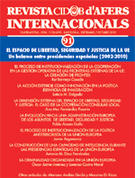
Introducción: El Espacio de Libertad, Seguridad y Justicia de la UE: Un balance entre presidencias españolas (2002-2010)
Abstract
Revista CIDOB d’Afers Internacionals, nº 91
Cuatrimestral (octubre- diciembre 2010)
ISSN:1133-6595 | E-ISSN:2013-035X
El Espacio de Libertad, Seguridad y Justicia (ELSJ) ha sido el campo de las políticas públicas europeas que ha experimentado un mayor dinamismo en la última década. Como resultado de ello, la Unión Europea ha incrementado exponencialmente su protagonismo en áreas como la inmigración, el control de fronteras, la cooperación judicial, así como la lucha contra el terrorismo y el crimen organizado. Estos aspectos se hallan a menudo entre las preocupaciones principales de los ciudadanos y gobiernos europeos y constituyen un campo de especial sensibilidad dentro del proceso de construcción europea debido a su localización central en la noción moderna de soberanía nacional. Desde su establecimiento en el Tratado de Maastricht (1992) ha existido, por lo tanto, una tensión manifiesta entre los impulsos para su progresiva comunitarización como repuesta a los procesos resultantes de la libre circulación de personas y a los recelos de los Estados Miembros a perder control en estas políticas. Por esta y otras razones, el programa de la Presidencia española del 2010 ha realzado el hecho de que España ha asumido la Presidencia en un “momento estratégico para Europa” (Ministerio de Exteriores, 2010); una afirmación que se ajusta perfectamente al enfoque que los autores han querido dar a este volumen, ya que no podría ser una descripción más acertada de un ELSJ que va a experimentar fundamentales ajustes institucionales tras la firma del Tratado de Lisboa y el desarrollo del Programa de Estocolmo. Y si se echa la vista atrás, es fácil percibir que esta no es la primera vez que una Presidencia española sirve como catalizador del desarrollo del ámbito de Justicia y Asuntos de Interior (JAI) dentro de la Unión, puesto que ya en el 2002 España afrontaba el mismo reto en el periodo posterior a los atentados del 11 de septiembre de 2001.
References
ASPINWALL, M.D. y SCHNEIDER, G. “Same menu, separate tables: The institutionalist turn in political science and the study of European integration”. European Journal of Political Research. No. 38 (2000). P. 1-36.
BALZACQ, T. et al. “Security and the Two-Level Game: The Treaty of Prüm, the EU and the Management of Threats”. CEPS Working Document. No. 234 (2006). Bruselas.
BULMER, S. y BURCH, M. “Organizing for Europe: Whitehall, the British state and European Union”. Public Administration. No. 76 (1998). P. 601-628.
ECLN. Statement by the European Civil Liberties Network* on the new EU five-year plan on Justice and Home Affairs (edición 2009) [en línea] [Consulta: 17 de abril de 2010]. http://www.ecln.org/ECLN-statement-on-Stockholm-Programme-April-2009-eng.pdf
COMISIÓN EUROPEA. Commission Activities in the Fight against Terrorism. Bruselas, 12 de marzo de 2007. Memo/07/98.
CONSEJO DE LA UNIÓN EUROPEA. Council Framework Decision 2002/465/JHA of 13 June 2002 on Joint Investigation Teams, Bruselas, 20 de junio de 2002(a). Official Journal of the European Union, L 162.
– Council Framework Decision 2002/584/JHA of 13 June 2002 on the European Arrest Warrant and the surrender procedures between Member States. Bruselas, 18 de julio de 2002(b). Official Journal of the European Union, L 190.
– Council Framework Decision 2002/475/JHA of 13 June 2002 on Combating Terrorism, Bruselas, 18 de julio de 2002(c). Official Journal of the European Union, L 190.
– The Hague Programme: strengthening freedom, security and justice in the European Union. Bruselas, 13 de diciembre de 2004, 16054/04.
– The Stockholm Programme – An open and secure Europe serving and protecting the citizens. Bruselas, 2 de diciembre de 2009, 17024/09.
GEORGE, S. y BACHE, I. Politics in the European Union. Oxford: Oxford University Press, 2001.
GEYER, F. “Fruit of the Poisonous Tree - Member States’ Indirect Use of Extraordinary Rendition and the EU Counter-Terrorism Strategy”. CEPS Working Document. No. 263 (2007). Bruselas.
HALL, P.A. y TAYLOR, R.C.R. “Political Science and the Three New Institutionalisms”. Political Studies. No. XLIV (1996). P. 936-57.
HIX, S. “The Study of the European Community: The Challenge to Comparative. Politics”. West European Politics. No. 17 (1994). P. 1-30.
JUPILLE J. y CAPORASO, J.A. “Institutionalism and the European Union: Beyond International Relations and Comparative Politics”. Annual Review of Political Science. No. 2 (1999).
JUPILLE J.; CAPORASO, J.A. y CHECKEL J.T. “Integrating institutions – rationalism, constructivism, and the study of the European Union”. Comparative Political Studies. Vol. 36. No. 1 / 2 (2003). P. 7-39.
Langdal, Fredik. “An evaluation of the Swedish EU Presidency: Difficult Setting, Pragmatic Style and Mixed Results”. Analisis of the Real Instituto Elcano (ARI). No. 28/2010 (03.02.2010): http://www.realinstitutoelcano.org/wps/portal/rielcano_eng/Content WCM_GLOBAL_CONTEXT=/elcano/Elcano_in/Zonas_in/ARI28-2010 [Consulta: 28 de marzo de 2010].
MARCH, J. y OLSEN, J. Rediscovering institutions: the organizational basis of politics. New York: Free Press, 1989.
MINISTERIO DE EXTERIORES ESPAÑOL. “Programa de la Presidencia Española del Consejo de la Unión Europea. (1 de enero a 10 de junio de 2010). Innovando Europa” (2010) [en línea] [Consulta: 9 de marzo de 2010]: http://www.eu2010.es/export/sites/presidencia/comun/descargas/programa_ES.PDF
MONAR, J. “Towards a European Area of Freedom, Security and Justice? The Hague Programme in Perspective”. EPC. No. 14 (2005) [en línea] [Consulta: 19 de febrero de 2008]: http://www.epc.eu/en/ce.asp?AI=446&LV=177&PG=CE/EN/detail&TYP=CE&l=3&see=y&t=42
PARLAMENTO EUROPEO. Stockholm programme: more citizens’ rights, say MEPs. Bruselas, 25 de noviembre de 2009 [en línea] [Consulta: 3 de febrero de 2010]: http://www.europarl.europa.eu/news/expert/infopress_page/019-65084-327-11-48-902-20091124IPR65083-23-11-2009-2009-false/default_en.htm
POLLACK, M.A. “The New Institutionalisms and European Integration”. En: DIEZ, T. y WERNER, A. (eds.) European Integration Theory. Oxford: Oxford University Press, 2004.
REES, W. “The External Face of Internal Security”. En: HILL, C. y SMITH, M. (eds.) International Relations and the European Union. Oxford: Oxford University Press, 2005.
– “Inside Out: The external face of EU internal security policy”. Journal of European Integration. Vol. 30. No. 1 (2008). P. 97-111.
SCHMIDT, V. A. “Approaches to the Study of European Politics”. ECSA Review. Vol. XII. No. 2 (1999). P. 2-9.
BUNYAN, T. “Statewatch Analysis. Commission: Action Plan on the Stockholm Programme. A bit more freedom and justice and a lot more security” (2009) [en línea] [Consulta: 7 de abril de 2010]: http://www.statewatch.org/analyses/no-95-stockholm-action-plan.pdf
THELEN, K. y STEINMO, S. “Historical institutionalism in comparative politics”. En: STEINMO, S.; THELEN, K. y LONGSTRETH, F. (eds.) Structuring Politics. Historical Institutionalism in Comparative Analysis. Cambridge: Cambridge University Press, 1992.
WOLFF, S., WICHMANN, N. y MOUNIER, G. “The External Dimension of Justice and Home Affairs: A Different Security Agenda for the EU?”. Journal of European Integration. Vol. 31. No. 1 (2009). P. 9-23.