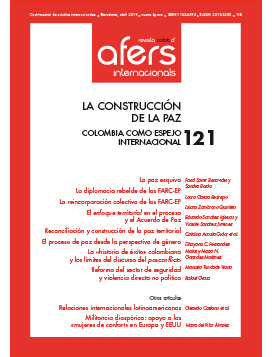
The FARC-EP’s rebel diplomacy in the Colombian peace process
Keywords:
rebel diplomacy, internal armed conflicts, peace process, Colombia, FARC-EPAbstract
Revista CIDOB d’Afers Internacionals, nº 121
Quadrimestral (January-April 2019)
ISSN:1133-6595 | E-ISSN:2013-035X
DOI: doi.org/10.24241/rcai.2019.121.1.19
In recent decades, the world’s armed conflicts have mainly taken place within countries. As a result, it is all the more important to investigate internal armed conflicts from underexplored perspectives, such as the use of non-violent tactics by insurgent groups. It is in this sense that some scholars are using the term “rebel diplomacy” to refer to strategic relations between insurgents and international actors in order to achieve political and military objectives in times of war. Taking as a case study the recent peace process between the Revolutionary Armed Forces of Colombia-People's Army (FARC-EP) and the Colombian government, this paper analyses the role of the guerrilla group's rebel diplomacy during this process.
>> The full text articles of this issue are available only in Spanish language
References
Acosta, Henry. El hombre clave. Colombia: Aguilar, 2016.
Arjona, Ana. Rebelocracy: Social order in the Colombian civil war. Cambridge: Cambridge University Press, 2016.
Arjona, Ana; Kasfir, Nelson y Mampilly Zachariah. «Introduction». En: Arjona, Ana; Kasfir, Nelson y Mampilly, Zachariah (eds.). Rebel governance in civil war. Cambridge: Cambridge University Press, 2015, p. 1-20.
Barreto, Miguel. «Los procesos de paz en Colombia y el rol de la comunidad internacional: ¿crónica de un nacimiento anunciado?». Revista Análisis Internacional, vol. 5, n.° 2 (2014), p. 219-243 (en línea) [Fecha de consulta: 14.04.2018] https://revistas.utadeo.edu.co/index.php/RAI/article/view/983
Bellal, Annyssa. The War Report: Armed Conflicts in 2017. The Geneva Academy of International Humanitarian Law and Human Rights, 2018. (en línea) [Fecha de consulta: 20.04.2018] https://www.geneva-academy.ch/joomlatoolsfiles/docman-files/The%20War%20Report%202017.pdf
Bob, Clifford. «Merchants of morality». Social Policy, n.° 129 (2002), p. 36-45 (en línea) [Fecha de consulta: 10.06.2017] https://ssrn.com/abstract=922037
Bob, Clifford. The Marketing of Rebellion. Insurgents, media and international activism. Nueva York: Cambridge University Press, 2005.
Borda, Sandra P. The internationalization of domestic conflicts: a comparative study of Colombia, El Salvador and Guatemala. Tesis de Doctorado en Filosofía, University of Minnesota, 2009.
Borda, Sandra P. y Gómez, Santiago. «The Internationalization of Colombia›s current peace process: From isolation to containment». En: Bagley, Bruce y Rosen, Jonathan, (eds.). Colombia’s political economy at the outset of the Twenty-first Century: From Uribe to Santos and beyond. Lanham: Lexington Books, 2015 p. 163-192.
Calvert, Peter. Revolution and International Politics. London: Frances Pinter, 1984.
Coggins, Bridget L. «Rebel diplomacy: Theorizing violent non-state actors’ strategic use of talk». En: Arjona, Ana; Kasfir, Nelson y Mampilly Zachariah (eds.). Rebel governance in civil war. Cambridge: Cambridge University Press, 2015, p. 98-118.
Constantinou, Costas M.; Kerr, Pauline y Sharp, Paul (eds.). The SAGE handbook of diplomacy. Los Angeles: SAGE, 2016.
Fazal, Tanisha M. «Rebellion, war aims & the laws of war». Daedalus, vol. 146, n.° 1 (2017), p. 71-82 (en línea) [Fecha de consulta: 30.05.2017] https://doi.org/10.1162/DAED_a_00423
Fearon, James D. y Laitin, David D. «Ethnicity, insurgency, and civil war». American Political Science Review, vol. 97, n.° 1 (2003), p. 75-90 (en línea) [Fecha de consulta: 17.05.2017] http://www.jstor.org.ezproxy.lib.gla.ac.uk/stable/3118222
GMH-Grupo de Memoria Histórica. «Basta ya! Colombia: Memorias de Guerra y dignidad». Bogotá: CNMH, 2013 (en línea) [Fecha de consulta: 06.04.2017] http://www.centrodememoriahistorica.gov.co/micrositios/informeGeneral/
Greig, J. Michael. «Rebels at the Gates: Civil War Battle Locations, Movement, and Openings for Diplomacy». International Studies Quarterly, vol. 59, n.º 4, (2015), p. 680-693 (en línea) [Fecha de consulta: 28.10.2018] https://doi.org/10.1111/isqu.12130
Haspeslagh, Sophie. «Listing terrorists: The impact of proscription on thirdparty efforts to engage armed groups in peace processes - a practitioner’s perspective». Critical Studies on Terrorism, vol. 6, n.° 1 (2013), p. 189-208 (en línea) [Fecha de consulta: 17.05.2017] https://doi.org/10.1080/17539153.2013.765706
Heger, Lindsay y Jung, Danielle. «Negotiating with rebels: The effect of rebel service provision on conflict negotiations». Journal of Conflict Resolution, vol. 61, n.° 6 (2015), p. 1.203-1.229 (en línea) [Fecha de consulta: 30.05.2017] https://doi.org/10.1177%2F0022002715603451
Huang, Reyko. «Rebel diplomacy in civil war». International Security, vol. 40, n.° 4 (2016), p. 89-126 (en línea) [Fecha de consulta: 10.02.2017] https://doi.org/10.1162/ISEC_a_00237
Jo, Hyeran. Compliant rebels. Rebel groups and international law in world politics. Cambridge: Cambridge University Press, 2015.
Jones, Benjamin y Mattiacci, Eleonora. «A manifesto, in 140 characters or fewer: Social media as a tool of rebel diplomacy». British Journal of Political Science, (2017), p. 1-23 (en línea) [Fecha de consulta: 10.02.2018] https://doi.org/10.1017/S0007123416000612
Kaplan, Morgan. Strategies of Rebel Diplomacy: Evidence from the Iraqi Kurdish Liberation Movement. Manuscrito sin publicar, 2017.
Kasfir, Nelson. «Guerrillas and civilian participation: the National Resistance Army in Uganda, 1981-86». The Journal of Modern African Studies, vol. 43, n.° 2 (2005) p. 271-296. (en línea) [Fecha de consulta: 10.02.2018] https://doi.org/10.1017/S0022278X05000832
Mampilly, Zachariah. «Insurgent governance in the Democratic Republic of the Congo». En: Krieger, Heike (ed.). Inducing compliance with International Humanitarian Law: Lessons from the African Great Lakes Region. Cambridge: Cambridge University Press, 2015, p. 44-78.
Martinez, Luis R. «Transnational insurgents: Evidence from Colombia’s FARC at the border with Chavez’s Venezuela». Journal of Development Economics, vol. 126, (2017) p. 138-153 (en línea) [Fecha de consulta: 28.10.2018] https://doi.org/10.1016/j.jdeveco.2017.01.003
Palacios, Marco. «A historical perspective on counterinsurgency and the «war on drugs» in Colombia». En: Arnson, Cynthia (ed.). In the wake of war: democratization and internal armed conflict in Latin America. Stanford, CA: Stanford University Press, 2012, p. 175-206.
Palma, Oscar. Transnational networks of insurgency and crime: explaining the spread of the Revolutionary Armed Forces of Colombia beyond national borders. Tesis de Doctorado en Filosofía, The London School of Economics and Political Science, 2013.
Pecaut, Daniel. «Presente, pasado y futuro de la violencia en Colombia». Desarrollo Económico, vol. 36, n.° 144 (1997), p. 891-930 (en línea) [Fecha de consulta: 20.06.2017] https://www.jstor.org/stable/3467131
Pérez, José Gregorio. Raúl Reyes. El canciller de la montaña. Bogotá: Norma, 2008.
Pizarro, Eduardo. «Una luz al final del túnel. Balance estratégico del conflicto armado en Colombia». Nueva Sociedad, n.° 192 (2004), p. 72-84 (en línea) [Fecha de consulta: 13.07.2017] http://nuso.org/articulo/una-luz-al-final-del-tunel-balance-estrategico-del-conflicto-armado-encolombia/
Ramírez, Socorro. «Actores europeos ante el conflicto colombiano». En: Gutiérrez, Francisco; Wills, María Emma y Sánchez, Gonzalo (eds.). Nuestra guerra sin nombre. Transformaciones del conflicto en Colombia. Bogotá: IEPRIEditorial Norma, 2006a, p. 71-120.
Ramírez, Socorro. «La ambigua regionalización del conflicto colombiano». En: Gutiérrez, Francisco; Wills, María Emma y Sánchez, Gonzalo (eds.). Nuestra guerra sin nombre. Transformaciones del conflicto en Colombia. Bogotá: IEPRIEditorial Norma, 2006b, p.121-168.
Reyes, Raúl. «Carta abierta a los gobiernos de Francia, Suecia y demás». FARCEP, (2002) (en línea) [Fecha de consulta: 20.08.2017] http://www.farc-ep.co/comunicado/carta-abierta-a-los-gobiernos-de-francia-suecia-y-demas.html
Sabates-Wheeler, Rachel y Verwimp, Philip. «Extortion with protection: Understanding the effect of rebel taxation on civilian welfare in Burundi». Journal of Conflict Resolution, vol. 58, n.º 8 (2014), p. 1.474-1.499 (en línea) [Fecha de consulta: 15.03.2017] https://doi.
org/10.1177%2F0022002714547885
Safford, Frank y Palacios, Marco. Colombia: fragmented land, divided society. Nueva York y Oxford: Oxford University Press, 2002.
Salehyan, Idean; Gleditsch, Kristian y Cunningham, David. «Explaining external support for insurgent groups». International Organization, vol. 65, n.º 4 (2011), p. 709-744 (en línea) [Fecha de consulta: 23.04.2017] https://www.jstor.org/stable/23016231
Schultze-Kraft, Markus. «Europe’s role in fostering peace in Central America and Colombia». En: Arnson, Cynthia (ed.). In the wake of war: democratization and internal armed conflict in Latin America. Stanford, CA.: Stanford University Press, 2012, p. 287-315.
Segura, Renata y Mechoulan, Delphine. Made in La Habana: Cómo Colombia y las FARC decidieron terminar la Guerra. Nueva York: International Peace Institute, 2017 (en línea) [Fecha de consulta: 07.08.2017] https://www.ipinst.org/wp-content/uploads/2017/02/IPI-Rpt-Made-in-HavanaSpan.pdf
Semana. «The world of the FARC (Part i: Europe)». Semana, (mayo de 2009a), (en línea) [Fecha de consulta: 20.08.2017] http://www.semana.com/international/print-edition/articulo/the-world-of-the-farc-part-i-europe/98823-3
Semana. «The world of the FARC (Part ii: America)». Semana, (junio de 2009b), (en línea) [Fecha de consulta: 20.08.2017] http://www.semana.com/international/print-edition/articulo/the-world-of-the-farc-part-ii-america/98843-3
The International Institute for Strategic Studies. The FARC files: Venezuela, Ecuador and the secret archive of «Raul Reyes». London: The International Institute for Strategic Studies, 2011.
Torrijos, Vicente y Pérez, Andrés. «La paradiplomacia de las FARC-EP». Revista Política y Estrategia, n.º 120 (2012), p. 15-56 (en línea) [Fecha de consulta: 06.02.2017] http://132.248.9.34/hevila/Politicayestrategia/2012/no120/1.pdf
Trejos, Luis Fernando. Un actor no estatal en el escenario internacional. El caso de las FARC-EP (1966-2010). Barranquilla: Editorial Universidad del Norte, 2015.
Ucrós-Maldonado, Andrés. «What Is the Colombian Peace Process Teaching the World?». New England Journal of Public Policy, vol. 29, n.º 1 (2017), p. 1-7 (en línea) [Fecha de consulta: 27.10.2018] https://scholarworks.umb.edu/nejpp/vol29/iss1/9/
Villamizar, Darío. Las guerrillas en Colombia. Una historia desde los orígenes hasta los confines. Bogotá: Penguin Random House, 2017.
Wickham-Crowley, Timothy. «Del gobierno de abajo al gobierno de arriba…and back: transitions to and from rebel governance in Latin America 1956-90». En: Arjona, Ana; Kasfir, Nelson y Mampilly, Zachariah (eds.). Rebel governance in civil war. Cambridge: Cambridge University Press, 2015, p. 47-73.