Archivos - Página 2
-
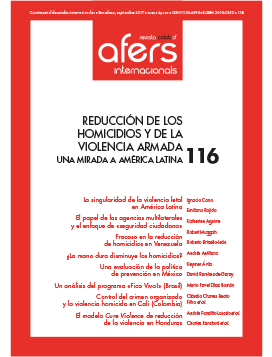
Núm. 116. Reducción de los homicidios y de la violencia armada: una mirada a América Latina
Revista CIDOB d’Afers Internacionals, nº 116
Cuatrimestral (mayo-septiembre 2017)
ISSN:1133-6595 | E-ISSN:2013-035X
DOI: https://doi.org/10.24241/rcai.2017.116.2« Reducción de los homicidios y de la violencia armada: una mirada a América Latina»
Coordinadores científicos: Ignacio Cano y Emiliano Rojido
Este número monográfico trata sobre la violencia letal en América Latina, la región con la mayor incidencia de homicidios del planeta. La explicación de este fenómeno no es consensual entre los especialistas, mientras que las intervenciones orientadas a revertirlo son escasas y poco focalizadas, además de ser raramente objeto de evaluaciones rigurosas. Este volumen pretende contribuir a la comprensión del fenómeno y a la reflexión sobre medidas para su control. Los temas abordados por los artículos comprenden, entre otros, las causas de la violencia letal, la descripción y la evaluación de programas nacionales y locales de prevención de homicidios, así como el papel de las instituciones internacionales en este campo. Los estudios adoptan metodologías cuantitativas y cualitativas. Los países analizados incluyen a Venezuela, Colombia, México, Brasil y Honduras, todos ellos territorios con elevadas tasas de homicidio. Esperamos que el lector que recorra estas páginas acabe con una visión más profunda sobre el problema de los homicidios en América Latina y sobre las formas de enfrentarlo.
-
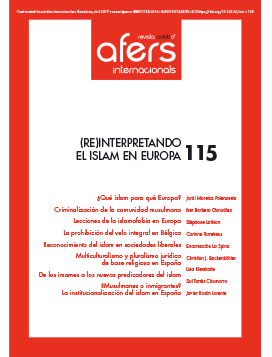
Núm. 115. (Re)interpretando el islam en Europa
Revista CIDOB d’Afers Internacionals, nº 115
Cuatrimestral (enero-abril 2017)
ISSN:1133-6595 | E-ISSN:2013-035X
DOI: https://doi.org/10.24241/rcai.2017.115.1«(Re)interpretando el islam en Europa»
Coordinador científico: Jordi Moreras
Este monográfico plantea un nuevo enfoque interpretativo en torno al islam en Europa Occidental, el cual ya no puede ser visto como una consecuencia del asentamiento de colectivos migrantes originarios de países musulmanes. Los artículos exploran los nuevos escenarios posmigratorios que se están configurando, sugiriendo enfoques de análisis alternativos –en el contexto de los procesos de encaje de una nueva ciudadanía musulmana, la emergencia de las nuevas generaciones de musulmanes ya nacidos en Europa–, para interpretar las controversias provocadas ante la visibilidad de simbologías islámicas en el espacio público, y para diseccionar las bases prejuiciosas sobre las que se fundamenta la islamofobia. Todas estas reflexiones proponen una forma diferente de pensar lo que supone hoy en día ser musulmán en Europa, que ya no constituye la expresión de una fidelidad con respecto a una tradición cultural o nacional concreta, sino la expresión de pertenencias múltiples en el marco de sociedades plurales, complejas y contradictorias como son las europeas.
-
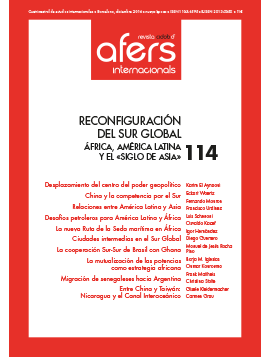
Núm. 114. Reconfiguración del Sur Global: África, América Latina y el «siglo de Asia»
Revista CIDOB d’Afers Internacionals, nº 114
Cuatrimestral (septiembre-diciembre 2016)
ISSN:1133-6595 | E-ISSN:2013-035X
DOI: https://doi.org/10.24241/rcai.2016.114.3«Reconfiguración del Sur Global: África, América Latina y el «siglo de Asia»»
Coordinadores científicos: Karim El Aynaoui y Eckart Woertz
Desde la década de los ochenta, se está produciendo en el sistema internacional un desplazamiento continuo del centro del poder –económico, político y cultural– desde Occidente hacia Asia-Pacífico. Países como China e India se están consolidando como potencias económicas que buscan nuevas vías para los flujos de inversión y cooperación para el desarrollo. En este proceso, el posicionamiento de África y de América Latina ha sido poco estudiado y este es, precisamente, el objetivo de este número: investigar –en el contexto de expansión e inversión asiáticas, principalmente china– en qué medida ambas regiones mantienen relaciones bilaterales (de cooperación y/o competencia) y podrían formular iniciativas de desarrollo y de política exterior propias. Los artículos de este número prestan especial atención a la cooperación Sur-Sur entre América Latina y África, e incluyen aspectos poco explorados como los patrones migratorios y la competencia entre China y potencias regionales como Brasil y Sudáfrica.

-
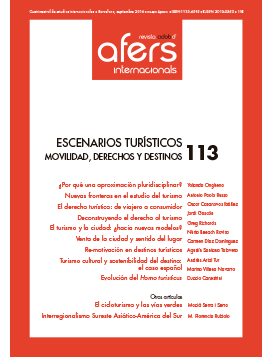
Núm.113. Escenarios turísticos: movilidad, derechos y destinos
Revista CIDOB d’Afers Internacionals, nº 113
Cuatrimestral (mayo-septiembre 2016)
ISSN:1133-6595 | E-ISSN:2013-035X
DOI: https://doi.org/10.24241/rcai.2016.113.2«Escenarios turísticos: movilidad, derechos y destinos»
Coordinadora científica: Yolanda Onghena
El estudio del turismo ha pasado de un discurso eufórico de enfoques economicistas y una visión más bien crítica a partir de perspectivas locales y ecologistas, a centrarse en una visión holística del desarrollo de la industria turística transnacional. Sin embargo, el turismo es el producto de una confluencia de elementos múltiples, materiales e imaginarios, subjetivos y colectivos. Además, si uno de estos múltiples elementos cambia, el turismo cambia también, por la complejidad de relaciones, movilidades e interacciones que lo caracterizan. Para situar los momentos, las experiencias y las actividades turísticas y su evolución, es necesario plantear nuevas preguntas en relación con los significados, movilidades e implicaciones que enmarcan y definen el fenómeno turístico. Este monográfico tiene como objetivo situar el turismo dentro de los procesos globales y favorecer una comprensión más flexible a partir de visiones que se entrecruzan y son interdependientes. Proponemos una puesta en común de perspectivas desde diferentes disciplinas para formular nuevas preguntas y orientar nuevas reflexiones.
-
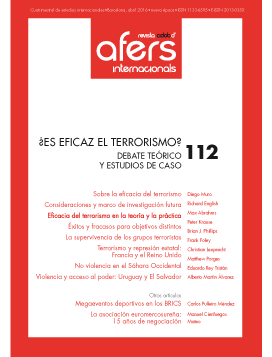
Núm. 112. ¿Es eficaz el terrorismo? Debate teórico y estudios de caso
Revista CIDOB d’Afers Internacionals, nº 112
Cuatrimestral (enero-abril 2016)
ISSN:1133-6595 | E-ISSN:2013-035X
DOI: https://doi.org/10.24241/rcai.2016.112.1«¿Es eficaz el terrorismo? Debate teórico y estudios de caso»
Coordinador científico: Diego Muro
Los expertos están divididos entre los que defienden que el terrorismo es un instrumento eficaz para conseguir concesiones políticas y aquellos que argumentan que son muy pocos los grupos terroristas que han conseguido sus objetivos estratégicos a largo plazo. El éxito o no de la violencia política es una cuestión de vital importancia a nivel teórico y práctico para los gobiernos y sociedades que se enfrentan a amenazas terroristas, así como para los propios grupos terroristas (interesados en la supervivencia del grupo). La relevancia operativa resulta, también, incuestionable: identificar las condiciones que llevan al fracaso del terrorismo sería de gran utilidad para los responsables de la seguridad. Este número aborda estas y otras aportaciones recientes al debate sobre la eficacia del terrorismo; destaca varias de las problemáticas inherentes a la discusión académica y ofrece una series de estudios de caso: desde el terrorismo yihadista en el Reino Unido y Francia hasta la estrategia no violenta en el Sáhara Occidental, pasando por la violencia revolucionaria en El Salvador y Uruguay.
-
Núm. 111. Control de fronteras y derechos humanos: más allá de la seguridad
Revista CIDOB d’Afers Internacionals, nº 111
Cuatrimestral (septiembre-diciembre 2015)
ISSN:1133-6595 | E-ISSN:2013-035X«Control de fronteras y derechos humanos: más allá de la seguridad»
Coordinadoras científicas: Claudia Jiménez y Mirentxu Jordana
El control de las fronteras exteriores es, sin duda, un tema de máxima actualidad que plantea una serie de retos en varios frentes y en un contexto donde la movilidad de la población es un proceso imparable en un mundo cada vez más globalizado. Para los países receptores es esencial lograr una gestión inteligente, eficaz y ordenada de las fronteras exteriores, pero a su vez es esencial garantizar el respeto a los derechos humanos. Este número de Revista CIDOB d’Afers Internacionals tiene por objeto reflexionar sobre el control de las fronteras exteriores desde una perspectiva que intenta dar una mayor visibilidad a la necesidad del respeto de los derechos humanos frente a enfoques cuya prioridad es esencialmente la seguridad. Por ello aporta cinco estudios focalizados en el ámbito europeo, además de otros tres que analizan otras experiencias y modelos de actuación que sirven para enriquecer el debate y tener una perspectiva más amplia de la temática.
-
Núm.110. Relaciones Interregionales: transatlánticas, transpacíficas y transeuroasiáticas
Revista CIDOB d’Afers Internacionals, nº 110
Cuatrimestral (mayo-septiembre 2015)
ISSN:1133-6595 | E-ISSN:2013-035X«Relaciones Interregionales: transatlánticas, transpacíficas y transeuroasiáticas»
Coordinadores científicos: Jordi Bacaria y Valeria Marina Valle
La evolución y las perspectivas de las relaciones interregionales están configurando –desde finales del siglo XX e inicios del siglo XXI– un nuevo orden geopolítico y geoeconómico mundial. Este número especial de la Revista CIDOB d’Afers Internacionals, coeditado con el CISAN-UNAM, propone un acercamiento a las relaciones interregionales transatlánticas, transpacíficas y transeuroasiáticas. Los artículos recogidos en este monográfico abordan, desde una perspectiva multidisciplinaria, con una base empírica y un enfoque comprehensivo, las relaciones entre Europa y América del Norte, América del Norte y Asia, y Europa y Asia.
Coeditado con: CISAN-UNAM
-
Núm. 109. Escenarios post-Primavera Árabe: actores y dinámicas de cambio
Revista CIDOB d’Afers Internacionals, nº 109
Cuatrimestral (enero-abril 2015 )
ISSN:1133-6595 | E-ISSN:2013-035X«Escenarios post-Primavera Árabe: actores y dinámicas de cambio»
Coordinadora científica: Inmaculada Szmolka
Han pasado más de cuatro años desde que tuvo lugar la denominada Primavera Árabe. Ante el estallido social en el Norte de África y Oriente Próximo, varios analistas y académicos hablaron entonces de una nueva «ola de democratización». No obstante, no podemos referirnos a una ola de democratización, sino más bien a una «ola de cambio político» , circunscrita a la región, con efectos muy diversos sobre la naturaleza de los regímenes árabes. De las transiciones democráticas abiertas en 2011, solo en Túnez se ha establecido un régimen democrático, mientras que, en Egipto, se ha producido una progresión autoritaria y, en Yemen y en Libia, la situación actual es de ingobernabilidad. Otros países árabes emprendieron procesos de liberalización política que tampoco han provocado una modificación sustancial de la naturaleza autoritaria del poder. Este monográfico analiza el alcance democratizador real de estas transformaciones políticas a través del análisis de varios países y ámbitos de cambio.
-
Núm. 108. La Unión Europea y el orden mundial: adaptación o atrincheramiento
Revista CIDOB d’Afers Internacionals, nº 108
Cuatrimestral (septiembre-diciembre 2014 )
ISSN:1133-6595 | E-ISSN:2013-035X«La Unión Europea y el orden mundial: adaptación o atrincheramiento»
Coordinadora científica: Esther Barbé
La convergencia de una UE en crisis con un orden mundial en cambio (transición de poder) constituye el objeto de análisis de este número de la Revista CIDOB d’Afers Internacionals. La crisis de la UE no es solo económica; su magnetismo, cargado de normas, instituciones y multilateralismo, ha dejado de funcionar. Tanto en el terreno del poder material como en el de las ideas, el mundo es más adverso para la UE de lo que era hace unos años.
En un contexto internacional adverso, ¿cómo actúa la Unión Europea para mantener su capacidad de influencia en las instituciones multilaterales y en los mecanismos de gobernanza global? ¿Está modificando su comportamiento? Y, si es así, ¿cómo? ¿Se adapta o se atrinchera?
Los artículos que conforman este monográfico, basándose en un marco analítico común, intentan responder a estas preguntas a partir del estudio de la reacción de la UE en instituciones multilaterales de ámbitos diversos (economía, medio ambiente, energía y seguridad).
-
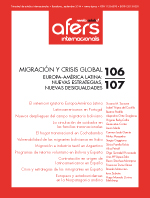
Núm. 106-107. Migración y crisis global. Europa-América Latina: nuevas estrategias, nuevas desigualdades
Revista CIDOB d’Afers Internacionals, nº 106-107
Cuatrimestral (mayo-septiembre 2014 )
ISSN:1133-6595 | E-ISSN:2013-035X«Migración y crisis global. Europa-América Latina: nuevas estrategias, nuevas desigualdades»
Coordinadoras científicas: Susana M. Sassone e Isabel Yépez del Castillo
¿Cuáles son los impactos de la crisis global en los procesos migratorios entre Europa y América Latina? ¿Cómo reaccionan los estados ante los posibles o potenciales redireccionamientos de los flujos migratorios? ¿Las políticas migratorias ponen en tensión la soberanía de los estados? ¿Cuáles son las estrategias y los recursos de los y las migrantes ante el desempleo? ¿El retorno es una opción elegida o una necesidad imperativa? ¿Cómo se redefinen las maneras de hacer familia y las solidaridades intra-familiares en los contextos actuales? Las migraciones internacionales son extremadamente sensibles a los contextos de cambio que ha impuesto la globalización, en especial desde 2007, cuando se produjo la crisis del capitalismo avanzado. Este número de la Revista CIDOB d’Afers Internacionals indaga, a través de once investigaciones, tanto la acción de los migrantes como la dimensión política y hasta geopolítica de estos sistemas de movilidades, particularmente entre los países de la Europa del Sur en relación con países de América del Sur. En este siglo xxi, en particular, los flujos están cambiando la orientación del péndulo y contribuyen a replantear la agenda global.
-
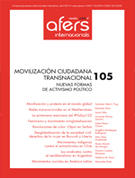
Núm. 105. Movilización ciudadana transnacional: nuevas formas de activismo político
Revista CIDOB d’Afers Internacionals, nº 105
Cuatrimestral (enero-abril 2014)
ISSN:1133-6595 | E-ISSN:2013-035X«Movilización ciudadana transnacional: nuevas formas de activismo político»
Coordinadores científicos: Salvador Martí i Puig y Eduardo Silva
¿Qué importancia tienen las protestas ciudadanas en la política doméstica e internacional? ¿Pueden los ciudadanos comunes influir realmente en cuestiones geopolíticas y trastocar los equilibrios existentes en y entre estados soberanos? ¿Ha cambiado el rol y el poder de la ciudadanía en un mundo global? ¿Qué efecto tiene la creciente interconexión global en los movimientos sociales y en las relaciones que se establecen entre ellos? Estas son algunas de las preguntas que se plantean en este número de la Revista CIDOB d’Afers Internacionals a través de ocho investigaciones que abordan casos de África Central, América del Sur, Europa, Mesoamérica y Magreb y Oriente Medio. A pesar de la pluralidad de los temas abordados, todos los casos están relacionados o bien con la reivindicación de los derechos civiles y democráticos de la población en general, o bien con la defensa y reivindicación de los derechos de algún colectivo específico, concretamente, el de las mujeres, los trabajadores y los pueblos indígenas. A partir de los análisis, se constata que, desde hace poco más de una década –a raíz del desarrollo de las nuevas tecnologías de la información y de la comunicación y de las facilidades en el transporte internacional–, es imprescindible tener en cuenta tanto los episodios de movilización ciudadana como la acción de redes de organizaciones de la sociedad civil para comprender la evolución de la agenda política global, así como los equilibrios geopolíticos del planeta.
-
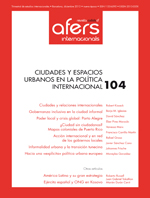
Núm. 104. Ciudades y espacios urbanos en la política internacional
Revista CIDOB d’Afers Internacionals, nº 104
Cuatrimestral (septiembre-diciembre 2013)
ISSN:1133-6595 | E-ISSN:2013-035X«Ciudades y espacios urbanos en la política internacional»
Coordinador científico: Robert Kissack
¿Qué papel tienen las ciudades en la política internacional del siglo XXI? ¿Hasta qué punto la incorporación de las ciudades a las instituciones de gobernanza global supone una amenaza para el rol de los estados soberanos como enlace entre la política doméstica y la internacional? En 2010 las ciudades superaron a las áreas rurales como hogar de más de la mitad de la población mundial, y esa cifra podría llegar hasta el 70% en una generación por el crecimiento de la población y las migraciones. El presente número de Revista CIDOB d’Afers Internacionals explora el impacto de las ciudades en la política internacional desde diversas perspectivas: la incorporación de las ciudades a las estructuras de gobernanza global; su relación con los recientes levantamientos populares; así como los efectos y la realidad de la economía informal en el espacio urbano. Asimismo, se ofrecen dos estudios de caso que ilustran cuestiones de identidad y cultura e iniciativas innovadoras y pioneras, además de un estudio sobre la política urbana de la UE.
-
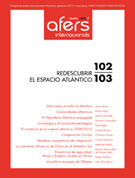
Núm. 102-103. Redescubrir el espacio atlántico
Revista CIDOB d’Afers Internacionals, nº 102-103
Cuatrimestral (2013)
ISSN:1133-6595 | E-ISSN:2013-035XLa cuenca del Atlántico se está convirtiendo en un escenario central de la globalización y, como tal, merece la misma atención que el área emergente del Pacífico. En el espacio atlántico existen vínculos crecientes en ámbitos como la energía, el comercio, la seguridad humana, las normas, los valores y otras cuestiones relacionadas con el océano mismo. A medida que crecen las interdependencias a través de esta cuenca, se generan nuevas oportunidades, pero también surgen nuevas vulnerabilidades que afectan a las sociedades interconectadas que la integran. Con problemas comunes cada vez más urgentes, los estados y regiones atlánticos buscan con renovado interés a sus homólogos en todas las riberas del océano. El objetivo de este número es arrojar luz sobre estos procesos aun poco explorados. Para ello contamos con la colaboración de autores de diferentes orillas del Atlántico que, desde un amplio espectro de orientaciones teóricas y cuestiones empíricas, analizan las consecuencias de los cambios y transformaciones en curso dentro del espacio atlántico.
-
Núm. 101. Multilateralismo: narrativas y prácticas de un nuevo orden institucional
Revista CIDOB d’Afers Internacionals, nº 101
Cuatrimestral (abril 2013)
ISSN:1133-6595 | E-ISSN:2013-035X«Multilateralismo: narrativas y prácticas de un nuevo orden institucional»
Coordinador científico: Oriol Costa Fernández
El multilateralismo está en crisis. Este es el diagnóstico, por una vez compartido, de observadores, participantes y estudiosos de las relaciones internacionales. Esta crisis cuenta con múltiples facetas, más o menos relacionadas entre sí: las profundas transformaciones que está experimentando la estructura de poder; el cambio en la relación entre lo global y lo regional; el peso cada vez mayor de las redes de políticas en la elaboración de políticas públicas domésticas, que ha venido a subrayar el problema de la legitimidad democrática de la gobernanza global y de su politización; así como la expansión del multilateralismo a un abanico cada vez más amplio de distintos temas. Este número, con análisis teóricos y estudios de caso, pretende arrojar algo de luz sobre estos procesos.
-
Núm. 100. Estudios internacionales en 2012: grandes temas para el debate
Revista CIDOB d’Afers Internacionals, nº 100
Cuatrimestral (diciembre 2012)
ISSN:1133-6595 | E-ISSN:2013-035X«Estudios internacionales en 2012: grandes temas para el debate»
Coordinador científico: Jordi Vaquer i Fanés
El lector tiene en sus manos el número 100 de Revista CIDOB d’Afers Internacionals. No es un ejemplar más: para una revista dedicada a los estudios internacionales en lengua española, conseguir llegar a este número resulta de por sí destacable, pero lo logra además consolidándose como una de las publicaciones de referencia en esta materia para los lectores en español.
Para celebrar el número 100 y a la vez conmemorar 30 años de existencia de Revista CIDOB d’Afers Internacionals, hemos editado un número muy especial. Con el título «Los estudios internacionales en 2012: grandes temas para el debate», este volumen recoge aportaciones de gran valía de una selección de autores de prestigio internacional. El conjunto presenta un interesante recorrido por algunas de las principales cuestiones que marcan la actualidad del pensamiento y los estudios internacionales. Es, a la vez, una demostración de la vitalidad del pensamiento en relaciones internacionales en países alejados del tradicional centro de la disciplina en Estados Unidos.
-
Núm. 99. Las comunidades autónomas españolas en el proceso decisorio de la UE. Un callejón con salida
«Las comunidades autónomas españolas en el proceso decisorio de la UE. Un callejón con salida»
Coordinadores científicos: Susana Beltrán y John Etherington (coords.)
El tema central de este monográfico es la participación de las comunidades autónomas del Estado español en el proceso de toma de decisiones en la UE y, en especial, en el Consejo. Con la inclusión de dos estudios comparados de ámbito europeo (Bélgica y Alemania) y otro externo (Brasil), el objetivo de este número es analizar tanto los problemas como la viabilidad de que los estados compuestos, como España, puedan participar efectivamente en los procesos de integración regional, ya que han de conciliar el interés de las entidades subestatales por intervenir, sin mermar su capacidad negociadora. A pesar de que numerosos trabajos han examinado las posibilidades de actuación de las regiones fuera de las fronteras nacionales, apenas se ha abordado cómo dichas entidades pueden trabajar con los gobiernos centrales para mejorar la proyección del Estado en el ámbito europeo e internacional. Los artículos que se presentan en este número tratan de contribuir a esta reflexión.
-

Núm. 97-98. El Brasil de Dilma Rousseff: Balance del primer año de Gobierno
«El Brasil de Dilma Rousseff: Balance del primer año de Gobierno»
Coordinadora científica: Anna Ayuso, Investigadora principal CIDOB
Tras los dos mandatos de Gobierno de Lula da Silva, Dilma Rousseff asumió en 2011 la Presidencia de Brasil como heredera del carismático líder del PT. La nueva jefa de Estado adquirió los retos de mantener los logros hacia un desarrollo más inclusivo, profundizar las transformaciones económicas y asumir las responsabilidades del creciente liderazgo brasileño en un contexto de crisis económica internacional. Este número monográfico hace un balance del primer año de Gobierno en cuatro dimensiones: en primer lugar, se abordan los desafíos económicos y sociales internos para la gobernabilidad de Brasil, especialmente las perspectivas de crecimiento y la lucha contra la pobreza; en segundo lugar, se analiza el liderazgo en la cooperación regional y las relaciones hemisféricas; seguidamente, en tercer lugar, se trata la ampliación de la proyección de Brasil en el ámbito global y, finalmente, en último lugar, cómo todo ello se proyecta en la relación con la Unión Europea y España.
-

Núm. 96. Veinte años después, ¿hacia dónde va Rusia?
Revista CIDOB d’Afers Internacionals, nº 96
Cuatrimestral (diciembre 2011)
ISSN:1133-6595 | E-ISSN:2013-035X
«Veinte años después, ¿hacia dónde va Rusia?»
Coordinadoras científicos: Carmen Claudín y Nicolás de Pedro
Las nutridas manifestaciones ciudadanas de diciembre de 2011 en Moscú y otras ciudades rusas, como protesta contra el triunfo presuntamente fraudulento del partido gubernamental Rusia Unida en las elecciones parlamentarias, pueden ser interpretadas como un primer síntoma claro de que algo se mueve en Rusia. Han pasado veinte años de la desaparición de la Unión Soviética y muchas de las incógnitas que se planteaban entonces siguen vigentes hoy. ¿Cuándo y cómo se establecerá un sistema plenamente democrático? ¿Cuál es o debería ser el modelo de desarrollo económico? ¿Se modernizará la economía rusa? ¿Qué papel desempeñan la sociedad civil y los medios de comunicación? ¿Cómo se articularán las relaciones interétnicas? ¿Qué papel jugarán los movimientos y sentimientos nacionalistas? ¿Cómo se articularán las relaciones centro/periferia en la Federación Rusa? ¿Cuál será el papel de Rusia en el mundo globalizado del siglo XXI? Este número monográfico de la Revista CIDOB d’afers internacionals aspira a ofrecer respuestas a estas y otras preguntas, recurriendo a los análisis de reconocidos especialistas en la materia.
-
Núm. 95. Realidades emergentes en el espacio europeo: Complejidad, movilidad y dinámicas interculturales
Revista CIDOB d'afers internacionals, núm. 95
Durante el trío de presidencias de la Unión Europea de 2010-2011 de España, Bélgica y Hungría, se inició un proyecto común para explorar, en una reflexión multidisciplinar y abierta, la emergencia de Europa en un contexto de globalización, desterritorialización y dinámicas culturales complejas; pensando que la reflexión sobre la Europa contemporánea debía superar el nivel de cuestiones como la identidad, los conflictos étnicos, el Estado-nación, la tolerancia religiosa y los valores culturales esencialistas; que la realidad actual exigía concentrarse en interacciones en múltiples contextos y redes, así como mirar a “Europa como un ágora de interacciones múltiples o como un sistema dinámico y complejo”. La complejidad social en la que vivimos nos exige imaginar escenarios de acción capaces de articular un sentido común de pertenencia. Y en este marco, ¿cómo puede ser útil la teoría de la complejidad? Necesitamos reconocer que Europa es diversidad; una multiplicidad de identidades con sus propias memorias y deseos de pertenencia. ¿Cuál sería el eslabón perdido que puede facilitar la unión y que, además, incluya esta miríada de constantes y variables, de continuidades y rupturas? En este espacio se sitúan los artículos de este monográfico, reflexiones y nuevos puntos de vista capaces de incorporar todo tipo de irregularidades, excepciones y desacuerdos para comprender un sinfín de eventos de coincidencias imprevisibles.
-
Núm. 93-94. Islam político en el Mediterráneo: Transformación y adaptación en un contexto cambiante
Revista CIDOB d’Afers Internacionals, nº 93-94
Cuatrimestral (abril 2011)
ISSN:1133-6595 | E-ISSN:2013-035X«Islam político en el Mediterráneo: Transformación y adaptación en un contexto cambiante»
Ferran Izquierdo Brichs (Coord.)
La lucha por la democracia ha llegado al mundo árabe y, aunque los cambios que la acompañen seguramente no responderán totalmente a las esperanzas de la población o serán reprimidos, ya nada será igual tras los “días de la ira”. Hasta este momento, el islamismo había ocupado un lugar central en el debate sobre las transformaciones en el mundo árabe, pero las recientes revueltas parecen desmentir la importancia que se le continuaba otorgando. Como veremos, el islamismo ha evolucionado a posiciones mucho más moderadas que en los años ochenta o primeros noventa del siglo pasado. En la actualidad, los partidos islamistas ni tienen la fuerza de entonces, ni reclaman las mismas cosas, ni siquiera siguen las mismas políticas. En este sentido, desde Turquía a Marruecos, pasando por Siria, Líbano, Israel, Palestina, Egipto, Somalia, Argelia y Túnez, los artículos recogidos en este número de la Revista CIDOB d’afers internacionals serán muy útiles para situar el islam político en el contexto actual.
-
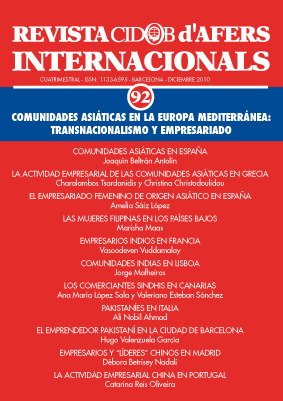
Núm. 92. Comunidades asiáticas en la Europa mediterránea: Transnacionalismo y empresariado
Revista CIDOB d’Afers Internacionals, nº 92
Cuatrimestral (diciembre 2012)
ISSN:1133-6595 | E-ISSN:2013-035X«Comunidades asiáticas en la Europa mediterránea: Transnacionalismo y empresariado»
Coordinadores científicos: Joaquín Beltrán y Amelia Sáiz
Este monográfico abre un nuevo marco de estudio de las comunidades asiáticas asentadas en Europa, concretamente en la zona meridional o mediterránea, desde una perspectiva conjunta, comparada y transversal. Ello lo convierte en un compendio pionero entre los estudios de este fenómeno, que se justifica por la constatación de que el asentamiento de las diásporas asiáticas —chinas, indias, pakistaníes, filipinas, etc.—en esta área geográfica no se puede entender sin tener en consideración un contexto más amplio, de escala europea y/o internacional. Tras ahondar en el trabajo de campo, los trabajos presentados buscan distanciarse deliberadamente de los discursos generados por las urgencias en la gestión de los flujos migratorios y la diversidad étnica que priorizan los estados, los cuales han descuidado sistemáticamente el estudio de sus protagonistas y sus trayectorias personales. Así, mediante los diversos artículos, vemos como con su asentamiento en países como España, Grecia, Francia o Portugal, los emprendedores y emprendedoras asiáticos refuerzan la internacionalización de las economías nacionales, al vincularlas a redes transnacionales de comercio y distribución que cabalgan a lomos de la globalización. También observamos como contribuyen a la transformación de las sociedades de acogida y de origen, enriqueciendo el acervo cultural y dejando su impronta en el paisaje urbano cotidiano de destino. Progresivamente, estas diversas diásporas asiáticas van desarrollando vínculos crecientes con las sociedades de acogida y las autoridades locales, ya sea mediante sus “portavoces” o a través de sus elites. Asimismo, vemos como la familia emerge como una institución central del entramado étnico, es decir, como la estructura básica sobre la que proliferan las relaciones económicas y sociales. En conjunto, podemos afirmar que la presencia de asiáticos en el Mediterráneo es un fenómeno en auge, que va de la mano de la proliferación de redes transnacionales y de los vínculos crecientes entre la Europa mediterránea y Asia; como fenómeno transnacional, exige una imagen compuesta, transversal y transnacional, que supere el enfoque tradicional de país.
-
Núm. 91. El Espacio de Libertad, Seguridad y Justicia de la UE: un balance entre presidencias españolas (2002-2010)
Revista CIDOB d’Afers Internacionals, nº 91
Cuatrimestral (octubre- diciembre 2010)
ISSN:1133-6595 | E-ISSN:2013-035X
«El Espacio de Libertad, Seguridad y Justicia de la UE. Un balance entre presidencias españolas (2002-2010) »
Coordinación científica: Rut Bermejo y Javier Argomaniz
El Espacio de Libertad, Seguridad y Justicia (ELSJ) de la UE ha sido el campo de las políticas públicas europeas que ha experimentado un mayor dinamismo en la última década. Desde la anterior presidencia española de 2002, la Unión ha incrementado exponencialmente su protagonismo en áreas como la inmigración, el control de fronteras, la cooperación judicial y la lucha contra el terrorismo y el crimen organizado. Todos estos temas a menudo se hallan entre las prioridades principales no solo de los gobiernos europeos y sus instituciones, sino también de sus ciudadanos. Constituyen también un campo de especial sensibilidad dentro del proceso de construcción europea debido a su localización central en la noción moderna de soberanía nacional. Esto ha sido así desde su establecimiento en el Tratado de Maastricht (1992), en una tensión manifiesta entre los impulsos para su progresiva comunitarización como repuesta a los procesos resultantes de la libre circulación de personas y los recelos de los Estados Miembros a perder el control de estas políticas.
Coincidiendo con la recién Presidencia española de la UE, uno de cuyos objetivos ha sido el impulso a la cooperación europea en estos temas, este número presenta una revisión de los avances en estos últimos años de algunas de las políticas y temas que constituyen el tercer pilar de la Unión.
-
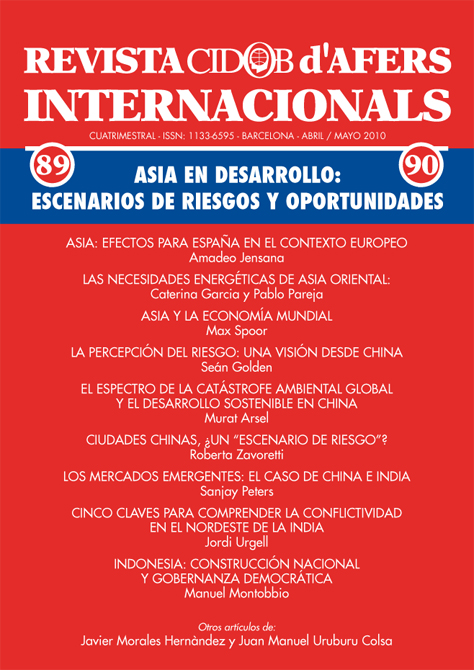
Núm. 89-90. Asia en desarrollo: escenarios de riesgos y oportunidades
Revista CIDOB d’Afers Internacionals, nº 89-90
Cuatrimestral (abril 2010)
ISSN:1133-6595 | E-ISSN:2013-035XA nadie sorprende hoy la afirmación de que Asia ha despertado definitivamente de su letargo para convertirse en la región más dinámica del planeta y en un polo emergente de las relaciones internacionales. De manera especial, China e India se han convertido en dos motores esenciales de la economía mundial, gracias a su formidable crecimiento económico, que han logrado sostener en el tiempo, y a sus enormes poblaciones que, medidas conjuntamente, representan más de un tercio de la población mundial. Ello se ha hecho especialmente evidente, recientemente, con el desfallecimiento de las economías desarrolladas occidentales, debido a la crisis financiera, y con el liderato de las dos potencias emergentes asiáticas en la recuperación mundial, hecho que subraya su candidatura a asumir mayores cuotas de responsabilidad en la articulación de un sistema internacional multipolar. No hay duda de que un reequilibrio de tales dimensiones contiene un potencial ambivalente, ya que si bien es cierto que ofrece enormes oportunidades de cooperación y estímulo (para los propios asiáticos, pero también para el resto del mundo), también contiene considerables riesgos, ligados a la inestabilidad derivada de dichos cambios. Desde ésta doble óptica, el análisis de un amplio abanico de escenarios posibles es el objetivo de este número de la Revista CIDOB d’Afers Internacionals. Con un enfoque multidisciplinar, los diferentes artículos profundizan en las cuestiones económicas (de comercio, inversiones y cooperación científica), ambientales (cambio climático y seguridad ambiental) y políticas (como el rol de los Estados Unidos y el auge del poder chino, los conflictos étnicos del nordeste indio o el complejo proceso de construcción de la Indonesia contemporánea). Un conjunto de análisis que tienen como objetivo común facilitarnos la comprensión de uno de los fenómenos más cruciales de nuestro tiempo.
-
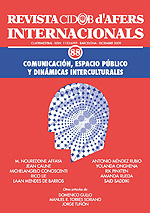
Núm. 88. Comunicación, espacio público y dinámicas interculturales
Revista CIDOB d’Afers Internacionals, nº 88
Cuatrimestral (diciembre 2009)
ISSN:1133-6595 | E-ISSN:2013-035X
«Comunicación, espacio público y dinámicas interculturales»
Coordinación científica: Yolanda Onghena
A través de las múltiples formas de comunicación, interacción y mediación, se plantea la comunicación como fenómeno de conexión, y se cuestionan las diversas modalidades de relación entre personas en un contexto en función de los soportes y códigos, así como los procesos de comunicación en su capacidad de generar un imaginario común y un sentimiento de pertenencia. ¿Se trata de un espacio que unifica y banaliza o, por el contrario, un espacio con nuevos desafíos, nuevas posibilidades de intercambios e interacciones?
El número 88 de la Revista CIDOB d’Afers Internacionals recoge las intervenciones del seminario "Comunicación, espacio público y dinámicas interculturales" que tuvo lugar los días 18 y 19 de septiembre de 2008 en la sede de CIDOB.
-
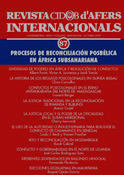
Núm. 87. Procesos de reconciliación posbélica en África Subsahariana
Revista CIDOB d’Afers Internacionals, nº 87
Cuatrimestral (octubre 2009)
ISSN:1133-6595 | E-ISSN:2013-035X
«Procesos de reconciliación posbélica en África Subsahariana»
Coordinación científica: Albert Farré y Jordi Tomàs
El presente volumen aborda el papel de las llamadas autoridades tradicionales en la resolución de conflictos en varios países del África Subsahariana. Tras las independencias, los gobiernos de los nuevos estados poscoloniales tendieron a ignorar el rol mediador de muchos líderes tradicionales. A pesar de ello, las actividades en favor de la paz de dichas autoridades entre las que se incluyen jefes religiosos, reyes sagrados, tribunales tradicionales, etc. continuaron, y además lo hicieron a menudo a la sombra de los estudios especializados y de las instituciones internacionales. Desde hace pocos años, el interés por estos líderes ha vuelto a escena, mostrando tanto la legitimidad que pueden tener para la población local como su plena operatividad frente a situaciones de crisis. Estos actores, además, tienen que lidiar no sólo con los gobiernos estatales sino con otros poderes autóctonos, así como con la presencia, cada vez más acentuada, de numerosos agentes de la cooperación internacional. Precisamente para analizar la diversidad de estrategias y dificultades de estas autoridades, CIDOB, junto con el Centro de Estudos Africanos del ISCTE (Lisboa) y la red temática ARDA/RIDA (Red de Investigación y Docencia sobre África), organizaron en noviembre de 2008 las II Jornadas de autoridades tradicionales en África (como continuación de la primera edición, que había tenido lugar en Lisboa en 2007), bajo el título “La paz y la palabra: procesos de reconciliación posbélica en África Subsahariana”, en las que se trataron los casos de Casamance (Senegal), Guinea-Bissau, Sudán, Uganda, Rwanda, Burundi, Angola, Mozambique y Madagascar. Fruto de esta experiencia nació la idea de elaborar este volumen.