Construyendo (la capital de) Europa como una heterotopía
Palabras clave:
Europa, Bruselas, capital, urbanidad, imaginarios urbanosResumen
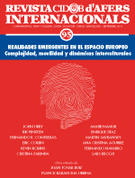
Revista CIDOB d’Afers Internacionals, nº 95
Cuatrimestral (septiembre 2011)
ISSN:1133-6595 | E-ISSN:2013-035X
El proyecto de unificación europea necesita de la imaginación para conseguir la adhesión de la población. Ese es el papel que puede jugar una ciudad capital, no sólo para ser la sede de las instituciones, sino también para constituirse como el lugar donde se desarrollan las artes, la cultura y la innovación relacionadas con el proyecto. Convertirse en una capital de Europa sería un buen proyecto urbano para Bruselas. Para ello, hace falta una evaluación crítica de los efectos del proceso de unificación con una fuerte dialéctica centro-periferia. En dicho proceso, el estilo de vida mediterráneo se está desvaneciendo, aun siendo una parte vital de la “europeidad”. Al objeto de construir un imaginario europeo posnacional e invertir en el proyecto de una ciudad capital se necesita una identidad descentrada en un espacio heterotópico.
Citas
Castells, Manuel. The information age. Economy, society and culture (3 vol.). Oxford: Blackwell Publishers, 1996-1998.
Castoriadis, Cornelius. L’institution imaginaire de la society. Paris: Seuil, 1975.
COMISIÓN EUROPEA/Presidencia Belga. “Brussels, Capital of Europe”. Final report, 2001.
Corijn, Eric. “Europe’s Unification Project and the Ethics of Leisure Studies”. En: Henry, Ian (ed.) Leisure: Modernity, Postmodernity and Lifestyles. Brighton: LSA Publications, 1994. P. 13-27.
— “L’Europe a besoin d’un projet multiculturel”. En: Culture & Société. Bruxelles: Ministère de la Communauté Française, 1998. P. 94-103.
CORijn, Eric ; DE CORTE, Stefan & DE LANNOY, Walter. « Bruxelles, de ville mosaique multiculturelle à capitale méditerranéenne de lEurope? » / « Brussel: van multiculturele en gefragmenteerde stad tot mediterrane hoofdstad van Europa ». En: Corijn, Eric & De Lannoy, Walter (eds.) La qualité de la différence/ De kwaliteit van het verschil. Brussel : VUB-Press, 2000. P. 17-27-41.
CORijn, Eric; DE CORTE, Stefan & DE LANNOY, Walter. “From a Multicultural and fragmented city towards the ‘Mediterranean’ capital of Europe”. En: INURA, The contested metropolis. Six cities at the beginning of the 21st century. Basel/Boston/Berlin: Birkhauser, 2004. P. 78-88.
Dehaene, Michiel & DECAUTER, Lieven. “Hippodamus’s ‘Third space’. Towards a general theorie of heterodoxie”. En: The rise of Heterotopia. Public space and the architectiure of the everyday in a postcivil society. Leuven: EAAE Colloquium, 2005. P. 70-86.
Foucault , Michel. « Des espaces autres. Conférence inédite ». En : Dits et écrits, IV. París: Gallimard, 1967.
Groth, Jacqueline & CORIJN, Eric. “Reclaiming Urbanity: Indeterminate spaces, informal actors and urban agenda setting. A case study in Helsinki, Brussels and Berlin”. Urban Studies. Vol. 42. No. 3 (2005). P. 511-534. London: Routledge.
MAGOSSE, Reinoud. “Imagining (the capital of) Europe”. En: Hein, C. Bruxelles, l’Européenne. Capitale de qui? Ville de qui?. Bruselas: ISACF-La Cambre & La Lettre volée, 2005.
OSWALT, Philip; OVERMEYER, Klaus & MISSELWITZ, Philip (eds.) Urban catalyst. Strategies for temporary use. Berlin: Studio Urban Catalyst, 2004.
Rose, Martin & WADHAM-SMITH, Nick. Mutuality, Trust and Cultural Relations. London: Counterpoint, British Council, 2004.
Sardar , Ziaudin. Beyond Difference: Cultural relations in the New Century. London: British Council, 2004.
SCARDIGLI , Victor. La consommation, culture au quotidien. París: P.U.F., 1976.
– Ways of life and social change in Europe. Bruselas: E.E.G., 1983.
– L’Europe des modes de vies. París: CNRS, 1987.
– “Consumption, Leisure and Lifestyle in Western Europe”. En: Filipcovà, Blanca; Glyptis, Sue & Tokarski, Walter (eds.): Life Styles, Theories, concepts, methods and results of life style research in international perspective. Prague: ISA13/Academy of Sciences (2 vol.), 1989. P. 302-321.
URBAN UNLIMITED ROTTERDAM et.al. The shadow city. Freezones in Brussels and Rotterdam. Rotterdam, 2004. 64 págs. No publicado.
Van Parijs, P. & VAN PARIJS, J. “Brussels, capital of Europe: a sustainable choice?”. Brussels Studies. No. 38 (2010).
Weber, Max. The protestant ethic and the spirit of capitalism. London: Allan & Unwin, 1967.