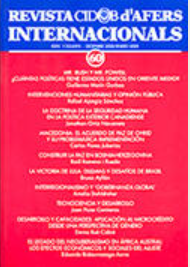
Desarrollo y capacidades: aplicación al microcrédito desde una perspectiva de género
Palabras clave:
Desarrollo, créditos, microfinanciación, género, proyectos de desarrollo, Índia, BangladeshResumen
Revista CIDOB d'Afers Internacionals, nº. 60
Cuatrimestral (enero 2003)
ISSN:1133-6595
Desde de los años ochenta se han popularizado los programas de microfinanzas como un componente de los proyectos productivos y de apoyo a la microempresa en los países en desarrollo, debido a su potencial en la lucha contra la pobreza y a favor del empoderamiento de los grupos más desfavorecidos de la sociedad –muy especialmente, las mujeres. Partiendo de la teoría de las capacidades de Amartya K. Sen y Martha C. Nussbaum, el artículo intenta establecer hasta qué punto puede el microcrédito desencadenar un proceso de transformación de las instituciones que limitan las oportunidades económicas, sociales y políticas de las mujeres y constriñen su capacidad de realización. El análisis del funcionamiento del mercado y de las relaciones intrafamiliares, desde una perspectiva de género, nos permite concretar algunos de los efectos positivos del microcrédito. No obstante, este análisis institucional revela también algunos de los factores –estructurales y organizativos– que pueden limitar su impacto, y plantea cuáles son los retos que deben afrontar las organizaciones que gestionan este tipo de programas, tanto en su diseño como en su evaluación, para garantizar que las microfinanzas promuevan una transformación institucional efectiva que dé lugar a la ampliación de las capacidades de las mujeres.
Citas
ACKERLY, A. “Testing the tools of development: credit programmes, loan involvement, and women’s empowerment”. IDS Bulletin. No. 26(3) (1995), p.56-68.
BERGER, I. “Giving Women Credit: the strengths and limitations of credit as a tool for alleviating poverty”. World Development. No. 17(7) (1989), p.1017-1032.
BOURDIEU, P. La dominación masculina. Barcelona: Ed. Anagrama, 2000.
BRUCE, J. “Homes Divided”. World Development. No. 17(7) (1989), p.979-991.
CHAMBERS, R. Whose Reality Counts? Putting the first last. Bath: Intermediate Technology Publications, 1999, p. 45-47.
CONNELL, R. Gender and Power. Cambridge: Polity, 1987, p. 99.
CROCKER, D. “Functioning and Capability: the Foundations of Sen’s and Nussbaum’s Development Ethic, Part 2”. En: NUSSBAUM, N. y GLOVER, J. (eds.) Women, Culture and Development. A study of human capabilities. Oxford: Oxford University Press, 1995, p.153-198.
DE ASÍS, A. “La microempresa y los programas de apoyo al sector microempresarial”. En: GÓMEZ GALÁN, M. y SOTA, J. Las Microempresas como Agentes de Desarrollo en el Sur. Madrid CIDEAL, (2000), p.19-47.
FRANCIS, E. Rural Livelihoods and Gender. Mimeo., 2000, p.110-111.
GOETZ, A.M. y SEN GUPTA, R. “Who Takes the Credit? Gender, Power, and Control over Loan Use in Rural Credit Programs in Bangladesh”. World Development. No. 24(1), (1996), p.45-63.
HASHEMI, S. M., SCHULER, S.R. y RILEY, A.P. “Rural credit programs and women’s empowerment in Bangladesh”. World Development. No. 24(4), (1996), p.635-653.
JACKSON, C. “Rescuing Gender from the Poverty Trap”. World Development. No. 24(3), (1996), p.489-504.
JOHNSON, S. Micro-finance and poverty: facing the challenges of the ‘New World’. Londres: ActionAid UK, 1996.
JOHNSON, S. “Gender impact assessment in microfinance and microenterprise: why and how”. Development in Practice. No.10(1), (2000a), p.89-93.
JOHNSON, S. Gender and Microfinance: guidelines for good practice, 2000b http://www.soc.titech.ac.jp/icm/wind/gendersjonson.html.
KABEER, N. “Gender, Production and Well-being: rethinking the Household Economy”. IDS Bulletin. Discussion paper No.288, (1991), p.1-50.
KABEER, N. “Targeting women or transforming institutions?”. Development in practice. No. 5(2), 1995, p.108-116.
KABEER, N. Money Can’t Buy Me Love? Re-evaluating Gender, Credit and Empowerment in Rural Bangladesh. IDS Discussion Paper No.363, Brighton - Institute of Development Studies, 1998.
KABEER, N. The Conditions and Consequences of Choice: reflections on the measurement of women’s empowerment. UNSRID Discussion Paper No.108, 1999.
KANDIYOTI, D. “Bargaining with Patriarchy”. Gender & Society, No. 2(3), (1988), p.274-290.
MAYOUX, L. From Vicious to Virtuous Circles? Gender and Micro-Enterprise Development. UNRISD Occasional Paper No.3 for Fourth World Conference on Women, Beijing, 1995.
MAYOUX, L. “Women’s Empowerment and Microfinance Programmes: Strategies for Increasing Impact”. Development in Practice. No. 8(2), (1998), p.235-241.
MAYOUX, L. From Access to Empowerment: Gender Issues in Microfinance. 1999. http:// www.soc.titech.ac.jp/icm/wind/mayoux.html.
MOSLEY, P. y HULME, D. “Finance for the poor or poorest? Financial innovation, poverty and vulnerability”. En: WOOD, G.D. y SHARIFF, I. (eds.) Who Needs Credit? Poverty and Finance in Bangladesh. Dhaka: The University Press, 1997.
NUSSBAUM, M.C. Women and Human Development. The Capabilities Approach. Cambridge: Cambridge University Press, 2001.
OSMANI, L. “Impact of Credit on the Relative Well-Being of Women. Evidence from the Grameen Bank”. IDS Bulletin. No. 29(4), (1998), p.31-38.
PALMER, I. “Public Finance from a Gender Perspective”. World Development. No. 23(11), (1995), p.1981- 1986.
RAHMAN, A. “Micro-credit Initiatives for Equitable and Sustainable Development: Who Pays?”. World Development. No. 27(1), (1999), p.67-82.
SAFILIOS-ROTHSCHILD, C. “Socio-economic determinants of the outcomes of women’s income-generation in developing countries”. En: STICHTER y PARPART (eds.) Women, Employment and the family in the international division of labour. Philadelphia: Temple University Press, (1990), p. 221-228.
SEN, A.K. Development as Freedom. Oxford-New York: Oxford University Press, 1999.
SEN, A.K. Nuevo examen de la desigualdad. Madrid: Alianza Editorial, 1995.
SEN, A.K. (1993) “Mercados y libertades. Logros y limitaciones del mecanismo de mercado en el fomento de las libertades individuales”. En: SEN, A.K. Bienestar, Justicia y mercado. Barcelona: Paidós / ICE UAB, 1998.
SEN, A.K. “Development as Capability Expansion”. En: K. GRIFFIN y KNOGHTS, J. (eds.) Human Development and the International Strategy for the 1990s. Londres: MacMillan, 1990a.
SEN, A.K. “Gender and cooperative conflicts”. En: TINKER, I. (ed.) Persistent Inequalities. Women and World Development, 1990b.
SEN, A.K. (1990c) “Justicia: medios contra libertades”. En: SEN, A.K. Bienestar, Justicia y mercado. Barcelona: Paidós / ICE UAB, 1998.
SEN, A.K. (1985) “El bienestar, la condición de ser agente y la libertad. Conferencias ‘Dewey’ de 1984”. En: SEN, A.K. Bienestar, Justicia y mercado. Barcelona: Paidós / ICE UAB, 1998.
SHARIFF, I. “Poverty and Finance in Bangladesh: A New Policy Agenda”. En: WOOD, G.D. y SHARIFF, I. (eds.) Who Needs Credit? Poverty and Finance in Bangladesh. Dhaka: The University Press, 1997. The Virtual Library on Microcredit, http://www.gdrc.org/icm, 21/10/01.
WHITE, An Evaluation of NGO Effectiveness in Raising the Economic Status of the Rural Poor. Bangladesh Country Study, Overseas Development Institute, 1991.
WHITEHEAD, A. “I’m hungry, Mum: the politics of domestic budgeting”. En: YOUNG, K. et al. (eds.) Of Marriage and the Market: Women’s Subordination Internationally and its Lessons. Londres: Routledge,1984, p.93-116.