
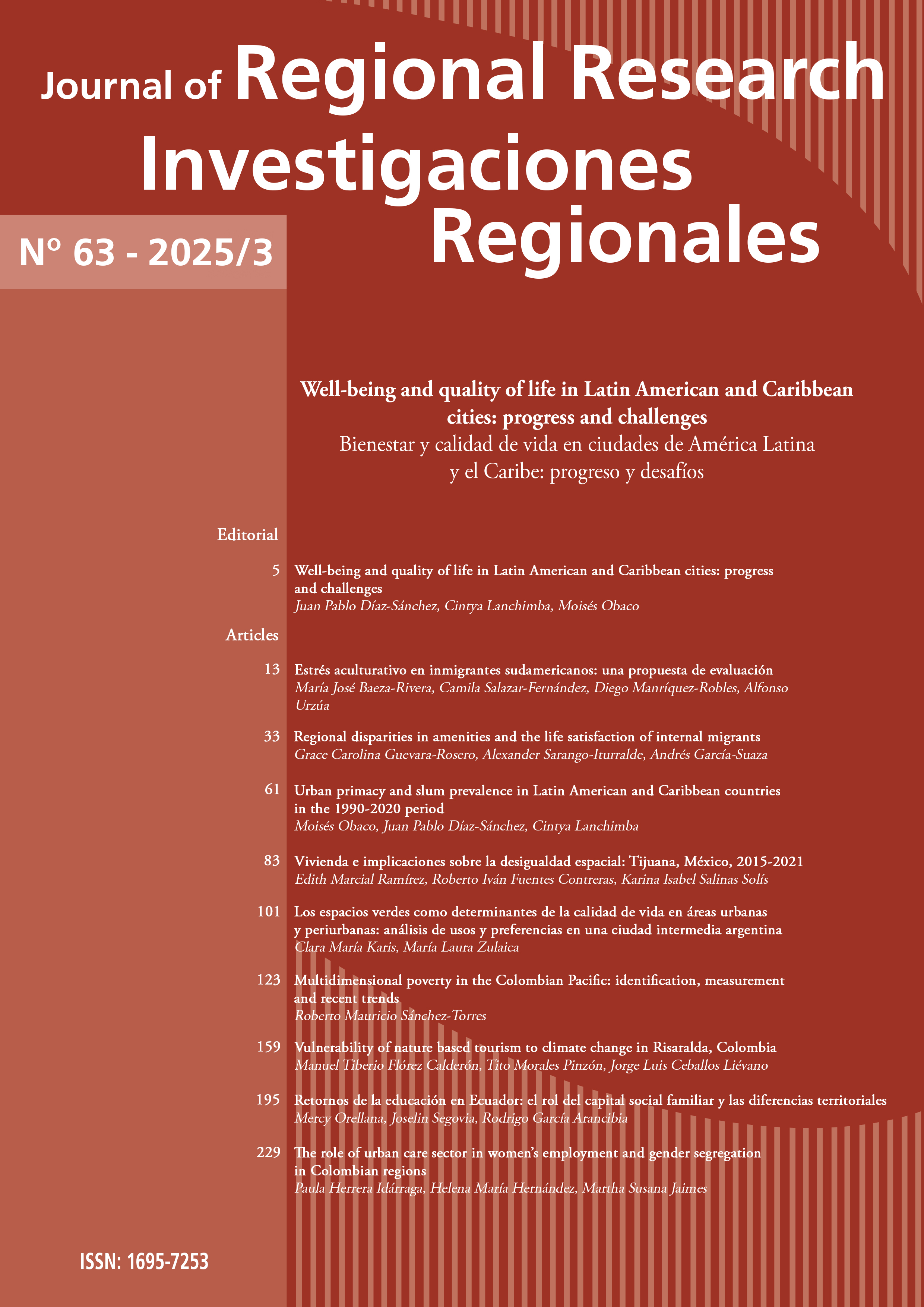
Urban primacy and slum prevalence in Latin American and Caribbean countries in the 1990-2020 period
DOI:
https://doi.org/10.38191/iirr-jorr.24.052Keywords:
Slums, Latin America, urban primacy, panel data, urbanizationAbstract
Slums are a global concern due to their impact on urban health and urban planning. Although Latin America and the Caribbean is one of the most urbanized developing regions, slums are still a significant concern. However, most studies have concentrated on a single city, using a sample of Latin American and Caribbean (LAC) countries or treating the region as one unit to analyze income inequality and urban primacy. Here, we present an analysis of the relationship between slums and urban primacy for LAC countries for the 1990–2020 period, controlling for GDP per capita and public spending on housing. In addition, we model the relationship between slums and demographic variables such as the fertility rate, migration rate, and urbanization. e analysis is based on panel data from the World Bank and e Economic Commission for Latin America and the Caribbean (ECLAC). During the period of study, a clear positive relationship is evident between urban primacy in the largest city and the slum rate in each LAC country. However, a high level of heterogeneity is observed in this relationship and our model explains the variation in the slum rate within countries better than the variation between countries.
Downloads
Published
Issue
Section
License
Copyright (c) 2024 Moises Obaco, Juan Pablo Díaz-Sánchez, Cintya Lanchimba

This work is licensed under a Creative Commons Attribution-NonCommercial 4.0 International License.
Aquellos autores/as que tengan publicaciones con esta revista, aceptan los términos siguientes:
En el momento de aceptar la publicación de sus artículos en Investigaciones Regionales / Journal of Regional Research, los autores acceden a utilizar la licencia Creative Commons CC BY-NC. IIRR/JRR es una revista abierta que permite a los autores retener el máximo control sobre su trabajo. Los autores aceptarán utilizar la licencia Creative Commons Attribution-NonCommercial. Esta licencia permite a cualquier persona copiar y distribuir el artículo con propósitos no comerciales, siempre y cuando se atribuya adecuadamente la atribución del trabajo a la revista y a los autores.
