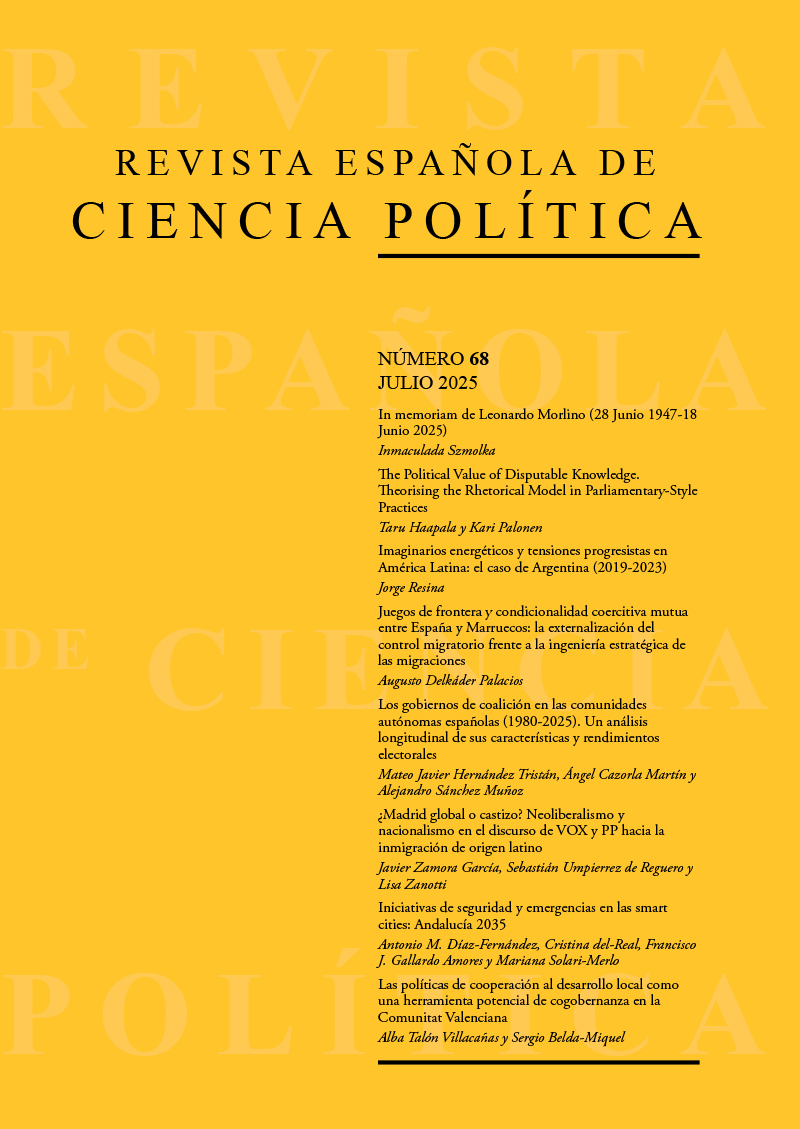
The Political Value of Disputable Knowledge. Theorising the Rhetorical Model in Parliamentary-Style Practices
DOI:
https://doi.org/10.21308/recp.68.01Keywords:
Political theory, Political knowledge, Debate, Scholarship and politics, Parliamentary practiceAbstract
In this article, the value of knowledge in politics is re-examined from the perspective of the rhetorical tradition. This alternative model contends that, unlike the assumptions made by such influential strands of scholarship as epistemic governance and knowledge brokerage, the disputability of knowledge derives from both the political actor(s) and their audience(s). Following the precepts of this model, the aim is to re-visit political knowledge, while acknowledging the procedures and practices of public debate from opposing points of view. Our research approach is to discuss the ideas of the model’s two major proponents in political theory, Max Weber and Quentin Skinner, who both consider knowledge in politics in terms of interventions in debate. The main finding is that both authors regard ‘knowledge’ either as new arguments contributing to an existing debate or as rhetorical moves to pursue new directions for debate. We examine this debate model of knowledge in relation to the practices of academic and parliamentary debates, the role of experts and officials in the parliamentary control practices, the rhetorical use of scientific knowledge by parliamentarians in the German Bundestag, and the role of parliamentarians as lay-scholars in the European Parliament. Finally, the debate model is applied to a case in which government officials claim to monopolise the interpretation of the existing situation, thereby restricting the extent of legitimate political discussion, resulting in the conclusion that the value of parliamentary debate is to defend the position of politicians, who should not accept any such reduction of their political responsibility.
Downloads
References
Alexander, David A. 2022. “Expertise, turnover and refreshment within the committees of the European Parliament: as much like Sisyphus pushing the boulder up the mountain as we may think?,” Journal of European Integration, 44(7): 899-917.
Bagehot, Walter. 1867/72 [2001]. The English Constitution, ed. by P. Smith. Cambridge: Cambridge University Press.
Burke, Kenneth. 1945 [1969]. A Grammar of Motives. Berkeley: University of California Press.
Burkhardt, Armin. 2003. Das Parlament und seine Sprache. Studien zu Theorie und Geschichte parlamentarischer Kommunikation. Tübingen: Niemayer.
Burris, Beverly H. 1993. Technocracy at Work. Albany, NY: State University of New York Press.
Cohn-Bendit, Daniel and Guy Verhofstadt. 2012. For Europe! Manifesto for a postnational revolution in Europe. Munich: Carl Hanser Verlag.
Collingwood, Robin George. 1939 [1978]. An Autobiography. Oxford: Clarendon Press.
Crewe, Emma. 2015. The House of Commons, an Antropology of MPs at Work. London: Bloomsbury.
Elomäki, Anna and Taru Haapala. 2024. “Politics of expertise in the European Parliament: discursive constructions and contestations of expertise by party-political actors”, Journal of European Integration, 46(3): 321-339.
Engels, Friedrich. 1878 [1948]. Herrn Eugen Dührings Umwälzung der Wissenschaft. Bücherei des Marxismus-Leninismus, 3. Berlin: Dietz. https://nbn-resolving.org/urn:nbn:de:0168-ssoar-59814-6
Evans, Paul. (ed.) 2017. Essays on the History of Parliamentary Procedure. London: Bloomsbury.
Griffith, John, Aneurin Grey and Michael Ryle. 2003. Parliament: Functions, Practices and Procedures, 2nd edition by R. Blackburn and A. Kinnon. London: Sweet & Maxwell.
Ilie, Cornelia (ed.) 2010. European Parliaments under Scrutiny. Discourse strategies and interpretative Practices. Amsterdam: Benjamins.
Kauppi, Niilo and Kari Palonen. 2022. Introduction, in Niilo Kauppi and Kari Palonen (eds) Rhetoric and Bricolage in European Politics and Beyond: The Political Mind in Action. Cham: Palgrave Macmillan: 1-10.
Koselleck, Reinhart. 1979. Vergangene Zukunft. Frankfurt/M: Suhrkamp.
Martini, Carlo, Davide Battisti, Federico Bina and Monica Consolandi. 2022. “Knowledge Brokers in Crisis: Public Communication of Science During the COVID-19 Pandemic,” Social Epistemology, 36(5): 656-669.
May, Thomas Erskine. 1883. A Treatise on the Law, Privileges, Proceedings and Usage of Parliament. 9th edition. London: Butterworths.
Melchor, Lorenzo, Carolina Cañibano, Kristian Krieger and José Real-Dato. 2024. The Spanish scientific and technical advisory ecosystem for public policy. Luxembourg: Publications Office of the European Union. https://data.europa.eu/doi/10.2760/452411
Merkel, Wolfgang. 2023. Im Zwielicht. Zerbrechlichkeit und Resilienz der Demokratie im 21. Jahrhundert. Frankfurt am Main: Campus.
Meyer, Morgan. 2010. “The Rise of the Knowledge Broker”, Science Communication, 32(1): 118-27.
Mill, John Stuart. 1859 [1991]. “On Liberty”, in On Liberty and other writings. Stefan Collini (ed). Cambridge: Cambridge University Press: 1-115.
Ministry of Finance (Finland). 2022. Uudistuva ja kestävä Suomi: Valtiovarainministeriön virkamiespuheenvuoro 2022 [An innovative and sustainable Finland: Outlook review by officials at the Ministry of Finance]. Publications of the Ministry of Finance, 2022: 77, Helsinki. Accessed on 19 February 2024: http://urn.fi/URN:ISBN:978-952-367-205-5
Mormina, Maru. 2022. “Knowledge, Expertise and Science Advice During COVID-19: In Search of Epistemic Justice for the ‘Wicked’ Problems of Post-Normal Times”, Social Epistemology, 36(6): 671-85.
Morrison, Herbert. 1954. Government and Parliament. A survey from the inside. Oxford: Oxford University Press.
Palonen, Kari. 2010. ”Objektivität” als faires Spiel. Wissenschaft als Politik bei Max Weber. Baden-Baden: Nomos.
Palonen, Kari. 2014. The Politics of Parliamentary Procedure. The formation of the Westminster procedure as a parliamentary ideal type. Leverkusen: Budrich.
Palonen, Kari. 2021. Politik als parlamentarischer Begriff. Perspektiven aus den Plenardebatten des Deutschen Bundestags. Leverkusen: Budrich.
Redlich, Josef. 1905. Recht und Technik des Englischen Parlamentarismus. Leipzig: Duncker & Humblot.
Rorty, Richard. 1982. Consequences of Pragmatism: Essays, 1972-1980. Minneapolis: University of Minnesota Press.
Santillán-García, Azucena, E Oliver, Grigorian Shamagian L, Climent AM, Melchor L. 2021. [#CienciaenelParlamento: the need for a parliamentary office of science and technology advice]. Gaceta Sanitaria, 35(3):293-297. DOI: 10.1016/j.gaceta.2019.08.004.
Selinger, William. 2019. Parliamentarism: From Burke to Weber. Cambridge: Cambridge University Press.
Siefken, Sven T. 2018. Parlamentarische Kontrolle im Wandel. Baden-Baden: Nomos.
Skinner, Quentin. 1969. “Meaning and Understanding in the History of Ideas,” History and Theory, 8: 3-53.
Skinner, Quentin. 1999. “Rhetoric and Conceptual Change,” Finnish Yearbook of Political Thought, 3: 60-73, https://journal-redescriptions.org/articles/abstract/10.7227/R.3.1.5/
Skinner, Quentin. 2008a. Hobbes and Republican Liberty. Cambridge: Cambridge University Press.
Skinner, Quentin. 2008b. Quentin Skinner Interviewed by Alan Macfarlane, 10 January 2008, http://www.alanmacfarlane.com/DO/filmshow/skinnertx1.htm
Skinner, Quentin. 2014. Forensic Shakespeare. Oxford: Oxford University Press.
Skinner, Quentin. 2018. From Humanism to Hobbes. Cambridge: Cambridge University Press.
Steiner, Jörg, André Bächtiger, Marcus Spröndli and Marco R. Steenbergen. 2004. Deliberative Politics in Action. Analysing parliamentary discourse. Cambridge: Cambridge University Press.
UK Parliament. 2019. Erskine May’s treatise on the law, privileges, proceedings and usage of Parliament (25th edition, 2019), online and free to use. http://erskinemay.parliament.uk
in ‘t Veld, Sophie. 2021. The Scent of Wild Animals. Self-publication. Accessed on 19 February 2024: https://www.sophieintveld.eu/nl/publicaties
Verhofstadt, Guy. 2006. The United States of Europe: A manifesto for a new Europe. London: The Federal Trust.
Weber, Max. 1904 [1973]. “Die ‘Objektivität’ der sozialwissenschaftlichen und sozialpolitischen Erkenntnis’,” in Johannes Winckelmann, (ed.), Gesammelte Aufsätze zur Wissenschaftslehre. Tübingen: Mohr: 146-214.
Weber, Max. 1917 [1984a]. “Wahlrecht und Demokratie in Deutschland,” in Wolfgang J. Mommsen and Gangolf Hübinger, (eds.), Max-Weber-Studienausgabe I/15. Tübingen: Mohr: 155-189.
Weber, Max. 1918 [1984b]. “Parlament und Regierung im neugeordneten Deutschland,” in Wolfgang J. Mommsen and Gangolf Hübinger, (eds.), Max-Weber-Studienausgabe I/15. Tübingen: Mohr: 202-302.
Weber, Max 1919 [1994a]. “Politik als Beruf”, in Wolfgang Schluchter and Wolfgang J. Mommsen (eds), Max-Weber-Studienausgabe I/17. Tübingen: Mohr: 35-88.
Weber, Max. 1994b. Political Writings, ed. by P. Lassman and R. Speirs. Cambridge: Cambridge University Press.
Weber, Max. 2004. “The ‘Objectivity’ of Knowledge in Social Science and Social Policy,” trans. by Keith Tribe, in Sam Whimster, (ed.), The Essential Weber. London: Routledge: 359-404.
Wiesner, Claudia, Taru Haapala and Kari Palonen. 2017. Debates, Rhetoric and Political Action. Practices of Textual Interpretation and Analysis. London: Palgrave Macmillan.
Wodak, Ruth and Teun A. Van Dijk (eds.). 2000. Racism at the Top. Parliamentary discourses on ethnic issues in six European states. Klagenfurt: Drava.
Published
How to Cite
Issue
Section
License
Copyright (c) 2025 Taru Haapala, Kari Palonen

This work is licensed under a Creative Commons Attribution-NonCommercial-NoDerivatives 4.0 International License.