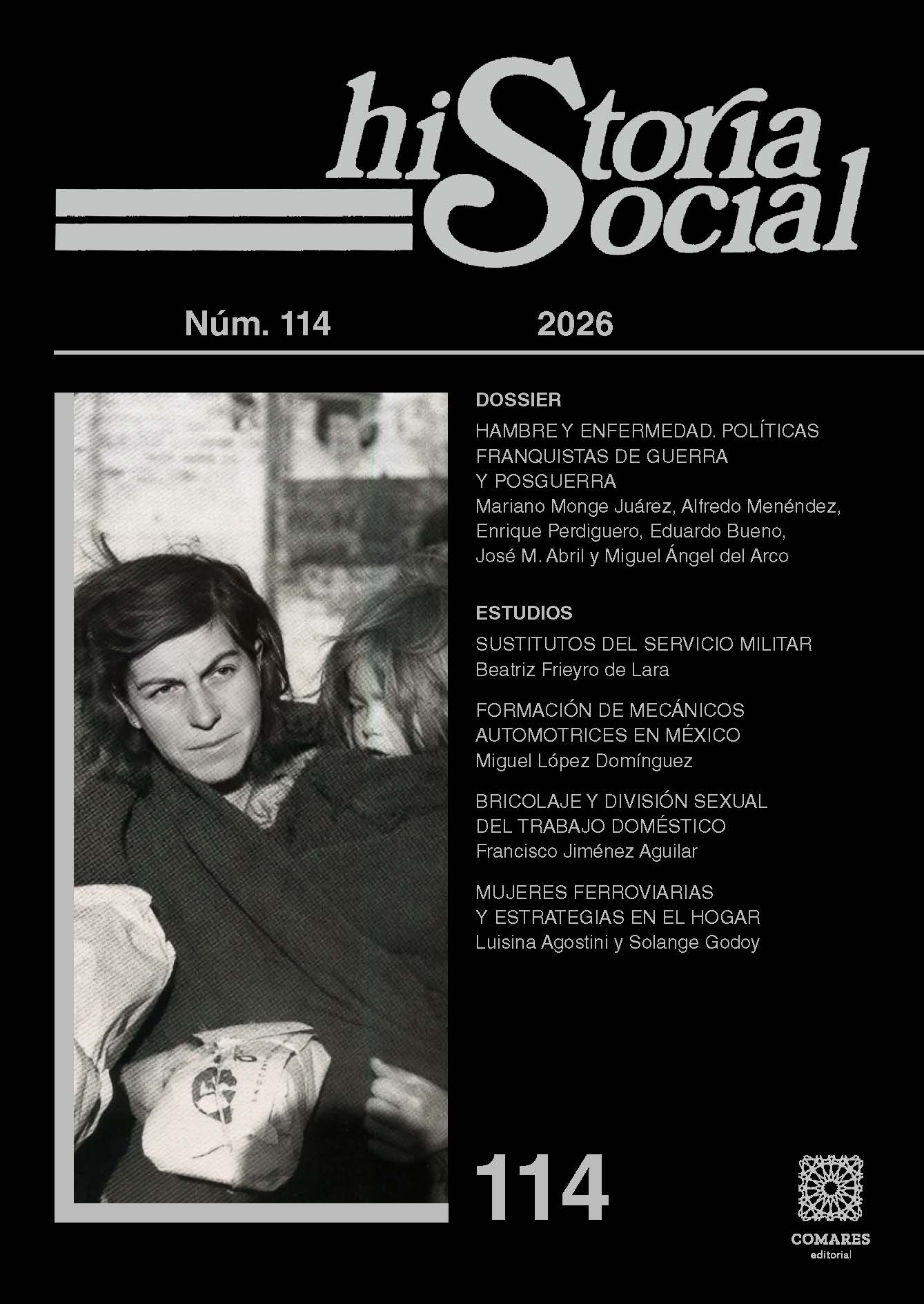
The medicalisation and pharmaceuticalisation of hunger in post-war Spain

Authors

DOI:

https://doi.org/10.70794/hs.113487

Keywords:

Hunger, Post-war Spain, Francoism, Medicalisation, Pharmaceuticalisation

Abstract

Recent historiography of hunger in post-war Spain has emphasised its use as a form of political repression and regime legitimisation. The aim of this work is to examine the processes of medicalisation and pharmaceuticalisation of hunger in this period. We analyse the medical literature on hunger produced by the working group led by Enríquez Salamanca, and we examine the role of pharmaceutical benefits provided by the National Health Insurance system to compensate for nutritional deficiencies in times of scarcity. Both processes contributed to making hunger and its social and political determinants invisible, transforming them into a biomedical and healthcare issue.
Author Biographies

Alfredo Menéndez-Navarro, Department of the History of Science, University of Granada

Professor of the History of Science at the University of Granada. My main field of research is the history of public health, especially occupational health, in which I have explored the ways of conceiving and facing the risks of respirable crystalline silica and asbestos in contemporary Spain. I have also paid attention to the history of health campaigns and healthcare during the Franco regime, exploring the role played by the Spanish newsreel NO-DO in the expansion of the hospital-centred and technified healthcare model of our time.

Enrique Perdiguero-Gil, Universidad Miguel Hernández de Elche e Instituto Interuniversitario López Piñero

Professor of the History of Science at the Miguel Hernández University in Elche and Researcher at the López Piñero Interuniversity Institute. I have dealt with various aspects of the history of public health in Spain combining historiographical and socio-anthropological approaches. I have also dedicated work to the history of healthcare pluralism. Over the last fifteen years my work has centred on the study of health and illness during the Franco era, with studies on the development of the health system, especially the compulsory health insurance, rural medicine, health education and the fight against cancer.

Eduardo Bueno Vergara, Universidad Miguel Hernández de Elche

Assistant Professor of History of Science at the Miguel Hernández University of Elche and Researcher at the López Piñero Interuniversity Institute. Bachelor's and Doctorate in History, specialising in the study of health and disease under dictatorships. My research has focused on the development of the healthcare system under Franco and, more recently, on the history of cancer during the dictatorships of Primo de Rivera and Franco. My work provides new perspectives on the relationship between science, health, disease and power in the 20th century.

Published

2026-02-03

Issue

Section

Dossier

Funding data

Similar Articles

1 2 3 4 5 > >> 

You may also start an advanced similarity search for this article.