
THE PLANNING OF THE AREA ADJACENT TO MAJOR CITY THOROUGHFARES : THE «VOIE ET VILLE» EXPERIENCE
Abstract
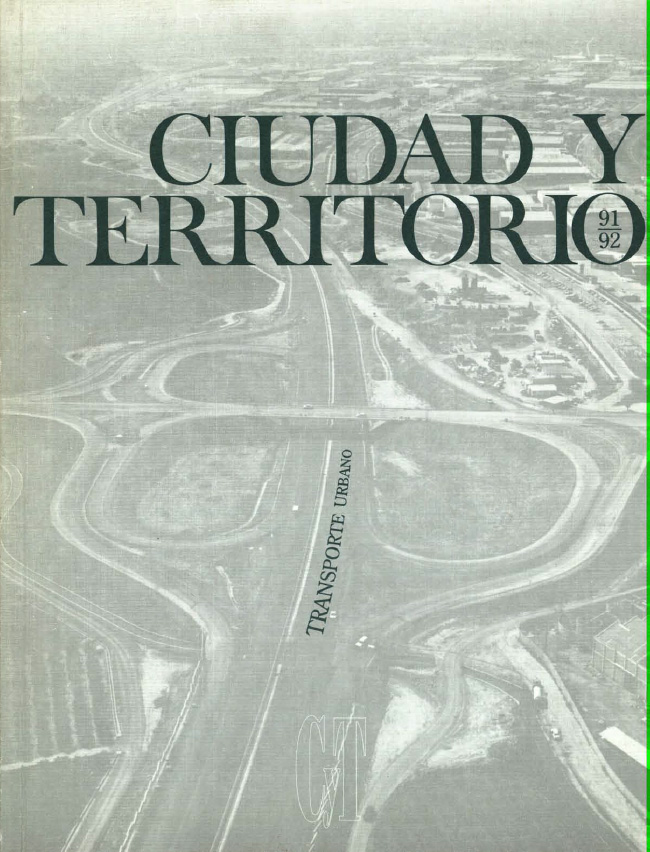
The interrelation as between the road lay-out and city space brings into play a whole series of administrative bodies at all manner of levels. The paper holds that this need to take into account the road network as within any general planning for the city also offers the chance of a specific planning for the areas borderiing uponthe system. Planning and technical problems will ari thus arise from the creation of any new route worthy of being taken to be a potentialand structure creator in the zone it crosses. In the same wise, the negative aspects of the same as to noise, walk-way disuption and the like will have to be borne in mind. Four examples of how routes can be thus planned for beyond their merely-technical object» aspect are here offered for consideration by the Interministerial Committee for the City CIV.
Downloads
Downloads
Published
How to Cite
Issue
Section
License
Copyright (c) 1992 Pierre Skriabine

This work is licensed under a Creative Commons Attribution-NonCommercial-NoDerivatives 4.0 International License.
Considering the provisions of the current legislation on Intellectual Property, and in accordance with them, all authors publishing in CyTET give -in a non-exclusive way and without time limit- to the Ministry of Transport, Mobility and Urban Agenda the rights to disseminate, reproduce, communicate and distribute in any current or future format, on paper or electronic, the original or derived version of their work under a Creative Commons Attribution-NonCommercial-NoDerivative 4.0 license International (CC BY-NC-ND 4.0), as well as to include or assign to third parties the inclusion of its content in national and international indexes, repositories and databases, with reference and recognition in any case of its authorship.
In addition, when sending the work, the author(s) declares that it is an original work in which the sources that have been used are recognized, committing to respect the scientific evidence, to no longer modify the original data and to verify or refute its hypothesis. Author(s) also declare that the essential content of the work has not been previously published nor will it be published in any other publication while it is under evaluation by CyTET; and that it has not been simultaneously sent to another journal.
Authors must sign a Transfer of Rights Form, which will be sent to them from the CyTET Secretariat once the article is accepted for publication.
With the aim of promoting the dissemination of knowledge, CyTET joins the Open Journal Access (OA) movement and delivers all of its content to various national and international indexes, repositories and databases under this protocol; therefore, the submission of a work to be published in the journal presupposes the explicit acceptance by the author of this distribution method.
Authors are encouraged to reproduce and host their work published in CyTET in institutional repositories, web pages, etc. with the intention of contributing to the improvement of the transfer of knowledge and the citation of said works.



 Enlace a CyTET en Linkedin
 Hashtag en Twitter: #RevistaCyTET