
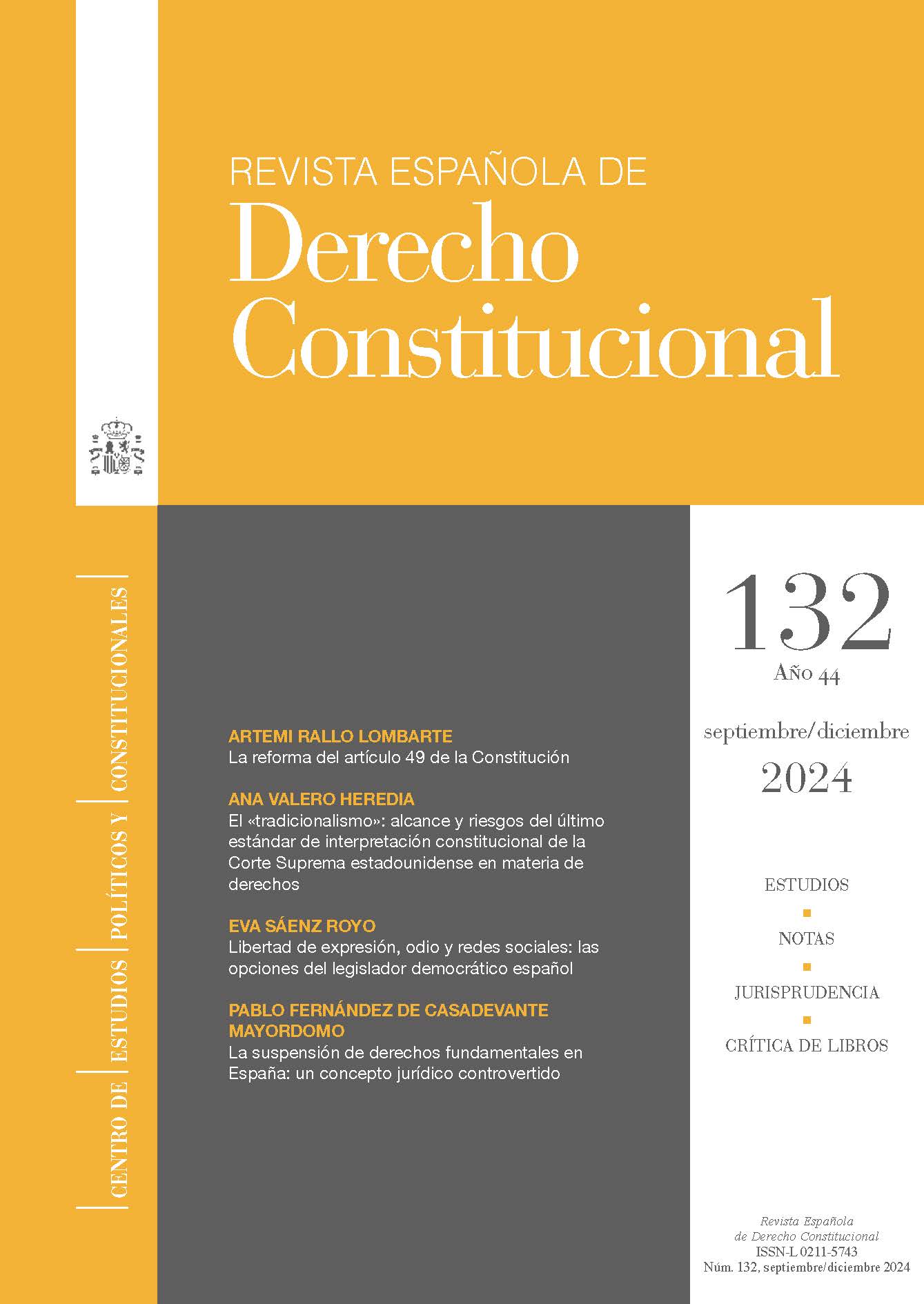
Libertad de expresión, odio y redes sociales: las opciones del legislador democrático español
DOI:
https://doi.org/10.18042/cepc/redc.132.03Resumen
La libertad de expresión y sus límites han adquirido nuevas dimensiones en la era digital. Resulta evidente que se ha ampliado el campo de acción de la libertad de expresión a través del uso de internet. Sin embargo, las ventajas de este medio van acompañadas de una serie de riesgos. Contenidos difamatorios, odiosos o violentos pueden difundirse como nunca antes por todo el mundo en cuestión de segundos y hacerse bajo la impunidad del anonimato. Esta nueva realidad ha tenido un doble efecto.
Por una parte, las instituciones públicas intentan poner límites a las expresiones de odio en las redes. A este respecto se plantea si una ley puede exigir responsabilidades a las plataformas de internet por el discurso de odio vertido por terceros o cuándo puede exigirse a esas plataformas que retiren el contenido y exigirles responsabilidad en caso de no hacerlo. Por otra parte, las grandes plataformas de internet (Twitter —ahora X—, Facebook, Instagram o Google) se han erigido en las controladoras de esas expresiones de odio creando sus propias normas para controlar el contenido que circula en ellas. A este respecto las cuestiones que se plantean es si son las plataformas digitales libres a la hora de moderar sus contenidos y la eficacia mediata o inmediata que tiene el derecho a la libertad de expresión de los usuarios respecto a estas plataformas.
Se trata de dos cuestiones complejas que exigen respuestas coherentes para ambas. Sin existir todavía en España un marco jurídico definido para estas cuestiones, en este trabajo abordaremos las posibilidades que tiene el legislador democrático español a partir de un análisis de la normativa y la jurisprudencia que sobre estas dos cuestiones se han desarrollado tanto en Estados Unidos como en la Unión Europea
Descargas
Publicado
Cómo citar
Número
Sección
Licencia
En el momento en que una obra es aceptada para su publicación, se entiende que el autor cede a la REDC en exclusiva los derechos de reproducción, distribución y venta de su manuscrito para su explotación en todos los países del mundo en formato de revista de papel, así como en cualquier otro soporte magnético, óptico y digital.
Los autores cederán también a la REDC los derechos de comunicación pública para su difusión y explotación a través de intranets, internet y cualesquiera portales y dispositivos inalámbricos que decida el editor, mediante la puesta a disposición de los usuarios para consulta online de su contenido y su extracto, para su impresión en papel y/o para su descarga y archivo, todo ello en los términos y condiciones que consten en la web donde se halle alojada la obra.
A su vez, la REDC autoriza a los autores de los trabajos publicados en la revista a que ofrezcan en sus webs personales o en cualquier repositorio de acceso abierto una copia de esos trabajos una vez publicados; junto con esa copia ha de incluirse una mención específica de la REDC, citando el año y el número de la revista en que fue publicado y añadiendo el enlace a la web de la REDC.
Pasado un año desde su publicación, los trabajos de la REDC quedarán bajo la licencia de Creative Commons Reconocimiento-NoComercial-SinObraDerivada 4.0 España (CC BY-NC-ND 4.0 ES), que implica que el artículo y la nota de investigación pueda copiarse, distribuirse y comunicarse públicamente con la única restricción de que en los créditos se reconozca explícitamente al autor y la obra bajo la forma establecida por éste, sin derecho a su explotación comercial y la elaboración de obras derivadas.
Prácticas deshonestas: plagio y fraude científico
A efectos de lo estipulado en la Ley de Propiedad Intelectual respecto a las acciones y procedimientos que puedan emprenderse contra quien infrinja los derechos de propiedad intelectual, la publicación de un trabajo que atente contra dichos derechos será responsabilidad de los autores, quienes en consecuencia asumirán los eventuales litigios por derechos de autor y fraude científico.
- Presentar el trabajo ajeno como propio.
- Adoptar palabras o ideas de otros autores sin el debido reconocimiento.
- No emplear las comillas u otro formato distintivo en una cita literal.
- Dar información incorrecta sobre la verdadera fuente de una cita.
- El parafraseo de una fuente sin mencionar la fuente.
- El parafraseo abusivo, incluso si se menciona la fuente.
Las prácticas constitutivas de fraude científicoson las siguientes:
- Fabricación, falsificación u omisión de datos y plagio.
- Publicación duplicada.
- Conflictos de autoría.
