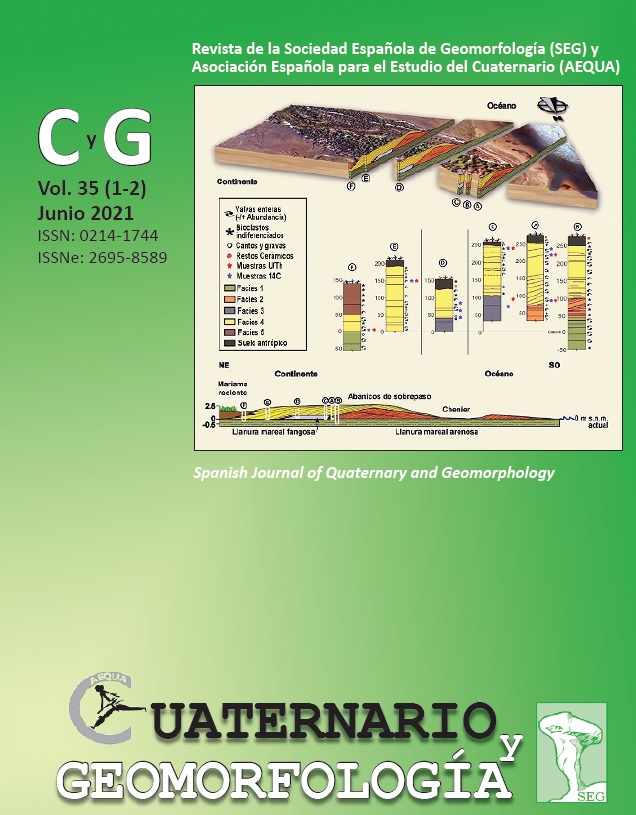
Comparison of radiometric dating in Late Holocene seashell samples: The example of the Huelva Estuary tempestites
DOI:
https://doi.org/10.17735/cyg.v35i1-2.89315Keywords:
Holocene; Tempestite; Dating; Uranium series; Radiocarbon; Huelva EstuaryAbstract
The study of the Holocene sedimentary record of the Estuary of the Tinto and Odiel rivers (Huelva) has been carried out historically by boreholes and surficial outcrops. New natural profiles on Saltés Island (La Cascajera) are offering a new perspective on the genesis and chronology of the deposits. For the temporal determination of these processes, radiometric dating was carried out by radiocarbon and uranium series analysis, being the ages of 14C are about 200 years older than those of U / Th, for the same samples. The contrast of the results of both techniques has allowed us to observe large time lags in the uranium series. Post-sedimentary contamination in these open systems has favored the rejuvenation of the age of the samples, due to the continuous contribution of 234U and 238U to the system. This highlights the inappropriateness of the U/Th method in recent estuarine sediments and, above all, highly polluted; therefore, this method shouldn't be used exclusively. The radiocarbon method seems to be more precise and adequate, always applying the pertinent regional marine calibrations (ΔR) to the conventional results, being advisable a Bayesian modeling (OxCal).
Downloads