
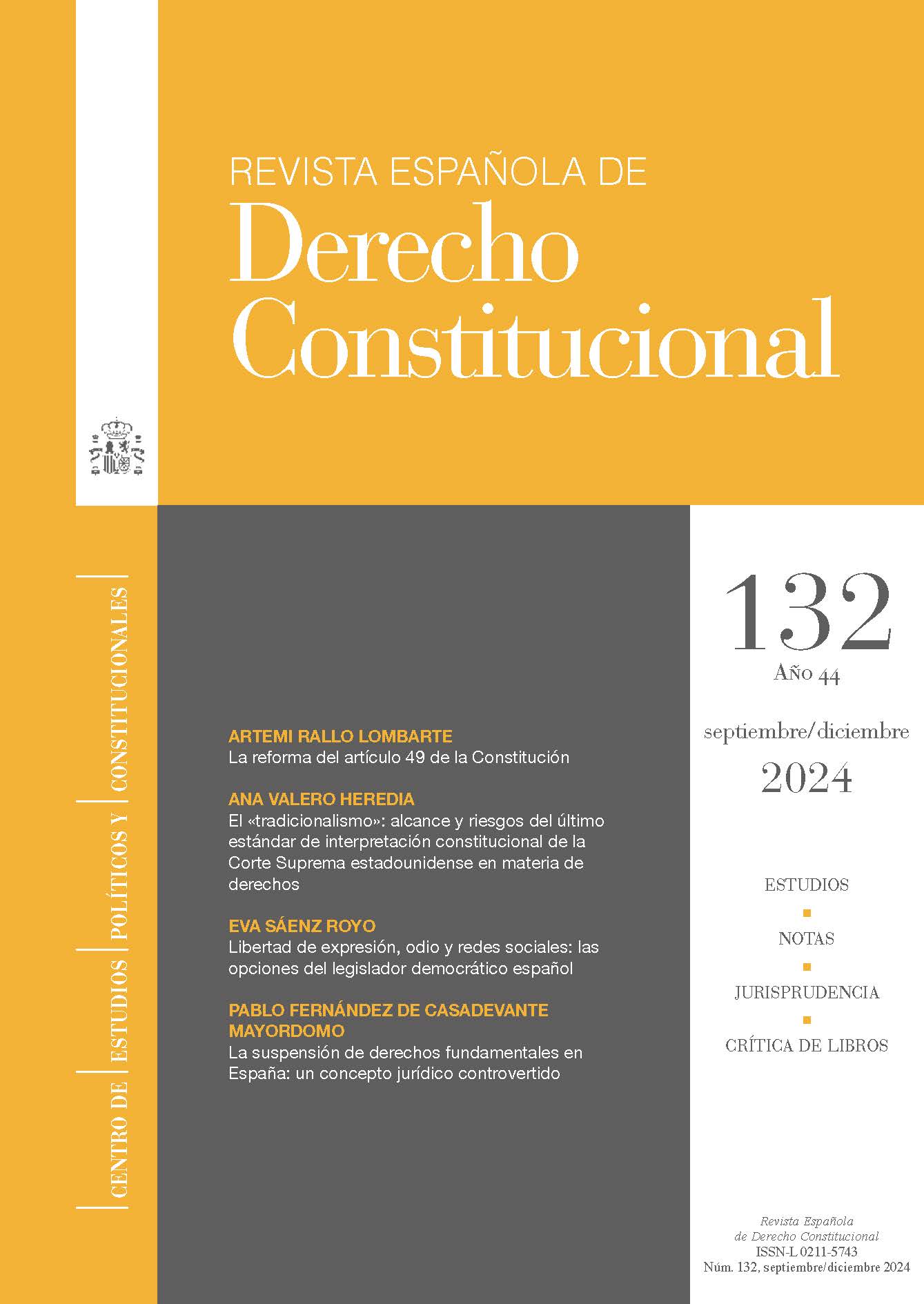
La suspensión de derechos fundamentales en España: un concepto jurídico controvertido
DOI:
https://doi.org/10.18042/cepc/redc.132.04Resum
La suspensión en materia de derechos fundamentales constituye una de las manifestaciones más habituales del derecho de emergencia constitucional de cualquier país, algo que queda igualmente reflejado en la Constitución de 1978. En concreto, en forma de un art. 55 concebido para hacer frente a peligros que van desde las alteraciones del orden público más graves —art. 55.1 CE— hasta ciertas investigaciones en materia eminentemente antiterrorista —art. 55.2 CE—.
En todos esos casos, la eficacia en la respuesta deberá ir de la mano de un
garantismo para modular en función de las medidas adoptadas, tarea especialmente compleja si hablamos de suspensiones generales impuestas ante emergencias
Descàrregues
Les dades de descàrrega encara no estan disponibles.
Publicades
2024-12-05
Com citar
Fernández de Casadevant, P. e . (2024). La suspensión de derechos fundamentales en España: un concepto jurídico controvertido. Revista Española De Derecho Constitucional, (132), 105–134. https://doi.org/10.18042/cepc/redc.132.04
Número
Secció
ESTUDIOS
Llicència
En el momento en que una obra es aceptada para su publicación, se entiende que el autor cede a la REDC en exclusiva los derechos de reproducción, distribución y venta de su manuscrito para su explotación en todos los países del mundo en formato de revista de papel, así como en cualquier otro soporte magnético, óptico y digital.
Los autores cederán también a la REDC los derechos de comunicación pública para su difusión y explotación a través de intranets, internet y cualesquiera portales y dispositivos inalámbricos que decida el editor, mediante la puesta a disposición de los usuarios para consulta online de su contenido y su extracto, para su impresión en papel y/o para su descarga y archivo, todo ello en los términos y condiciones que consten en la web donde se halle alojada la obra.
A su vez, la REDC autoriza a los autores de los trabajos publicados en la revista a que ofrezcan en sus webs personales o en cualquier repositorio de acceso abierto una copia de esos trabajos una vez publicados; junto con esa copia ha de incluirse una mención específica de la REDC, citando el año y el número de la revista en que fue publicado y añadiendo el enlace a la web de la REDC.
Pasado un año desde su publicación, los trabajos de la REDC quedarán bajo la licencia de Creative Commons Reconocimiento-NoComercial-SinObraDerivada 4.0 España (CC BY-NC-ND 4.0 ES), que implica que el artículo y la nota de investigación pueda copiarse, distribuirse y comunicarse públicamente con la única restricción de que en los créditos se reconozca explícitamente al autor y la obra bajo la forma establecida por éste, sin derecho a su explotación comercial y la elaboración de obras derivadas.
Prácticas deshonestas: plagio y fraude científico
A efectos de lo estipulado en la Ley de Propiedad Intelectual respecto a las acciones y procedimientos que puedan emprenderse contra quien infrinja los derechos de propiedad intelectual, la publicación de un trabajo que atente contra dichos derechos será responsabilidad de los autores, quienes en consecuencia asumirán los eventuales litigios por derechos de autor y fraude científico.
- Presentar el trabajo ajeno como propio.
- Adoptar palabras o ideas de otros autores sin el debido reconocimiento.
- No emplear las comillas u otro formato distintivo en una cita literal.
- Dar información incorrecta sobre la verdadera fuente de una cita.
- El parafraseo de una fuente sin mencionar la fuente.
- El parafraseo abusivo, incluso si se menciona la fuente.
Las prácticas constitutivas de fraude científicoson las siguientes:
- Fabricación, falsificación u omisión de datos y plagio.
- Publicación duplicada.
- Conflictos de autoría.
