Artículos / Articles
DOI: 10.22325/fes/res.2023.205
Departamento de Teoría, Metodología y Cambio Social,
Universidad Nacional de Educación a Distancia (UNED), España. lcamarero@poli.uned.es.
Departamento de Sociología y Trabajo Social, Universidad Pública de Navarra, España.
mariajesus.rivera@unavarra.es.
Revista Española de Sociología (RES), Vol. 33 Núm. 1 (Enero - Marzo, 2024), a205. pp. 1-17. ISSN: 1578-2824
Received / Recibido: 21/11/2022
Accepted / Aceptado: 29/08/2023
Suggested citation / Sugerencia de cita: Camarero Rioja, L. A., y Rivera Escribano, M. J. (2024). Demographic challenge, migration and settlement of young rurals. Revista Española de Sociología, 33(1), a205. https://doi.org/10.22325/fes/res.2023.205
ABSTRACT
In analysing rural depopulation, concerns about population loss have contributed to neglecting the newcomers to rural areas, namely those who fall under the category of new rural residents. The aim of this paper is therefore to examine the current demographic challenges facing rural areas, from this dual perspective. To achieve this, the paper briefly outlines the context of rural settlement by looking at the cycles of settlement and depopulation. It also highlights some of the population changes that have taken place in Spain in recent years; using data from the Residential Variation Statistics and the Official Register of Inhabitants. The paper looks specifically at young adults, as they represent a key population group, so as to better understand the demographic challenge and vulnerability of rural areas. The main findings show that the lack of a young population is linked to fertility trends. In fact, data from censuses and official registers show that migratory flows lead to a positive balance, in the case of young adults and increased heterogeneity within the group, even if in absolute terms there is still an over-aged rural population. Finally, after the analysis, the paper discusses whether rural areas can facilitate the settlement of a diversity of new residents, as this is a key issue when rethinking social sustainability policies for rural areas.
Keywords: Rural depopulation, demographic challenge, rural young, rural rooting.
RESUMEN
La preocupación sobre la pérdida de población rural ha hecho que los estudios apenas aborden la cuestión de quiénes son los que llegan, los denominados de forma genérica nuevos residentes. Con este propósito, contextualizaremos brevemente la cuestión del poblamiento rural en cuanto ciclos de poblamiento y despoblamiento y destacaremos algunos de los cambios poblacionales acaecidos en las zonas rurales en los últimos años a partir de los datos de la Estadística de Variaciones Residenciales y los Padrones Continuos. En este recorrido nos detendremos en un grupo clave: los jóvenes adultos, también denominados tardo-jóvenes. El seguimiento de las tendencias migratorias de este grupo resulta crucial para la comprensión del reto demográfico y de vulnerabilidad al que se enfrentan las áreas rurales. Los principales resultados señalan que la falta de jóvenes tiene que ver con las tendencias de la fecundidad y que precisamente, según desvelan los datos de las series censales y padronales, los flujos migratorios generan saldos positivos para los grupos de jóvenes rurales -tanto por la llegada de jóvenes urbanos como por la entrada de población joven extranjera- a la vez que se incrementa la diversidad poblacional por origen. Sin embargo, estos flujos son incapaces de trastocar el sobre-envejecimiento rural. Finalmente, después del análisis abriremos el debate sobre la capacidad de las áreas rurales para favorecer el arraigo de la diversidad de procedencia de nuevos residentes, cuestión muy relevante a la hora de repensar el proceso de políticas de sostenibilidad social de las áreas rurales.
Palabras clave: Despoblación rural, reto demográfico, jóvenes rurales, arraigo rural.
If there is currently one topic about the rural world that is the main subject of academic and media interest, political agendas and public opinion, it is the depopulation process which certain rural areas are undergoing. Issues such as the demographic challenge, the vulnerability of territories, or rural sustainability have been incorporated into the language to show the difficulties that certain villages and small municipalities are facing in order to provide a stable framework of life that guarantees well-being and social sustainability. Depopulation, understood as the loss of population volume, although more pronounced in Spain and in Mediterranean zones, is affecting European societies as a whole. (European Observation Network for Territorial Development and Cohesion [ESPON], 2018). From the institutions themselves, the difficulties endured by certain areas with a low population density in permanently fixing their population to the territory have already been recognised. In this sense, work is in progress on the need to promote social and territorial structuring (Economic and Social Council, 2018; Spanish Ministry for Territorial Policy and Public Function, 2019).
The concern for rural depopulation is today the object of intense political actions regarding the National Strategy against the Demographic Challenge by the Ministry for Territorial Policy and Public Function (2019). This consists of a plan containing some 130 measures that have been laid down by the Ministry for Ecological Transition and Demographic Challenge (2020), in an attempt to address the different difficulties that rural territories experience from different settings and to set out priority lines of action to ensure more cohesive rural territories committed to the future (Gómez Benito and Moyano, 2021). This same concern has been transferred to the differing regional strategic plans being drawn up in many Autonomous Communities these years 1 .
The depopulation process, in certain locations, exists alongside the arrival of new residents. Although this arrival in itself is unlikely to redress a situation that has been building up over time, it does suppose a decisive element for demographic revitalisation, for human capital and for economic activities in scarcely populated rural areas. Thus, the new rural residents, beyond the evident effect of adding numbers to the population and supporting the maintaining of certain services (schools, health centres etc.), can develop new economic activities and services, establish new neighbourly networks, incorporate new values and customs and generate new frameworks that are favourable to innovation. (Rivera, 2021). Under this premise, attracting new residents represents an important strategic action to slow down or halt the depopulation rates in certain rural areas.
Nevertheless, this arrival of new residents does not always imply long-term or definitive settlement, but rather involves a high degree of volatility (Rivera, 2021), or simply represents a way station as happens time and again with people who have recently arrived from abroad (Camarero et al., 2013). That is to say that if the new residents do not find a place which can fulfil their expectations regarding the location and developing their life project -whether it be economic, work or lifestyle etc.-they will find themselves facing a vital dilemma: adapt their expectations to the reality that they have found and persist in rooting by means of different processes (Halfacree and Rivera, 2012), or they will leave the place when circumstances allow. Knowledge of the motivation behind their arrival and some of the critical elements when establishing themselves permanently may provide different keys to be considered when designing policies aimed at attracting and settling the population in rural areas that are suffering from depopulation.
The profound global economic crisis of 2008 hit rural areas particularly intensely. It caused a major drop in employment -unemployment rates exceeded 25% for Spain as a whole - with cutbacks in social protection and assistance which contributed to the net outflow of population from rural areas and to the delay in family reunification in the case of the immigrant population. In short, trajectories for the population to potentially take root were altered.
The impact of that crisis shaped the image of depopulation through its intense but short-lived effects. Publication of the book España Vacía [Empty Spain] by Sergio del Molino (2016), at a time when the demographic decline -both natural as well as migratory- of rural areas was at its most intense (Camarero, 2020) constituted the milestone that drove depopulation into the political arena. In that context of “emptiness” the idea of the extinction of small municipalities gained popularity in the media (Collantes and Pinilla, 2019). In the midst of these debates, this idea was adopted by public administrations to interpret this rural depopulation as a demographic challenge to be addressed. A challenge that was crystallised in a scenario in which the effects of this rural exodus, but also the drop in fertility and the major ageing of the population, generated strong imbalances in the generational composition of rural areas which seemed doomed to extinction.
The present paper focuses on the migratory behaviour of rural young adults, as a particularly relevant group when population dynamics are analysed, and their impact on the rural world. The exodus of rural young people is a constant that is added to the view of generational emptying projected by society on rural areas. However, important influxes of population into rural areas have been observed throughout the 21st century; these have to a certain extent compensated the secular exodus of the young adults. This article seeks to determine the possible contribution of the incoming population both as a result of internal migrations as well as transnational flows and their hypothetical effect as a brake on youth departure. The aim is to delve into the question as to the effect that the arrival and possible settling of new young residents - both exurban as well as foreign persons - has on groups of young adults in depopulated rural areas. This process of arrival and establishing roots supposes, on the one hand, the arrival of a population that is, generally speaking, nearing the moment to have a family and with a life project that goes beyond their immediate situation. On the other hand, in the light of the characteristic ageing of rural areas facing depopulation, this group of new residents can drive innovative activities and projects which in turn can facilitate social change processes in the area.
The first section covers the dynamism of population flows and migratory balances in rural areas, in which the main trends of the rural exodus from the 20th century to the present day are presented. This shows the growing demographic dependence of rural areas with respect to immigration frows from abroad. The second section then provides specific analysis of the migratory behaviour of young adults as a particularly important group and the effects, in terms of attraction and expulsion from rural areas, of the 2008 and 2019 crises. Finally, conclusions are presented in order to point out possible areas of action to facilitate the permanent settlement of young people in rural areas that face special vulnerability.
The statistical analysis carried out is based on the main demographic sources elaborated by the Spanish National Statistics Institute (INE) for the whole of Spain: continuous census data, residential variations statistics and the recent Population Census from 2021. As far as possible, small-sized population strata have been used in order to differently consider those strata of municipalities with fewer than 1,000 inhabitants where depopulation processes reach greater values. In the case of long historical series from the Residential Variations Survey it was not possible to distinguish the stratum of fewer than 10,000 inhabitants, given that the INE does not publish them in a differentiated manner, to ensure statistical secrecy.
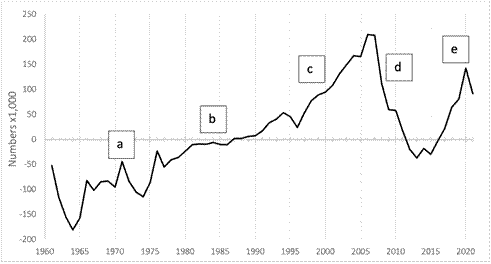
The Residential Variations Statistics compile all the changes of address that are registered year by year and this enables the trend and evolution of migratory balances in rural areas to be clearly observed. Figure 1 shows these balances by habitat size stratum from the middle of the last century through to 2021. Several sequences of cycles of demographic losses and gains can be distinguished for the small municipalities:
The well-known rural exodus of the 1960s and its progressive slowing until the early 1980s with a change of trend in which the inflows of population progressively dominated over the outflows from rural areas.
During the 1980s, in parallel with its entry into the European Union, Spain underwent a counterurbanization process that entailed residential transformation and restructuring of rural economies at the end of the 20th century. Outflows and inflows progressively counterbalanced each other until they ultimately reflected positive balances.
The acceleration of demographic growth owing to the influx of immigrants in the early years of the 21st century.
The effects of the so-called Great Depression of 2008 which halted inflows and led to the return to negative migratory balances until the end of the 2010s, when growth due to immigration returned.
The population recovery episode accelerated due to the effect of the pandemic. Inflows to municipalities of fewer than 10,000 inhabitants reached their peak in 2020, when the greatest effects of the pandemic were felt, and residential expectations were reoriented.
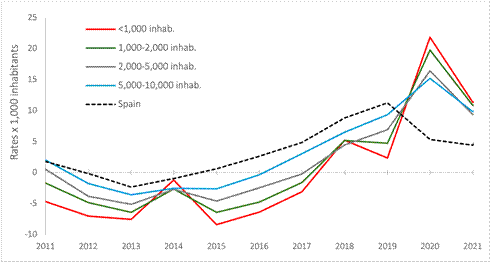
For the last decade (2011-2021) it was possible to more accurately differentiate the migratory balances by population size strata for small municipalities. Figure 2 enables us to observe the period between the two crises of 2008 and 2019 in greater detail. The demographic effect of the Great Recession can be more clearly appreciated in the smaller sized municipalities. Comparatively, a delay of around two years can be seen in those municipalities with fewer than 5,000 inhabitants in recovering positive migratory balances. However, the effect of rural population growth caused by the pandemic moved in the opposite way, with the smallest municipalities being those that experienced the most intense growth. The effects of this will be dealt with later, in the second section, from the study of the population composition by birthplace and generation.
Figure 1 Migration balances 1961-2021 in municipalities with fewer than 10,000 inhabitants
Source: Residential Variations Statistics. INE. Own elaboration.
In the mid-1950s, the rural exodus signalled the progressive movement of population from rural areas to urban environments. This process responded to the modernising economic model in which the city became the vector for economic growth and social transformation. Whilst the metropolitan phenomenon spread, rural areas were relegated to the background, with a clear lag with regard to modernisation and development processes. In contrast to the city, which was a source of employment opportunities, a centre for cultural life and the support for generalised welfare state services (schools, health centres), villages represented culturally backward places, with scant employment opportunities beyond working in increasingly mechanised farming, which was demanding less and less manual labour. (De Miguel, 1972). The rural exodus in that period was intense and very selective from the point of view of generation. It drastically altered generational balances and conditioned demographic reproduction. The roots of that demographic decline are, to a great extent, firmly placed in those years. (Camarero et al., 2009).
A new phase began at the end of the 1980s, in which there was an incipient population recovery in some rural areas that is not explained by natural population growth, but by urban inhabitants arriving in certain rural areas in a movement resembling the counterurbanisation already previously seen in other neighbouring countries (Camarero, 1993; Champion, 1989; Fielding, 1982; Kontuly, 1998). That moment coincided with Spain’s entry into the European Economic Community, as it was known at the time, and which enabled the establishment of rural development programmes seeking to integrate the de-agrarianised rural world into economic activity as a whole. This led to a major transformation of rural activities, moving away from merely agricultural production towards the integration of environmental, tourism and quality food processing services. Thus, a new rural medium started to take shape, one which was less peasant, more multi-functional and linked to a new economy of signs (Lash and Urry, 1994). The natural parks or zones of special relevance in matters of biodiversity (at different levels) that were established began to attract new visitors who, in turn, required service facilities (hotels and rural houses, restaurants, café bars, etc.). What had previously been a medium suffering from ongoing abandonment and which was barely valued initiated a transformation into a medium with a high landscape and identity value and which was attractive to certain population groups. This transformation is part of a global change in which nature has begun to be valued differently (Shucksmith, 2018), with the “authentic” and artisan become rising values with major symbolic power.
Figure 2 Details of the migratory balances for 2011-2021 by strata of municipality size
Source: Residential Variations Statistics. INE. Own elaboration.
This transformation of the rural setting did not just convert it into a new rural tourism space, but, as seen in other neighbouring countries, the urban inhabitants also “discovered” the rural setting as a residential destination and thus a counterurbanisation trend developed. This trend was initially associated with a professional middle class that could even commute to work in the city yet reside in the countryside at the end of their working day (Brown et al., 2015). Nevertheless, as different studies started to expand their view, it was observed that the profile of these new rural residents was broadening to different profiles: retired people, commuters, neo-rural dwellers… (Phillips et al., 2020; Rivera, 2007).
The population exoduses in the 1960s and 1970s and the influxes at the end of the last century and start of the present century configured a rural population which was not necessarily native to the areas. According to the 2022 census, using data as of 1 January, 48% of those living in municipalities with fewer than 1,000 inhabitants were born in municipalities from the same population stratum. This figure indicates that approximately half of the inhabitants (52%) residing in those small municipalities had come from other places. If we contrast that data with larger sized municipalities (>30,000 inhabitants) we can see that 68% of their inhabitants were born in those municipalities (table 1). This means that there are proportionally more local people among the people living in large municipalities than among those living in small municipalities.
The result is quite the opposite to what we would have expected under the hypothesis of the transfer of the rural population to urban locations. The data show that contrary to the idea-force of rural emptying there are in fact rural areas that experienced the arrival of population from differing origins and, consequently, also a growing social heterogeneity.
Table 1 Persons born in and residents by population size stratum of the municipality.
Although the counterurbanisation trend started in the past century and has continued into the 21st century, with its migration current linked to the search for and expression of a particular life style (Benson and O’Reilly, 2009; Benson and Osbaldiston, 2016), nowadays it is joined by the incorporation of foreign people who find work in the agricultural sector, in construction, or in the care economy. The foreign population, due to its sheer size and its young profile and being of a more family and natalist nature, becomes a key group when it comes to reducing the effects of the demographic winter (Sampedro and Camarero, 2020).
These data indicate that, beneath the population outflows, there are inflows of persons and, likely associated with them, different rooting and life projects of a pro-rural nature coexist. Specifically in the context of depopulation the interest resides in knowing, in addition to the processes of the autochthonous population remaining in the place, the processes of taking roots of those persons arriving in the rural setting driven by different motivations. Thus, whilst some villages lose population, others will be becoming the destination of professional urban classes seeking a more amenable way of life, but also the attraction of young people searching for new life projects, as well as an immigrant population seeking to make a livelihood.
Their motivations are diverse and very often they have more than one. Different territories attract different profiles of new residents. If at one extreme of pragmatism and need we find a foreign population that finds rural municipalities as an arrival point in the country where they can access niches in the job market linked predominately to farmwork, care, and hospitality (Sampedro and Camarero, 2019), at the other extreme we have an ex-urban population whose motivations are linked to finding a vital connection with nature and a lifestyle change guided by an idealised representation of nature and life in a rural environment (Rivera, 2007; Guirado, 2011). A series of elements are observed between both extremes that are present in the majority of cases, such as the desire to have a better quality of life, distancing from the city and the urban discomfort encountered on a daily basis (in the case of commuters), and access to more affordable housing under certain circumstances, etc.
Along with these diverse motivations and expectations regarding the type and conditions of life sought by the new residents in the rural environment, the expectations themselves can vary as time passes and needs change, especially those linked to life cycles, when expectations and the reality found do not require adjustment (Halfacree and Rivera, 2012).
In the case of young adults, the difficulties that they face to settle may be related to their ability to access affordable housing in settings that are undergoing gentrification or elitisation (Solana, 2006; Guirado, 2011), but also with the achievement or not of some of the motivations that drove their departure from the city to the village. Amongst these, the main reasons are the lack of economic resources and administrative help to set up the businesses that they had in mind, as well as the difficulty in creating a relational environment beyond the new residents. The need for a relational environment can be particularly burdensome in the case of small enclaves with highly aged populations, specifically due to the lack of young people. But adaptation issues are also relevant to the setting with sociocultural idiosyncrasy which may prove vastly different to their own (Rivera, 2021). For the case of the young immigrant population, their opportunities to settle are related to the labour market, but also to family strategies and the opportunity for family reunification (Sampedro and Camarero, 2019).

The force of the young adults’ exodus from rural areas paradoxically increases the interest in studying those groups of young adults who arrive. In the context of depopulation, not only the permanence of people but especially the juvenilising of the population is key to maintaining rural birthrates and the economic dynamism of rural areas in the short term. The group of those aged 25-34 years has been chosen as the control group for studying migratory behaviour. Such a choice is driven by the mean age of youth emancipation in Spain, which is at 29.8 years of age (30.7 for men and 28.8 for women) 2 . This group could be denominated as late-young (Elzo, 2000). This group of young adults have finished studying and some of them have even become mothers or fathers. In rural municipalities, the mean age of mothers at the birth of their firstborn child was 32.6 years old, whilst in urban municipalities the figure was 33 years of age 3 . Analysis of residential changes focuses on the moment of emancipation and thus constitutes the best observation point for analysing potential rooting processes.
Studies have underlined the progressive absence of rural population and in particular of rural young adults. Nevertheless, if we refer to the reduced proportion of rural young adults, then the effect that it has on the population ageing process itself is not clearly considered. That is to say that the greater the weight of the elderly, the more statistically reduced the relative weight of the youngsters will be. Likewise, when we refer to the temporal evolution of the number of young adults in absolute terms, the fall in fertility is once again not intuitively considered. As a general rule, the fall in the number of young adults is attributed to the emigration of the young rural adults themselves. The raw data that are handled and which show that there are fewer young adults in the villages generate the automatic interpretation that the loss of young people is due to waves of depopulation, without distinguishing nor considering other factors. It is normal that there are proportionally fewer young adults and also in numbers, without this necessarily meaning that emigration exists. If we consider the effect of the drop in fertility, it is understandable that the birth cohorts are smaller and smaller and, consequently, the number of people in young groups will thus become smaller and smaller in the following generations.
We shall first explore the effect of the 2008 economic crisis and the 2019 health crisis in young people’s migratory flows and subsequently, we will observe their effects on the demographic structure in greater detail.
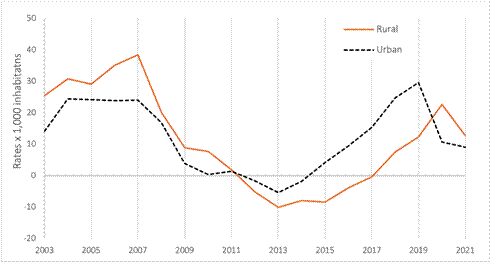
The 21st century has strung together global economic and health crises. Although those crises were vastly different, both had deep-reaching effects on social functioning. From an analytical perspective it is difficult to understand what is happening in rural areas beyond the cycles that mark these crisis periods, and which impel important migratory flows. Figure 3 shows the rupture of the 2008 crisis in terms of the migratory balance; rural attractiveness fell, especially among young adults, whilst the 2019 health crisis supposed, at least momentarily, quite the opposite effect.
The beginning of this century has seen young adults being attracted to both rural as well as to urban areas. The fact that both habitats are growing in unison indicates that the population has come from abroad. Moreover, in consonance with the growing idea of diversity, we note that from the rates the impact is proportionately greater in rural areas, where the proportion of young adults was lower. The so-called Great Recession of 2008 curtailed the migratory flow and led to a population loss in absolute terms among the young age groups 4 . The recovery of that group was slow in rural areas and did not become significant until 2018. The growth in the young population was especially notable in the months of 2020 as a consequence of residential movements opened up by the health crisis, favouring settlement as an alternative to mobility restrictions. Nevertheless, the questions that arise for the future concern how long this rural attractiveness will last and whether it will continue to be a place of residence compared to urban areas.
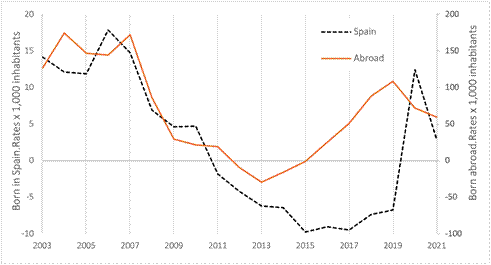
We have seen how the 2008 crisis altered the potential for establishing roots in rural areas with respect to the foreign population, which had been growing at a very high rate. We must not forget that migratory inflows have an effect, not due to their volume, but exclusively if those who arrive remain there permanently. Evidence points to two very different behaviour patterns. On the one hand, it was observed that the effect of the health crisis led to a drastic break from the trend of rural abandonment by the young persons born in Spain, a trend that may be short-lived insofar as, once the pandemic was over and without substantial changes in job markets and access to services, there are unlikely to be opportunities for greater settlement than before (Figure 4). On the other hand, the inflow of young foreigners has also slowed. For that population, which has a key role in the process of rooting population and demographic dynamisation, the health crisis broke the trend of recovery that had followed the post-economic crisis period.
The plot shows the rural population flows but does not enable us to highlight the rooting and long-term settlement processes of the population in rural areas. The 2008 crisis appears as an important breaking point and as a warning of the volatility regarding whether these new residents will remain in rural areas.
Figure 3 Rural and urban migratory flows. Population aged 25-34 years
Source: Own elaboration based on the Residential Variations Statistics and continuous census records. INE. Rural municipalities: fewer than 10,000 inhabitants.
Figure 4 Rural migratory flows according to place of birth. Population aged 25-34 years 5
Source: Own elaboration based on the Residential Variations Statistics and continuous census records. INE. Rural municipalities: fewer than 10,000 inhabitants.
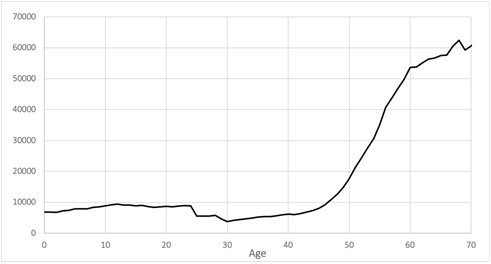
The data for the first two decades of this century show that there are fewer young rural adults, but that same effect can also be seen in the urban population. As we have indicated, the cohorts are increasingly smaller, given the downward trend in the birth rate. Thus, each year the group of young persons will be smaller in number than that for the previous year. The fact that the control group we wish to observe shrinks year on year should not be considered as a strange phenomenon. Nevertheless, rural emigration could indeed aggravate this fall in the number of young people, but it could also cushion that fall. The contraction in the youth group is clearly seen in Figure 5. The graph shows the 2021 population born in municipalities with fewer than 1,000 inhabitants and it can be seen that current cohorts are one sixth 6 of those of the generations born in those same rural municipalities in the 1960s, highlighting a demographic contraction.
There are clearly fewer young persons both in number and in proportion, but that is primarily owing to the effect of fertility contraction. In fact, if nobody had emigrated from the rural areas there would be just one 20-year-old for every six 60-year-olds, thereby indicating that even if there had been no emigration, there would still only be very few young persons in those rural areas.
Figure 5 Persons born in Spain in municipalities with fewer than 1,000 inhabitants who lived in Spain, by age in 2021.
Source: Population census 2021. Own elaboration.
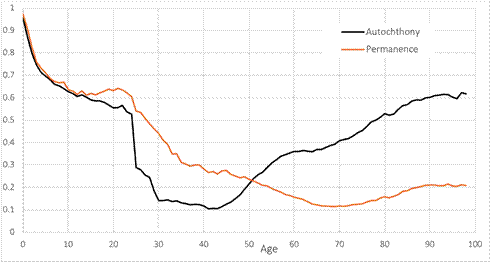
In order to study demographic challenge policies, the question to be answered concerns the specific effect that migratory movements have on the age composition, and particularly so in the young generations. Two indicators will be utilised in the analysis presented below. The first indicator of permanence reports on the weightings of those young adults who continue living in the places of origin, compared to a hypothetical situation in which all those born had remained in the rural municipalities. The second indicator refers to the degree of autochthony and indicates the weight that those born in the location has on the rural population structure.
The indicators were calculated using 2021 Population Census data for each age group and refer to the group of municipalities with fewer than 1,000 inhabitants.
The permanence indicator is defined as the proportion of persons born in the municipality who continued residing in the municipality 7 in 2021. The indicator of the degree of autochthony is defined as the proportion of residents in 2021 in the municipality who were born in the same municipality 8 . Both indicators are shown for each age group in Figure 6.
Figure 6 Indicators of permanence and autochthony by age for municipalities with fewer than 1,000 inhabitants in 2021.
Note: Residents born in Spain. Source: Population census 2021. Own elaboration.
As can be seen from the data in Figure 6, by the time they are 20 years old only half of the young adults born in municipalities with fewer than 1,000 inhabitants still live in those municipalities. At 35 years of age, the population of those who continue to reside there has fallen to one third of the cohort of those born. In parallel, if we observe the proportion of those born there over the total number of residents, we can see that the autochthony index falls drastically after 25 years old. Autochthonous young adults are only a very small fraction of rural young people. In other words, the majority of the young adults abandon their birth municipality, but those that do remain are a minority compared to the young adults of their same cohort who have arrived as new residents. This is an unexpected effect, and therefore said finding warrants more in-depth attention.
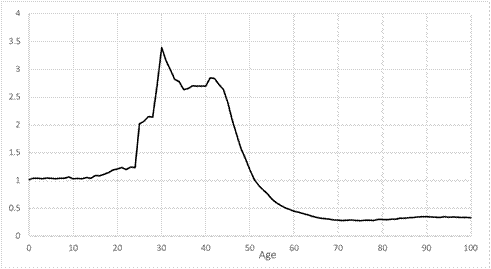
A complementary indicator would be to consider the ratio of residents to those born there. That is to say, the weight that immigrants would have among the residents of rural areas if those persons born in the area had remained in the areas -hypothesis of zero emigration-. This information is given in Figure 7. It shows the ratio of all residents -both those born in Spain as well as those born abroad- over all those persons born in municipalities with fewer than 1,000 inhabitants.
Figure 7 presents the hypothetical impact of people incorporated as residents into rural areas under the assumption that all those born there had remained there. The results are revealing. Although the group of 25-45-year-olds is, given the ageing of the rural population and the drop in the fertility rate, numerically small, it is also a proportionally small group compared to the population arriving as new residents. The data indicate that for that generational group we find more than two people who were not born in that place for each person born there. This figure is the opposite of that for the degree of autochthony series (Figure 6). Figure 6 in the permanence series shows that young adults born in rural areas depart, but it is also true that the rural young adults are above all young adults born outside rural areas, as shown by the degree of autochthony series (Figure 6) and which is verified more visibly in Figure 7.
Figure 7 Ratio of current residents over those born in municipalities of fewer than 1,000 inhabitants by age in years.
Source: Population census. Own elaboration.
The corollary is clear: there is an important renewal of the young rural population. Diversity significantly increases, particularly among the late-young groups. The study by Camarero and Sampedro (2020) highlighted the importance of diversity by origin of those known as the 1.5 generation (under 13 years of age). The results of those authors analysed not only the proportion of persons born abroad, but also that of those who, despite being born in Spain, have mothers who were born abroad. The figures denote that over one fifth of rural children and adolescents had roots outside of Spain.
In short, the drop in fertility has meant that there are fewer young people and that the reduced numbers of young people have been interpreted in the context of depopulation as a reflection of emigration. However, although the emigration of autochthonous persons does exist, the incorporation of young people into rural areas is also significant.
Rural depopulation is not a new process (Collantes and Pinilla, 2011; Collantes and Pinilla, 2020), nor is it uniform in time and space (Vidal Bendito, 1979), but nowadays it represents one of the main debates surrounding the future of rural areas. The importance socially and in the media that the issue of depopulation has acquired as a social challenge has, on occasions, led to the study of processes of change in rural populations being accused of significant analytical simplification, focused on measuring the volume and growth, whilst leaving aside other aspects, such as those relating to the real possibility of rooting in rural villages.
In contrast to the usual relationship between depopulation and a continual exodus of young persons, the study of population flows of young and late-young people shows a far more complex and heterogenous reality. Two main turning points can be observed. On the one hand, the impact of the 2008 economic crisis which drove an exodus of young adults to the city and also slowed the arrival of urban young adults seeking a different way of life and, more generally, of foreigners who found a way into the country through the precarious rural job market. On the other hand, the health crisis that arose in 2019 would seem to have driven a new flow of young adults towards small rural settlements.
These turning points enable us to make two observations linked to the logic of the demographic challenge. Firstly, the statement that in certain circumstances, rural areas do in fact represent a setting that can be attractive for the arrival of people, both ex-urban people from the same country as well as foreigners. Therefore, the issue is not so much whether the rural areas have the capacity to attract people, but more to question their scant retention capacity, particularly in times of crisis. In turn, this fact causes greater fragility of the territory as an environment to live in for the local population, but even more so for the new young Spanish and foreign residents. All this reveals the need to consider plans for welcoming those arriving which go beyond merely a job offer, and that take into account their life projects and especially their family projects.
On the other hand, the halting or slowing down in depopulation evidently requires policies to be designed that are targeted at an increasingly heterogenous population both in sociocultural terms, as well as in their needs and expectations from life. Thus, even though they may not generate significant demographic growth, population waves do progressively introduce lines of social change into rural areas. In this sense, welcome plans should also include the local community to favour the recognition of diversity and opportunities for transformation afforded by the arrival of new residents and especially of young residents, whether they be Spanish or foreign.
In conclusion, policies and programmes have in many cases placed emphasis on the idea of population attraction, often forgetting the importance of also guaranteeing continuity and fostering stable and permanent conditions for the new young residents to put down roots. So, if we think in terms of solutions to address the demographic challenge it seems that the ideal equation of “they arrive and stay” is not adequately fulfilled. The fact of merely arriving often does not entail staying and yet this ought to be the starting point.
[2] Demographic and Anti-Population Guidelines in Aragon [Directriz de Política Demográfica y Contra la Despoblación en Aragón] (2017). The Strategy to Combat Depopulation in Castilla-La Mancha [La Estrategia Frente a la Despoblación de CastillaLa Mancha] (2021). The Agenda for the Population of Castilla and Leon 2010-2020 [Agenda para la Población de Castilla y León 2010-2020]. The Agenda for the Population of La Rioja 2030 [La Agenda para la Población de La Rioja 2030] (Cabello et al. 2020).
[5] Note the outflow effect of the economic crises, including that of 1993 in Figure 1. However, the outflow effect does not exclude the occasional arrival of new residents to rural areas in times of crisis (Oliva and Rivera, 2020, Rivera, 2023). This process is consistent with that observed in other crisis contexts (Figueiredo et al. 2020, Gkartzios 2013).
[6] To correctly interpret the figure, it should be noted that the birthrates for Spain use a scale that is 10-fold lower than that used for those born abroad.
[7] The data do not take mortality into account. The actual numbers of births were higher, but such a correction would only widen the difference observed regarding the volume of generations. As this deals with residents, it also affects the emigration of those persons born in Spain who currently do not reside in the country. In fact, it was observed that the group in their thirties is relatively smaller than that of those in their twenties when there is no observable growth in fertility rates. This difference reflects, to a certain extent, the exodus of young Spanish adults to foreign countries brought on by the 2008 crisis. At any rate, neither the correction that could be made for mortality, nor that for external emigration would significantly change the picture among generations of births.
The reflection presented herein is part of the research project entitled “Focusing on the rural gap: accessibility, mobilities and social inequalities” (RURAL ACCESS) (2020-2024), code PID2019-111201RB-I00/ AEI/ 10.13039/501100011033, funded by the Spanish Ministry for Science and Innovation.