Texto escrito en el marco de la Unidad
de excelencia
científica FiloLanb-UGR. Este artículo forma parte de los proyectos de investigación
"Institución y
Constitución de la Individualidad: Aspectos Ontológicos, Sociales y de Derecho"
(InCOn)(PID2020-117413GA-I00) y "Desacuerdo en actitudes. Normatividad, desacuerdo
y polarización
afectiva" (PID2019-109764RB-I00).
INTRODUCTION
This article has two main parts: the reading of the courses that Pierre Bourdieu (2013) dedicates to Manet, which shows us a model for symbolic
revolutions, and the
analysis of one of these revolutions in the contemporary Spanish intellectual field, which
justifies some
nuances and a clarification of Bourdieu's model in relation to the academic role in these
revolutions. For the
first part, we will highlight everything that contributes to a sociology of philosophy in
Bourdieu's courses: in
the development of his lessons, Bourdieu uses examples derived from philosophical discourse and
the challenges
that arise from confronting it sociologically. The parallelism with the sociology of philosophy,
therefore, is
imposed by the author himself. In the second part, we will broaden the perspective by including
examples of our
own research on contemporary Spanish philosophy.
One key aspect in the article is the effect of the academic institutions on
the cultural
production. We will try to clarify how Bourdieu’s Manet helps us to understand
fundamental aspects of the
genesis and functioning of the scholastic attitude in art and philosophy. This work should be
read in continuity
with three further works (Moreno Pestaña, 2013 and 2016;
Costa Delgado, 2019) in which another (not scholastic) model of practicing
the history of
philosophy was explored, fundamentally by discussing Ortega y Gasset’s works from the 1940s and
1950s and the
Generation of ‘14. Specifically, in regard to Bourdieu in particular and to the sociology of
culture in general,
a series of parallelisms is reconstructed. The first section helps to understand the material
conditions for any
symbolic revolution, and it shows how Bourdieu applies the same scheme that he used for other
processes of
cultural creativity. After that, we analyze what Bourdieu means by scholasticism and what
characteristics a
scholastic disposition has in cultural production, particularly in painting and philosophy, to
expose, in the
third section, a specific reading of the intellectual creator on the basis of Bourdieu. Thus, we
will see how a
creator can break with scholasticism and revolutionize the way of understanding painting or
philosophy. The last
three sections, dedicated to the Generation of ‘14 in Spain, will show how the features of
symbolic revolutions
can vary according to the historical context, what will help us nuance the model of symbolic
revolution and the
notion of scholasticism constructed by Bourdieu based on Manet’s case.
THE SYMBOLIC REVOLUTION
Bourdieu (2003, p. 131) states that there is a general model for all symbolic
revolutions. We
are going to explore it by referring to the study dedicated to Manet, his most specific work (Bourdieu, 2013). He has reflected on that question at least since 1971,
although the topic is
already present in his early work on Algeria and the economy of symbolic goods (Sapiro, 2016, pp.
91-92 ). In a fundamental work for his perspective, Bourdieu (1971a, p.
334) points out
the difference between political revolutions and revolutions that modify the way of judging and
perceiving the
world: the symbolic ones. Although the former need the latter, they do not always integrate
them. We find
identical statements in later works, for example regarding the difference between economic and
symbolic
transformation (Bourdieu, 2012, p. 234). Symbolic revolutions know different
scales ranging
from localized spaces -for example, pedagogical relations (Bourdieu, 2012, p.
274)- to
structures of enormous historical scope, such as the modern state (Bourdieu,
2012, p. 226) or
the crisis of the family related to the feminist or gay movement (Bourdieu, 2003,
pp. 152-153;
Bourdieu, 2016, p. 228).
All fields do not have the same logic, which is why we will refer below to
certain specific
features of the philosophical field as opposed to the field of painting or literature. In The
Rules of
Art, Bourdieu studies the literary field, but at the same time he affirms that this
study supposes a model
that can be extrapolated to other fields, obviously prior empirical work, which in our case
refers to the study
of the Generation of '14. But before going into more detail, let us present the central features
of the symbolic
revolution.
Bourdieu begins to analyze demographic changes. The increased number of
students produced a
transformation of audiences that had been previously restricted. The bohemians were, in France,
an artistic
entity shaped by factors genuine to the Hexagon: political history (with the joint effect of the
Revolution, the
Restoration and the Empire) brought about a turnover of administrative staff, who seized power
at a relatively
young age. Furthermore, France’s centralization imposed the concentration of aspirants in Paris:
the capital is
the place where cultural capital -among others- is accumulated. The political elites, on the
other hand, were
strongly prevented against the social mobility produced by culture and the deleterious effects
of the Arts and
Humanities on the perspectives of the middle classes: Frédéric’s trajectory, the hero of
Sentimental
Education, unforgettably described by Bourdieu (1998, pp. 19-81) in
The Rules of
Art, is an ideal type of this period. The ambitious youth of the middle classes, unable
to settle for
their position, shifting from politics to art, represent a wind of social Fronde,
although very
politically ambiguous (Bourdieu, 2013, pp. 243-246; 2016, pp.
584-585).
Bourdieu does not mention it, but he seems to use Norbert Elias’s model
(1989, p. 71) in The Civilizing Process as a reference. Elias described, during
the
18th century, the exclusion of the German intelligentsia by their national elite,
which stood in
contrast with the centripetal character of the French Court. The 19th century in
France, however,
witnessed how the expectations -stirred up because of political changes on the turnover of
cultural and
administrative staff- were brutally shut out and the situation started to look like the one in
Germany in the
previous century. The dramatic growth in the cohorts that could access the educational system
confronted
graduates with their dashed hopes and, just like in May 1968, those who held the greatest
expectations were the
ones who experienced it the most. Just like Randall Collins (2009, pp. 791-797)
, Bourdieu
considers that scholastic repetition only works when the material foundations (economic,
institutional,
disciplinary) remain unaltered. When these get out of place -for instance, with the arrival of
not integrated
candidates-, there is a possibility of intellectual novelties breaking in.
What did the world of dashed hopes invent? The pseudo-proletarian
intelligentsia (Max
Weber) or a basic layer of the lumpenproletariat (in a note of 18 Brumaire, Marx included
bohemians
there, as Bourdieu recalls). Rejected, they did not go home; quite on the contrary: the
rejection triggered an
enormous process of multiplication of instances of academic consolation (schools, publishers,
journals,
colloquiums…). Such parallel symbolic markets went by their own momentum against an art that was
fully
controlled by the State, which worked as an apparatus. A mass audience was also born, as the
school system
provided for more producers and consumers. Bourdieu does not attribute any features of salvation
to this new
audience. Bohemians represent the empire of opportunists, of the rejected by the Salon and the
Academy who wish
they could have entered, of the mandarins who sense changes and switch sides…
This audience did not understand that Manet explored low-prestige themes,
since the power of
the norm lies in saying what is susceptible of being art and what is not, what is a big theme
and what isn’t,
what is, on a different level, an important philosopher and what isn’t, what is a fundamental
historic event and
what is a bagatelle: bohemians, despite their turbulent character, could still defend the canon
(claiming to be
better than the ones who were in it) or replace the privileged poles while maintaining the
hierarchical system.
Spaces opened up, audiences changed, France’s political history generated a political apparatus
too centralized
and distrustful. In Manet, the state always appears linked to a routine norm that
introduces heteronomy
into the artistic field, although this is not the only logical and empirical possibility: on
other occasions, a
state intervention can reinforce the autonomy of a specific social field. We will show how
fractions of the
field of state, also influential in the intellectual field and linked to processes prior to
themselves, promoted
the symbolic revolution in the Generation of '14.
However, bohemians by themselves, they don’t explain it all. Replete with
loose cannons,
speculators and tricksters, Manet could not rely on this group to build an alternative instance
of consecration.
Because this is exactly what any creator needs: someone who assures him that he is not mad, that
he is not an
impostor pretending to be cursed. Bourdieu always insisted that social conditions enable a
symbolic revolution,
but do not determine it absolutely (Bourdieu, 2013, pp. 389-396; Bourdieu,
2017, p. 615): it is necessary to understand the specific logic of the production space
in which the
author in question is located and what the author transforms in it. In the next sections, we
will try to provide
an answer to that question: what conditions does intellectual autonomy possess according to
Bourdieu and what
allows it to resist academicism?
SCHOLASTICISM: THE INFLUENCE OF SYSTEMATIC INSTITUTIONS ON CULTURAL CREATION
Bourdieu is confronted with the scholastic attitude because, even in its best
versions, it
is the main obstacle to a historical sociology of art. What do we understand by scholasticism?
In principle, it
is the set of dispositions generated by academic experience and, very remarkably, the liberation
from practical
urgencies
1
. This liberation from the demands of daily life comes with the submission to the
exclusively academic
demands and tends to be projected towards all the works of culture and, in general, to the view
on the social
world.
Nonetheless, Bourdieu leaves some questions open in his identification of
scholasticism. On
the one hand, in a specific sense connected with the production of academic habits, he
identifies as scholastic
the art dependent on a school (Bourdieu, 2012, p. 168). In more general
terms, he considers
the dehistoricized reading that characterizes commentators as scholastic (Bourdieu, 2012, p.
106). Bourdieu rotates between explanations without being clear: sometimes he seems to
preach the
academy’s scholasticism; then, scholasticism is equated with dehistoricized commentary, which
only pays
attention to the works and to whatever can be deemed worthy or unworthy in them with respect to
the canon.
The doubt could be resolved by trying to clarify Bourdieu himself, which is
always a risk.
We could get out of the problem by pointing out that scholastic criticism entails an
intellectual reading of all
practices: obviously, those practices arising from the academic institution itself, but also
other practices
that have nothing to do with it and even break away from it, philosophical and artistic
practices that are
different from commenting philosophical texts or exhibiting one’s mastery on the canvas. There
is an identical
anxiety underpinning the young philosopher who wishes to guarantee his status by comparing
Merleau-Ponty with
Husserl (though without studying the ideological and intellectual crisis of Catholic
philosophical societies in
the 1930s) and the reader of Manet who only allows himself to talk about the Venus of Urbino
(but not about the
socio-demographic shifts of the symbolic revolution): not tarnishing the canon with social or
historical
problems which are by definition excluded from it. These practices share a similar disposition
to that of
artists or philosophers who reproduce dogmatic patterns in their works dictated by an
institution which,
protected by tradition, ignores the social and historical genesis that gives meaning to the
practices that are
transmitted.
An important difference, however, can be established between academic art and
the artistic
field: in the latter, the specifically aesthetic skill is increasingly valued. This can also be
said of the
philosophical field in a certain sense, but in a much less explicit way. In academia, both in
philosophy and
painting, the norm stemming from the scholar universe is irresistibly established, to the point
that it ends up
conceptually wasting art itself or creative philosophies. When an academic writer reads a work
or commentates a
painting, he will always look for specific features: whether its finish is good, whether the
author is competent
according to the dominating pattern, whether the historical references are correct… But what
does he forget? The
fact that an innovative work harbors a tradition, but it also alters what was transmitted of it
and the uses by
means of which it was transmitted, connecting it with new uses or sensitivities, or even
recovering the living
richness of a tradition as opposed to its reificated version caused by academic routine (Bourdieu, 2012, pp. 355-364 ). Therefore, he proposes a new way to read
history, a new way to
define the finish of works, a new way, in sum, to define the artistic, literary or philosophical
skill. In this
sense, as Bourdieu reminds us, when Manet sought to be admitted in the painting canon, he
intended something
impossible: for the canon to accept what was going to destroy it. In sum, in order to be loyal
to authentic
iconological or conceptual innovation, the history of artistic and philosophical creation needs
to invoke much
more than just icons or concepts. Manet’s symbolic revolution was indigestible for scholar and
scholastic
reading devices (Bourdieu, 1998, p. 172).
READING DIFFERENTLY, WITHOUT SCHOLASTIC MUTILATION. BEYOND THE QUESTION OF
BREAK AND
CONTINUITY
Bourdieu’s argument about the symbolic revolution reminds us of a thesis by
Randall Collins (2009, pp. 150-151). After comparing Greece and China between
500-300 BCE, Collins
confirms the existence of twelve creative generations in the former and a shorter sequence in
China. Chinese
authoritarian patterns imposed legitimation in a way that Athens never did, where Plato could
develop his
philosophy without trouble, despite it being completely hostile to democracy. In the case of
France, the
creation of alternative markets allowed for the survival of intellectuals in conflict with the
norm. England,
with its arriviste and submissive artists, draws analogies with the case of China’s Confucian
unification,
although in a more decentralized way. Paris and Athens have two things in common: the
concentration of the space
of attention and the possibility of a competitive intellectual market not severely monopolized
by any political
institution, which facilitate ties between schools, debates and rivalries. Without them,
intellectual life can
perish due to dispersion and to the absence of a critical mass.
But we still have the problem of what revolutionizes the revolutionary. In the
first place,
revolutionaries do not reject tradition: rather, they proof that orthodoxy misunderstands it.
Manet had the
history of painting embedded in himself and therefore, he was able to rescue Velázquez against
the art
pompier of his time. His contemporaries, who boasted of upholding tradition, actually
ignored it; in fact,
they only knew about it what the school administered, and the school always captures the past in
a biased way.
Bourdieu devises a magnificent formula: Manet proposed “a mobilization of the technical capital
that had
accumulated over the history of painting, but had been mutilated by academic selection” (Bourdieu, 2012, p. 355). Wherever there is a norm, continuities, consecrated
genealogies… the
revolutionary proposes new syntheses. At that moment, the academy loses its symbolic support
because, with its
actions, the revolutionary accuses it of separating what should not be apart and of uniting what
should be
separated.
In support of his thesis, Bourdieu (2012, p. 285) appeals
to the
description of Heidegger’s attack to the neo-Kantians. Although the analogies between the
philosophical field
and the artistic field come from Bourdieu himself, the peculiarities of the former must be
established. The
philosophical field, whose existence Bourdieu (2003, p. 34) traces back to the
fifth century
BC is characterized in the contemporary world by the constant loss of its own objects, which
have been
monopolized by specialized disciplines. In this sense, the philosophical field must always refer
to such lost
knowledge, to a large extent demonstrating its unacknowledged debts to philosophy (Bourdieu, 2003,
pp. 43-47). The relationship of philosophy with its tradition is not identical to the
logic of permanent
revolution that characterizes the fields of restricted production in art, where producers
produce for a public
of creators, with the inevitable mediation of intermediaries: critics, editors, gallery
owners... (Bourdieu, 1998, pp. 208-209). The specifically philosophical
activity consists much more in a
permanent rereading of tradition in order to confront present conflicts (Bourdieu, 2016, p.
571). Certainly, Bourdieu considers that any great creator knows the history of his
field. In philosophy
this is shown in a more intense and academically guaranteed way. In fact, it has been pointed
out that a
condition of belonging to the field is still the competence in the history of philosophy (Pinto,
2007, p. 65). This is something that is well verified in the case of Heidegger.
In Kant and the Problem of Metaphysics, Heidegger showed the primacy of
Aesthetics
and the intuition about the logical categories of knowledge and the foundations of science.
Time, which is
constitutive of imagination, lays the foundations for the subject of knowledge; therefore,
science is not
embedded in logic, but in a deeper experience: the specific, existential temporality (Bourdieu,
1988, p. 71 ). Similar to what Manet did with Velázquez with regard to the
pompier academia,
Heidegger proved neo-Kantians that they did not know their prince of thought. He also avoided
Jünger-like
essayism like the plague. Where Jünger -equivalent to the Parisian bohemians- invoked Nietzsche,
Heidegger went
back to the pre-Socratics (Bourdieu, 1988, pp. 47-48). Therefore, the symbolic
revolutionaries, like Heidegger and Manet, know the tradition but without its academic
mutilation, and precisely
because they know it, they distinguish themselves from the false revolutionaries, who are in
truth amateur
critics of academia (and this will always have an easy time to disqualify them).
Let us recapitulate: we have the crisis of the institution, with its plethora
of aspirants
who do not find their space and step forward to contest the mandarinate; in addition, we find
the creation of
new markets where to find support and, subsequently, we find a revolutionary who is particularly
well-educated
in the history of the field, be it Manet or Heidegger. And something enigmatic: we find a
tradition mutilated by
academia that allows the revolutionary to overcome orthodoxy (by precisely, using its forte: the
“sources”) and
to distinguish himself from the resentful criticism made by those expelled without much
competence (Bourdieu, 2012, p. 455 ).
However, in which way is tradition mutilated? To our understanding, this is
the key
question. Tradition is mutilated because it is dehistorized and it turns ancestors into
summarized and
stereotyped characters susceptible of academic transmission, into mere labels, a coherence that
ignores the
whole pragmatic effort that the creator had to deal with. We can mobilize here Ortega y Gasset
(2009, p. 730), who wonders about the temporality of thought and concludes that it
depends on pragmatic
situations and on how these -which unite thought and institutions- last through time. Bourdieu
himself states
something similar when he claims a “good use” of anachronism: when one has good general models,
the past can be
compared, always with precautions, with structural equivalents, homologous in certain
oppositions, but not in
others (Bourdieu, 2012, p. 360). This is an example of the mobilization of
tradition, but it
is a pragmatic mobilization that takes the thinker (or the artist) without removing him from his
time and
conflicts. The creator perceives the sociological and intellectual moment in which the
conjunction claims a
certain past. This, of course, is not taken from academic manuals: it requires to know more than
what they
contain, as well as knowing what in the concrete world claims a new reading of the past. The
creator is
possessed by the history of the field, as Bourdieu insists repeatedly, but he can also see the
objective
possibilities in the present. Is he an intellectual genius? Yes, but because he is a
sociological, even a
political genius. And that genius makes him a great painter or a great philosopher. Revolution
is not just
intellectual: it is also social. Otherwise, Bourdieu would take us back to the charismatic
ideology of the
creator. The creator can tell intuitively that there is an opportunity in a specific conjunction
of a new
articulation of tradition. Bourdieu (1998, pp. 222-223; 1988,
pp. 56-57)
insists that it is a collective process that cannot be made to depend on a single individual. As
Fowler (2020, p. 454) points out, Bourdieu puts forward an "anti-charismatic
conception of
social creativity" and, referring to the links between symbolic revolutions and politics, states
that "groups
create themselves by creating people who create the group". In the artistic field, Bourdieu
(1977b, pp. 5-7) argues that the value of the work depends on a circuit of agents that
go beyond the
writer or the painter. That said, there is no doubt that the creator is also an active agent who
strongly
resembles the prophet in the religious field. The prophet -or the creator- has nothing
extraordinary about him,
but he grasps the extraordinary situations and allows what was only among the virtualities of
the present to
exist (Bourdieu, 1971a, pp. 331-334). Moreover, Bourdieu (1998,
pp.
185-188) has tried to specify the social properties of the great creators: they are
subjects with a high
symbolic capital, often coming from dominant classes, but absolutely distanced from bourgeois
routines. We will
return to this question later, with regard to the collective subjetc of the symbolic revolution
in the
Generation of '14.
Thus, do we recover the theory of charisma? Not at all: the description of the
creator’s
social and financial resources shows in some way the collective work from which the individual’s
social
intuition emerges. The creator concentrates a whole network of collective work on a proper noun.
Favorable
comments about Manet’s paintings can be explained by its previous relations: he could fascinate,
indeed, but the
fascinated ones were in networks that were already well disposed to a warm reception. “The more
science
progresses, the more the charismatic myth disappears” (Bourdieu, 2013, p. 442
).
DIFFERENT WAYS OF INTERPRETING BOURDIEU'S MODEL OF SYMBOLIC REVOLUTIONS: CAN
THE ACADEMIA
CONTRIBUTE TO A RADICAL TRANSFORMATION OF CULTURAL PRODUCTION?
In the previous pages we have seen how scholasticism could appear in different
circumstances, though all of them express the discipline that some kind of external institution
imposes over the
space of cultural production. Now we would like to address one specific question: can the
academia have a
positive role in a symbolic revolution? As we have pointed out, we can find support for this in
works by
Bourdieu other than the one we have analyzed. In his course On the State, Bourdieu
remarks that the state
conditions, in collaboration or in conflict with the subjects of each field, the capitals that
function in each
social space. This can be done through the arbitrary imposition of bureaucratic rules, but also
by encouraging
the creation of autonomous environments, governed by their own rules (Bourdieu,
2012, pp.
196-197; Bourdieu, 1993, pp. 52-53). For Bourdieu, it is clear that
Manet's revolution
developed against the academy, but it is possible to think about a symbolic revolution whose
basis are supported
by a temporal institution.
For that to happen, the rules enforced by this institution should help a group
of creators
to resist the external influences threatening the authority of the very field of production to
stablish
principles of legitimacy over the system of relations of production, circulation and consumption
of the symbolic
goods that have a place in it. In order to affirm that this institutional intervention
contributes to a symbolic
revolution, in addition to supporting the autonomy of the field it must, paradoxically, promote
its
transformation and guarantee a space of relative cultural freedom.
Bourdieu (1971b, p. 50) proposes three dimensions necessary for the formation
of an
autonomous intellectual or artistic field: 1) the development of a market for symbolic goods,
which opens up the
possibility of economic independence and a principle of impersonal competitive legitimization,
free from the
tutelage of temporal authorities such as the aristocracy, the church or the state; 2) the
constitution of a
specialized group of producers and intermediaries of the symbolic goods in question; 3) the
multiplication and
diversification of specific and competitive consecration instances within the field.
Subsequently, this field is
structured in an opposition between two poles: that of restricted production, aimed at an
audience of producers,
and that of production aimed at the general public (Bourdieu, 1971b, pp.
54-55). Of course, Bourdieu (1971b, p. 49) reminds us, autonomy is
always relative and external pressures never
cease to exert their influence, although this is expressed with a variable refraction effect
depending on the
field's own categories.
We argue that these three dimensions are present in the case of Generation of
14' in Spain,
a group that played a fundamental role in a symbolic revolution that promoted the autonomy of
the intellectual
fields especially linked to the state through the university, as well as in the journalistic
field. In this
article we will focus on the philosophical field, although references to the effects of the
Generation of '14 in
other social spaces will be inevitable, given its interdisciplinary character and its active
-albeit unequal-
political involvement. In the following, we will briefly review
2
how the three dimensions of an autonomus field proposed by Bourdieu are expressed for the
philosophical
field in the Generation of '14:
Development of a market for symbolic goods: at the beginning of the 20th
century, a series
of cultural and socio-demographic transformations were observed in Spain that allow us to speak
of a significant
increase in the public of virtual consumers of symbolic goods, observable in the expansion of
access to
university and in the transformation in the mode of generation of a relevant fraction of Spanish
elites. We will
devote the next section to this, using the study by Costa Delgado (2019) .
-
Constitution of a specialized group of intermediaries and
producers: if we take
institutional recognition as a relevant indicator, since the middle of the 19th
century, the different
scientific disciplines have been breaking away from philosophy, obtaining
institutional recognition as
autonomous studies in the university: in 1857, with the creation of a "Faculty of
Exact, Physical and
Natural Sciences", and in 1900, differentiating between "philosophical studies",
"literary studies" and
"historical studies" within the faculties of "Philosophy and Letters". The process
of specialization
accelerated in the following years, especially with the Second Republic (Niño, 2013).
In addition, the mode of access to the position of university professor was also
profoundly transformed
between 1894 and 1901, limiting the interference of political power in appointments
and introducing more
specialized evaluation criteria, such as studies abroad, the requirement that the
members of the tribunal
were "professors of a subject equal or analogous to that which is the object of the
competition", or the
delivery of a "original research or doctrinal work", in addition to the program of
the subject (Martínez Neira, 2014). In general, what can be
observed up to 1936 is a tendency to
impose meritocratic criteria specific to the university, in the face of the double
threat of political
interference (political parties and the church) and "recommendations" (social
capital). And, nevertheless,
this whole process had the variable support of different fractions of the political
field, including the
numerous institutional spaces that the members of the Generation of '14 conquered
throughout their
professional and political careers.
-
The Generation of '14 prevented scholasticism by avoiding the
imposition of an
academic orthodoxy, while at the same time fought against the ideological pressure
of an authority outside
the philosophical field. To this end, the Generation of '14 contributed to
multiplying the instances of
consecration specific to the field: along with the consolidation of an increasingly
autonomous pole of
academic consecration in the university, the members of the Generation of '14
participated in other
instances aimed at diverse audiences. There are three main ones: publishing houses
oriented to the
publication of scientific works; journals oriented to an intellectual public
-although not separated by
disciplines- and the daily press. Most of the publishing projects controlled by the
generational core
3
were characterized by their pretension of specialization and intellectual
level; the desire to
stimulate the demand of a public with a certain cultural capital; the
professionalization of the staff;
the use of technical advances in terms of material, management and advertising; and,
above all, the
attempt to generate a press autonomous from politics, in contrast to the
journalistic environment
characteristic of the Restoration (Cabrera, 1994). All this did
not prevent the
existence, throughout the generational trajectory and often within the same
subjects, of a permanent
tension between the vocation to address an audience of specialists and the vocation
to create a work aimed
at a broad public, normally materialized in journalistic and political
interventions.
Considering the above, we propose the case of the Spanish Generation of ‘14 as
an example of
a symbolic revolution developed through the academia, and not against it. Not every symbolic
revolution is made
against the academia from the outside. And so, the rejection of a castrating academia would just
be one of the
historical possibilities in which the creative autonomy against scholasticism is expressed. As
mentioned above,
here we adopt Bourdieu's view of academia as a set of public cultural institutions promoted and
financed by the
State, with the university in a place of special relevance. Of course, as every academia, these
institutions
enforced a set of rules that modified the cultural agents' behaviour in a very significant way,
either through
submission or rejection, in many different intermediate degrees. We believe that, in the case of
Spain at the
beginning of the 20th century, these temporal institutions were capable of producing a
liberating interference
in the cultural production, reinforcing pre-existing tendencies -and at the same time as a
result of them-, as
well as reinforcing the actions of specific agents -which, in turn, modified the orientation of
these temporary
institutions, in conflict and collaboration with other agents.
The case of the Generation of '14 allows us to explore a logical possibility
that Bourdieu's
model admits, but which is not present in Manet's empirical case. In the Spanish case,
the symbolic
revolution had the support of a fraction of the state in the face of pressures fundamentally
coming from the
political field (from positions of different ideological signs, but especially from the parties
of turnism,
which controlled the political power in Spain during the Restoration) and from the church, an
institution with
an enormous influence in the Spanish educational system. But does not such support from the
state imply a form
of interference from a temporary power that questions the autonomy of the field? We believe not,
as long as such
interference reinforces the autonomy of the field by positively influencing the three dimensions
previously
mentioned (Bourdieu, 1971b). The curriculum of the republican Faculty of
Philosophy and
Letters in 1931, promoted by significant members of the Generation of '14, is a good example of
this: the state
sanctioned an official curriculum that recognized disciplinary specialization, greater freedom
for studens to
choose a personalized curriculum and greater autonomy for teachers within the subjects to be
taught. These
measures were intended to put an end to the "intellectual rigidity of the system of university
chairs and opened
up the possibility of disciplinary innovation, as well as introducing a certain degree of
competition" (Niño, 2013, p. 96 ). One part of the academia used its
institutional power against itself to
counteract the scholasticism characteristic of the university at the end of the nineteenth
century.
Let us now turn to Costa Delgado’s study (2019) , with the
systematized
data on the origin and social trajectory of a group of intellectuals and politicians involved in
the Generation
of ‘14. This will help us to deepen our understanding of the collective dimension of the
symbolic revolution and
will concretize the sociodemographic aspects mentioned above.
BRIEF METHODOLOGICAL INTRODUCTION TO THE EMPIRICAL RESEARCH ON THE GENERATION
OF ‘14 IN
SPAIN
The statistical categories used in this section require an additional
explanation, since
they are based on materials from empirical research whose selection should be justified. The
Generation of ‘14
was a group of people who conceived themselves in generational terms, tried to act in a
coordinated manner
between 1910 and 1914, and continued to maintain close bonds and common practices until the
Spanish Civil War,
with the permeability that defines any social group in a complex society where social destinies
are not fixed
legally from birth. This group was characterized, sociologically, by its high cultural capital,
its links with
Madrid, its predominantly bourgeois background, its relative youth in 1914 and, what we find
most interesting in
this article, its major role in the radical transformation of the Spanish intellectual field in
the early
20th century, which we can define as a “symbolic revolution”. In short, such a
revolution can be
characterized by a greater intellectual autonomy from the political field and from the Church,
materialized in
the three dimensions mentioned in the preceding section, and the institutional recognition of
this autonomy,
with a rationalization of public administration that was accompanied by the transformation of
the recruitment
criteria for the civil service, especially at university. Of course, all this was accompanied by
a radical
transformation of the way of understanding intellectual production in the fields that were most
affected by it:
the various scientific fields closely linked to the university and the field of journalism;
although the
symbolic revolution also produced significant changes in other fields, especially the political
one
4
.
Costa Delgado (2019, pp. 53-76) elaborated a reasoned corpus as a starting
point for his
study of the Generation of ‘14. Here, the existence of two indisputably generational manifestos
-because of
their content and signatories, in 1910 and 1913- offers many advantages: it is a wide selection
that does not
fall back into an arbitrary preselection of relevant personalities; it responds to the group’s
internal criteria
in relation to a specific social context; the manifestos are published in two important moments
of the
constitution of the group as such, and they generated significant responses and controversies
following their
publication; in short, it is the public image that the group projected when presenting
themselves in society.
As far as this article is concerned, we will mainly use the treatment by
descriptive
statistics of a selection of variables from the signatories’ available data (there were 169
signatories of the
manifestos, out of which around 100 present available data). The population of this study is a
fraction of the
Spanish elites that stands out for its cultural capital, but the study had to place it, at the
same time, in a
broader social context: in relation to other fractions of the elites -particularly those that
stand out for
their economic capital- and to those social sectors excluded from the elites -popular classes
and petite
bourgeoisie without cultural capital. Hence, the categories do not pretend to be
universal or to reflect
essential properties of the subjects, but rather combine social class criteria with professional
ocupations
whose access was mediated by the possession of cultural capital.
For the categorization of social positions, the study has been inspired by the
variables
used by Christophe Charle (2006, pp. 19-30) . We have adapted them to the
Spanish case and
considered some social sectors that he excluded for different reasons. The grouping of subjects
into categories
is not representative of the whole Spanish society of the time; rather, it is adapted to the
characteristics of
the study’s population: very nuanced in terms of the internal social divisions of the educated
elites and with
much more heterogeneous categories when it comes to economic capital and the popular classes.
The latter two
categories are in the minority -though present- among the signatories, but they are more
frequent in their
social background.
Also, 1910-13 and the Second Spanish Republic (1931-36) are generational
milestones marking
the beginning and end of the generational trajectory. The first date responds to the signing of
the manifestos
and the beginning of many of the signatories’ public presence; the second indicates the
generational social
destiny before the break and radical alteration of the political and social order that came with
the Spanish
Civil War. In addition to these two milestones, we added the signatories’ social background,
collected from the
available data from their parents’ birth certificates and the available biographical news.
THE SOCIAL CONDITIONS FOR CREATORS: A STATISTICAL ANALYSIS OF THE
SOCIO-DEMOGRAPHIC FACTORS
OF THE GENERATIONAL BREAK
What does the case of the Generation of '14 contribute to Bourdieu's model of
symbolic
revolution?
The characterization of academia as a social space based on the distance from
necessity and
practical urgencies had a strong presence as a normative ideal in the Generation of ‘14, as it
can be observed
in the recurring opposition between university professors and journalists, which structures
important debates
within the group. However, in this case, the symbolic revolution did not occur from the outside
and against
academia, but from a dominated part of academia against the institution’s conservative sector,
relying on a
bohemian group made up of young writers and journalists and, at least during its rise, on its
dominated
counterpart in the political field: the labor and the republican movement. The complex and
variable composition
of these groups generated in turn a receptive audience in face of a creative disposition prone
to breaking the
mold of an academia that was closed in on itself. If we resume the four defining
socio-demographic factors of
symbolic revolutions previously identified, we can better compare the contexts of the Generation
of 14's and
Manet. Let’s recapitulate: (1) crisis of the institution, (2) candidates without space and prone
to rebellion,
(3) new markets, and (4) revolutionary educated in the field, who renews it by recovering
tradition in an
original way.
-
The crisis of the institution is very present in both cases, with
a very strong
criticism of its sclerotization, lack of originality and lack of capacity of
renewal, attachment to
outdated traditions and disengagement from social matters that needed to be
addressed. However, whereas
Bourdieu’s criticism of the Ateliers in Paris presents them as a homogeneous
bloc in its
academicism, the university faced by the Generation of ‘14 harbored a minority that
anticipated some of
the breaks that would characterize the symbolic revolution and even paved her way by
introducing important
changes in the recruiting of professors and in the definition of their academic
trajectory. This is one of
the factors that explain that the revolution against academia was not staged from
the outside, but from a
part of academia, with external support, against the dominating sector of it.
-
The increase in the university student population in Spain in the
early
20th century and, at the same time, the spectacular rise in the
proportion between assistant
professors and full professors generated an equivalent to the situation of shortage
in employment combined
with a large number of candidates, but with a greater capacity of integration by
academia and the State,
since the parallel process of transformation of the political field from the
parliamentary system made it
difficult for the notables to put the apparatus of the State at the service of its
client networks and, as
a consequence, made possible a larger rationalization of the administration and its
recruiting system.
-
The emergence of new markets, in the Spanish case, presented
different forms linked to
that complex coalition between dominated academics, intellectual bohemians and
political opponents, but in
general it was characterized by a larger capacity to associate non-academic
audiences with a cultural
production from academia or, at least, from the academics linked to this symbolic
revolution. The
coalition took variable forms, including publishing projects which explicitly sought
-with mixed but
remarkable success- to generate new dynamics of intellectual production oriented to
large audiences,
looking for economic independence, quality and specialization of contents, formal
excellence, and an
efficient management (Cabrera, 1994).
-
The emergence of a revolutionary (in our Spanish case, a group)
educated in a field
that renews it makes a substantial difference, which is not at all present in the
French case: the
reference to Europe and cultural importation as a value in itself. The reason behind
this difference is
evident: internationally, the position of France and Spain in the symbolic hierarchy
was opposite. Whereas
France mainly competed with Germany and England as international cultural references
of the time, Spain
was part of Europe’s periphery, and its intellectual and political debates were
mediated by the
importation from metropolises. The Generation of ‘14 claimed to be importing the
European culture into a
backward Spain.
Let us now comment on the social composition of the signatories of the
generational
manifestos, with the aim of contrasting the hypotheses derived from Bourdieu’s model of symbolic
revolution. As
seen above, in order to explain the exceptional nature of the symbolic revolutionary, what we
previously termed
as “creative autonomy”, Bourdieu does not only allude to his cultural capital, but also to
“external” resources
outside the intellectual field such as his social capital -the network of previous contacts that
reacts
favorably to his production and disseminates it- and his economic capital -which allows him to
disengage from
practical urgencies and from the economic repercussion of being excluded from consecrated
spaces-. In sum, we
wonder: is it possible to imagine creative autonomy from social coordinates that are different
from Manet’s?
Let us look at three charts that depict the social trajectory of the
Generation of ‘14:
social background, social position in 1913 and social position during the Second Spanish
Republic (1931-1936) of
the signatories of two generational manifestos. Studying the differences between these three
milestones will
shed light on which type of social conditions were required to participate in the group and
which social changes
this concatenation of facts -which we sum up in the concept of generation- brought about to its
participants.
A comparison between Chart 1 and Chart 3
leaves no doubt
about the group’s evolution. In a family generation’s time, a limited upward social mobility
occurred, combined
with a conversion of economic capital into cultural capital, the latter being much more
prominent than the
former. The decrease in “Popular classes and petite bourgeoisie” compared to all the
other categories,
considering how this category is constructed in this research, shows that upward tendency in
terms of social
position. The variation in the proportion between university professors and secondary school
teachers points in
the same direction, although in this case, the social distance between both categories is much
shorter. A piece
of data that points towards the moderation of this social mobility is the fact that the
proportion between
mid-level civil servants and the sum of owners and high-ranking civil servants did not vary at
all. Changes in
legal professions and the category of “Journalists, writers and artists” are not good indicators
of social
mobility due to the great internal heterogeneity of these categories in terms of economic and
symbolic capital.
Chart 1. Social background of the Generation of 1914
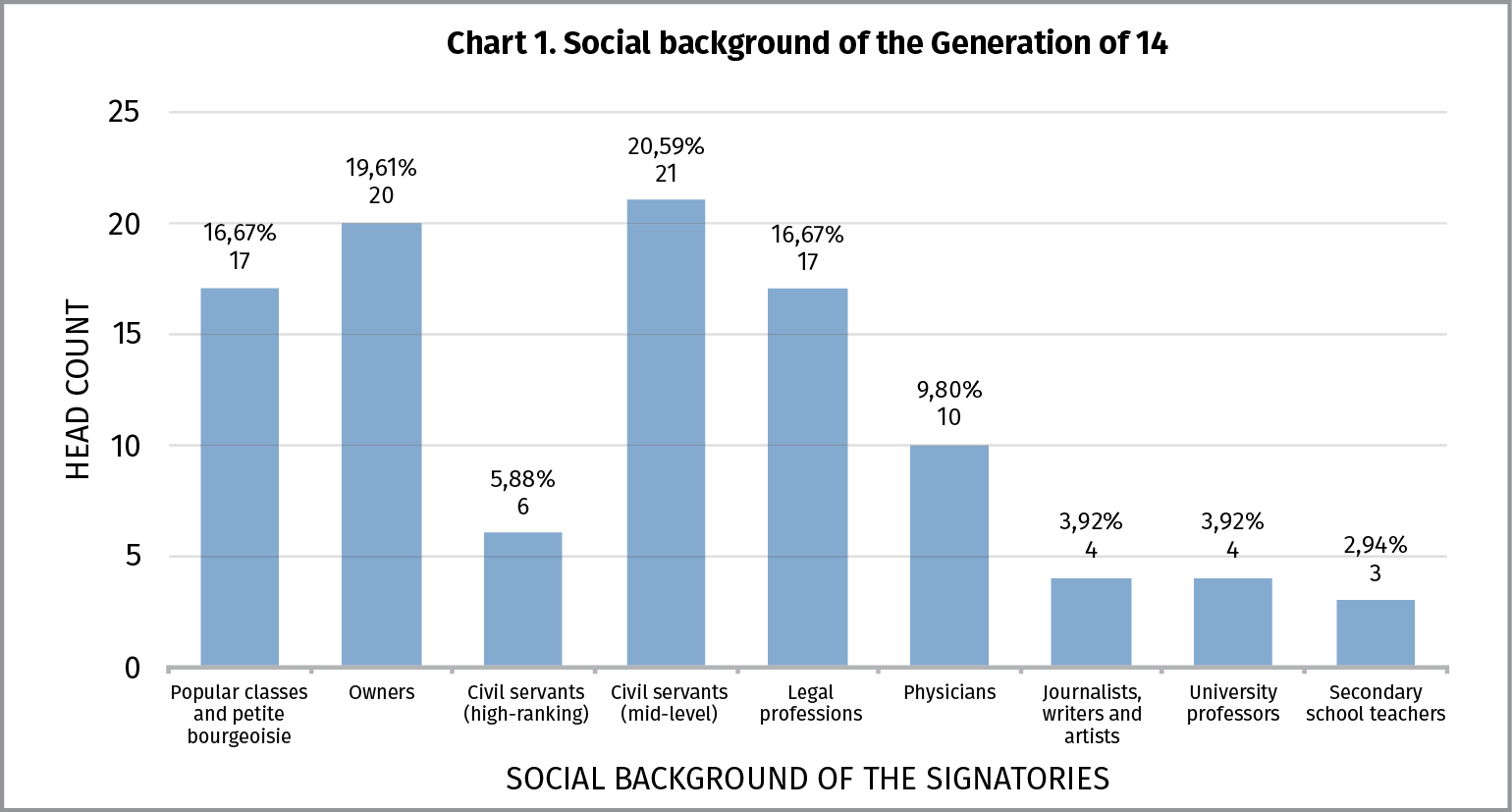
Chart 2. Social position of the Generation of 1914 in 1913
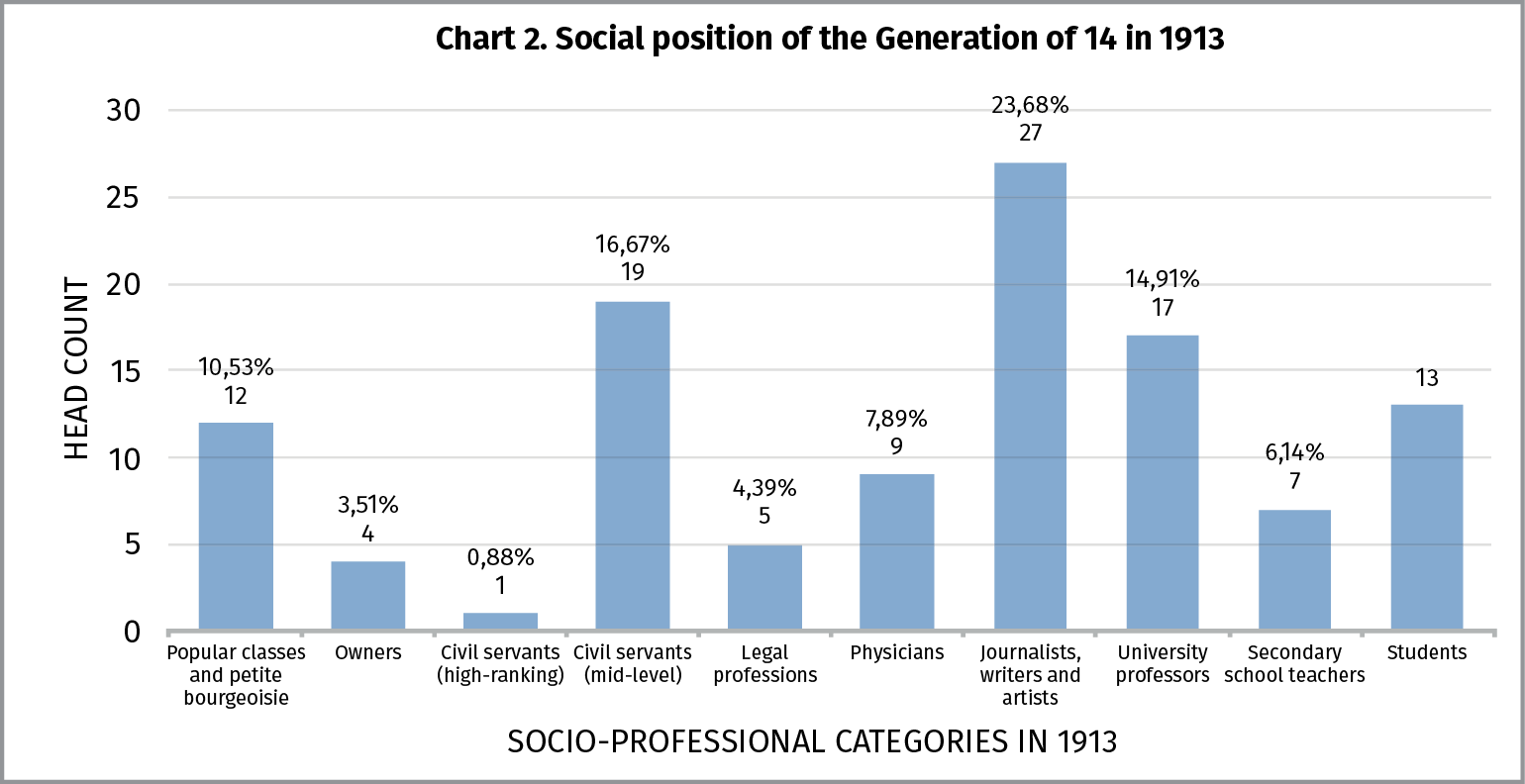
Chart 3. Social position of the Generation of 1914 in 1931-36
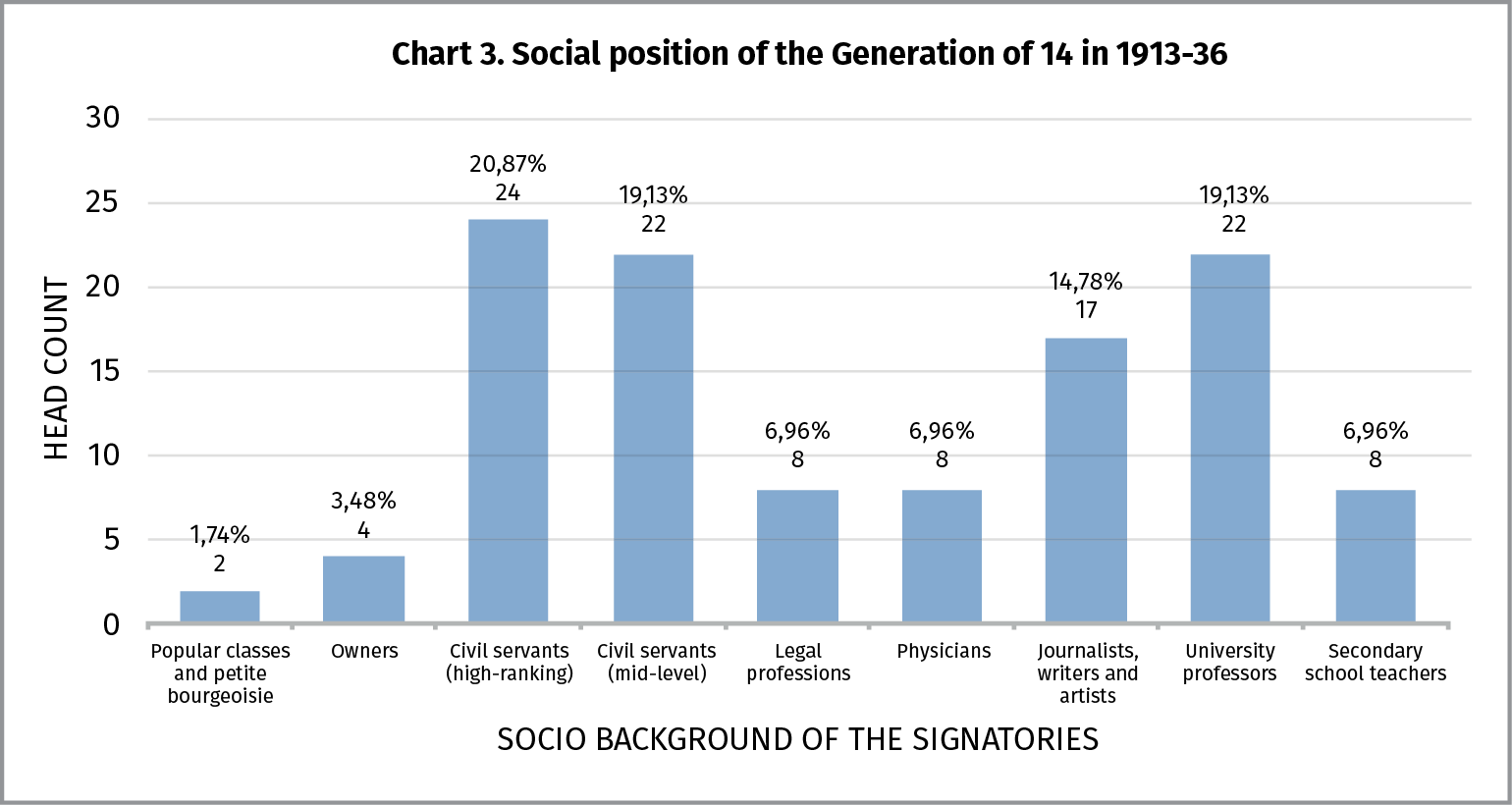
The generational conversion of economic capital into cultural capital is
evident. The
enormous increase in university professors and secondary school teachers serves as an indicator
of the
importance of cultural capital in the social trajectory of the Generation of ‘14, which was also
very closely
associated with public administration. This can be observed in the significant reversal
-practically
symmetrical- in the number of owners and high-ranking civil servants, which shows an important
generational
shift in the way that elites were recruited: the Generation of ‘14 stood out for reverting the
inherited
financial and social capital in a determined cultural stake, thus modifying the conditions for
the symbolic
validation of economic capital. This lateral generational mobility of the elites, oriented
towards public
administration -especially towards educational and cultural institutions- is the biggest
difference between the
Generation of ‘14 and the symbolic revolution analysed by Bourdieu in Manet. The alliance
between the
revolutionary academic section and the intellectual bohemians can be clearly observed in the
trajectory depicted
in the three charts.
In terms of social background, we can see an important presence of economic
capital (owners
and a part of the petite bourgeoisie) and the cultural capital most closely linked to it
and to politics
(legal professions), although there is also a relevant link with administration, illustrated by
the 21
signatories’ fathers who were mid-level civil servants. In this regard, it is important to note
that the
symbolic revolution does not come out of the blue, it is not an absolute novelty: it recovers
potentialities
that are present in the field and rewrites them, also at the family habitus level. In
1913, the lesser
importance of the categories that we highlighted in the social background is confirmed, with the
logical
exception of mid-level civil servants. However, we also observe an important increase in those
categories
associated with intellectual bohemians (journalists, writers and artists) and academia
(professors and students,
but also a majority of mid-level civil servants linked to educational and cultural
institutions). The early
academic consecration that is shown in this second chart is accompanied in the social destiny
chart (Second
Spanish Republic, 1931-36) by an outstanding increase in high-ranking and mid-level civil
servants, as well as a
moderate growth in professors and teachers (already present in 1913). This occurred at the
expense of a part of
the intellectual bohemians who found a more stable social position, though not necessarily a
more prestigious
one, in public administration: the symbolic revolution, in this case, created an institutional
space for the
revolutionaries within the state apparatus.
The possibility of a symbolic revolution driven and sustained from academia is
therefore
demonstrated, having always in mind that, as we said before, this academia was very distant from
the one
described by Bourdieu for art in the Second French Empire. In the Spanish case, the previous
generation had
managed to introduce relevant changes in the recruitment of professors and in the access to the
civil service,
paving the way for the symbolic revolution of those who succeeded them. But what about the two
missing
requirements that, according to Bourdieu, accompany cultural capital in the symbolic
revolutionary? Does the
academic support of the Generation of ‘14 mean that social and economic capital were not as
decisive to sustain
“creative autonomy” against scholasticism?
In this aspect, the Spanish case seems to partially support Bourdieu’s claims,
although
there are two significant differences: 1. The collective and impersonal support that an academic
institution
guarantees is not exactly equivalent to the economic and social capital that a single individual
can accumulate,
even if we find a socially elitist selection in the access to the academia. 2. The fact of a
symbolic revolution
from inside the academia opens new theoretical possibilities to think this process in different
empirical
contexts and, above all, to analyze the logic of the field resulting from the symbolic
revolution. Both
differences have important sociological and philosophical implications, as discussed in the
conclusion.
About the social and economic capital, the charts do not disclose any
information beyond the
evident social selection that shows the social background of the signatories. Only 16.67%
belonged to the
category “Popular classes and petite bourgeoisie”, a markedly low percentage compared
with the
quantitative representation of this category in the Spanish society of the time. However, the
internal dynamics
of the Generation of ‘14, studied from a qualitative analysis of trajectories and variables
relative to the
political evolution of the subjects provide us with more information, at least in regard to
these three points:
-
In a society that was profoundly shaped by class differences, the
lack of economic
capital tended to result in children who had to work and contribute to sustaining
the family economy being
expelled very early from the scholar institution. In the rare cases in which such an
exclusion was late
compensated (for instance, with the support of workers’ unions and parties) there
was always a mark of
cultural illegitimacy -both subjective and objective- that pushed these subjects to
the margins of the
intellectual field (Costa Delgado, 2019, pp. 263-310). This huge
gap that separated the
instances of bourgeois legitimacy from those which were specifically for workers
also led to important
disagreements inside the “coalition” that set in motion the symbolic revolution:
there were several
rapprochements between academics and intellectual bohemians, on the one side, and
republican and labor
parties with a broad grassroots base, on the other hand; but with the exception of
some particular cases,
they were always collectively ephemeral, partly because of the little interest of
the latter in playing
the academic-intellectual game of the former.
-
Once this access limitation had been overcome, the distance from
necessity and the
urgencies of practical life tended to distribute subjects among different places
within the intellectual
field. As we have seen before, Bourdieu identifies this aspect as one of the social
foundations of
scholasticism and, undoubtedly, it is present in fundamental intragenerational
oppositions, such as the
one that confronts university professors and journalists, which becomes evident in
different exchanges and
moments of the generational trajectory and granted the latter a lower status due to
their dependence on
short-term production. Also, that scholastic dimension is revealed in many of the
signatories' perception
of what meant to be an intellectual and in their political projects. However, the
previous social
selection process (which did not make this group as univocally dependent on academia
as the intellectuals
from humble backgrounds that the Church tended to recruit), as well as the fact that
the academia of the
time included forms of recruitment and promotion partly adjusted to the patterns of
the new symbolic
revolution
5
, resulted in the academic sector of the Generation of ‘14 not being prone to
maintaining the
pre-existent academic orthodoxy. The uniqueness of the Generation of ‘14 lies in the
fact that its
processes of “creative autonomy” responded to similar principles to the ones that
drove the new academic
norm, in a wider context of reformation of the cultural institutions of the State:
this norm was, so to
speak, circumstantially functional to the symbolic revolution. Thus, this generation
can be characterized
by a scholasticism in the way of understanding the intellectual’s social place
(something that is
inevitably linked to their social and economic background, by the way), but this was
compatible with a
non-scholastic intellectual praxis promoted by academia itself. Adhering to this new
praxis was easier
from an academia that stimulated it and tended to be harder when one got away from
it and was put under
other pressures, such as the need to stick to current political affairs or the
urgency of presenting
poorly written texts for economic reasons.
-
There is a third form of exclusion that reveals itself in a very
subtle way. The
accumulation of social capital required knowing how to behave in social spaces where
a brutal classism
operated and was made evident through details, through little interactions that
selectively motivated or
discouraged the subjects who participated in them with different properties and
social resources
profoundly rooted in their habitus. Modifying the deep layers of the
habitus is an
extraordinarily difficult endeavor, which reactivates forms of exclusion homologous
to the ones described
in the first point, but not exactly the same. As demonstrated by the comparison
between the trajectories
of Tomás Álvarez Angulo and Francisco Núñez Moreno (Costa Delgado,
2019, pp. 263-310 ),
it was easier to integrate oneself into the intellectual elites that made up the
Generation of ‘14 if you
were a laborer without formal education from the center of Madrid than if you were
the son of a
cacique from a small village in Andalusia with a brilliant academic track
record: in this case, the
uneven social distance from the informal rituals required in the center of the
kingdom’s intellectual and
political life was a determining factor in order to stimulate or discourage the
integration into the
social networks that also sustained the Generation of ‘14, both within the academia
and outside of it.
In sum, academia allowed the Generation of ‘14 to have institutional support
for its
symbolic revolution, but it did not eradicate the weight of social and economic capital, as they
continued to be
an implicit part in the social recruitment of the intellectual and political elites that made up
the group. This
is different from Manet’s case, since managing a career and a creative process that are
sustained by
institutional networks does not respond to the same determinants as managing a career while
being exclusively
dependent on one’s family rent and a network of symbolically prestigious contacts. But the
institution, at least
in our Spanish case, did not remove the weight of these two factors in the possibility of
participating in a
symbolic revolution.