INTRODUCTION
A distinctive role of family care defines the Southern European welfare
models. Several
studies have highlighted the functional overload for families with children under three years
old, in which
unpaid work is mainly provided by women (even when they work full time), in a context in which
the public and
private childcare provision is insufficient to meet families' needs. In addition, the impact of
the so-called
new social risks (Taylor-Gooby, 2004; Bonoli, 2007)
has hit these
societies particularly hard because of the characteristics of their welfare models (Marí-Klose
& Moreno-Fuentes, 2013), which also expose the middle classes to difficulties in
ensuring economic
security (Ranci et al., 2021). In this context, the COVID-19 pandemic in
southern Europe
magnified existing inequalities in care, exacerbating the gendered differences in the provision
of unpaid work
within families. For mothers with young children, the school and nursery closures due to the
first lockdown
implied a further effort in care, usually compensated with leaves or a reduction in working
hours (Maestripieri, 2021).
A few years ago, demand for 0-3 childcare in Barcelona began to be partially
covered by the
emergence of grassroots initiatives that created communities of care made up of parents and
educators.
Communities of care are informal communities made of parents and educators that gather around
socially
innovative projects of early childhood education and care; parents and educators are involved
personally in the
functioning of these initiatives, which propose educational projects based on free education.
These projects,
working at the boundaries between the loving environment offered by families and the
institutionalised care
provided by nurseries, are particularly valued by both the participating families and the public
institutions
for their capacity to propose alternative solutions to the market and the public sector and to
act as agents
that promote alternative pedagogies —e.g., Montessori, Waldorf, and Pikler—. In addition, they
offer an
environment open to the participation of parents in the care of their young children, reducing
the distance
between care in the home and caring institutions thanks to the capacity of care offered by the
communities that
sustain these projects, made up of both parents and educators.
This article aims to investigate to what extent participation in social
innovation was a
resource used by families during the first COVID-19 outbreak in March-June 2020 in Barcelona
when nurseries and
schools closed. We argue that social innovation could constitute a valuable resource, offering
community support
in times of need to working mothers when lockdown suddenly deprived them of the help of their
primary networks
(because of social distancing) and public services (because of school closures). At the same
time, however, the
economic precariousness suffered by these projects and the lack of institutional acknowledgement
have exposed
these projects to the harshest consequences of the pandemic, putting their survival seriously at
risk. But the
same community worked to help them survive, thanks to solidarity mechanisms established between
families and
educators. The research questions addressed in this study are the following: what were the
consequences of
COVID-19 on the work-life balance of the mothers who participated in social innovation? What was
the impact of
the school lockdown on socially innovative projects? Could the communities of care established
around socially
innovative projects constitute a resource to cope with the social isolation and economic turmoil
caused by the
pandemic?
Stemming from the Primera Infància research project (2018-2021), this article
presents a
follow-up investigation on the social innovation projects and their families: it analyses what
happened between
March and June 2020 when schools were closed in Barcelona.
1
It considers three types of projects that we define as socially innovative because of their
community
organisation, because they stem from citizen initiatives, and because they apply free-education
pedagogical
principles. These projects are llars de criança (childminders), espais de criança
(free-education
nurseries) and grups de criança (community care groups) (see section 4 for further
explanation). This
article applies a mixed-method approach and uses different qualitative and quantitative data
collected between
June 2020 and May 2021. It analyses qualitative interviews with mothers (June 2020),
representatives from the
associations that bring together these projects (June 2021), online structured interviews with
educators working
in these projects (June 2020), and a live survey conducted with mothers of children from 0 to 3
years old in
Barcelona (July-October 2020). Results demonstrate the resilience of these projects and the
support given by the
community around them during the worst phase of the pandemic in Spain.
The article is structured as follows. The next section presents the main
characteristics of
the southern European welfare model in terms of the gendered distribution of paid and unpaid
work. We also
review the main consequences of the COVID-19 crisis on gender equality in southern Europe.
Section 3 presents
the mixed-method approach applied, while the subsequent sections show the main results, focusing
respectively on
the pre-COVID-19 childcare situation in Barcelona (§ 4), the consequences of COVID-19 on
families (§ 5), and its
repercussions on socially innovative childcare projects (§ 6). The last section discusses the
empirical evidence
in light of the debate on the southern European welfare model and draws the preliminary
conclusions on the role
that social innovation can play as a resilience agent.
THE SOUTHERN EUROPEAN MODEL AND ITS RESILIENCE IN THE FACE OF THE COVID-19
PANDEMIC
The development of southern European countries’ welfare regimes (SEC)
-namely, those in
Greece, Italy, Portugal and Spain- was inextricably linked to transitions to democracy
starting in the 1970s and
Europe-led welfare policy diffusion processes. In contrast to other European welfare states,
the SEC models
emerged and consolidated over the 1980s in a context of profound, ongoing structural changes
that have led to
welfare state retrenchment and recalibration from the 1990s to the present day (Gallego et
al., 2005, Gallego & Subirats, 2011, 2012).
The initial characterisation of the SEC welfare model in the mid-1990s
presented an
analytical challenge to the mainstream theory of Esping-Andersen (1990),
who included SECs in
the conservative cluster because of their work-based protections. However, authors such as
Ferrera (1996) contested this categorization. According to him, the
welfare states of SECs
included features similar to the conservative model of social protection and employment,
although less advanced.
They were defined by relatively high unemployment rates and relatively low female
participation in the labour
market, and a clear insider/outsider division based on their relationship with an employment
regime that
developed slowly but eventually became rigid and highly protective. While work-related
income maintenance
schemes are at the core of public welfare, non-contributory programmes and services for
beneficiaries such as
orphans, widows, or the disabled are weak and poorly coordinated.
In fact, SEC social protection system foresees a labour policy approach
that protects the
work of the male breadwinner as much as possible, to the detriment of more marginal groups
in the labour market.
This model of social policy considers women as the main ones responsible for the unpaid work
within families. In
contrast, women’s labour market participation is regarded as an additional (and thus
expendable) income to the
main income of their male partner (Vesan, 2015). In this context,
economic slowdowns and
labour deregulation reforms have had a particularly negative impact on layers of the
population with weak
connections to the labour market - temporary contracts, seasonal employment, freelance work,
and work in the
underground economy. All these situations are suffered more frequently by women than by men
(Marí-Klose & Moreno-Fuentes 2013).
Thus, this welfare model is marked by its low levels of social spending
-corresponding to
late industrialisation and modernisation- and by the relevance of the traditional family
model, based on the
figure of the male breadwinner and the gender roles that this entails (Castles, 1995; Esping-Andersen, 1999). Some studies
highlight the importance of religion and culture in
explaining the survival of traditional family values (Castles, 1994; Van
Kersbergen & Manow, 2009). Despite the emphasis placed on the role of the
family, social policies do
not reinforce the family's capacity as a provider of well-being in the absence of
institutional help. The
familialist scheme has continued to compensate for the weakness and fragmentation of social
assistance and
social care policies and the social exclusion derived from the lack of policies to support
young people leaving
the parental home, care for dependents or the transformations of the labour market.
Given this context, the emergence and impact of new social risks
(NSR) have been
particularly disruptive in southern European societies. NSR refer to difficult situations
people may face due to
the transition to a post-industrial society (Bonoli, 2007). They include
inadequate welfare
protection stemming from labour market precarity in numerous situations: low-paid work
either for unskilled or
over-qualified workers; long-term unemployment because of obsolete skills; unstable jobs or
careers; elderly or
child dependents; difficulties in making paid and unpaid family work compatible, etc.
Although some policy
schemes to combat NSR follow EU regulations, they differ considerably across southern
European welfare regimes
and regions with devolved powers, which have each developed different welfare regimes since
the 1980s (Gallego et al., 2003). Leftist governments and expansive
economic periods lead to a higher
investment in policies that supports citizens against NSRs, but, especially in SEC
countries, these types of
policies remain unstable, intermittent, and often reversible (Bonoli,
2005). NSR have placed
the family "pillar" of the Mediterranean welfare model under unsustainable stress and
pressure: the family can
no longer perform its traditional "shock absorber" role. Middle-class households have been
increasingly exposed
to financial insecurity and vulnerability in southern Europe, putting into question the
capacity of the welfare
model in this area to protect against risks (Ranci et al., 2021).
Studies have shown
how citizens have been forced to resort to new care strategies outside the traditional
family provider model (Caïs & Folguera, 2013).
Further analyses point at profound transformations since the 2000s in
these countries,
prompted by several factors shaking up the SEC welfare model. First, European integration
and the 2008 global
crisis forced fiscal austerity and cost-containment policies, together with the retrenchment
and calibration of
income-maintenance and service provision policies to counteract population ageing. Second,
the sharp transition
to a post-industrial society, with a service-based economy and family and gender relations
much closer to the
neighbouring northern European countries, has sparked unprecedented challenges for SEC
welfare regimes (Marí-Klose & Moreno-Fuentes 2013). The rise of
female employment, on the one hand, and the
expansion of job precariousness, on the other hand, have accentuated the impact of the
institutional weaknesses
of the southern welfare model. In fact, in recent years, thanks to the promotion of European
cohesion policies,
investment in early childhood policies has also grown in southern European countries and is
considered key for
obtaining more female participation in the labour market (Guillén & León,
2011).
Nevertheless, women are still those mainly responsible for unpaid work. Quite frequently,
the birth of a child
implies that women leave the labour market or permanently reduce their working hours (Maestripieri, 2015).
There is no doubt that the COVID-19 pandemic has put further stress on the
social protection
weaknesses of the southern European welfare regimes. The closure of essential services, the
2020 spring
lockdown, and job losses or furloughs deepened traditional class and gender inequality
cleavages and exacerbated
the insider/outsider divide. They also strongly highlighted the debate over NSR. The
pandemic exposed just how
much the economic security of the middle class has been at risk over the last decades (Ranci et
al., 2021; Bertogg & Koos, 2021). The outbreak increased the
need for care provision
suddenly and unprecedentedly, both inside and outside the home (Craig,
2020). Since women
have traditionally assumed a disproportionately high share of this unpaid work, projections
pointed to the risk
that they would take on most of these increased responsibilities. Empirical evidence shows
that consequences
were particularly severe for vulnerable groups, such as single-parent families or those at
risk of social
exclusion. Women with caregiving responsibilities saw their well-being and career prospects
greatly affected (Blaskó et al., 2020; Maestripieri,
2021). The most recent research on the
impact of the lockdown on gendered roles shows that inequalities persisted in temporal and
spatial workplace
constraints (Craig, 2020). The present pattern of job losses and
furloughing from the
pandemic appears to be gender-neutral (Hupkau & Petrongolo, 2020).
However, women have
suffered more significant pressure than men to reduce their working hours or stop working
temporarily, causing
an increase in the paid working hours gender gap (Collins et al., 2020;
Craig &
Churchill, 2020; Dias et al., 2020).
The gendered effects of the pandemic are stronger in institutional
contexts - such as
southern European countries - where the proportion of the population exposed to the new
social risks is higher,
and there is a weaker institutional environment (Maestripieri, 2021). In
the case of Spain,
the spring 2020 lockdown was one of the strictest in Europe. It substantially impacted the
labour market,
causing many job losses, especially in non-essential sectors where teleworking was not an
option. Job losses
mainly regarded temporary jobs and struck low-skilled workers. The probability of losing a
job was slightly
higher for women than for men. The increased need for childcare and housework derived from
lockdown, school
closures and the impossibility of outsourcing was taken on mainly by women. In this context,
the government did
not put forward any emergency benefits to help families face the widespread school lockdown
(Koslowski et al., 2020). Consequently, the burden of parental care
mainly was taken on by
women. The pandemic, therefore, increased gender inequality in both paid and unpaid work (Farré
et al., 2020). However, men slightly increased their participation in these tasks.
Some studies have
detected changes in the distribution of household and caring tasks compared with the
pre-pandemic situation (Sevilla and Smith, 2020). These changes vary from
country to country, but also according to
existing axes of inequality - gender, educational and socio-economic levels, ethnicity - and
other emerging
ones, such as the mothers' or fathers' possibility of teleworking or not.
Most research up to now has focused on the difficulties of the state, the
market and the
family spheres to provide their share of welfare responsibilities since the onset of the
pandemic. However, a
fourth sphere or pillar also contributes to the configuration of a welfare regime, with
responsibilities and
functions regarding individual and collective well-being: the community formed by social and
associative
networks in local contexts (Gallego et al., 2003, 2005; Gallego & Subirats, 2011, 2012). This community sphere includes a
diverse and complex configuration of civil society initiatives of variable degrees of
formalisation, from ad hoc
neighbourhood networks to well-established non-governmental organisations. These
experiences, sometimes called
non-profits or third sector, emphasise that they do not belong either to the public or the
market sectors.
During the COVID-19 pandemic, and particularly during the lockdown periods, some social
groups heavily depended
on the actions of both informal and formal community networks. This study will focus on
socially innovative
projects in early childhood education and care in the city of Barcelona during the pandemic.
METHODS
The empirical evidence stems from the Primera Infància research project
(2018-2021),
financed by the private RecerCaixa foundation. The project's scope was to investigate to
what extent the choice
of a particular model of 0-3 care influences mothers' participation in the labour market,
partly focusing on the
socially innovative projects based on collaborative practices between parents and educators.
Specifically, the
research objects in this article are the mothers involved in socially innovative early
childhood education and
care projects. We investigated the constraints mothers must face when making employment
decisions; therefore,
the study does not involve fathers. The project uses a mixed-method design, in which the
qualitative data
collection preceded and informed the quantitative data collection. The questions proposed in
the survey were
developed out of the analysis previously done on the qualitative interviews, constituting a
sequential and
equivalent mixed-method design as defined by Leech (2009).
The complexity of social innovation poses a challenge to the
operationalisation of this
concept in our research on early childhood education and care. We selected projects that
respected the following
criteria for this research work: initiatives that i. were led by citizens; ii. foster
cooperative and horizontal
relationships among the participants; iii. generate alternatives to childcare services
offered by public
institutions or the market, following the definitions of social innovation previously
mentioned (Blanco & León, 2017). Under these conditions, we identified
three types of projects:
childminders (llars de criança or mares de dia), care groups (grups de
criança), and
free-education nurseries (espais de criança) (see the next section for more details
on the projects
involved).
The COVID-19 pandemic broke out during the data collection phase, notably
after the
semi-structured interviews with mothers and educators of the socially innovative projects
and before the survey
with mothers of children under three in Barcelona, scheduled for April-June 2020. The
outbreak of the pandemic
disrupted our planned schedule. Still, at the same time, it offered us the opportunity to
investigate lively
what the consequences of closing schools were on social innovation in 0-3 childcare. To
gather empirical
evidence on the impacts of the first lockdown, in June 2020 we contacted again the 15
educators and 18 mothers
we had interviewed before the pandemic (May 2019-January 2020). Of the 15 educators, we
collected ten structured
interviews through a Microsoft Forms questionnaire, one WhatsApp voice message and one
telephonic follow-up
(reaching 12/15 of the pre-Covid interviewees). These sources allowed us to collect
information regarding the
economic impact of the pandemic on the projects and the strategies that educators put in
place to cope with the
worst consequences of the spring 2020 lockdown. Of the 18 mothers, we collected one
follow-up by Skype and nine
follow-ups by WhatsApp voice message. Two more mothers answered by email (reaching 12/18 of
the pre-Covid
interviewees). In the case of the mothers, the main interest of the follow-up regarded the
strategies they put
in place to cope with the closure of the childcare services, including the distribution of
unpaid work with
their partners and their commitment to paid work during the months in which schools were
closed. Mothers could
not rely on primary networks nor on private childcare help because of social distancing
measures (March-June
2020). In May 2021, at the end of the first year of living with the pandemic, we conducted
three interviews with
representatives from the main associations of socially innovative projects in Barcelona to
complete the picture
of what had happened over the previous school year. Interviews and voice messages have been
transcribed verbatim
and analysed with Atlas-ti, except for one educator who refused recording during the
telephonic follow-up. We
coded qualitative materials for detailed content analysis, and the following sections will
present selected
extracts to sustain the results of our analysis empirically.
Regarding the quantitative data, we organised an online live survey which
was open for
answers from June 2020 to November 2020. We collected 520 responses from mothers with
children born between 2016
and 2019 residing in Barcelona at the moment of the survey. The questionnaire collected
information related to
each mother's career and childcare choices. Although it was not a longitudinal survey, the
questionnaire
structure included retrospective questions that allowed us to reconstruct information on
work and childcare from
the child's birth up to the present. It also reported information on the partner's job (if
present), the
socio-economic condition of the household, and attitudes towards social innovation.
Given that we conducted the live survey after the first COVID-19 lockdown,
we also could ask
what impact COVID-19 was having on the households' economic security and mothers' work. That
said, we did not
design the survey to be representative of mothers with children under three in Barcelona,
since there was no
random sampling conducted for participating in the survey. We circulated the survey
primarily via schools,
social networks (Facebook and Twitter), and the primary networks of the researchers. To
collect as many social
innovation cases as possible, we asked the previously interviewed mothers and educators to
circulate the survey
within the analysed projects. We also asked the main associations of social innovation
projects to distribute it
among their members. In September-October 2020, to recalibrate the sample to better cover
families from lower
socio-economic backgrounds and who had been under-represented in the first wave of data
collection (June-July
2020), we performed 75 phone surveys using contacts that primary schools gave us. Data
includes 89 participants
that had participated - at least occasionally - in a socially innovative project. Survey
data have been
primarily analysed at a descriptive level and compared with the findings emerging from the
analysis of the
content of the previously mentioned interviews.
The empirical material collected was analysed by using a mixed-method
approach. We
integrated the qualitative and quantitative data from different sources to comprehensively
understand the
empirical case under investigation (Bryman, 2009). The extracts we
collected from the various
types of follow-up interviews were analysed under a content analysis and compared with the
information emerging
from the survey. Many of the interviewed mothers also answered our survey. This fact
facilitated the integration
of data from different sources in a nested design (Small, 2011); however,
we could not match
qualitative and quantitative responses as the answers in the survey were fully anonymous.
Part of the content of
the structured interviews was categorised and analysed quantitatively. Given the reduced
numbers we had in our
samples, we do not have the ambition of reaching a statistical representativity.
We rely on different data to answer the research questions we presented in
the introduction:
we used the empirical material collected from mothers involved in the projects (including
interviews, WhatsApp,
email and the survey) to analyse the consequences of COVID-19 on the work-life balance of
the mothers who
participated in social innovation; we used the empirical material collected with the
educators working in the
projects (the structured interviews, WhatsApp message, the phone interviews and the
semi-structured interviews
with the three key informants) to investigate the impact of the school lockdown on socially
innovative projects.
We used the joint analysis of the two corpora of empirical materials to analyse the role of
the communities of
care (composed of the mothers and the educators who participate in the social innovation
projects). All
materials thus concurred to answer our third research question: could the communities of
care established around
socially innovative projects constitute a resource to cope with the social isolation and
economic turmoil caused
by the pandemic?
The following findings section was organised by focusing on two different
units of analysis:
the mothers of children who attended socially innovative projects (section 5) and the
socially innovative
projects themselves (section 6). Section 4 presents the three cases that we studied in our
project.
SOCIALLY INNOVATIVE 0-3 CARE IN PRE-COVID-19 BARCELONA
Over the last two decades, Barcelona has experienced a robust growth in
the
institutionalised 0-3 childcare services. The "escola bressol" model (EBM) is solid and
based on the
construction of municipal public nurseries, which have consolidated their reputation for
offering high-quality
services over the years. Currently, there are 102 EBMs distributed evenly around the city,
with a capacity to
school 8,500 children. Despite their growth, there are only enough public places (around
14,000) to serve a
fraction of those who apply for the service; these places serve about the 21% of the
children under three who
are residents in the city (38,377 children in 2020), while around 24% attend private
nurseries. However, in its
latest strategic plan for early childhood education and care (dated April 2021), the
municipality itself
recognises that an institutionalised care model can only partially cover the increasing
multiculturality and
diversity of the families applying for the service and its growing differentiation of needs
(Ajuntament de Barcelona, 2021).
Socially innovative projects have stemmed from citizens' initiatives to
cope with these
increasingly diverse needs. On the one side, families and educators were unsatisfied with
public and private
institutionalised services' high ratios (one educator per every 8 children under one year
old, one educator per
every 13 children under two, and one educator per every 20 children under three; art. 12.1,
DECRET 282/2006,
Generalitat de Catalunya). On the other side, social innovators criticised the
institutionalisation of such
young children. They wished to create an environment more akin to being cared for in the
home (llars de
criança) or playgroups (espais/grups de criança).
"The attention given in traditional nurseries is not the
same quality as in
care groups. Already assuming that the ratio is much lower. In traditional
kindergartens, the ratio for a
class of under-ones is 12 children per adult. And there's a second adult that rotates
between several classes.
But, during the day, there are 12 or 13 children who are alone with one person. One
person on their own will
not attend to their needs in the same way, emotionally and practically, and manage the
children's conflicts as
to when there's an adult per 4 or 5 children. So, in the care groups, the ratio is very
low, 4 or 5 children
per adult." [Mother, free-education nursery]
"And so, what kind of differences are there...? Well,
what we talked about a
little earlier about it not being an institution but a home. And that's the difference
for families and for
the children. When things change, they're tiny, right? Going from their mothers into the
world should be taken
little by little. Maybe they've been with a babysitter or their grandmothers for one
day. So before arriving
at a kindergarten with 25 children, an educator and a structure, an institution, so,
they come through here,
it's a familiar world where there's free play, and where someone other than your mother
or father takes care
of them, in another environment, with other children. They still need to adapt, and,
here too, we adapt things
slowly, it's different. I believe that for babies so young, this step is huge. So, going
straight from your
mother's house to the kindergarten, well, I think that's a huge shock." [Educator,
childminder]
Three main types of projects emerged as alternatives to the EBMs and the
private nurseries.
Although different in their functioning, the projects we have included all have things in
common: small ratios
(three to five children per adult), small groups (maximum 20 children) and a community
organisation with the
parents' direct involvement in their everyday functioning. The first model studied in this
article is the
llars de criança or mares de dia, in which an educator (or two) opens their
houses to welcome the
youngest children in a home-like environment. Although public institutions have not formally
recognised them as
an alternative 0-3 care service, they have established an association (Llars de Criança, in
2010) and a
cooperative (Cooperativa de Mares de Dia, in 2017), which constitute a point of reference
for educators,
offering training and counselling. The projects are usually relatively small since the
maximum ratio per
educator is three to four children, and one or two educators typically manage them. In this
model, the educators
run the pedagogical project, while community involvement is limited to food preparation and
social activities
with other families.
The other two types of projects (espais and grups de
criança) have a more
substantial communitarian nature. They are bigger (around 15-20 children) and involve
slighter older children
(one to six years old). In these cases, parents and educators collaborate in the project's
management and the
definition of its goals, usually renting a private space or, less frequently, occupying an
abandoned building or
being assigned a space by the municipality. Families share running costs, and the management
is self-organised
through assemblies, where participants contribute according to their abilities. The main
difference between
these two projects regards educational projects: in the case of espais, the educators
take the lead and
decide how to organise learning activities with the children; in the case of grups,
parents take the lead
and usually participate directly in the care by supporting one or two educators, hired by
the association, in
their work. Both types of projects have Xell as their reference association. This
association was founded
in 2003, and promotes free-education practices, supports home-schooling and offers training
and counselling to
projects and families. However, there is no specific requirement in formal education to
participate in these
projects: many educators joined the free-education movement when they became parents and
ended up running a
project after their children grew up and started primary school. As in the case of llars
de criança,
public institutions do not formally acknowledge these projects as alternative services for
the care of the
under-threes. But, unlike the llars de criança, their association is not eager to
receive formal
acknowledgement of their educational activities, since regulation could impede the freedom
of education and
management that characterise these projects.
In 2021, there are 29 llars de criança and 19 espais and
grups de criança
in total in Barcelona. Given the reduced ratios that characterise these projects and the
consequent higher
costs, it is not surprising that only a few hundred children across the city can access
these types of childcare
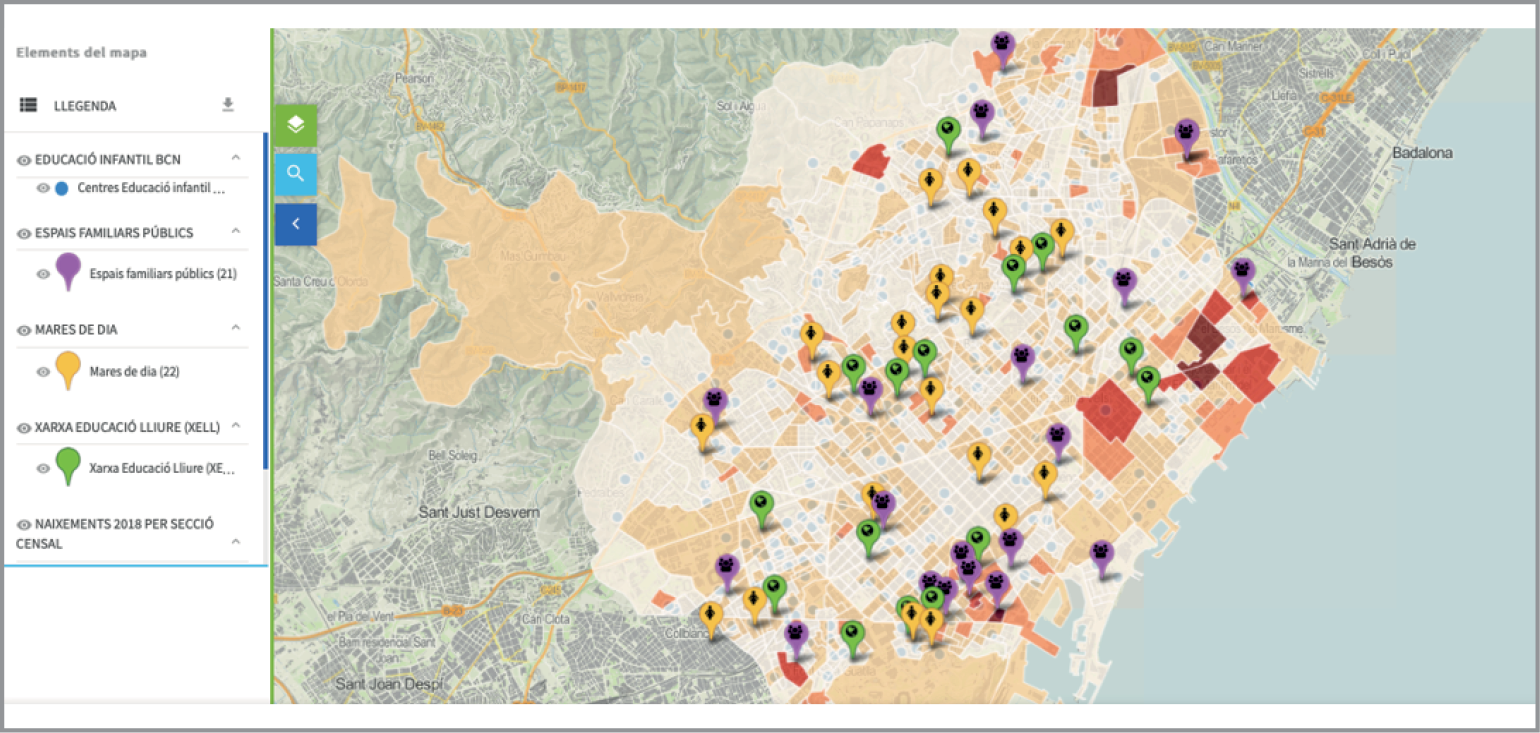
services. Furthermore, they are not evenly distributed across the city. Still, they tend to
concentrate in
currently gentrifying and affluent neighbourhoods such as Gràcia or Poble-Sec, areas where
professionals tend to
live and where a lively civil society favours the emergence of citizen-led initiatives (Cruz
et al., 2017).
In the survey conducted within the project, about 17.1% of our sample
(corresponding to 89
cases) was involved at least once in a social innovation project. Only around 6% of the
sample used social
innovation regularly in each of the three age spans we analysed in our survey (see Table 1).
About 77% of the sample heard of such projects, but only 21.7% of people who were never
involved in the social
innovation would like to try these services.
Self-selection thus characterises the families that participate: they
usually belong to the
most socially active and well-off strata of the intellectual middle-class, as shown in Table
2. Socially innovative projects tend to be chosen more often by professionals,
high-level public sector
staff and the self-employed. Still, manual workers rarely choose this option - at least in
our survey. Most
manual workers do not even know these social innovation projects exist, confirming previous
results that point
to social innovation as mainly a middle-class phenomenon (Cruz et al.,
2017; Maestripieri, 2017). In our survey, 38 of the 89 cases with
contacts with the innovative
projects did not apply for the EBMs. This finding confirms that social innovation is not
exclusively a
second-best choice for those families who do not enter the public system, but an explicit
preference for those
against the institutionalisation of their children.
Table 1. The use of socially innovative care
|
Type of care
|
Between 4 and 12 months |
Between 12 and 24 months |
Between 24 and 36 months |
|
Family care (mother/partner) |
45% |
21.9% |
27.5% |
|
Other relatives/friends |
11.6% |
9.5% |
10.4% |
|
Social innovation (including llars de criança, grups de criança &
espais de criança) |
5.8% |
7.3% |
6.5% |
|
Public nurseries |
18.3% |
34% |
28.3% |
|
Private care (including childminders) |
19.4% |
27.3% |
27.3% |
|
Absolute values |
520 |
465 |
385 |
Table 2. The use of socially innovative care by the occupational position of
the
mother
|
Type of care
|
Experience of SI |
Would use it |
Would not use it |
Do not know SI |
|
Professional |
15.1% |
30.3% |
38.6% |
15.9% |
|
High-level public sector staff |
14.6% |
22.9% |
46.9% |
15.6% |
|
Self-employed worker |
15% |
20% |
25% |
40% |
|
Manual work |
12% |
16% |
32% |
40% |
|
Out of work mother |
19.3% |
16.7% |
38.9% |
25.2% |
|
Absolute values |
89 |
113 |
203 |
115 |
A second important element to consider is the lack of institutional
acknowledgement. This
situation makes it impossible to receive funding from public institutions for the projects'
running costs,
causing a certain economic precariousness that endangered the survival of these projects
even before the
pandemic. The precariousness is only partially compensated for by funding received by the
projects for specific
ventures. This situation does not guarantee long-term financial sustainability for projects
which depend
entirely on the fees paid by the participants.
"The current financial aid for public nurseries is for
regulated schools.
Eh... or the private nurseries that are approved by the education department. A
free-education nursery is
not... it's an association... it's something else. And you can't get help to pay for it,
no. Economically it's
very tough." [Mother, free-education nursery]
"I don't know, it's work, sometimes I work till late,
you need to. And my
colleagues... they too have extra jobs to pay the bills. So I think it's a little
precarious or quite
precarious. And that, if there were a public will to finance this type of education,
with less money than gets
allocated to a public school, we could provide an education with a better ratio and with
lots of innovation.
So it's disappointing." [Educator, community care group]
The situation before the pandemic had already revealed severe
vulnerabilities in the
projects. The small number of children involved in the projects and the educators' working
conditions led to
extreme precariousness. The financial sustainability of the projects is precarious since
they need to find a
delicate equilibrium between very high fixed costs (determined by the private rental market
in a city like
Barcelona) and the need to go beyond a pure non-profit activity for those educators
involved. The results are
fees comparable to private nurseries but, in any case, are pretty expensive for those
families that can access
public nurseries at lower sliding-scale prices. Although they constitute interesting
experiments in terms of
community practices and pedagogical innovations, an unavoidable elitism marks these socially
innovative 0-3
childcare projects. This elitism stems from a lack of public funding since public
institutions cannot support
financially projects that are not recognised as childcare services by the regulation. The
main consequence is
that part of the population is excluded for economic reasons, and these projects are not
recognised as
alternatives to EBM among working-class families (as shown in Table 2).
The financial shock
caused by the 2020 lockdown drastically affected these projects and magnified a situation of
precariousness that
was already in place, as we will see in the following section.
THE IMPACT OF COVID-19 ON FAMILIES
The COVID-19 outbreak generated various needs among social groups that are
usually not
included as needing public and community support (Bertogg & Koos,
2021). If we focus on
families with small children, the closure of nurseries and the need to maintain social
bubbles to protect older
people meant that parents were suddenly left alone to navigate the challenges of juggling
work and family within
their homes (Maestripieri, 2021).
Nevertheless, the mothers who participate in these projects usually belong
to the educated
middle class. Consistent with the literature on the social consequences of COVID-19 (Maestripieri, 2021), they have coped better with the consequences of the
pandemic. As shown in
Table 3, the mothers involved in social innovation projects are usually
medium- and
high-skilled. The majority of mothers participating in social innovation are employed
part-time since
participating in these projects requires the constant involvement of parents, a requirement
usually covered by
the mothers (64% of cases), confirming that even in these families, care is still highly
gendered. If we focus
on the consequences of the pandemic on the economic insecurity of their households, however,
families that opted
for socially innovative projects demonstrated resilience to the COVID-19 crisis. They are
the only category that
showed an increase in economic security after the onset of the COVID-19 outbreak (from 84%
to 88% of households
received unexpected aid of 700 euros monthly). The vast majority of them also do not have
experience in late
payment of utility bills, with only 8% of families first experiencing this after COVID-19
compared to 15% of
those who opt for family care, other relatives or public care.
Table 3. Type of care by socio-economic conditions
|
|
Family care |
Other relatives |
SI. |
Public care |
Private care |
|
Education
|
|
|
|
|
|
|
Low skilled |
40.6% |
12.5% |
3.1% |
40.6% |
3.1% |
|
Medium skilled |
41.5% |
12.2% |
6.1% |
24.4% |
15.8% |
|
High skilled |
29.3% |
11.8% |
4.7% |
26.6% |
27.6% |
|
|
|
|
|
|
|
|
Working activity
|
|
|
|
|
|
|
Inactive |
67.4% |
6.3% |
1% |
16.8% |
8.4% |
|
Part-Time worker |
34.8% |
9.1% |
9.1% |
25% |
21.9% |
|
Full-Time worker |
18% |
15.7% |
3.4% |
31.4% |
31.4% |
|
|
|
|
|
|
|
|
Economic insecurity
|
|
|
|
|
|
|
Received 700€ |
73.8% |
82.3% |
84% |
76.3% |
87.3% |
|
After COVID-19 |
64.3% |
74.2% |
88% |
66.9% |
78.6% |
|
No delay in bills |
81.5% |
83.9% |
92% |
82.7% |
92.9% |
|
Delay due to COVID-19 |
14.9% |
14.5% |
8% |
14.4% |
6.3% |
Despite faring better in the economic crisis, the interviews confirm the
struggles of
families participating in socially innovative projects in terms of work-family balance. In
particular, mothers
had to juggle the re-domestication of care during the spring lockdown, which in the case of
our interviewees
implied the necessity of finding a new balance between home care and working from home.
Despite the advantages
of teleworking, mothers struggled because of the sudden lack of external support, which
included childcare and
an increased load of housework once it was no longer possible to hire external help. The
unpaid workload
increased suddenly, and couples had to find new solutions. Women struggled to cope with
remote work, care and
the impossibility of obtaining help from nannies or grandparents. The government did not put
any specific
economic measures to support families in this challenge. In contrast with the case of other
southern European
countries (such as Italy, for example), in Spain, there was no change in the usual provision
of benefits (Koslowski et al., 2020).
"Well, in the lockdown, we both started to work, both my
partner and me.
So... of course, our child was here, at home, with us, and it's true that we noticed
that there was more
housework, because of course, we had to cook more meals and go shopping more, the truth
is that we also spent
more time on that because of the queues and that it was more difficult." [Mother,
childminder group]
However, we noticed evolving dynamics between mothers and fathers. In
fact, in families
where both parents could work from home, the lockdown had an equalising effect, with care
provision balanced
between mothers and fathers - confirming what the preliminary investigations on COVID-19
published throughout
2020 ascertained (Maestripieri, 2021). For the first time, many fathers
experienced the
possibility of enjoying more time with their children: the reduction in working hours and
the possibility of
working from home meant more time to care for their children, usually a privilege culturally
reserved for
mothers. This situation aligns with recent research about fathers' changing roles in younger
generations, with
men's contribution to housework and childcare increasing significantly among the most
highly-educated profiles
(Ruspini, 2019). But even within this privileged layer of the population,
the care was
rebalanced only when fathers were forced to be at home. If they kept working in person, the
effect of the
COVID-19 emergency was to magnify the gender imbalance in unpaid work, not to reduce it.
"I think *father* is enjoying it more because he can
spend much longer with
her than he usually could. He's delighted. And he says so. Me too, eh! But it's true
that I've had the chance
of spending more time with her than *father*." [Mother, free-education nursery]
"Well, the first two weeks of the State of Alarm, both
my partner and I
worked from home. It was great (I suppose because it was also at the beginning); we took
turns teleworking,
and we were with the children more than ever, especially *partner*, who in "normal life"
on weekdays was only
with the children for a quick breakfast before work/school and when he arrived at 8 in
the evening, just to
have dinner and go to bed. But after those first two weeks that were wonderful,
*partner* had to return to
work in person, at first only in the mornings. Still, after a week, he was already doing
"normal working
hours", and I stayed (and I still am) at home with the children and telework, and it is
horrible. Before,
since *partner* was always away from home, he "did what he could", dinner, filling the
dishwasher, and little
else, so I "did the rest", a lot or a little depending on what needed to be done. We had
a girl who came to
clean the house once a week, but with Coronavirus, obviously, we asked her not to come,
and of course, I did
ALL her tasks, plus specific things like buying clothes, kindergarten registration, etc.
Before, I had a
specific time for each thing: work, home, children. Now everything's mixed together, and
being at home all
day, it gets dirtier, now we not only have breakfast and dinner. We have breakfast,
morning snack, lunch,
afternoon snack and dinner at home, so these dirty dishes are "extras". Although the
dishwasher is my
partner's job, since he's out all day, it has become "one of my tasks". He still puts
one load on, but I do
the extra one." [Mother, free-education nursery]
The situation was very different for unemployed mothers when the lockdown
started. In those
cases, they reverted to a situation where their role was to be a mother 100% of the time,
impacting other facets
of their identities. So, the pandemic was not a mechanism favouring gender equality: the
gender rebalance takes
place when women and men have the same working conditions. When women are economically
dependent on their
partners, families tend to revert to traditional gendered models of care, even though we are
usually talking
about highly educated and empowered women.
"Lockdown at the beginning was a bit... quite hard
because ehm... my partner
worked from home, but he would shut himself in, he still shuts himself in his room and
so... and so, it's not
that he can help me much and so it was me and *child* 24 hours, eh... [...] this was our
lockdown, *child* 24
hours, *partner* when he finished work, around six, seven PM. So he spent an hour with
him, the time that I
was making dinner, eh... that's all." [Mother, community care group]
In conclusion, the COVID-19 emergency has exacerbated inequalities already
present before
the outbreak. What emerges from our data is that affluent families, in which both working
members could work
remotely, could find a new equilibrium in which gendered roles could be questioned. In the
cases in which either
the partner went out to work as usual or in which mothers were not employed, school closures
were covered
entirely by the provision of women's work. In any case, in all households, the pandemic had
constituted a stress
test for the management of unpaid work when families were suddenly deprived of the external
help they usually
received from other women in the form of nannies and cleaners.
THE IMPACT OF COVID-19 ON SOCIAL INNOVATION
As far as educators in these projects are concerned, they have struggled
to survive
financially during closures. Although these projects are not formally recognised as
schooling activities, their
representative associations recommended following the same rules applied to schools and
nurseries. So, they also
closed for the entire spring lockdown. When schools re-opened in September, they followed
the same
recommendations for social distancing applied in public and private nurseries. It has been a
challenging year
for the educators involved in the projects. The higher costs compared to public nurseries
and the uncertainty
with which the school year began led to a fall in demand for socially innovative childcare
services in the city
of Barcelona. This situation arose since families were still working reduced schedules or
living on public
emergency help and could not afford the higher costs of these types of childcare services.
As noted in the previous section, the projects were already struggling to
make ends meet
before the COVID-19 emergency. Only families' fees and the projects' emergency funds could
pay the project's
fixed costs. Of the ten educators that answered our structured interview, only in five
projects it was possible
to cover fixed costs thanks to emergency funds saved before the pandemic; in the other
cases, the continuous
support of families during the pandemic was crucial. When the emergency broke out, the
families' fees made the
difference between the project surviving or having to close, but families stopped paying
their fees in only two
cases out of ten. In six cases, educators reported that at least a part of the families kept
paying their fees
even if they could not access the services because of the restrictions imposed by the first
lockdown. In one
case, the lockdown led to a project closing. The fact that most of the workers in these
projects were women
shows that, again, women were those who paid the higher price for the COVID-19 crisis,
losing their jobs more
frequently (or their individual incomes in this case) (Maestripieri,
2021).
"Lockdown happened halfway through the project moving,
which benefitted us
since we paid the rent for the old premises with our deposit. We established a
continuity fee, lower than
normal, to meet the expenses that almost all families paid since they wanted to
contribute. At the moment, we
have only been able to negotiate a temporary discount on the new rent until November.
Another lockdown could
endanger our fragile economy." [Educator, group of criança]
Furthermore, only five out of the ten projects we talked with directly had
the possibility
of accessing the special funds made available by the government for dependent workers.
Educators partially
compensated for the loss of their incomes thanks to the emergency transfers offered by the
government to
workers, but public support was only available to those who had a contract or were
officially self-employed.
Many projects had only been able to stay afloat pre-pandemic by offering unregulated
agreements to their
workers, so those workers were not eligible for benefits.
Thus, accessing public help was only possible for better funded, more
established projects
with sufficient resources to employ their workers with regular contracts. Although it is
impossible to say how
many of the current projects need to use informal arrangements to make ends meet, it
nevertheless meant that the
more precarious, new, or less profitable projects found it impossible to apply for
government aid. The unstable
situation has hindered the possible consolidation of new initiatives in the near future,
leading to a reduction
in the diversity of 0-3 childcare offered in the city and the potential loss of spaces for
citizen-led
initiatives. Fortunately, the projects dismissed their workers just in one case.
"Then, they closed for these five days and then well…
during the entire
state of alarm until June, the projects were closed. The problem was that the people who
were registered as
self-employed, those people received government aid, right? But well, as we always talk
about the
precariousness of our projects well, many people were working under the table without
being registered, so
these people, well, received collaborative quotas from some of the families, which
helped to support that
person a little. Still, some of them went through a pretty rough time." [Association
representative]
The communities behind the projects, however, were a fundamental resource.
The help was
two-fold: on the one hand, the educators had the flexibility to help those families that
were forced to keep
working in person, and they provided the care required directly in the families' homes,
sometimes even breaking
the rules and risking fines. In addition, families helped each other share childcare: the
flexibility of
teleworking allowed them to take turns caring for their children by creating bubbles in
which they could find
the external help they needed. Instead of resorting to the market (nannies) or the family
(grandparents), the
main welfare actor became the community behind the social innovation projects.
"And then many families found themselves needing someone
to take care of
their children. Right? Because although there was a state of alarm and you were supposed
to stay at home,
there were people who went out to work. And some childminders went to families' homes,
like babysitters. Those
families with essential jobs could have been covered. Well, I suppose this happened with
all families that
took their children to the public nurseries or the private ones too. They didn't have
that service and didn't
know who to leave those tiny children with, and they had essential jobs. Some
childminders did this."
[Association representative]
On the other hand, families kept paying their fees, and this money was
fundamental to avoid
closing down the projects in which their children participated. The trust and bond
established in the community
of care before the pandemic became the social resource that could overcome - at least, in
part - the worst
consequences of the crisis for the projects. However, solidarity in the community of care
did not always occur.
In some cases, the COVID-19 emergency also severely impacted household incomes, with many
fathers and mothers on
furlough or left without clients (in the case of self-employed workers). In other cases,
some of the
participants in the projects broke the mutual aid rule that sustained the community and
reverted to
individualistic solutions.
"We've kept paying, right? But less. […] Well, there
were people who didn't
want to pay. Well, there were families who understood it more as a collective project,
and there were families
who did not. And well, because I don't know, we, for example, thought that beyond the
circumstances... That
the idea is, maybe, if there is a family that can afford to pay more if there is one
that cannot ... That is,
let's collectivise the problem a bit because it's a project that we understand to be
like that, it's
collective. But no. Many people were more like, on their own. "I can't pay, so that I
won't pay." More
one-sided, instead of thinking "I can pay your share and then you will return it to me."
I don't know. So
well, there's been quite a bit of conflict. […] Now there are thirteen families. There
were fifteen of us and
two left. And we'll lose more." [Mother, free-education nursery]
In conclusion, our research findings show that COVID-19 hardly hit the
participants in
social innovations. Still, at the same time, they show that the community became a
fundamental resource for
coping with the emergency caused by the pandemic. Parents and educators helped each other,
sharing care and
financial resources to keep the projects going and finding new work-family balance even when
projects were still
officially closed.