INTRODUCTION
The reconciliation of work with personal and family life is an established
theme in the field of social sciences. Gender differences and the distinct roles played by
women and men in professional and domestic life are among the most covered subjects in
recent literature, with most studies pointing to the persistence of gender disparities, in
which women take on the greatest share of reproductive work (Rashmi &
Kataria, 2022). These differences are largely due to gendered social representations
that attribute responsibilities to men in the public sphere and care and domestic roles to
women (Amâncio, 1994; Monteiro et al., 2015). Likewise,
there has been an increase in the number of articles on family-friendly policies
-particularly studies on the role of mothers-, focusing on the potential of public policies
to either reduce or reinforce inequalities (Li & Zhang, 2023).
In fact, public policies, mainly established at the national level, can
play a major role in determining satisfactory standards of work-life reconciliation and
promoting more egalitarian gender relations, although a change in attitudes, particularly
regarding gender equality, can also take place independently of public policies (Ramos et al., 2019). Therefore, although the relationship between work
and family is significantly influenced by the legal and institutional framework of each life
and work context, the dominant social and cultural norms in each country are a key factor in
understanding the variations in social policies and the way these are perceived at the
individual level (Pfau-Effinger, 2023).
This article presents the results of a quantitative survey of local public
administration employees from the Portuguese region of Cávado, specifically the
intermunicipal community (CIM) of Cávado. The CIM of Cávado is composed of six
municipalities: Amares, Barcelos, Braga, Esposende, Terras de Bouro, and Vila Verde. It is
situated in the northern region of the country, occupying an area of 1246 km2 (INE, 2022), and is a diverse territory, including coastal
municipalities, such as Esposende, and rural mountain municipalities with low population
density, such as Amares or Terras de Bouro, as well as densely populated urban
municipalities, such as Braga (CIM Cávado, 2024). The aim of the CIM is
to create synergies between the different municipalities and to find solutions to shared
problems.
The questionnaire was conceived within the scope of a project aimed at
promoting work-life reconciliation and gender equality through local public policies. The
project began with a diagnosis, in which we carried out the questionnaire survey that
underlies the analysis presented in this article. In addition to indicators on professional
and domestic practices, the survey included questions on gender attitudes, under the
assumption that attitudes towards gender equality have repercussions on the way policies
promoting it are received both by the population at large and within a particular work
organization (Coron, 2020).
In Portugal, female employment patterns display particular qualities
within the European context. The country combines high full-time employment rates for women,
a predominantly dual-earner model based on an “early return to full-time work” (Escobedo & Wall, 2015) and low salaries, with signs of what has come
to be considered a traditional gender culture (Tavora & Rubery,
2013). This traditional gender culture coexists with a strong state orientation
towards the development of public policies promoting equality (Marques et
al., 2021).
On the one hand, the predominance of high female employment and full-time
work, as well as egalitarian legislation, challenge more traditional views of gender. On the
other hand, the entry of women into the labour market was not accompanied by enough care
structures and equipment, or an equivalent entry of men into the domestic and care sphere.
Thus, the strong presence of women in employment, especially those with younger children,
often gives rise to “contradictory and guilt-inducing” attitudes (Ramos et
al., 2019) that hinder defamilization (Perista et al., 2016; Marques et al., 2021).
This is the context on which our research is grounded, together with the
specific features of employment in local public administration. In 2022, the public sector
in Portugal employed 742194 individuals, representing around 15% of total employment -
approximately 75% of public administration workers are employed in central administration,
with the remainder distributed across regional and local administrations (Direção Geral de Administração e Emprego Público [DGAEP], 2023). This
workforce shows a marked aging trend, with a high concentration of employees in older age
groups. Between 2011 and 2022 the number of public administration workers declined across
all age groups under 55, with the most significant decreases in the 25-34 and 35-44 age
groups, representing approximately 11% and 22% of this workforce in 2022, respectively. This
trend is pronounced among local public administration workers - in 2022, 36.2% of local
public administration employees were aged 55 or over, compared to 31.5% in central public
administration (DGAEP, 2023). A strong presence of women is
characteristic of the public employment sector, which - in spite of the changes it has
undergone - offers more favourable working conditions than the private sector, not only in
terms of salaries, but also in terms of working time arrangements and measures to support
work-life balance (European Foundation for the Improvement of Living and
Working Conditions [Eurofound], 2020). In Portugal, as well as the work-life
measures that are available to all workers (namely paid and unpaid leaves), public sector
workers are legally entitled to flexible work arrangements and continuous working days,
which may or may not be possible in the private sector. However, public employment is highly
diverse, including occupational disparities that are relevant to understand variations in
attitudes towards reconciliation, especially at local level.
In Portuguese public administration, women represent 61.8% of the total
number of workers (DGAEP, 2023). There are three main occupational
categories in the local public sector and a strong correspondence with specific educational
levels: senior officers (professionals with higher education, such as legal experts,
engineers, economists, HR managers); technical assistants (technical and administrative
occupations, usually with non-tertiary education); and operational assistants (support staff
in areas such as cleaning, gardening or maintenance, with basic educational levels). In
2022, around 55% of public administration workers held higher education degrees, while 27%
and 18% had secondary and basic education, respectively - these distributions differ in
local public administration, where 30.0% held higher education, 31.5% secondary, and 38.5%
basic education (DGAEP, 2023). Women are overrepresented among senior
officers (68.7%) and technical assistants (73.2%). They are also predominant in middle
management positions (56.9%), but most top management positions are still occupied by men
(55.7%). There is also a strong occupational gender segregation in specific sectors: for
instance, men represent 80.3% of local police agents and 95.9% of fire workers (DGAEP, 2023). The sector is therefore subject to logics of labour market
segregation, both horizontal and occupational, as well as vertical (Burchell,
1996; Mora & Ruiz-Castillo, 2004; Monteiro et
al., 2015).
This article begins by presenting the Portuguese context. In the following
sections, we focus on the methodology, results and their discussion. We finish with the main
conclusions and limitations of the study.
Portugal: Between traditionalism and embracing gender equality
Portugal is a particular case with regard to gender equality in the EU
context: while it shares traditional values and representations with some countries from the
south of Europe (particularly, Italy
1
), whether specifically concerning gender or with a consequence for gender equality, it
shares other practices with countries from the north of Europe, such as the widespread
presence of women in the labour market. In Portugal, the female employment rate for women
between the ages of 15 and 64 was 74.0% in 2022, i.e. above the EU-27 average of 69.5% (Eurostat, 2022). Women are more widely represented in the Portuguese
labour market than in other countries from the south of Europe, such as Italy or Greece
(with employment rates for the same year of 56.4% and 61.4%, respectively) and mainly work
full-time, as opposed to countries from the north of Europe. In Portugal, only 7.2% of
employed people work part-time, in contrast with 17.8% of employed people in the European
Union (Eurostat, 2023a).
However, the significant presence of women in the Portuguese labour market
cannot be immediately attributed to more egalitarian gender attitudes, but instead to the
fact that Portugal is also one of the Western European countries where people receive some
of the lowest work-related income, representing a fourth of the income earned in Nordic or
Central European countries (Leão et al., 2024). The need for an income
from work results in maternity not having its usual impact of diminishing the presence of
women in the labour market, although it still influences career progression and exacerbates
inequalities in care work (Leão et al., 2024). Portugal is the European
country where women spend most time (more than four hours a day) on household chores or
childcare, and where the difference between women and men is the greatest (European
Institute for Gender Equality [EIGE], 2022a). The participation of men in household and care
responsibilities is a gender equality dimension that is still found to be lacking, with
care, reproductive and unpaid work being ensured by women through the “second shift” in the
domestic sphere (Blair-Loy et al., 2015; Hochschild &
Machung, 1989). As demonstrated by several studies, Portuguese women combine their
active participation in the labour market with a domestic and care workload, which continues
to be mainly taken on by them (Amâncio & Correia, 2019; Perista et al., 2016; Rodrigues et al., 2015; Wall et al., 2016), with repercussions on women’s mental health and
wellbeing (Guerreiro & Carvalho, 2007).
In terms of values, according to the World Values Survey (2017-2022), and
taking the Inglehart-Welzel world cultural map as reference, Portugal appears close to 0.5
on the axis of survival (with emphasis on economic and physical security) vs.
self-expression values (support for post-materialistic values, including gender equality),
therefore already qualifying for the latter, albeit still somewhat tentatively (Haerpfer et al., 2022). Within the axis that measures traditional
(including traditional family values) vs. secular values (distance from traditional family
values and support for egalitarian gender roles), Portugal continues to appear in the
former, although close to 0.0. Therefore, we seem to be facing a changing society (Torres et al., 2013), which is becoming more open and supportive of
diversity and gender equality, although still situated within traditional values,
characteristic of weaker economies, where families rely more heavily on the state (Haerpfer et al., 2022). This is probably a consequence of the nearly
fifty-year-long dictatorship that promoted different roles for women and men both inside and
outside the family (Wall et al., 2016), and which only came to an end in
1974 with the Carnation Revolution.
When analysing indicators directly linked with gender equality, there are
also signs of more traditional views coexisting with more progressive approaches. According
to data from the Eurobarometer (European Commission, 2017), Portugal and
Sweden have the greatest consensus in EU-28 countries in totally agreeing that the promotion
of gender equality is important to ensure a fair and democratic society (98.0). However,
Portugal is close to the EU-28 average in the gender stereotype index (7.3), scoring 7.2,
while Sweden scores 3.0 (EC, 2017).
Ever since the restoration of democracy in 1974, there has been
significant development at legislation level, as well as progress in public policies
promoting gender equality or affecting gender equality. In the Social Institutions and
Gender Index (Organization for Economic Co-Operation and Development [OECD],
2023), Portugal gets a score of “very low” for gender discrimination. However, in
the EU’s Gender Equality Index, more anchored in measuring practices than legislation,
Portugal scored 67.4 in the same year, below the EU-27 average of 70.2 (EIGE,
2022b).
Policies to promote gender equality
Although at a less immediate pace than legislation, public policies
promoting gender equality have been developing in Portugal and were initially driven by the
country’s accession to the then European Economic Community in 1986. In 1997, the first
Global Plan for Equality was approved (Resolution of the Council of Ministers 49/97), with
the aim of combating discrimination, promoting equal participation of women and men in the
different spheres of live, and ensuring work-life reconciliation for both men and women.
Successive national plans followed until the launch of the current National Strategy for
Equality and Non-Discrimination 2018-2030 (Resolution of the Council of Ministers 61/2018).
Important policy measures to tackle gender disparities in the family
sphere and in care have also been developed and implemented in the country, namely
recognition of the right to work-life reconciliation for all workers (since 1997);
compulsory parental leave to be used exclusively by the father (since 1999); incentives for
shared parental leave; and the terminology employed, since 2009, determining the use of the
expression “parental leave”, as opposed to “maternity” or “paternity”.
Portugal’s administrative structure is highly centralized, with policies
being determined mostly by the central government. However, concrete efforts have been made
to emphasize the role of municipalities in the promotion of gender equality, namely the
creation of the Municipal Plans for Equality, coordinated by municipal councils. Recently,
the National Strategy for Equality and Non-Discrimination 2018-2030 encouraged widespread
implementation of these in all 308 Portuguese municipalities, as well as the creation of
intermunicipal plans for equality. These plans should include measures to promote gender
equality internally, such as the implementation of flexible working time arrangements, or
incentives to using parental leave, and others aimed at the promotion of gender equality
externally, in areas such as education, health, social services, urban planning, or
environment. However, at the time of our study, none of the municipalities involved in our
research had an equality plan in place.
Methodology
Procedures
To meet the objectives of the study, a questionnaire survey was
conducted with local public administration employees from the Cávado’s CIM in Portugal.
The questionnaire was specifically designed for this study and
included attitude indicators and scales previously validated in the literature. The
pre-test questionnaire was applied during the month of July 2021 to approximately thirty
employees, who formed a diverse sample in terms of gender, age, schooling, professional
category and work department. Once the necessary changes were made, the survey was
conducted between the months of September 2021 and January 2022, both online and in
person, to ensure participation from employees with less access to technology.
All participants were informed of the objectives of the study - the
application of the survey was preceded by information sessions about the project, during
which workers were encouraged to participate. Participation was voluntary, the anonymity
of all employees was ensured, and prior consent was required before answering the
questionnaire.
Sample
The universe of the study consists of 3708 local public administration
employees from the CIM of Cávado. All employees from the six municipalities were invited
to participate in the study by email, letter, or through their direct superiors. A total
of 2375 valid responses were obtained, corresponding to a response rate of 64%. Although
the questionnaire was distributed to the entire population, participation was voluntary
and based on self-selection. Therefore, the sample is considered non-probabilistic, as
no random selection process was applied. Nevertheless, we have obtained a statistically
robust sample which ensures a high degree of statistical representativeness.
Measures
To analyse gender representations among the study population, we used
a variable including 10 statements, in relation to which participants had to express
their agreement or disagreement on a four-point Likert scale, where 1 meant “totally
agree” and 4 “totally disagree”. We gave priority to the use of measures already
validated in international surveys and applied in Portugal (Monteiro et
al., 2015; Wall et al., 2016; Leite et al.,
2016) - International Social Survey Programme (ISSP Research
Group, 1988, 2012); European Social Survey [ESS] (2004); European Values Study [EVS] (1999); we also used a statement of our
own, adapted from a previous study (Saleiro & Sales Oliveira,
2018):
-
When jobs are scarce, men should have more right to a job
than women (ESS, 2004)
-
A husband’s job is to earn money. A wife’s job is to look
after the home and family (ISSP Research Group, 1988, 2012)
-
It’s better to have a man as your boss than a woman (Leite et al., 2016; Monteiro et al.,
2015)
-
All in all, family life suffers when the woman has a
full-time job (ISSP Research Group, 1988, 2012; Monteiro et al., 2015)
-
In the organization where I work, there are jobs that
should be done only by men and others only by women (Leite et
al., 2016; Monteiro et al., 2015)
-
In a couple, the man and woman should share the household
chores equally (ISSP Research Group, 2012; Wall et al., 2016)
-
The father is just as capable as the mother of looking
after a baby under the age of one (ISSP Research Group,
1998, 2012; EVS, 1999)
-
Children suffer when fathers are not involved in childcare
(ISSP Research Group, 2012; Wall et al.,
2016)
-
Women already have the same opportunities as men in
professional life (Leite et al., 2016)
-
Inequality between men and women is a thing of the past
(Saleiro & Sales Oliveira, 2018)
Considering the strong social desirability pressure of the topic, and
the likelihood of respondents showing socially acceptable behaviour, the original scales
were adapted to four-point measures to avoid misuse of the midpoint and to force a
choice (Chyung et al., 2017). Data analysis included an initial
exploratory review (distributions and missing values), descriptive comparisons of
agreement levels by gender, and a principal component analysis (PCA with varimax
rotation) to reduce dimensionality and identify components underlying gender attitudes.
These components were tested for internal consistency and used in bivariate analysis
(t-test and one-way ANOVA), conducted separately for women and men, to assess
differences by age, education, geographic area, and parenthood. The results were
significant at 0.05. Data was analysed with the SPSS (Statistical Package for Social
Sciences, IBM SPSS Statistics version 28.0).
Results
Description of the sample
Table 1 presents the main sociodemographic characteristics of the
sample by gender. In line with the gender distribution in Portuguese public
administration, the sample is mainly composed of women (62.7%). Ages range between 20
and 69 and the average age is approximately 48 (SD=9.6). The most represented age group
is 45-54-year-olds (36.9%), followed by 35-44-year-olds (24.0%). Just as with the
current age distribution in Portuguese public administration, where there is a
pronounced ageing trend (DGAEP, 2023), older employees are more represented than younger
ones. Men are more represented in the 55 and over age group, which is a legacy of the
more recent massive entry of women into the formal labour market in Portugal.
Most of the respondents completed secondary education (International
Standard Classification of Education, ISCED 3) (40.3%), and the percentage of those with
higher education (31.1%) is virtually the same as those who only completed basic
education (ISCED 2) (28.6%). The large proportion of less qualified workers reflects not
only the levels of formal schooling in the country, where most of the population has
received less education (Eurostat, 2023b), but also in municipal
public administration, where, as previously mentioned, the percentage of workers with
higher education still falls short of that in central public administration (DGAEP,
2023). However, as a recent trend in Portuguese society, women are more qualified than
men and are more represented in secondary education (45.3% of women and 32.0% of men)
and in higher education (32.4% and 28.9% respectively). Men are still significantly more
represented in primary education (39.1% of men and 22.3% of women).
The majority of workers are concentrated in urban areas, which are
more densely populated, and most of them are women. Regarding parenthood, most
respondents have children (80.2%), although more women than men have children.
Table 1 Sociodemographic characteristics of female and male workers
|
|
n |
% |
Women
|
Men |
| Gender
2
|
Women |
1488 |
62.7 |
| Men |
886 |
37.3 |
| Total |
2374 |
100.0 |
n |
% |
n |
% |
| Age |
≤ 34 |
202 |
9.8 |
133 |
10.0 |
69 |
9.5 |
| 35 - 44 |
493 |
24.0 |
322 |
24.2 |
170 |
23.5 |
| 45 - 54 |
757 |
36.9 |
511 |
38.4 |
246 |
34.0 |
| 55 - 59 |
322 |
15.7 |
201 |
15.1 |
121 |
16.7 |
| ≥ 60 |
280 |
13.6 |
162 |
12.2 |
118 |
16.3 |
| Total |
2054 |
100.0 |
1329 |
100.0 |
724 |
100.0 |
| Education |
Basic |
673 |
28.6 |
330 |
22.3 |
342 |
39.1 |
| Secondary
|
950 |
40.3 |
670 |
45.3 |
280 |
32.0 |
| Tertiary
|
733 |
31.1 |
480 |
32.4 |
253 |
28.9 |
| Total |
2356 |
100.0 |
1480 |
100.0 |
875 |
100.0 |
| Geographical area |
Urban |
1821 |
77.2 |
1169 |
79.2 |
652 |
73.9 |
| Rural |
538 |
22.8 |
307 |
20.8 |
230 |
26.1 |
| Total |
2359 |
100.0 |
1476 |
100.0 |
882 |
100.0 |
| Children |
Yes |
1888 |
80.2 |
711 |
47.8 |
391 |
44.1 |
| No |
467 |
19.8 |
777 |
52.2 |
495 |
55.9 |
| Total |
2355 |
100.0 |
1488 |
100.0 |
886 |
100.0 |
Attitudes towards gender roles
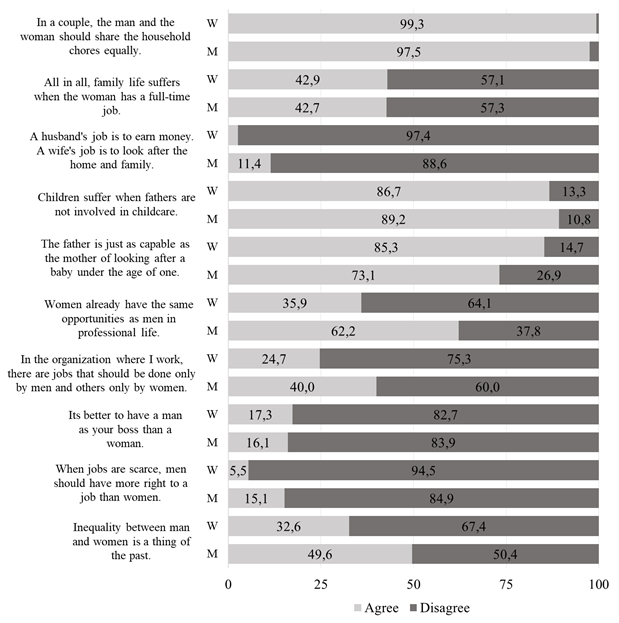
Considering each of the statements individually and merging the
totally agreement/totally disagreement and the agreement/disagreement levels, results
show tendentially egalitarian gender attitudes, although these are more evident in the
group of women (Figure 1).
The statement that points towards a stereotyped view of gender roles,
where men are expected to be the economic providers of the family and women are expected
to care for the home and family, has the highest levels of disagreement. For women, this
disagreement is almost consensual, while for men, 11.4% still agree with the statement.
The statement with the highest level of agreement is that which indicates the need for
an equal division of household chores between women and men, with the highest level of
consensus both for men and for women.
Figure 1 Attitudes of female workers and male workers towards gender equality
(%)
Source: Questionnaire survey "Equality and reconciliation of personal,
family and professional life" in the NUTSIII Cávado (2021/22). Own elaboration.
To reduce multidimensionality and increase the interpretability of
data, a principal component analysis (PCA) with orthogonal rotation (varimax) was
conducted. The adequacy of the data for PCA was confirmed by the Kaiser-Meyer-Olkin
test, with a score of 0.768 - above the usually considered acceptable 0.6 (Reis, 2001) -, and by the Bartlett’s test of sphericity, which was
significant (X
2
(45)=3460.292, p<0.05). The analysis of eigenvalues indicates that
three factors meet the Kaiser criterion (eigenvalue>1) and explain 54.7% of the total
variance. The scree plot also showed inflections retaining three factors. Based on these
statistical results and existing literature, three principal components were retained
(Table 2).
Component 1 - gender attitudes in the work-family interface -
includes statements that point towards stereotyped gender views concerning the role that
women and men should play in employment, in organizations and in the family, and
specifically, in the way of reconciling work and family. Component 2 - gender
attitudes in housework and care - includes statements referring to egalitarian
social representations in terms of the division of household and care responsibilities
between women and men. Component 3 - perceptions of the evolution of gender
equality - includes views on gender equality at a global level, indicating
attitudes of gender blindness or gender (un)awareness. Among the three, component 2 is
associated with the most egalitarian attitudes, followed by component 1, and then
component 3.
Based on these components, we created composite variables by
calculating the mean of employees’ responses to the items with the highest loadings in
each dimension. For component 2, item scores were reversed to ensure that higher values
consistently correspond to more egalitarian attitudes (i.e. 4 = highest level of
agreement).
To assess the internal consistency of each component, we calculated
Cronbach’s alpha, the Spearman-Brown coefficient, and the average of inter-item
correlations. Component 1 proved to have adequate consistency [α = 0.699; average of
inter-item correlations = 0.47, i.e. within the 0.15-0.50 range recommended by Clark and Watson (1995)]. Component 2 presented a lower alpha (α =
0.500); although values below 0.6 are usually considered to reflect poor reliability,
they are not necessarily unacceptable - particularly in exploratory research or when
components include a small number of items, as is the case here (George
& Mallery, 2003). Moreover, the average inter-item correlation for this
factor was 0.51, suggesting a strong internal relationship between the items. Component
3 obtained an alpha of 0.618 and an inter-item correlation of 0.45, which is considered
acceptable within the context of exploratory analyses.
Table 2 Gender attitudes. PCA with varimax rotation
| |
Principal components
|
| Variables
|
Gender
attitudes in the work-family interface |
Gender
attitudes in housework and care |
Perceptions
of the evolution of gender equality |
| When jobs
are scarce, men should have more right to a job than women. |
0.736 |
-0.211 |
0.251 |
| A husband’s
job is to earn money. A wife’s job is to look after the home and family.
|
0.695 |
-0.224 |
0.197 |
| It's better
to have a man as your boss than a woman. |
0.690 |
-0.044 |
0.045 |
| All in all,
family life suffers when the woman has a full-time job. |
0.622 |
0.042 |
-0.109 |
| In the
organization where I work, there are jobs that should be done only by
men and others only by women. |
0.580 |
-0.076 |
0.172 |
| In a couple,
the man and woman should share the household chores equally. |
-0.145 |
0.730 |
-0.077 |
| The father
is just as capable as the mother of looking after a baby under the age
of one. |
-0.207 |
0.691 |
0.147 |
| Children
suffer when fathers are not involved in childcare. |
0.055 |
0.685 |
-0.168 |
| Women
already have the same opportunities as men in professional life. |
0.069 |
-0.050 |
0.848 |
| Inequality
between men and women is a thing of the past. |
0.205 |
-0.044 |
0.791 |
| % variance
explained |
23.4 |
15.9 |
15.5 |
| α (average
inter-item correlation) |
0.699(0.47)
|
0.500(0.51)
|
0.618(0.45)
|
Subsequently, and to understand to what extent the independent
variables of the study explain the existence of significant differences in each of the
components, we conducted several bivariate analyses, performing t-tests for the
differences between means and analyses of variance (one-way ANOVA), in two subsamples:
women and men.
Gender attitudes in the work-family interface
Table 3 shows the results of the statistical tests carried out for the
first dimension, where higher mean scores reflect more egalitarian gender attitudes.
Overall, workers tend to reveal egalitarian social representations regarding gender
division in employment (M=3.12, SD=0.526).
Table 3 Gender attitudes of female workers and male workers regarding
employment
| |
|
Mean |
SD |
Statistic
|
Mean
Difference |
| Gender |
Women |
3.175 |
0.467 |
t(1303.376)=6.210***
|
|
| Men |
3.018 |
0.602 |
|
|
|
Women
|
| Age |
≤ 34 |
3.515 |
0.388 |
F(4.1198)=24.016***
|
≤ 34 ≠
35-44*** |
| 35 - 44 |
3.240 |
0.427 |
|
≤ 34 ≠
45-45*** |
| 45 - 54 |
3.184 |
0.441 |
|
≤ 34 ≠
55-59*** |
| 55 - 59 |
3.105 |
0.453 |
|
≤ 34 ≠ 60 or
more *** |
| ≥ 60 |
3.020 |
0.509 |
|
55-59 ≠
35-44* |
| |
|
|
|
≥ 60 ≠
35-44*** |
| |
|
|
|
≥ 60 ≠
45-54*** |
| Education |
Basic |
2.947 |
0.474 |
F(2.1309)=94.273***
|
Basic ≠
Secondary** |
| Secondary
|
3.122 |
0.427 |
|
Basic ≠
Secondary*** |
| Tertiary
|
3.387 |
0.425 |
|
Secondary ≠
Tertiary*** |
| Geographical area |
Urban |
3.175 |
0.470 |
t(1304)=0.424
|
|
| Rural |
3.162 |
0.456 |
|
|
| Children |
Yes |
3.130 |
0.461 |
t(1308)=-7.350***
|
|
| No |
3.363 |
0.449 |
|
|
|
Men
|
| Age |
≤ 34 |
3.232 |
0.698 |
F(4.658)=14.639***
|
55-59 ≠ ≤
34* |
| 35 - 44 |
3.246 |
0.524 |
|
55-59
≠35-44*** |
| 45 - 54 |
3.093 |
0.535 |
|
≥ 60 ≠ ≤
34*** |
| 55 - 59 |
2.918 |
0.553 |
|
≥ 60 ≠
35-44*** |
| ≥ 60 |
2.773 |
0.582 |
|
≥ 60 ≠
45-54*** |
| Education |
Basic |
2.708 |
0.597 |
F(2.758)=102.675***
|
Basic ≠
Secondary*** |
| Secondary
|
3.032 |
0.488 |
|
Basic ≠
Tertiary*** |
| Tertiary
|
3.389 |
0.497 |
|
Secondary ≠
Tertiary*** |
| Geographical area |
Urban |
3.079 |
0.586 |
t(760)=5.228***
|
|
| Rural |
2.819 |
0.607 |
|
|
| Children |
Yes |
2.985 |
0.591 |
t(759)=-3.049**
|
|
| No |
3.148 |
0.630 |
|
|
| *p<0.05
**p<0.01 ***p<0.001 |
The analysis shows significant differences between men and women,
indicating that, on average, women (M=3.175, SD=0.467) hold more egalitarian
attitudes than men (M=3.018, SD=0.602) concerning gender attitudes in the
work-family interface [t(1303.376) = 6.210, p = 0.000].
There are also significant differences in terms of age groups for
women [F(4.1198) = 24.016, p = 0.000] and for men [F(4.658) =
14.639, p = 0.000]. In the sub-sample of women, younger individuals (until the
age of 34) present the most egalitarian social representations (M=3.515,
SD=0.388), whereas older ones present the least egalitarian views (M=3.020,
SD=0.509). As we progress along the age groups, mean scores decrease. Significant
differences were found between the group of younger workers and all the other age
groups, as well as between the older age groups (55-59 years old and 60 or older) and
the groups immediately preceding them (35-44 years old and 45-54 years old). However, in
the sub-sample of men, workers aged 35-44 years show relatively more egalitarian
attitudes (M=3.246, SD=0.524) than the youngest ones (M=3.232, SD=0.698).
Significant differences were found between the oldest age group and the three age
categories immediately preceding, and between those aged 55-59 years and the two
youngest age groups.
The level of schooling also influences individuals’ gender attitudes
for both women and men [F(2.1309) = 94.273, p = 0.000 and F(2.758)
= 102.675, p = 0.000, respectively], as significant differences were found
between all educational levels under analysis. As the level of schooling increases,
workers tend to reveal more egalitarian social representations, on average. Workers who
only completed basic education present less egalitarian attitudes than those who
completed secondary education or higher education, on average. The latter are those with
the most egalitarian social representations, both in the sub-sample of women and of men,
although women show higher levels of egalitarian views than men in all three educational
categories.
The geographic area impacted significantly the attitudes of men
(t(760) = 5.228), with those working in urban areas showing more egalitarian
attitudes (M=3.079, SD=0.586) but showed no significant impact in the group of
women.
Finally, parenthood appears to be related to less egalitarian
attitudes, as individuals without children showed more egalitarian views than those with
children, both in the subsample of women [t(1308) = -7.350, p = 0.000],
and of men’s [t(759) = -3.049, p = 0.000]. The difference between having
or not children is greater for men. Men with children show less egalitarian views
(M=2.985, SD=0.591) than women with children (M=3.130, SD=0.461), and
women without children present more egalitarian views (M=3.363, SD=0.449) than
men without children (M=3.148, SD=0.630).
Gender attitudes in housework and care
Just as in component 1, the results show significant effects between
women and men [t(1446.585) = 4.981, p = 0.000] in the component that
measures representations regarding household and care responsibilities, with women
revealing more egalitarian attitudes (M=3.380, SD=0.459) than men
(M=3.267, SD=0.526) (see Table 4).
Age also proved to be a statistically significant variable, both in
the case of women [F(4.1197) = 14.745, p = 0.000], and of men
[F(4.663) = 10.611, p = 0,000]. Overall, younger women show more
egalitarian attitudes than older women, especially in the lower age groups (until the
age of 34) (M=3.648, SD=0.402) which has a statistically significant difference
from all the others, and the group immediately after it - 35-44 years old
(M=3.416, SD=0.446), which is also significantly different from the oldest age
group, 60 and over (M=3.249, SD=0.502). The youngest men (M=3.385,
SD=0.534), on the other hand, only differ significantly from the oldest ones
(M=3.052, SD=0.521), with no significant differences from the 55-59 age group
(M=3.220, SD=0.476). The second youngest age group of men, 35-44 years old
(M=3.449, SD=0.478), in turn, differs significantly from the 55-59 age group
(M=3.220, SD=0.476).
Education also has a significant effect on the representations of
women [F(2.1314) = 23.308, p = 0.000] and men [F(2.765) = 35.528,
p = 0.000] regarding attitudes towards domestic chores and caring. Both women
(M=3.495, SD=0.465) and men (M=3.458, SD=0.492) with higher education have
more egalitarian attitudes than women and men with lower degrees, respectively. The
difference lies in the fact that in the groups of men there is also a statistically
significant difference between those with secondary education (M=3.303, SD=0.498)
and those with only basic education (M=3.086, SD=0.521).
Just as in the previous component, the geographic area impacted
significantly the attitudes of men [t(767) = 5.129, p = 0,000], with those
working in urban areas showing more egalitarian attitudes (M=3.321, SD=0.515) but
showed no significant impact in the group of women.
Finally, parenthood appears to be related to less egalitarian
attitudes for women [t(1313) = -4.245, p = 0.000], as women without
children (M=3.489, SD=0.466) showed more egalitarian views than those with
children (M=3.355, SD=0.454). However, in the sub-sample of men, this variable
showed no significant effect on this component.
Table 4 Gender attitudes of female workers and male workers regarding the
division of household and care responsibilities
| |
|
Mean |
SD |
Statistic
|
Mean
Difference |
| Gender |
Women |
3.380 |
0.459 |
t(1446.585)=4.981***
|
|
| Men |
3.267 |
0.526 |
|
|
|
Women
|
| Age |
≤ 34 |
3.648 |
0.402 |
F(4.1197)=14.745***
|
≤ 34 ≠
35-44*** |
| 35 - 44 |
3.416 |
0.446 |
|
≤ 34 ≠
45-45*** |
| 45 - 54 |
3.363 |
0.455 |
|
≤ 34 ≠
55-59*** |
| 55 - 59 |
3.335 |
0.438 |
|
≤ 34 ≠ ≥
60*** |
| ≥ 60 |
3.249 |
0.502 |
|
35-44 ≠ ≥
60* |
| Education |
Basic |
3.282 |
0.449 |
F(2.1314)=23.308***
|
Tertiary ≠
Basic*** |
| Secondary
|
3.339 |
0.443 |
|
Tertiary ≠
Secondary*** |
| Tertiary
|
3.495 |
0.465 |
|
|
| Geographical area |
Urban |
3.385 |
0.461 |
t(1307)=1.110
|
|
| Rural |
3.351 |
0.455 |
|
|
| Children |
Yes |
3.355 |
0.454 |
t(1313)=-4.245***
|
|
| No |
3.489 |
0.466 |
|
|
|
Men
|
| Age |
≤ 34 |
3.385 |
0.534 |
F(4.663)=10.611***
|
≥ 60 ≠ ≤
34** |
| 35 - 44 |
3.449 |
0.478 |
|
≥ 60 ≠
35-44*** |
| 45 - 54 |
3.295 |
0.535 |
|
≥ 60 ≠
45-54** |
| 55 - 59 |
3.220 |
0.476 |
|
55-59
≠35-44* |
| ≥ 60 |
3.052 |
0.521 |
|
|
| Education |
Basic |
3.086 |
0.521 |
F(2.765)=35.528***
|
Basic ≠
Secondary*** |
| Secondary
|
3.303 |
0.498 |
|
Basic ≠
Tertiary*** |
| Tertiary
|
3.458 |
0.492 |
|
Secondary ≠
Tertirary** |
| Geographical area |
Urban |
3.321 |
0.515 |
t(767)=5.129***
|
|
| Rural |
3.097 |
0.526 |
|
|
| Children |
Yes |
3.268 |
0.514 |
t(764)=-0.364
|
|
| No |
3.285 |
0.567 |
|
|
| *p<0.05
**p<0.01 ***p<0.001 |
Perceptions of the evolution of gender equality
In component 3, significant differences could be noticed according to
gender [t(2131) = 11.697, p = 0.000], with women presenting more awareness
of the persistence of gender inequalities (M=2.775, SD=0.731) than men
(M=2.393, SD=0.721) (see table 5).
Significant differences by age groups were found in the sub-sample of
women [F(4.1216) = 8.420, p = 0.000], but showed no effect for men.
Younger women (until the age of 34) present more egalitarian social representations on
average than all the other age groups (M=3.096, SD=0.720). As age increases,
gender-awareness views diminish, i.e. those that recognize that there is still some room
for improvement in the current state of gender equality.
The level of schooling also has significant impact on the assessments
of the current state of gender equality in Portugal, for both women [F(2.1341) =
53.813, p = 0.000], and men [F(2.776) = 5.307, p = 0.000]. Higher
levels of schooling are associated with greater awareness of gender inequalities.
Workers with basic education are, on average, less aware than those with secondary
education, or higher education. The latter are those with greater awareness. In the
group of women, significant differences were found between all three educational levels,
while for men, these differences are only significant between basic education
(M=2.288, SD=0.671) and higher education (M=2.489, SD=0.772). Having
children or not is another element with an impact on assessments of the current
situation of gender equality in Portugal. Significant differences could be noticed
between workers with and without children, for both women and men. Women without
children (M=3.026, SD=0.674) present a less positive view of the current
situation of gender equality than women with children, on average (M=2.718,
SD=0.731). In the same line, men without children show more gender awareness
(M=2.519, SD=0.782), than those with children (M=2.368, SD=0.701).
Finally, geographic area does not seem to determine individuals’ views
of the current situation of gender equality in these groups of workers.
Table 5 Perceptions of female workers and male workers of the evolution of
gender equality
| |
|
Mean |
SD |
Statistic
|
Mean
Difference |
| Gender |
Women |
2.775 |
0.731 |
t(2131)=11.697***
|
|
| Men |
2.393 |
0.721 |
|
|
|
Women
|
| Age |
≤ 34 |
3.096 |
0.720 |
F(4.1216)=8.420***
|
≤ 34 ≠
35-44* |
| 35 - 44 |
2.851 |
0.730 |
|
≤ 34 ≠
45-45*** |
| 45 - 54 |
2.751 |
0.727 |
|
≤ 34 ≠
55-59*** |
| 55 - 59 |
2.720 |
0.685 |
|
≤ 34 ≠ ≥
60*** |
| ≥ 60 |
2.641 |
0.717 |
|
|
| Education |
Basic |
2.530 |
0.718 |
F(2.1341)=53.813***
|
Basic ≠
Secondary** |
| Secondary
|
2.698 |
0.695 |
|
Basic ≠
Tertiary*** |
| Tertiary
|
3.044 |
0.700 |
|
Secondary ≠
Tertiary*** |
| Geographical area |
Urban |
2.780 |
0.725 |
t(1336)=0.599
|
|
| Rural |
2.751 |
0.750 |
|
|
| Children |
Yes |
2.718 |
0.731 |
t(430.327)=-6.563***
|
|
| No |
3.026 |
0.674 |
|
|
|
Men
|
| Age |
≤ 34 |
2.477 |
0.757 |
F(4.669)=0.582
|
|
| 35 - 44 |
2.466 |
0.744 |
|
|
| 45 - 54 |
2.407 |
0.739 |
|
|
| 55 - 59 |
2.345 |
0.687 |
|
|
| ≥ 60 |
2.400 |
0.719 |
|
|
| Education |
Basic |
2.288 |
0.671 |
F(2.776)=5.307**
|
Basic ≠
Tertiary** |
| Secondary
|
2.416 |
0.715 |
|
|
| Tertiary
|
2.489 |
0.772 |
|
|
| Geographical area |
Urban |
2.398 |
0.747 |
t(359.198)=0.375
|
|
| Rural |
2.377 |
0.640 |
|
|
| Children |
Yes |
2.368 |
0.701 |
t(775)=-2.374*
|
|
| No |
2.519 |
0.782 |
|
|
| *p<0.05
**p<0.01 ***p<0.001 |
Discussion
In general, the representations expressed by local public administration
employees from the CIM of Cávado tend towards agreeing with equality between men and women.
This is in line with the path followed by Portuguese society over the last fifty years,
after breaking with a dictatorship opposed to changes in gender roles within families, at
work and in society at large. However, in all the components of analysis, women consistently
showed more egalitarian social representations than men. It is mainly women who feel the
effects of gender inequalities on their rights and on their well-being. In this sense, they
are much more aware that equal opportunities between men and women are still largely
unfulfilled, as shown by the results of component 3, the one with the greatest difference
between the appreciation of men and women. This difference in attitudes based on gender has
been noted in the literature, with women usually having more egalitarian attitudes in
countries that are less egalitarian, although with some country variations (McDaniel, 2008). The high rates of women’s participation in the
Portuguese labour market also influence this difference, since it is recognized that women
with paid work tend to have more egalitarian attitudes than those without (Khoudja & Fleichmann, 2018; Lietzmann &
Froderman, 2023; Preston, 2023).
The predominance of egalitarian attitudes is visible both in the sphere of
work and in the sphere of household and care responsibilities. However, in general, the most
egalitarian social representations were found regarding the participation of men in private
life. The component relating to the sharing of responsibilities for household chores and
care is the one with the least differences between the overall average for men and women and
where it is possible to notice a generational effect, with men from younger generations
presenting more egalitarian views than older ones. In line with what has been demonstrated
by Cunha et al. (2017), Escobedo & Wall (2015), or
Farré et al. (2022), for the case of Portugal and Spain, tendentially
egalitarian attitudes regarding the role of men in the family can already be seen. This is
partly due to investments in public policies, or to an openness towards having gender
equality policies implemented, even though the least egalitarian social representations
continue to come from men. Also, a result of the evolution of public policies, education
seems to have an influence on the formation of more egalitarian attitudes, both in the case
of women and men.
The participation of women in the formal labour market already has a
longer tradition in Portugal, which has one of the highest female full-time employment rates
in Europe. However, although there is broad consensus on the participation of women in the
labour market, there is less agreement on the impact that participation has on family life.
In fact, if women's pursuit of full-time employment does not go hand in hand with men
entering the spheres of work, home, and care, the quality of domestic and care work could
suffer. This is particularly true in countries like Portugal, where low salaries, especially
among lower and medium-skilled workers, leave little room for outsourcing domestic services.
There is still dissonance between the level of social representations,
tendentially egalitarian, and the level of practices, which continues to be based on
traditional views of gender roles (Amâncio & Correia, 2019; Ramos et al., 2019; Cunha & Atalaia, 2019). This
was also the finding for this same sample in the study of work-life reconciliation practices
(Barroso et al., 2024).
On the other hand, the equal participation of men and women in the labour
market does not necessarily mean they perform the same tasks, as evidenced by one of the
statements where there was less disagreement, concerning the existence, in local public
administration, of tasks preferably aimed at women and others aimed at men. In the dimension
of work, representations of horizontal and vertical segregation still prevail, as other
studies of local public administration workers have already shown (Monteiro
et al., 2015). The essentialization of the existence of jobs for men and women in
local public administration, which includes some of the most traditionally gendered
professions, especially those that are less qualified/more manual and require physical
strength or resistance to bad weather, continues to be more associated with male
stereotypes. However, in our study, and contrary to the previous survey (Monteiro et al., 2015), women also stand out as having more egalitarian
attitudes than men in this variable, which may be due to the fact that we are dealing with a
more highly qualified sample of women. Similarly, it does not mean parity at the level of
leadership roles, since women were only a majority at the level of middle managers (DGAEP, 2023). And, although much more of a minority than in previous
surveys (Monteiro et al., 2015), but here following the same trend, for
16% of men and 17% of women there is still a preference for leadership roles to be occupied
by men, which highlights the apparent greater difficulty in eradicating the naturalization
of vertical discrimination, even among women. In this sense, it can also be affirmed that
the predominance of egalitarian views regarding the participation of women in paid work
exists alongside segmented views of occupations, in a labour market that continues to be
very segregated, both vertically and horizontally.
In spite of the predominance of egalitarian views, the data confirm
variations in gender attitudes according to certain sociodemographic variables. The role of
education, which continues to be a vehicle for the promotion of egalitarian ideals (Abrantes, 2016), is noticeable in the differentiation between attitudes
according to the level of schooling, with more qualified individuals demonstrating more
egalitarian attitudes, in line with the results obtained in previous studies (Du et al., 2021; Rivera-Garrido, 2022; Wall & Amâncio, 2007). Thus, education proves to be an ally of
gender equality and of the awareness that it is not yet fully implemented. In this study,
higher education, even more than age in the case of men, was shown to have an effect on
egalitarian attitudes in all three components under analysis.
Another important variable concerns parenthood and the experience of
having children or not. The data show that more egalitarian attitudes towards work-family
reconciliation and towards gender roles in the sphere of household and care responsibilities
prevail within the group that do not have children, especially amongst women, being less
present among those who do have them. As suggested by Stone (2007) and Stone and Lovejoy (2021), there are a number of idealized expectations
that, once a child is born, collide with reality, namely at the level of the effects of
maternity on the careers of women, or of the lack of organizational or institutional support
for reconciliation, resulting in the traditionalization of gender roles (Stone, 2007; Boehnke, 2011).
Regarding the geographic area, it seems to have more impact in the group
of men, where egalitarian views are more widespread in urban areas than in rural ones. Urban
areas provide more economic opportunities for the participation of women, particularly in
education and formal employment, and more and better services, such as transport or
childcare services, combined with a more diverse context, greater possibilities for
anonymity and, therefore, less social control (Evans & UNU-WIDER,
2017; Pandey & Kumar, 2021), which can explain differences in
attitudes between urban and rural areas. Additionally, the fact that there are significant
differences between workers from rural and urban areas can mean that those very
organizations have their own gender regimes (Connell, 2006) that are not
immune to context and the way workers are influenced by that context. However, women workers
seem to be resisting it, as no significant effects of geographic area were found for women
workers.
Finally, age is also a relevant factor in explaining variations in
attitudes: overall, in our study, younger people, especially working women, have more
egalitarian attitudes than their older coworkers. When particularly analysing the
perceptions on the evolution of gender equality over time, the experience of changes that
have already taken place leads to more optimistic views of the evolution of gender equality
(Connell, 2006). Younger generations, especially women, in turn, have
greater expectations for the future and are more demanding in terms of the breadth of change
and, thus, have fewer positive views of the evolution of equality. In the specific case of
Portugal, the end of the dictatorship in 1974 is an essential milestone that explains
generational differences: while the older generations have witnessed exceptional changes in
gender roles and in the rights of women over the last 50 years, the younger generations -
especially those born after the consolidation of democracy - are less likely to value the
changes that have already taken place. This reading is not straightforward in the case of
men, reinforcing the relevance of gender-disaggregated analyses.
Moreover, the fact that older people are those with less egalitarian views
in the dimension of work and family may result in them having more modest expectations and
demands concerning what gender equality should be. In addition, women show a linear and
recurrent tendency for each new generation to have more egalitarian representations than the
previous generation, and this seems to be changing in the case of men, reinforcing again the
relevance of gender disaggregated analysis. Recent literature has, for example, studied the
electoral behaviour of men and women in Europe (e.g. Abou-Chadi, 2024),
showing a divergence between the two, especially in the case of the young population, with
men joining parties with ideologies that are adverse to gender equality (Carbonell, 2025). In line with this, the present study indicates that
younger workers attitudes (up to the age of 34) do not differ significantly from those of
the generations that precede them (particularly those aged 35-44). Significant differences
were found between younger and older workers (60 or over), but only in the first two
components. In the third component, which concerns the dimension of awareness of achieving
gender equality, age has no significant effect in the group of men, which means that they do
not differ from any previous generation, including those over 60, in the way they assess the
evolution of gender equality over time.