Gender differences in the profile of new students at the University of Andorra. Evolution in the last decade
Las diferencias de género en el perfil del estudiante de nuevo acceso de la University of Andorra. Una evolución de la última década
https://doi.org/10.4438/1988-592X-RE-2025-407-652
Montserrat Casalprim Ramonet
https://orcid.org/0000-0002-3888-7343
Univesitat d'Andorra
Betlem Sabrià Bernadó
https://orcid.org/0000-0003-2925-8593
Univesitat d'Andorra
Abstract
This article analyses the profile of students starting their first year of an in-person bachelor’s degree course at the University of Andorra and its evolution over the years, from the 2012–2013 academic year to the present (2022–2023), with a gender perspective. The data used in this work is drawn from a questionnaire about academic and family profile and a mathematical reasoning test completed by the students analysed. We obtained a sample of 924 students from a population of 1119. To analyse the relationships between variables, as distributions are not normal, we used the non-parametric Mann-Whitney U test to study the relationship between gender and numerical variables and the chi-square statistic for relationships between factors. Every year, significant differences are observed between gender and different variables, such as entrance scores (higher for women) and the result obtained in the mathematical reasoning test (higher for men). At the same time, results over the years show that the gradient between both scores increases over the years, and that, while the entrance score increases for both men and women, the result obtained in the mathematical reasoning test follows the opposite trend. Finally, another clear trend elucidated in this work is the high level of feminization of nursing and education studies, contrary to what happens with computer science studies. Given the repercussions that this gender segregation in university studies may have on the professional future of students in terms of consolidation of the wage gap between men and women, it is important to act to implement policies that manage to break down this segregation in the academic environment.
Keywords: gender differences, gender gap, STEM, stereotypes, university studies, feminization.
Resumen
En este trabajo se analiza el perfil del estudiante de nuevo acceso a los estudios reglados presenciales de la University of Andorra y su evolución a lo largo de los años, desde el curso 2012-2013 hasta la actualidad (2022-2023), desde una perspectiva de género. La recogida de datos se ha realizado mediante un cuestionario sobre el perfil académico y familiar, y una prueba de razonamiento matemático, a los estudiantes objeto de estudio. Obtuvimos una muestra de 924 estudiantes de una población de 1119. Para el análisis de las relaciones entre variables, al no cumplirse el supuesto de normalidad, se ha utilizado la prueba no paramétrica de U de Man-Whitney para estudiar la relación entre el género y las variables numéricas y el estadístico Chi-cuadrado para las relaciones entre factores. Todos los años se observan diferencias significativas entre el género y distintas variables, como son la nota de acceso (siendo más elevada para las mujeres) y la nota en la prueba de razonamiento matemático (siendo en este caso más elevada para los hombres). En cuanto a la evolución a lo largo de los años, se encuentra que el gradiente entre ambas variables es creciente, y que, mientras la nota de acceso va en aumento tanto para hombres como para mujeres, la nota de la prueba de razonamiento matemático sigue la tendencia opuesta. Finalmente, otra evidencia que se muestra en este trabajo es la elevada feminización de los estudios de enfermería y educación, al contrario de lo que pasa con los estudios de informática. Dada la repercusión que esta segregación de género en los estudios universitarios pueda tener en el futuro profesional de los estudiantes en términos de consolidación de la brecha salarial entre hombres y mujeres, es importante actuar en políticas que consigan romper esta segregación que se produce en el ámbito académico.
Palabras clave: diferencias de género, brecha de género, STEM, estereotipos, estudios universitarios, feminización.
Introduction
Since the second half of the twentieth century, access to higher education studies has improved globally. According to UNESCO data, this massification of higher education has been more beneficial for women, because the gender parity index in enrolment rates has increased (UNESCO, 2012; UNESCO, 2018). However, though undoubtedly positive, this evolution still has room for improvement, especially in terms of gender segregation by fields of knowledge, as well as in the masculinization of some professional sectors. In the academic field, while some areas are more feminized and others have reached parity, there is still a very low percentage of women in engineering, technology, physics and mathematics studies, which belong to the so-called STEM fields (Science, Technology, Engineering, Mathematics). Despite the efforts made to reverse this situation in the last 25 years in many countries, both in terms of scientific research and political intervention, representation of women in these fields of study is still very low (Watt, 2010). Meanwhile, studies indicate that women obtain better academic results in everything except mathematics (Fernández-Herrero et al., 2022) and that there are more women in universities. However, this advantage is not subsequently reflected in the professional sphere (Dancausa et al., 2021).
The aim of this study is to analyse whether there are gender differences in the profiles of new students at the University of Andorra and how they vary over the years. The specific objectives focus on three areas: differences in the students’ family environment according to gender, differences in overall academic level and mathematical competence, and difference in choice of studies. To carry out this study, we have analysed data collected from the 2012–2013 academic year to the 2022–2023 academic year from new students starting their on-site degree courses at the University of Andorra, in the fields of Business Administration, Nursing, Education and Computer Science. These students answered a survey on their profile, motivations and family environment and took a mathematical reasoning test when they joined the university. With these data, we have analysed the significant relationships between the variables collected and gender and observed that this relationship is repeated over the years with some variables (university entrance score, competence in mathematical reasoning and chosen studies). Another result obtained is that there are variables that do not show a significant relationship with gender, like the family environment (socio-economic level and parents’ studies). Finally, this analysis identifies possible strategies to guarantee more equal and universal access to higher education studies for the Andorran population.
Theoretical framework
As mentioned above, the literature features numerous studies that have analysed the underrepresentation of women in STEM (Science, Technology, Engineering, Mathematics) studies (Hill et al., 2010; Tejuca Martinez, 2020; Watt, 2010; World Bank, 2012). Goal 5 of the 2030 Agenda for Sustainable Development (UN, 2015), focusing on Gender Equality, is to ‘achieve gender equality and empower all women and girls’, and equal access to education without gender segregation by field of study can certainly contribute to this. In order to work towards this goal, many studies have analysed the possible causes of gender segregation in the academic sphere. Some studies have revealed lower academic expectations in women than in men when they start their university studies (Diniz et al., 2018; Lopez, 2014), but there is no consensus on this subject, as there are also studies that show precisely the opposite (Mau and Bikos, 2000; Mello, 2008). Within these expectations, women tend to have a lower self-perception in terms of mathematical ability (Sáinz and Upadyaya, 2016; Sax and Harper, 2007; Watt, 2010), which may explain women’s lesser attraction to university studies in this area. The work of Sax and Harper (2007) highlights other aspects in which women have a low self-perception: emotional health, artistic and academic ability, competitiveness and leadership. This poorer perception, also shown in the work of Sánchez García et al. (2011), can certainly influence their choice of academic field.
Meanwhile, in terms of academic results, women have the advantage (Fernández-Herrero et al., 2022; Tsaousis and Alghamdi, 2022). Studies by Parajuli and Thapa (2017); Plazas, Aponte and López (2006), and Sarmiento et al. (2012) also conclude that academic performance is higher in women. However, when differentiated by fields of study, many studies suggest that women perform better in language proficiency (Deary et al., 2007; Spinath et al., 2010), but not in STEM scientific proficiency (Lakin, 2013; Strand et al., 2006). Furthermore, despite the fact that girls achieve equal or higher grades than boys in all subjects throughout their education, gender stereotypes result in differences in interest in pursuing subjects such as mathematics, science and certain computer-related courses, where the interest for girls is lower (AAUW, 1998, p.28).
Other factors that may explain gender segregation according to area of study, apart from academic expectations, are diverse in nature. Some studies put the lower representation of women in STEM fields down to differences in cognitive skills between men and women, finding that men have better mathematical skills (Bharadwaj et al., 2012; Kahn and Ginther, 2017). However, more numerous than these studies are those that find explanations in a combination of factors, among which are social and psychological factors that influence the development of differentiated preferences between men and women (Antecol and Cobb-Clark, 2013; Buser et al., 2014; Zafar, 2013; Martín Carrasquilla et al., 2022), as well as socio-cultural barriers (Smith, 2011).
Fernández-Herrero et al. (2022) analyse various data such as early school dropout, school failure and PISA 2018 results in mathematics and science, and find that females are better in everything compared to males except mathematics results.
If we delve deeper into social and psychological factors, we find numerous studies that show gender differences in this regard. Some of them reveal that women have a greater emotional dependence on and attachment to their families during the first year of university studies (López, 2014; Sax and Harper, 2007), which translates into a need to remain close to them. In addition, Sax and Harper (2007) indicate that women are more oriented towards social activism, while men are more status-focused. The same study points to differentiated life goals and career choice motives according to gender, with women being more interested in starting a family and less politically engaged, while men maintain a greater interest in contributing to science. Donoso et al. (2011) also find a need to reconcile work with other life roles among female university students. Moreover, Andrew et al. (2022) highlights the influence of private life on women’s involvement in their studies, and more specifically, the influence of their heterosexual relationships, which in many cases must end so that they can continue their studies.
Outside the academic sphere, in the workplace, trends in female participation have not been homogeneous. As an example, Klasen’s 2019 study notes a decline in female labour force participation rates in South Asia. Moreover, sectorial segregation occurs in the labour market, where women are more employed in only a few sectors (Borrowman and Klasen, 2020), which may explain the persistence of the gender wage gap (Blau and Khan, 2017).
Given that the origins of these gender differences can be traced to before university studies are started (Goy et al., 2018; Santana-Vega et al., 2012), and that they are consolidated throughout university studies (Whitt et al., 2001), reversing this situation requires educational policies that begin before higher education and continue through university. Considering the influence of parents and teachers on women’s choice of university studies (Larose et al., 2008), other policies aimed at reversing this situation should also target these agents (family environment, teachers and school counsellors), as well as focusing on women’s empowerment, given that the perception of gender stereotypes plays an important role in defining women’s futures (Santana-Vega et al., 2023).
Gender segregation in academia not only affects STEM studies, where there are fewer women, but also has an impact in the opposite direction, in the fields of nursing and education (Porto, 2009). The work of Bosch Fiol et al. (2006), cited in Porto (2009), finds that women prefer studies that respond to traditional values and roles, such as education and care, while men are oriented towards technical degrees.
Any analysis of gender segregation in academic fields must take into account its impact at the occupational level (Bieri et al., 2016; Flabbi, 2011; Van Puyenbroeck et al., 2012). When we consider the fact that female-dominated careers tend to be of lower status and consequently come with lower salaries (Watt, 2010), a solution to this problem becomes even more urgent if we want to build a more egalitarian society. This problem starts at the pre-university stage; this is precisely when we have to act, given that gender-differentiated trajectories at school level – i.e. the choice of field of specialization during secondary school, which conditions the choice of university career and, in turn, the fact that women are less represented in scientific studies – impact future occupational segregation and the gender pay gap (Sahoo and Klasen, 2021).
In this unfavourable scenario for women, Astin et al. (2002) provide some reason for optimism by showing a reduction in the gender gap over the years, in terms of university success and professional aspirations. Furthermore, the considerable amount of scientific production aimed at analysing this situation and working towards the SDG in the 2030 Agenda (UN, 2015) augurs a better scenario in the near future.
This paper aims to contribute new knowledge in the field of gender differences in the university environment in order to find new proposals to contribute to reducing these differences.
Method
The University of Andorra is a very small university that offers four first-cycle studies courses, consisting of bachelor’s degrees belonging to the European Higher Education Area in the fields of Business Administration, Education, Nursing and Computer Science. Overall, the number of students has grown over the years, as recognition of the institution within the country has increased. Nonetheless, student numbers remain very small, in line with the size of Andorra.
The data used in this study were collected from a questionnaire and a mathematical reasoning test detailed in the instruments section, with questions to be processed using a quantitative methodology. The procedure section describes the different quantitative techniques used to analyse the data collected.
Sample
The population of this study is the new students in on-site bachelor’s degree courses at the University of Andorra, from the academic year 2012–2013 to the current academic year (2022–2023), which constitutes a total of 1,119 students. The sampling is accidental, since these are the students who attended the on-site session on the day of the mathematical reasoning test. There may be a selection bias, since this sampling is carried out with new students in the first semester of each academic year and does not consider those in the second semester (Lohr and Velasco, 2000). This lack of coverage is not important since the number of incoming students is very small in the second semester.
The sample consists of 924 students. The return rate is 82.6% and the maximum margin of sampling error is 1.3%, considering a 95% confidence level and the maximum possible variance of 0.25. These results confirm that the sample is representative of the population as it has the same characteristics, the return rate is high, and the margin of sampling error is very low. Table I details these values for each of the years studied. It shows that the sampling error is less than 5% in 8 of the 11 academic years, and is less than 7.5% in the others.
TABLE I. Population and sample by academic year
Academic year |
Sample |
Population |
Return rate |
Sampling error |
12-13 |
86 |
95 |
91% |
3,30 |
13-14 |
70 |
112 |
63% |
7,20 |
14-15 |
73 |
88 |
83% |
4,80 |
15-16 |
70 |
89 |
77% |
5,40 |
16-17 |
76 |
89 |
85% |
4,30 |
17-18 |
82 |
93 |
88% |
3,70 |
18-19 |
95 |
95 |
100% |
0,00 |
19-20 |
77 |
132 |
58% |
7,20 |
20-21 |
89 |
97 |
92% |
3,00 |
21-22 |
108 |
126 |
86% |
3,60 |
22-23 |
98 |
103 |
95% |
2,20 |
Source: Compiled by the authors.
Socio-demographic characteristics of the sample students
What follows is a description of this study’s sample in terms of socio-demographic characteristics. Table II shows the details, which indicate a greater presence of male students, most of whom are under 22 years of age, live at home and are exclusively dedicated to their studies.
TABLE II. Description of the sample: gender, age, residence and employment situation
Gender |
Male |
Female |
||
44.1% |
55.9% |
|||
Age |
Mean |
Standard deviation |
||
21.4 years |
5.9 years |
|||
<22 years |
[22.26] years |
[27,31] years |
>31 years |
|
72.9% |
15.5% |
4.3% |
7.3% |
|
Residence |
Family residence |
Independent residence |
||
78.6% |
21.4% |
|||
Employment situation |
Not working |
Part-time (<50%) |
Part-time (≥50%) |
|
59.4% |
26.5% |
14% |
||
Source: Compiled by the authors.
Table III contains data on the employment status and educational level of the parents of the students participating in the study. We observe that, regardless of gender, there are more parents with the lowest level of studies.
TABLE III. Distribution according to parents’ educational and employment status
Level of studies |
No studies/Compulsory studies |
Professional studies/High school |
University studies |
Father |
|||
53.4% |
29.6% |
17.0% |
|
Mother |
|||
48.4% |
31.8% |
19.8% |
|
Employment status |
Entrepreneur |
Employee |
Other |
Father |
|||
26.6% |
59.4% |
14.0% |
|
Mother |
|||
16.2% |
63.5% |
20.3% |
|
Source: Compiled by the authors.
Instruments
The first instrument used in this study is a questionnaire about the profile and environment of new students at the university. It is based on the one developed and validated by the University of Barcelona’s Research Group on Academic and Work Transitions on prior academic competences and family support in the transition to university. It contains the following sections:
- Personal profile
- Academic pathway prior to entry to the University of Andorra
- Influencing factors in the choice of university
- Influencing factors in the choice of studies
The other instrument used is a mathematical reasoning test based on entrance tests at different educational levels carried out in Andorra according the recommendations of the National Council of Teachers of Mathematics (NCTM, 2000). To succeed, only basic mathematical concepts are necessary. The test includes the following:
- Two questions to assess aptitude for manipulating elements according to learned rules
- Four questions to assess deductive logical reasoning
- One question with ten sections to assess the ability to read and interpret graphs
- Four questions on analytical reasoning to understand the information given and to solve specific problems in different contexts
Some examples are: interpreting a histogram, calculating the final mark on an assessment with exams and papers with different weightings, calculating percentages applied to prices in sale periods, calculating proportional distributions and calculating values in series.
We pilot-tested the two instruments during September 2011, then developed the final instruments used for the 11 years studied.
Procedure
Data collection took place in person during the month of September of the 11 years between 2012 and 2022. The students were informed that the data obtained would only be used for research purposes and with the utmost confidentiality. The mathematical reasoning test took place in the classroom under teacher supervision. It was distributed in paper format and the students were not allowed to use a calculator. Then, the questionnaire was completed after the test had been taken in the classroom. In 2012 and 2013, it was in paper format; since then, it has been in digital format.
We applied univariate descriptive statistics to analyse the student profile and its evolution during the period analysed, expressed with trend lines. For the analysis of the relationships between variables, it was not possible to apply parametric techniques widely used in previous studies, such as t-Student or ANOVA, because the assumption of normality – which we analysed by means of the Kolmogorov–Smirnov test – was not fulfilled for the numerical variables used (‘mathematical reasoning test score’ and ‘university entrance exam score’). In this situation, the bivariate analysis was carried out through the non-parametric Mann–Whitney U Test in order to study the relationship between gender and the numerical variables, while the Chi-square statistic was used for the relationship between factors. Non-parametric tests are not as efficient as parametric tests, which is why, in order to avoid bias, stronger evidence is needed, such as a large sample (Triola, 2004), as can be found in this study.
Results
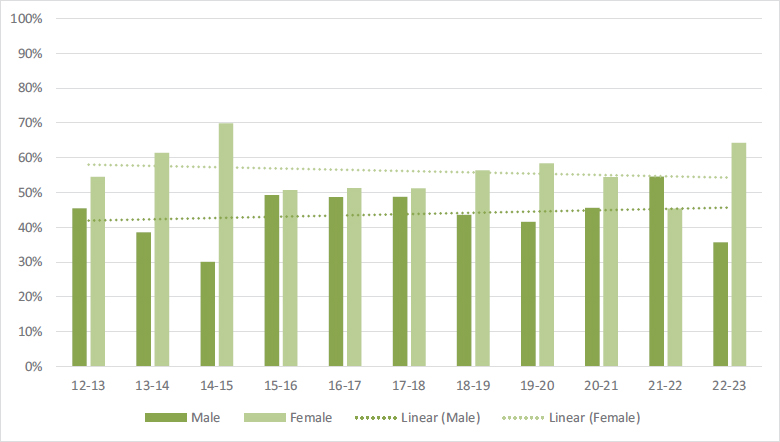
This section details the results of the variables with significant relationships obtained, considering the gender factor. These differences are significant at 90% confidence level when applying the Chi-square test (χ2 = 16.773, gl = 10, p = 0.080) in the distribution of the sample by gender and academic year, with women predominating over the years, as can be seen in Graph I.
GRAPH I. Students by gender
Source: Compiled by the authors.
This higher representation of women at university translates into a higher proportion of female university graduates among the adult population in all OECD countries, as shown in the Spanish Education Outlook Report (OECD, 2023). This report contains data for the year 2021, where the average for OECD and EU25 countries was 55% and 54.9% women, respectively. The United States, the United Kingdom and Sweden are the countries with the largest difference, while Germany and Japan had a difference of no more than 2.2 percentage points.
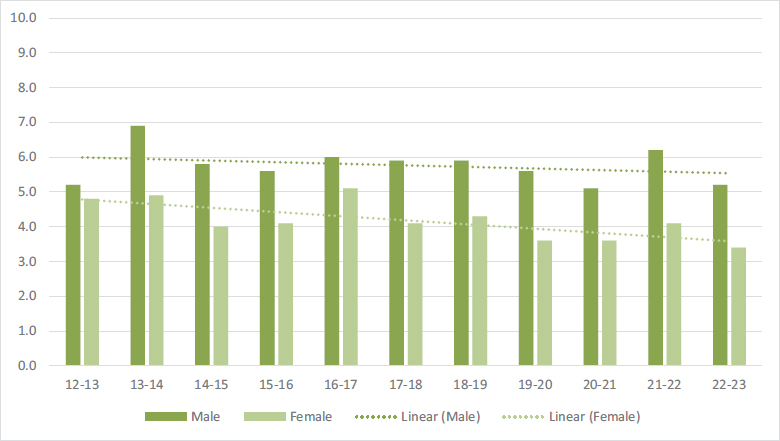
As the variable ‘mathematical reasoning test score’ does not have a normal distribution, we performed the non-parametric Mann–Whitney U test to study the relationship between gender and this variable. We obtained a statistically significant difference at 99% (with Mann–Whitney U=59258.000, Z=-10.091, p<=0.000), with the difference for men always being superior. In this case, the trend over the years is downward for both sexes, but is not heading towards parity; instead, the gap is increasing. These results are illustrated in Graph II. Table IV shows the results of the statistics for each academic year, which indicate statistically significant differences at 99% in all years except 15–16, which is significant at 95%; 16–17, with 90%; and 12–13, which accepts the Ho of equality between both sexes.
GRAPH II. Mathematical reasoning test score by gender
Source: Compiled by the authors.
TABLE IV. Mann–Whitney U test values between the reasoning test score variable and gender for each academic year
Academic year |
Mann–Whitney U test |
z |
p |
12–13 |
830.500 |
-0.775 |
0.438 |
13–14 |
269.500 |
-3.660 |
<0.000 |
14–15 |
321.500 |
-2.881 |
0.004 |
15–16 |
383.000 |
-2.546 |
0.011 |
16–17 |
523.000 |
-1.746 |
0.081 |
17–18 |
473.500 |
-3.266 |
0.001 |
18–19 |
571.500 |
-3.403 |
0.001 |
19–20 |
388.000 |
-3.377 |
0.001 |
20–21 |
385.000 |
-2.811 |
0.005 |
21–22 |
606.000 |
-4.400 |
<0.000 |
22–23 |
601.500 |
-3.715 |
<0.000 |
Source: Compiled by the authors.
This result is consistent with the findings of the work by Fernández-Herrero et al. (2022), which highlights women’s low results in the 2018 PISA tests in mathematics and science. Other studies point to women’s early drop-out from mathematics education options in pre-university studies (Watt, 2010).
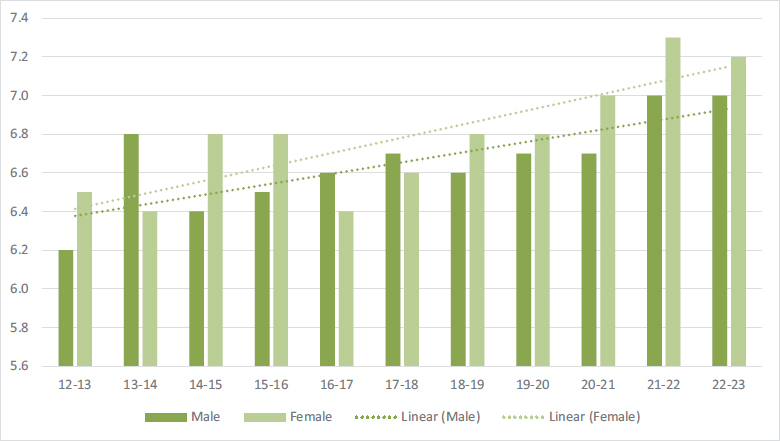
Another variable that does not have a normal distribution is ‘average university entrance qualification’. Again, we used the non-parametric Mann–Whitney U test to study the relationship between gender and this variable. Significant differences were observed at 95% (Mann–Whitney U=74295.000, Z=-2.208, p=0.027) and, in this case, they were more favourable for women. This trend is upward for both sexes, but the gap also tends to increase, as can be seen in Graph III. Table V shows the results of the statistics for each academic year, which indicate statistically significant differences at 90% in the years 14–15, 20–21 and 21–22.
GRAPH III. University entrance marks by gender
Source: Compiled by the authors.
TABLE V. Values of the Mann–Whitney U test between access mark variable and gender for each academic year
Academic year |
Mann–Whitney U test |
z |
p |
12–13 |
493.500 |
-1.016 |
0.309 |
13–14 |
367.000 |
-1.077 |
0.282 |
14–15 |
231.500 |
-1.950 |
0.051 |
15–16 |
390.000 |
-1.638 |
0.101 |
16–17 |
537.000 |
-0.505 |
0.614 |
17–18 |
557.000 |
-0.236 |
0.813 |
18–19 |
709.000 |
-1.438 |
0.137 |
19–20 |
400.000 |
-0.810 |
0.418 |
20–21 |
714.000 |
-1.663 |
0.096 |
21–22 |
1045.500 |
-1.667 |
0.096 |
22–23 |
943.500 |
-0.730 |
0.465 |
Source: Compiled by the authors.
In this case, the result is consistent with the data collected by the AAUW (1998), which show that girls obtain equal or higher grades than boys in all subjects throughout their education. Meanwhile, it is striking that, although the university entrance mark has increased over the years, the mark obtained in the mathematical reasoning test follows the opposite trend.
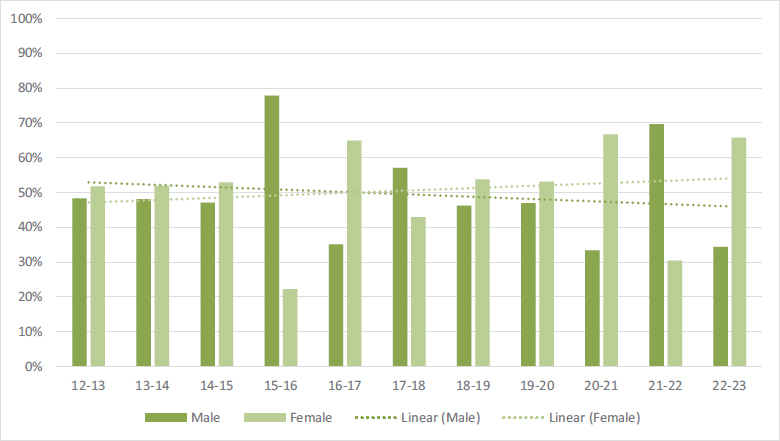
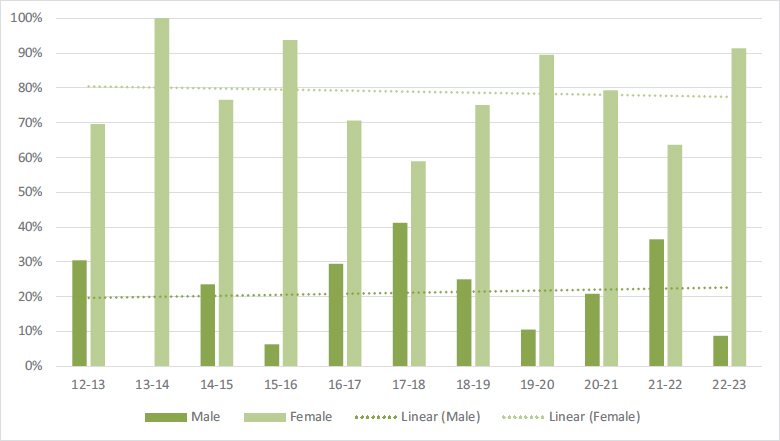
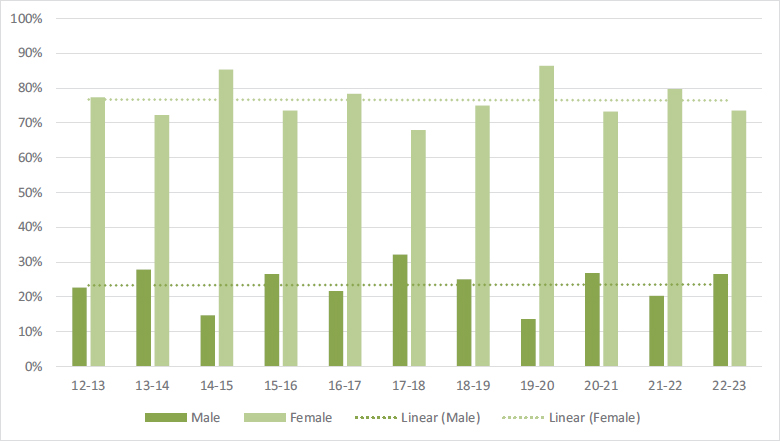
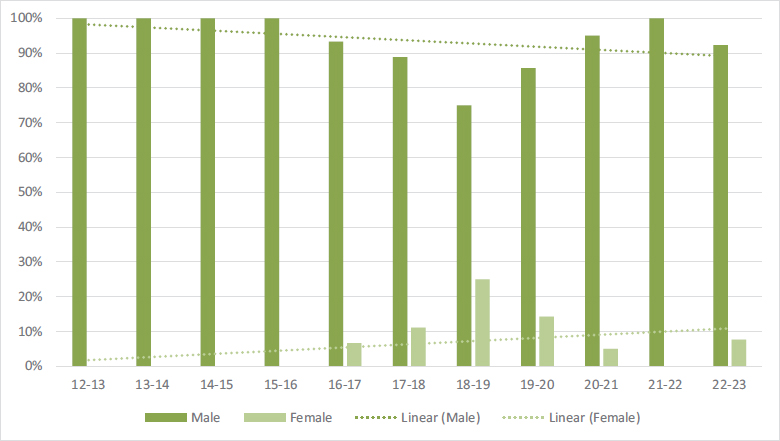
Regarding gender segregation by studies, the results of this study confirm the situation shown in the literature analysed, with a considerable masculinization of technological studies and a feminization of Education and Nursing studies, with this segregation being maintained over the years. Business Administration is the only area in which parity is observed; ten years ago, there was slightly more male representation, but this trend has been reversed, with a greater representation of women at present. This information is illustrated for each field of study in Graphs IV to VII.
GRAPH IV. Bachelor of Business Administration students by gender
Source: Compiled by the authors.
GRAPH V. Bachelor of Education students by gender
Source: Compiled by the authors.
GRAPH VI. Bachelor of Nursing students by gender
Source: Compiled by the authors.
GRAPH VII. Bachelor of Computer Science students by gender
Source: Compiled by the authors.
Other studies that have pointed to strong feminization in education and nursing courses are Grañeras Pastrana et al. (2001) (cited by Porto, 2009) and Ariño et al. (2022). The latter study also shows greater parity in the fields of economics, business and tourism. These gender differences by field of study also occur in all OECD countries: ‘Women are in the majority in the field of health and welfare for all countries among those entering short tertiary cycles’ (OECD, 2023), with data for the year 2021.
This final graph reflects the masculinization of technology studies, as other research has also highlighted (Ariño et al., 2022; Hill et al., 2010; OECD, 2023; Tejuca Martínez, 2020; Watt, 2010). Although the trend seems to be moving towards a reduction of this difference, the starting point is such a low representation of women in these studies that it is difficult to reach the desired parity, and the extreme categorization of highly masculinized studies proposed by Ariño et al. (2022) has continued to apply. In the data from 2021 published in the report on the education panorama (OECD, 2023), we observe that, on average in OECD countries, women are under-represented in the STEM fields but over-represented in the fields of health and welfare and education. In health and welfare and education, the average for these countries is a percentage of between 79 and 80% of women, with an even higher figure in Spain (90.9%). However, in the STEM field, women make up less than 25% of the OECD (24.1%) and EU25 (23.5%) averages. Once again, the gender gap is wider in Spain, where women represent only 15.6% of the total. Considering these data, we can see that, for the year 2021 (academic year 2021–2022), the gender gap in the area of health and welfare in Andorra is the same as the average of the OECD countries, but with a slightly lower gap than the average for studies in the area of education. Meanwhile, the gender gap in Andorra is higher than the OECD average in the field of technology. One point to be considered, however, is that there is only one degree available in each of these fields in Andorra, whereas the range of degrees in other countries is much more diverse.
Conclusions
This paper aims to explore where there are gender differences in university studies and how they have evolved over the years. Like the work of Watt (2010), this study shows that, despite the efforts made with national policies to increase female representation in STEM studies, the expected results are not being obtained and there has still been a great degree of masculinization in these studies at the University of Andorra over the years.
Considering the risks pointed out by work such as that of Bieri et al. (2016) pertaining to the consequences of this masculinization of studies for the future professional sphere, as they lead to jobs related to a higher socioeconomic status (Watt, 2010) – a fact that may contribute to consolidating the gender gap in professional salaries in the country – new measures that contribute to reversing this situation must be analysed urgently. The study by Sahoo and Klasen (2021) also points to the need to intervene in early educational stages to avoid gender segregation in university studies, which has repercussions on future professional segregation and consolidates the existing gender wage gap in today’s societies. Only in this way can we work in line with the Sustainable Development Goals (UN, 2015) determined by the 2030 agenda.
With the aim of providing information that may be useful for defining effective policies in this area, we analysed the profile of new students joining the University of Andorra over the years. The literature shows that gender differences in the choice of field of study exist from early stages (Goy et al., 2018, among others), and this may explain both the lower female representation in STEM studies and the worse results obtained in the mathematical reasoning test sat by newly admitted students on bachelor’s degree courses at the University of Andorra, as detailed in the results of this study. This signals the need for early intervention in the country’s schools, focused on empowering girls in order to fight against the stereotypes and expectations that determine their future academic choices according to previous studies analysed in this paper (Antecol and Cobb-Clark, 2013; Buser et al., 2014; Matín Carrasquilla et al., 2022; Santana-Vega et al., 2023; Zafar, 2013).
Another result observed in this study, and one in which female students come out on top, is the university entrance score, in line with other studies that show a better academic profile for women (Fernández-Herrero et al., 2022). The trend towards an increase in this access mark over the years observed in the data obtained in this study also points to a good prognosis, in this case for both men and women.
Despite this positive scenario, future research must explain how, in this context, the trend in mathematical reasoning test results is the opposite. It should be foreseeable that with a new entrant profile with an ever-increasing average academic score, the results in this test would also follow the same trend. Another piece of information revealed by this work is that the distribution of students by field of study has remained the same over the years. Moreover, the gradient between these two scores is increasing, which is contradictory and should be analysed by future research.
A significant relationship has also been found between gender and the result of the mathematical reasoning test, in this case in favour of male students, in line with previous studies (Fernández-Herrero et al., 2022; Lakin, 2013; Strand et al., 2006, among others).
The results presented in this study are based on a sample that is a faithful representation of the population, with a high return rate and a small sampling error, which is one of this paper’s key strengths. On the other hand, as a weakness, we should consider that, since the distribution of the numerical variables does not follow a normal distribution, we need to use non-parametric statistical techniques, which are less robust. Another limitation of this study is the small number of university courses considered (four); nonetheless, this is the total number of on-site bachelor’s degrees offered by the University of Andorra and representative of four different fields.
As a final conclusion, we would like to point out that another way of working towards reducing the wage gap between men and women in the professional environment could also be greater recognition of the professions that are more feminized, which stem from university courses that show this tendency, as proven by the results of this work, as well as that of Porto (2009), in the case of nursing and education studies. Along these lines, the University of Andorra is working to raise society’s awareness of the fundamental role played by these professional profiles and to design second-cycle university programmes (master’s degrees) in these specializations, which will contribute to the definition of new professional profiles related to higher levels of competence and remuneration.
Practical implications
After analysing the results of this work and detailing the conclusions reached, we propose some practical implications that could contribute to overcoming the challenges regarding gender equality in academia in today’s society, in line with Goal 4 and Goal 5 of the 2030 Agenda for Sustainable Development (UN, 2015).
From the university sphere, some measures that can contribute to improving gender inequalities, as pointed out by Ariño et al. (2022), include mainstreaming teaching and research with a gender perspective. To this end, training programmes aimed at teaching staff and specific to fields of study could be proposed, to provide them with tools to apply this new pedagogical approach. It is also important for higher education institutions to introduce the issue of work-life balance to students by facilitating the possibility of education for people with family responsibilities and for the whole population in general. Another aspect that can contribute to reducing the significant masculinization or feminization of university studies, depending on the field of study, is to give greater visibility to the less represented genders and students in all public and social events at universities.
Finally, and as a practical implication of greater impact, according to the recommendations highlighted in the literature reviewed (Basler & Kriesi, 2019; Sánchez García et al., 2011; Manic & Trajkovic, 2019; Sahoo & Kasen, 2021), action can be taken at early educational stages to contribute to changing established stereotypes and eliminating prejudices and lower academic expectations on the part of women, especially in STEM fields (Sáinz and Upadyaya, 2016; Sax and Harper, 2007; Watt, 2010). Measures to mainstream gender-responsive teaching, targeting teachers from primary schools onwards, could also serve this purpose. A more balanced gender ratio in academic professions exposes children to a more diverse environment and contributes towards breaking down stereotypes and countering the perception of early childhood and primary school teaching as a female profession (McGrath et al., 2020; Peeters et al., 2015; Warin, 2019). As proposed by Huang and Wang (2019), in order to break down the gender stereotypes that reduce the percentage of women in STEM, we should take three measures: (1) not differentiate according to gender in the relationship between teachers and students; (2) adopt a collaborative learning strategy in STEM fields; and (3) increase opportunities for girls to participate in STEM academic activities.
Bibliographic references
American Association of University Women Educational Foundation. (1998). Gender Gaps: Where Schools Still Fail Our Children, Author, researched by the American Institutes for Research, Washington, DC.
Andrew, L., Robinson, K., Costello, L. & Dare, J. (2022). Competing worlds: the private lives of women nurse students and gender equity in higher education. Studies in Higher Education, 47(6), 1171-1183. https://doi.org/10.1080/03075079.2020.1861597
Antecol, H. & Cobb-Clark, D. A. (2013). Do psychosocial traits help explain gender segregation in young people’s occupations? Labour Economics, 21, 59-73. https://doi.org/10.1016/j.labeco.2012.12.005
Ariño, A., Llopis, R., Martínez, M., Pons, M. & Prades, A. (2022). Via Universitària: Accés, condicions d’aprenentatge, expectatives i retorns dels estudis universitaris (2020-2022). Resultats principals, conclusions i propostes. Castelló de la Plana: Xarxa Vives d’Universitats
Astin, A. W., Oseguera, L., Sax, L. J. & Korn, W. S. (2002). The American Freshman: Thirty-Five Year Trends, Higher Education Research Institute, UCLA, Los Angeles.
Basler, A. y Kriesi, I. (2019). Adolescents’ development of occupational aspirations in a tracked and vocation-oriented educational system. Journal of Vocational Behavior, vol., 115 103330. https://doi.org/10.1016/j.jvb.2019.103330
Bharadwaj, De Giorgi, G., Hansen, D. & Neilson, C. (2012). The Gender Gap in Mathematics: Evidence from Low- and Middle-Income Countries. NBER Working Paper Series, 18464–Cambridge, MA: National Bureau of Economic Research. https://doi.org/10.3386/w18464
Bieri, F., Imdorf, C., Stoilova, R. & Boyadjieva, P. (2016). The Bulgarian educational system and gender segregation in the labour market. European Societies,, 18 158–179.
Blau, F. D. & Kahn, L. M. (2017). The gender wage gap: Extent, trends, and sources. Journal of Economic Literature,, 55 789–865. https://doi.org/10.1257/jel.20160995
Borrowman, M. & Klasen, S. (2020). Drivers of gendered sectoral and occupational segregation in developing countries. Feminist Economics, 26(2), 62–94. https://doi.org/10.1080/13545701.2019.1649708
Buser, Niederle, M. & Oosterbeek, H. (2014). Gender, competitiveness, and career choices. The Quarterly Journal of Economics, 129(3), 1409–1447. https://doi.org/10.1093/qje/qju009
Chubin, D. E., May, G. S. & Babco, E. L. (2005). Diversifying the Engineering Workforce. Journal of Engineering Education (Washington, D.C.), 94(1), 73–86. https://doi.org/10.1002/j.2168-9830.2005.tb00830.x
Dancausa, M.G., Millán, M.G., Hernández, R. y Jimber del Río, J.A. (2021). The Spanish Labor Market: A Gender Approach. International Journal of Environmental Research and Public Health, 18 (5), 2742. https://doi.org/10.3390/ijerph18052742
Deary, I. J., Strand, S., Smith, P. & Fernandes, C. (2007). Intelligence and educational achievement. Intelligence 35(1), 13–21. https://doi.org/10.1016/j.intell.2006.02.001
Diniz, A. M., Alfonso, S., Araújo, A. M., Deaño, M., Costa, A. R., Conde, Â. & Almeida, L. S. (2018). Gender differences in first-year college students’ academic expectations. Studies in Higher Education, 43(4), 689-701. https://doi.org/10.1080/03075079.2016.1196350
Donoso, T., Figuera, P. & Rodríguez Moreno, M.L. (2011). Barreras de género en el desarrollo profesional de la mujer universitaria. Revista de Educación,, 355 187-212. https://doi.org/10.4438/1988-592X-RE-2011-355-021
Fernández-Herrero, J., Herrero, C. & Soler-Guillen, A. (2022). Género y territorio en el círculo vicioso del fracaso escolar. Revista de Educación,, 398 219-247. https://doi.org/10.4438/1988-592X-RE-2022-398-558
Flabbi, L. (2011). Gender differentials in education, career, choices and labour market outcomes on a sample of OECD countries (Report). Washington, DC: World Bank
Goy, Wong, Y. L., Low, W. Y., Noor, S. N. M., Fazli-Khalaf, Z., Onyeneho, N., Daniel, E., Azizan, S., Hasbullah, M. & Ginika Uzoigwe, A. (2018). Swimming against the tide in STEM education and gender equality: a problem of recruitment or retention in Malaysia. Studies in Higher Education (Dorchester-on-Thames), 43(11), 1793–1809. https://doi.org/10.1080/03075079.2016.1277383
Hill, C., Corbett, C. & St. Rose, A. (2010). Why so few? Women in science, technology, engineering, and mathematics. Washington, DC: American Association of University Women
Huang, H.-W. & Wang, T.-W. (2019). Are There Gender Differences in Academic Performance?-Rethinking Gender Stereotype Threats of PISA Results in Taiwan. School Administrators, 122, 154–170. https://doi.org/10.6423/HHHC.201907_(122).0009
Kahn & Ginther, D. (2017). Women and STEM. NBER Working Paper Series, 23525–. Cambridge, MA: National Bureau of Economic Research. https://doi.org/10.3386/w23525
Klasen, S. (2019). What explains uneven female labor force participation levels and trends in developing countries? World Bank Research Observer,, 34 161–197.
Lakin, J. M. (2013). Sex differences in reasoning abilities: surprising evidence that male-female ratios in the tails of the quantitative reasoning distribution have increased. Intelligence 41, 263–274. https://doi.org/10.1016/j.intell.2013.04.004
Larose, S., Ratelle, C. F., Guay, F., Senécal, C., Harvey, M. & Drouin, E. (2008). A sociomotivational analysis of gender effects on persistence in science and technology: A 5-year longitudinal study. In H. M. G. Watt & J. S. Eccles (Eds.), Gender and occupational outcomes: Longitudinal assessments of individual, social, and cultural influences (pp. 171-192). American Psychological Association. https://doi.org/10.1037/11706-006
Lohr, S. L. & Velasco, O. A. P. (2000). Muestreo: diseño y análisis (No. 519.52 L64.). México: International Thomson Editores.
López, J. D. (2014). Gender Differences in Self-Efficacy among Latino College Freshmen. Hispanic Journal of Behavioral Sciences 36 (1): 95–104. https://doi.org/10.1177/0739986313510690
Manić, A. y Trajković, S.P. (2019). The role and importance of formal elementary education for the development of entrepreneurial abilities in accordance with the ethical principle. Journal of Process Management and New Technologies, 7(2), 60-69. https://doi.org/10.5937/jouproman7-21339
Martín Carrasquilla, O., Santaolalla Pascual, E. & Muñoz San Roque, I. (2022). La brecha de género en la Educación STEM. Revista De Educación, 396. https://doi.org/10.4438/1988-592X-RE-2022-396-533
Mau, W. C. & H. Bikos. (2000). Educational and Vocational Aspirations of Minority and Female Students: A Longitudinal Study. Journal of Counseling and Development, 78 (2), 186–94. https://doi.org/10.1002/j.1556-6676.2000.tb02577.x
McGrath, K., Moosa, S., Van Bergen, P. & Bhana, D. (2020). “The Plight of the Male Teacher: An Interdisciplinary and Multileveled Theoretical Framework for Researching a Shortage of Male Teachers”. The Journal of Men’s Studies, 28(2). https://doi.org/10.1177/1060826519873860
Mello, Z. R. (2008). Gender Variation in Developmental Trajectories of Educational and Occupational Expectations and Attainment from Adolescence to Adulthood. Developmental Psychology, 44 (4): 1069–80. https://doi.org/10.1037/0012-1649.44.4.1069
NCTM (2000). Principles and Standards for School Mathematics. Reston, VA: National Council of Teachers of Mathematics
OECD (2023). Panorama de la educación. Indicadores de la OCDE 2023. Informe español.
Parajuli, M. & Thapa, A. (2017). Gender differences in the academic performance of students. Journal of development and social engineering, 3(1), 39-47. https://doi.org/10.3126/jdse.v3i1.27958
Peeters, J., Rohrmann, T. & Emilsen, K. (2015). “Gender balance in ECEC: Why is there so little progress?” European Early Childhood Education Research Journal, 23(3), 302-314. https://doi.org/10.1080/1350293X.2015.1043805
Plazas, E. A., Aponte Penso, R. & Lopez, S. E. (2006). Relación entre estatus sociométrico, género y rendimiento académico. Psicología desde el Caribe: revista del Programa de Psicología de la Universidad del Norte, 17, 176-195
Porto, B. (2009). Feminización y masculinización en los estudios de maestro y educación física en Galicia. Revista de Investigación en Educación, 6: 50-57.
Sahoo, S. & Kasen, S. (2021). “Gender Segregation in Education: Evidence From Higher Secondary Stream Choice in India.” Demography, 58(3): 987-1010. https://doi.org/10.1215/00703370-9101042
Sáinz, M. & Upadyaya, K. (2016). “Accuracy and bias in Spanish secondary school students’ self-concept of math ability: The influence of gender and parental education level.” International Journal of Educational Research 77: 26-36. https://doi.org/10.1016/j.ijer.2016.02.009
Sánchez García, M., Suárez Ortega, M., Manzano Soto, N., Oliveros Martín-Varés, L., Lozano Santiago, S. Fernández D’Andrea, B. & Malik Liévano, B. (2011). Estereotipos de género y valores sobre el trabajo entre los estudiantes españoles. Revista De Educación, 355: 331-354. https://doi.org/10.4438/1988-592X-RE-2011-355-027
Santana Vega, L.E., Feliciano García, L. A. & Jiménez Llanos, A.B. (2012). Toma de decisiones y género en el Bachillerato. Revista de Educación,, 359 357-387. https://doi.org/10.4438/1988-592X-RE-2011-359-098
Santana-Vega, L.E., Ruiz-Alfonso, Z. & Feliciano-García, L.A. (2023). Estereotipos de género y variables vocacionales en alumnas de educación secundaria. Revista de Educación,, 400 265-294. https://doi.org/10.4438/1988-592X-RE-2023-400-578
Sarmiento Silva, C., Vargas Gallegos, M. & Díaz Gutiérrez, R. (2012). Diferencias en el rendimiento escolar por género asociadas al funcionamiento familiar de estudiantes de bachillerato. Cuadernos de psicología (Bellaterra, Barcelona), 14(2), 17–23. https://doi.org/10.5565/rev/qpsicologia.1052
Sax, L. & C. E. Harper. (2007). “Origins of the Gender gap: Pre-College and College Influences on Differences between men and Women.” Research in Higher Education 48 (6): 669–94. https://doi.org/10.1007/s11162-006-9046-z
Smith, E. (2011). Women into Science and Engineering? Gendered Participation in Higher Education STEM Subjects. British Educational Research Journal, 37(6), 993–1014. https://doi.org/10.1080/01411926.2010.515019
Spinath, B., Harald Freudenthaler, H. & and Neubauer, A. C. (2010). Domain-specific school achievement in boys and girls as predicted by intelligence, personality, and motivation. Personal. Individ. Differ., 48 481–486. https://doi.org/10.1016/j.paid.2009.11.028
Strand, S., Deary, I. J., and Smith, P. (2006). Sex differences in cognitive abilities test scores: a UK national picture. Br. J. Educ. Psychol. 76, 463–480. https://doi.org/10.1348/000709905X50906
Tejuca Martínez, M. (2020). Universidad y feminización: la experiencia cubana [University and feminization: the Cuban experience]. Educ Pesqui, 46. https://doi.org/10.1590/S1678-4634202046216073
Triola, M. F. (2004). Probabilidad y estadística. México: Pearson educación.
Tsaousis, I. & Alghamdi, M. H. (2022). Examining academic performance across gender differently: Measurement invariance and latent mean differences using bias-corrected bootstrap confidence intervals. Frontiers in Psychology, 13, 896638–896638. https://doi.org/10.3389/fpsyg.2022.896638
UN (2015). Organización de las Naciones Unidas. La agenda de desarrollo sostenible. Disponible en: < https://www.un.org/sustainabledevelopment/es/>. Acceso en: 24/03/2023.
UNESCO (2012). Atlas mundial de la igualdad de género en educación. París: Organización de las Naciones Unidas para la Educación, la Ciencia y la Cultura.
UNESCO (2018). Resumen sobre género del Informe de Seguimiento de la Educación en el Mundo: cumplir nuestros compromisos de igualdad de género en la educación.
Van Puyenbroeck, T., De Bruyne, K. & Sels, L. (2012). More than ‘mutual information’: Educational and sectoral gender segregation and their interaction on the Flemish labor market. Labour Economics, 19, 1–8. https://doi.org/10.1016/j.labeco.2011.05.002
Warin, J. (2019). Conceptualising the value of male practitioners in early childhood education and care: gender balance or gender flexibility. Gender and Education, 31(3). https://doi.org/10.1080/09540253.2017.1380172
Watt, H. M. (2010). “Gender and occupational choice.” In J.C. Chrisler & D.R. McCreary (Eds.), Handbook of Gender Research in Psychology (pp. 379-400). New York: Springer. https://doi.org/10.1007/978-1-4419-1467-5_16
Whitt, E. J., Edison, M. I., Pascarella, E. T., Terenzini, P. T. & Nora, A. (2001). Influences on Student’s Openness to Diversity and Challenge in the Second and Third Years of College. The Journal of Higher Education (Columbus), 72(2), 172-. https://doi.org/10.2307/2649321
World Bank. (2012). World development report 2012: Gender equality and development. Washington DC: World Bank.
Zafar, B. (2013). College major choice and the gender gap. Journal of Human Resources, 48: 545-595. https://doi.org/10.1353/jhr.2013.0022
Contact address: Montserrat Casalprim Ramonet. Univesitat d’Andorra, Centre d’Estudis Virtuals i d’Extensió Universitària. E-mail: mcasalprim@uda.ad