The Engineer: enhancing bachelor students’ English technical engineering vocabulary proficiency with a serious video game
The Engineer: mejora del dominio de vocabulario de ingeniería técnica en inglés entre estudiantes de grado mediante el uso de un videojuego serio
https://doi.org/10.4438/1988-592X-RE-2024-405-636
Ricardo Casañ Pitarch
https://orcid.org/0000-0002-1689-7954
Universitat Politècnica de València
Abstract
Since the decade of 2010, the game-based approach has given rise to new research in education. The quick advance of technology has also helped to introduce more powerful and sophisticated devices and digital applications in the classroom. As a result, gamifying a subject with serious video games is a new rising trend in the educational sector. Therefore, this research is based on the use of a serious video game that has been developed with institutional support and it aims to reinforce a university bachelor’s degree subject. The Engineer is a serious game designed to teach English for engineering and gives support to a textbook for the subject English B2 for Industrial Engineers at the Universitat Politècnica de València. This research aimed to measure the learners’ acquisition of new engineering vocabulary in English after using the game and the associated textbook. In our experiment, 64 Industrial Engineering degree students were divided into an experimental group that used the game and textbook and a control group that only used the textbook. Both groups took a pre-test and a post-test to measure their knowledge of general and specific engineering vocabulary. Results showed that the use of the serious game increased the exposure time to the foreign language, leading to better results among the experimental group. Students in the experimental group also showed more satisfaction with the course. The study concludes that serious games can be an effective tool for language learning and teaching as it extends the time of exposure to the new content and it also motivates the students due to its playful component.
Keywords: The Engineer, serious video games, gamification, game-based learning, teaching english as a foreign language, language for specific purposes, industrial engineering.
Resumen
Desde la década de los 2010, el enfoque basado en el juego ha dado lugar a nuevas investigaciones en el campo de la educación. El rápido avance de la tecnología también ha ayudado a introducir dispositivos y aplicaciones digitales más potentes y sofisticadas en el aula. Como resultado, gamificar una asignatura con videojuegos serios es una nueva tendencia al alza en el sector educativo. Por lo tanto, esta investigación se basa en el uso de un videojuego serio que se ha desarrollado con apoyo institucional con el objetivo de reforzar una asignatura de grado universitario. The Engineer es un juego serio diseñado para enseñar inglés para ingeniería y ofrece apoyo a un libro de texto para la asignatura Inglés B2 para Ingenieros Industriales en la Universitat Politècnica de València. El objetivo de la investigación es medir la retención de los estudiantes del nuevo vocabulario sobre ingeniería en inglés después de usar el videojuego y el libro de texto asociado. En nuestro experimento, se dividieron 64 estudiantes de grado en Ingeniería Industrial en un grupo experimental que usó el juego y el libro de texto, y un grupo de control que solo usó el libro de texto. Ambos grupos realizaron una prueba previa y una posterior para medir su conocimiento del vocabulario de ingeniería general y específico. Los resultados mostraron que el uso del juego serio aumentó el tiempo de exposición al idioma extranjero, lo que llevó a mejores resultados entre el grupo experimental. Los estudiantes en el grupo experimental también mostraron más satisfacción con la asignatura. El estudio concluye que los juegos serios pueden ser una herramienta efectiva para el aprendizaje y la enseñanza de idiomas ya que extiende el tiempo de exposición al nuevo contenido y también motiva a los estudiantes debido a su componente lúdico.
Palabras clave: The Engineer, videojuegos serios, gamificación, aprendizaje basado en juegos, enseñanza del inglés como lengua extranjera, lengua para fines específicos, ingeniería industrial..
Introduction
The use of video games for educational purposes in tertiary education is real. Some studies have proved that using video games to support the teaching of specific subjects is an effective pedagogical strategy. In the field of foreign language teaching, some studies have previously focused on the development of language skills or the acquisition of new language forms and its effectiveness. Some examples are Duolingo (Loewen et al., 2019), Guadalingo (Casañ-Pitarch & Wang, 2022; Díaz-Bravo, 2019), Her Story (Lee, 2019), ImmerseMe (Casañ-Pitarch & Gong, 2021; He & Smith, 2019), LyricsTraining (Casañ-Pitarch, 2020; Yin, 2021), Subtitle Legends (Calvo-Ferrer & Belda-Medina, 2021), The Conference Interpreter (Calvo-Ferrer & Belda-Medina, 2015), Twine (Ford, 2016).
In this paper, The Engineer, a serious video game created to help students acquire new technical language forms, was implemented among Industrial Engineering bachelor’s students; and whose results have been considered to measure its effectiveness. The objective of this research is to measure the effectiveness of the video game, which mainly aims at teaching professional industrial engineering English. To achieve our purpose, an experiment with industrial engineering students was carried out, in which the game was tested, and the students completed pre- and post-language tests to measure their progress within the development of the subject English B2 during the second term of the school year 2022-2023. The participants in the experiment were divided into two groups, an experimental group, and a control group.
The Engineer is played individually, and it is addressed to industrial engineering bachelor’s students from Universitat Politècnica de València who are enrolled in the subject ‘English B2’. The purpose of this subject is to help students with at least an English B1 level (CEFRL) to gain English B2 proficiency and learn specific language related to the professional field of industrial engineering. This video game is adhered to a teaching book called ‘The Engineer: English Language for Industrial Engineering’. This book contains six lessons, which are the content of the subject ‘English B2’. These lessons combine both general B2 English content and technical language for industrial engineers. In this sense, the video game mainly focuses on the technical language, which gives support to the book with additional activities in an immersive gamified environment.
Regarding the synopsis of the game, The Engineer introduces a recently graduated industrial engineer who aims at getting their first engineering job. The main character can be either male or female, and the gender choice is made at the beginning of the story. With the support of a labor consultancy from the university, the main character finds a job offer for an internship as an Industrial Engineer at the company Albuferum, located in the industrial city of Fallas. The language used in this company is English, and the main character must do a series of tasks and complete six missions related to the industrial engineering profession.
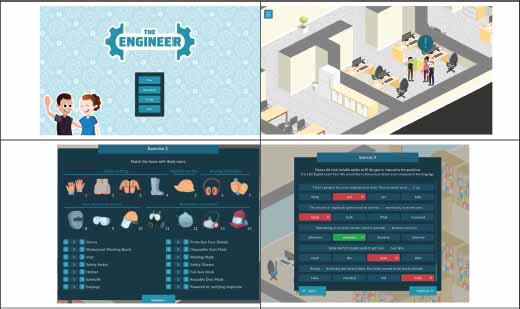
The new employee is expected to learn by doing and get motivated with the inclusion of rewards and the personal satisfaction of learning. The exercises are related to the industrial engineering industry and based on puzzles, tests, fictional dialogues, search and use of objects, and other skill games. The Engineer offers an environment of linguistic immersion through functional language, reading comprehension, and the interaction of the protagonist with other computerized characters. The new knowledge is introduced in the teaching book and practiced along with the corresponding missions of the video game. The following image shows some extracts from the video game.
IMAGE I. Image extracted from The Engineer
Source: The Engineer.
Literature Review
The dimension of this paper involves three fundamental terms that need to be defined: game-based learning, serious video games, and gamification. The ideas presented in this paper are based on the principles of game-based learning, which is an educational approach that uses video games and simulations as the primary tool for teaching and learning (Pivec, 2007; Tokac et al., 2019). The aim of game-based learning is to create an engaging learning experience that immerses students through gameplay mechanics, narratives, and other elements commonly found in video games (Kapp, 2017; Sailer, et al., 2017). As a result, the game-based approach pretends to make learning more interactive, enjoyable, and effective by leveraging the engagement and motivation that video games provide (Papastergiou, 2016; Sailer et al., 2017). This idea is related to the flow theory, which suggests that individuals are highly engaged and motivated when they are in a ‘state of flow’, where they are challenged but still able to accomplish their objectives.
According to Gee (2003), game-based learning offers a ‘situated cognition’ approach to learning, where learners are placed in a context that requires them to use specific knowledge and skills to solve problems and achieve goals. He argues that game-based learning is particularly effective for teaching complex systems, such as scientific or social issues, because it allows learners to explore and experiment with these systems in a safe and interactive environment. In addition to situated cognition and the flow theory, another theoretical principle related to game-based learning is constructivism, which suggests that game-based focuses on constructivism, a theoretical framework that highlights the importance of learners creating their own knowledge by actively exploring, experimenting, and reflecting about the world (De-Marcos et al., 2014; Squire, 2011).
After defining and explaining the main principles of game-based learning, this paper focuses on serious games and distinguishes them from conventional ones. In this sense, serious video games are designed with the goal of instructing a learner in particular knowledge or skills (Michael & Chen, 2005; Zyda, 2005; Ritterfeld et al., 2009). On the other hand, conventional games focus on entertainment, and learning is not primary (Casañ-Pitarch, 2022; Escribano, 2012). These games have gained significant popularity in foreign language learning as they provide an engaging and interactive method of language acquisition (Garris, Ahlers & Driskell, 2002). In contrast to traditional language learning techniques, such as textbooks or audio recordings, serious video games offer learners the opportunity to practice and apply their language skills in an immersive environment that is also enjoyable and engaging (Liu & Zhang, 2017). Although the design and structure of serious video games for foreign language learning can vary, they frequently incorporate language learning content into gameplay mechanics, such as quests, puzzles, or challenges, and provide learners with feedback and rewards for their progress (Casañ-Pitarch, 2017a, 2022; Don & Wang, 2019). These games typically introduce immersive storylines and characters, which can help learners to connect emotionally with the language they are learning and stay motivated to continue playing (Liu & Zhang, 2017). One advantage of serious video games for language learning is their capacity to customize the learning experience for each learner (Arnab et al., 2013). These games can adjust the difficulty of the language content according to the learner’s proficiency level, enabling them to progress at their own pace and feel a sense of achievement as they improve their language skills (Plass et al., 2013).
Among other benefits, serious video games provide learners with opportunities to practice real-world language skills (Prensky, 2003; Gee, 2003). These games can simulate real-life situations, such as ordering food in a restaurant or having a conversation with a native speaker, which can help learners to feel more confident and prepared when they encounter similar situations in real life. Serious video games can also provide learners with immediate feedback on their language skills, which is a valuable tool for improving language proficiency (Don & Wang, 2019; Pivec, 2007). This feedback can come in the form of corrective feedback on grammar or vocabulary, or positive reinforcement for correct answers or successful completion of a task. As a result, serious video games can be a valuable tool for foreign language learning, particularly for learners who are looking for a fun and engaging way to practice their language skills. By incorporating language learning content into game mechanics, providing immediate feedback and rewards, and simulating real-life language situations, serious video games can offer a unique and effective way for learners to improve their language proficiency.
For the interest of this paper, the third and last element that needs to be defined is gamification. We understand gamification as the process of transforming non-game content into educational games (Deterding et al., 2011; Werbach & Hunter, 2015). These games can be connected among them through a story or competition along which the learning flows (Casañ-Pitarch, 2017b; Edmond, 2011). The purpose of gamification is to increase learners’ engagement and motivation by making non-game activities more game-like. Gamification often involves adding points, badges, leaderboards, and other elements of game mechanics to non-game activities. In this sense, Deterding et al. (2011) argue that gamification is effective because it appeals to the intrinsic human desire to compete, achieve goals, and receive rewards. They suggest that gamification can be used to motivate learners to engage with material that might not be motivating for the students and also can reinforce learning by providing immediate feedback and rewards. In this sense, Kapp (2017) argues that gamification can help to create a more engaging and interactive learning experience. He suggests that gamification can be used to motivate learners to complete tasks, to foster collaboration and competition among learners, and to provide feedback and recognition for progress and achievement.
These ideas imply that the purpose of gamification is to motivate students. The process of gamification was explained by Robson et al. (2016) and then adapted by Casañ-Pitarch (2022). In these models, these authors explain how to transform non-game teaching material into gamified resources. This mechanism has been used in this research to transform the subject English B2 for industrial engineers into the serious video game The Engineer.
Method
Participants
This experiment included 64 participants. They were bachelor students of the Industrial Engineering degree at Universitat Politècnica de València and were taking the subject English B2. These students belong to two different groups, but they were taking the same subject. The experimental group was formed by 31 students, and the control group had 34 students.
Tools
Regarding the tools utilized in this research, we used the video game The Engineer and the associated book The Engineer: English Language for Industrial Engineering. For the tests, there were 8 pre-tests and 8 post-tests, which were developed using Google Forms. The students started with a pre-test on General B2 English and another one on specific language, and they ended the experiment with their two equivalent post-tests. These tests contained 30 multiple-choice questions each.
The questions for the General B2 English test were extracted from the ‘English Unlimited Placement Test’ (Cambridge University Press, 2010). This test contains 120 multiple-choice questions and covers the language levels from A2 to C1. To simplify our test, we focused on the B2 and C1 level questions (60) and created two tests with 30 questions each. The first test introduced the odd numbers (i.e., 1, 3, 5), and the post-test used the even numbers (i.e., 2, 4, 6). The test for the specific language was self-created and included the elements studied in class. To equalize the level of the pre and post-tests, we selected pairs of language forms that were similar to each other, and each one was used in one of the tests.
The remaining tests corresponded to the six lessons covered with our material. There was a pre-test and an equivalent post-test with 15 questions for each of the six lessons. These questions focused on the language forms studied in each mission, including both general and specific English language.
Procedure
The experiment consisted of teaching the same content to both the control group and the experimental group. The difference lay in the fact that the control group did not use the video game to reinforce their learning. The time for the lessons was the same for each group (30 hours), and while the experimental group played with the video game after completing the book lessons in class, the control group extended their practice with additional exercises similar to the ones done in class. The students were exposed to this material for six weeks, with two weekly sessions of two and a half hours each.
The students from both groups completed two pre-tests before the first lesson and two post-tests after the last lesson. One of the tests focused on General B2 English, and the other focused on the specific language forms studied in class. Both the book and the video game contained six missions/lessons. The students also completed a pre-test before each lesson and a post-test after completing the lesson and having practiced with the video game or having done the homework exercises. After completing the twelve lessons, the data was compiled and analyzed. The analysis consisted of measuring and comparing the progress before and after the teaching hours, including the progress within each lesson.
Results
The results of the experiment revealed that the experimental group made greater progress than the control group. Table I displays the performance of the experiment, including the pre- and post-test scores, the difference between their initial and final results, and the percentage variation to demonstrate their progress. Both groups exhibited progress in their post-tests. From a general perspective, the participants in the experimental group made progress of 36.36% in the general B2 English test, 52.29% in the specific language test, and the average progress among the six units was 39.59%. Remarkably, the experimental group’s most substantial progress was observed in the specific language test, at 52.29%, while the lowest progress occurred in the unit 4 test, at 31.11%. Conversely, the control group demonstrated progress of 26.52% in the general B2 English test, 33.24% in the specific language test, and the average progress among the six units was 24.87%. Unit 3 had the most significant progress in the control group, with 33.74%, whereas the lowest progress was recorded in unit 4, at 19.83%.
TABLE I. Experimental and control groups’ general results
Test |
Experimental Group |
Control Group |
||||||
Pre-T |
Post-T |
Dif. |
V% |
Pre-T |
Post-T |
Dif. |
V% |
|
General B2 |
16.39 |
22.35 |
5.96 |
36.36 |
16.48 |
20.85 |
4.37 |
26.52 |
Specific L. |
17.19 |
26.23 |
9.04 |
52.59 |
17.15 |
22.85 |
5.7 |
33.24 |
Unit 1 |
16.13 |
22.45 |
6.32 |
39.18 |
15.76 |
19.88 |
4.12 |
26.14 |
Unit 2 |
16.19 |
23.68 |
7.49 |
46.26 |
16.36 |
20.85 |
4.49 |
27.44 |
Unit 3 |
16.9 |
25.29 |
8.39 |
49.64 |
16.36 |
21.88 |
5.52 |
33.74 |
Unit 4 |
18.45 |
24.19 |
5.74 |
31.11 |
18.36 |
22.00 |
3.64 |
19.83 |
Unit 5 |
18.19 |
24.32 |
6.13 |
33.70 |
17.88 |
21.64 |
3.76 |
21.03 |
Unit 6 |
18.13 |
25.23 |
7.1 |
39.16 |
18.18 |
22.24 |
4.06 |
22.33 |
Mean U.1-6 |
17.33 |
24.19 |
6.86 |
39.59 |
17.15 |
21.42 |
4.27 |
24.87 |
Source: Compiled by the author.
Table II presents a comparison between the experimental and control groups at various stages of the study, analyzing their pre-test and post-test results. The findings reveal that during the pre-test, the experimental group’s score in the General B2 English level test was 0.55% lower than the control group’s score. However, in the post-test, the experimental group exhibited a remarkable improvement, surpassing the control group by 7.19%. Moreover, in the specific language test, the experimental group had a slight superiority over the control group, 0.23%, which significantly increased to 14.79% in the post-test. The results from units 1 to 6 replicated the previous cases, with the difference between the experimental and control groups ranging from -1.04% (unit 2) to 3.30% (unit 3) in the pre-tests, and from 9.95% (unit 4) to 15.59% (unit 3) in the post-tests. The average score across all six units showed that the experimental group scored 1.06% better than the control group in the pre-tests, and the difference increased to 13.44% in the post-test.
TABLE II. Difference between experimental and control groups in pre- and post-tests
Dif. % Test Exp. - Cont. |
Pre-T% |
Post-T% |
General B2 |
-0.55 |
7.19 |
Specific L. |
0.23 |
14.79 |
Unit 1 |
2.35 |
12.93 |
Unit 2 |
-1.04 |
13.57 |
Unit 3 |
3.30 |
15.59 |
Unit 4 |
0.49 |
9.95 |
Unit 5 |
1.73 |
12.38 |
Unit 6 |
-0.28 |
13.44 |
Mean U.1-6 |
1.06 |
12.97 |
Source: Compiled by the author.
Table III presents a comparative analysis of the progress made by the experimental and control groups, revealing that the former outperformed the latter. Specifically, the experimental group demonstrated higher average progress compared to the control group. In the general English B2 level test, the experimental group progressed by 36.36%, while the control group’s progress was limited to 26.52%. The percentage variation of these progresses was 37.13% favorable to the experimental group. Similarly, in the specific language test, the experimental group demonstrated significant progress of 52.59%, while the control group progressed by only 33.24%. This highlights a substantial difference of 58.23% in favor of the experimental group, which had played the video game. In addition, the control of the six teaching units revealed that the experimental group made considerable progress of 39.59%, while the control group exhibited inferior progress, 24.87%. Consequently, there is a substantial difference of 59.20% in favor of the experimental group. More specifically, an examination of the individual units reveals that the experimental group progressed from 31.11% (unit 4) to 49.64% (unit 3), whereas the control group progressed from 19.83% (unit 4) to 33.74% (unit 3). Moreover, the percentage variation of their progress ranged from 47.14% (unit 3) to 75.36% (unit 6), highlighting the significant impact of the video game on improving language acquisition among the experimental group.
TABLE III. Comparison of Progress between Experimental and Control Groups
Dif. V% Progress Exp-Cont |
Exp. |
Cont. |
V % |
General B2 |
36.36 |
26.52 |
37.13% |
Specific L. |
52.59 |
33.24 |
58.23% |
Unit 1 |
39.18 |
26.14 |
49.88% |
Unit 2 |
46.26 |
27.44 |
68.57% |
Unit 3 |
49.64 |
33.74 |
47.14% |
Unit 4 |
31.11 |
19.83 |
56.92% |
Unit 5 |
33.70 |
21.03 |
60.25% |
Unit 6 |
39.16 |
22.33 |
75.36% |
Mean U.1-6 |
39.59 |
24.87 |
59.20% |
Source: Compiled by the author.
Conclusion
The present research aims to assess the effectiveness of using a serious video game, The Engineer, as a language learning instrument for industrial engineering students enrolled at the Universitat Politècnica de València. The primary objective of this study is to examine whether playing video games can enhance the language learning process and lead to more significant progress in contrast to other conventional methods of language learning. More specifically, this study aims to measure the participants’ learning and acquisition of language for specific purposes related to the engineering industry, as well as their overall knowledge of English at the B2 level.
The results of the study suggest that using The Engineer as a language learning tool can enhance the students’ language learning process, resulting in greater progress than other traditional methods of language learning. As observed, the experimental group showed considerably higher progress in comparison to the control group, indicating that the use of video games as a language learning instrument can be an effective and engaging approach to language learning.
As previously specified, the primary aim of the video game is to teach professional industrial engineering English. The findings of the study reveal that the students made greater progress regarding language for specific purposes than in general B2 English. Although the students participated in lessons that addressed both general B2 English and language for specific purposes associated with the engineering industry, it should be noted that the principal objective of the video game is to teach professional industrial engineering English, although it also introduces general B2 English content. Consequently, it was expected that the participants would show progress in both areas, with greater advancement in the specific language assessment.
This study findings align with the principles introduced in the literature review. In this sense, the best performance of the experimental group seems to be related to a motivational factor. The exercises that were completed as homework were similar for both groups; the main difference was that whereas one group completed the exercises using a paper book, the other completed the same exercises by playing a video game. This refers to the engaging, immersive, interactive, enjoyable, and also effective environment created by playing a serious video game, as suggested by some authors (Kapp, 2017; Papastergiou, 2016; Sailer, et al., 2017).
In addition, The Engineer offers an environment that promotes specific language and technical knowledge and skills to solve problems and achieve goals, as proposed by Gee (2003). These ideas connect with the principles of situated cognition, flow theory, and constructivism exposed in this paper (De-Marcos et al., 2014; Gee, 2003; Squire, 2011). The application of these principles implies opportunities to practice and apply their language skills in an immersive enjoyable and engaging environment (Liu & Zhang, 2017). To this respect, the Engineer seems to own the characteristics to be considered a serious video game, introducing language learning content into gameplay mechanics, such as quests, puzzles, dialogues, or other challenges, and providing learners with feedback and rewards for their progress (Casañ-Pitarch, 2017a; 2022; 2022; Don & Wang, 2019). Furthermore, this video game is based on a story with fictional characters, which helps learners to connect emotionally with the language they are learning and stay motivated to continue playing (Liu & Zhang, 2017).
In this case, the students would also have felt motivated because they could identify themselves with the main characters and the story narrated along the video game, which simulated the life of a graduated engineer who gets a first job. This is beneficial because they also practiced real-world language and knowledge related to a specific profession (Prensky, 2003; Gee, 2003). Another characteristic of serious video games is that the learning experience is customized for each learner, in which students can play at their own pace and learn with their own rhythm (Arnab et al., 2013; Plass et al., 2013). As a result, learners avoid the comparison or pressure of learning slower or faster than other students, avoiding the feeling of stress and making the learning experience more pleasant and enjoyable.
In conclusion, using The Engineer among industrial engineering degree students offers a gamified version of the subject English B2, which connects the content through a story. The purpose of using this gamified material is to help learners increase their engagement and motivation by making an ordinary subject more game-like. The positive results obtained among the experimental group in this research seem to validate that the use of The Engineer, or other serious video games, in the foreign language classroom can be a suitable option to enhance learners’ motivation and, consequently, their performances.
At last, it shall be acknowledged that this study has been limited to be the first time it has been used in the classroom, and some bugs were discovered by the participants. This fact made some students have to restart their missions occasionally, and we think that this could lead to a certain degree of frustration or demotivation. In further research, the same process could be repeated, and the motivational factor be introduced to measure its influence on the learning process. Some tests that could be used are the learning motivation questionnaire: LMQ (Alario-Hoyos et al., 2017), the learning satisfaction questionnaire: LSQ (Kim et al., 2012), Motivated Strategies for Learning Questionnaire: MSLQ (Pintrich et al., 1993).
Acknowledgment
This work is one of the results of the educational innovation and improvement project, A+D 2023 – PIME C, reference number: 1920, entitled “Enseñanza de inglés para el negocio de la ingeniera industrial a través de simulación, juego y gamificación”, funded by the Vice-Rector's Office for Studies, Quality and Accreditation of the Universitat Politècnica de València: 2023 Learning + Teaching Call. Previously, the creation of the video game was founded by the Autonomous Government of the Valencian Community (Spain), Subvencions a grups d'investigació emergent, and whose reference number is GV/2021/035, which we should also acknowledge.
Bibliographic references
Alario-Hoyos, C., Estévez-Ayres, I., Pérez-Sanagustín, M., Delgado Kloos, C., y Fernández-Panadero, C. (2017). Understanding Learners’ Motivation and Learning Strategies in MOOCs. The International Review of Research in Open and Distributed Learning, 18 (3), 119–137. https://doi.org/10.19173/irrodl.v18i3.2996
Arnab, S., Brown, K., Clarke, S., Dunwell, I., Lim, T., Suttie, N., Louchart, S., Hendrix, M., & De Freitas, S. (2013). The development approach of a pedagogically-driven serious game to support Relationship and Sex Education (RSE) within a classroom setting. Computers & Education, 69, 15-30. https://doi.org/10.1016/j.compedu.2013.06.013.
Cambridge University Press (2010). English Unlimited Placement Test. https://shorturl.at/luzDU
Casañ-Pitarch, R. (2017a). Language for Specific Purposes and Graphic-Adventure Videogames: Supporting Content and Language Learning. Obra digital, 13, 169–183. https://shorturl.at/tLN07
Casañ-Pitarch, R. (2017b). Storyline-Based Videogames in the FL Classroom. Digital Education Review, 31, 80–92. https://doi.org/10.1344/der.2017.31.80-92.
Casañ-Pitarch, R. (2020). Enhancing Listening Skills and Learning Specific Language with Transcription Activities Using LyricsTraining. En Olmo-Cazevielle, F., Carrió-Pastor, M.L. Periñan-Pascual, C. and Romero-Forteza, F. (Eds.), Estudios de lingüística aplicada IV, 69–81. Universitat Politècnica de València.
Casañ-Pitarch, R. (2022). On Serious Games, Gamification, & Digital Game-Based Learning: Foreign Language Learning in the Digital Age. Tirant lo Blanch.
Casañ-Pitarch, R., & Gong, J. (2021). Testing ImmerseMe with Chinese students: acquisition of foreign language forms and vocabulary in Spanish. Language Learning in Higher Education, 11(1), 219–233. https://doi.org/10.1515/cercles-2021-2016
Casañ Pitarch, R., & Wang, L. (2022). Spanish B1 vocabulary acquisition among Chinese students with Guadalingo. The International Journal of Information and Learning Technology, 39(2), 197–208. https://doi.org/10.1108/IJILT-07-2021-0101
Calvo-Ferrer, J. R., & Belda-Medina, J. (2015). Análisis de la satisfacción del alumnado de L2 con respecto a la adquisición de terminología especializada por medio de videojuegos: estudio del caso. Porta Linguarum: revista internacional de didáctica de las lenguas extranjeras, 24, 179–190. https://doi.org/10.30827/Digibug.53869
Calvo-Ferrer, J. R., & Belda-Medina, J. (2021). El videojuego subtitle legends para la enseñanza de lengua inglesa en el ámbito de la traducción y la interpretación: planificación docente y percepción del alumnado. Lenguas Modernas, 58, 71–86. https://shorturl.at/opV45
De-Marcos, L., Domínguez, A., Saenz-de-Navarrete, J., & Pagés, C. (2014). An empirical study comparing gamification and social networking on e-learning. Computers & education, 75, 82–91. https://doi.org/10.1016/j.compedu.2014.01.012
Deterding, S., Dixon, D., Khaled, R., & Nacke, L. (2011). From game design elements to gamefulness: defining gamification. Proceedings of the 15th international academic MindTrek conference: Envisioning future media environments (pp. 9–15). Association for Computing Machinery. https://doi.org/10.1145/2181037.2181040
Díaz-Bravo, R. (2019). Guadalingo: aprendizaje experiencial de español LE/L2 en un entorno virtual gamificado. Journal of Spanish Language Teaching, 6(1), 64-70. https://doi.org/10.1080/23247797.2019.1613078.
Don, Y., & Wang, Y. (2019). Gamification in foreign language learning: A systematic review. Computer Assisted Language Learning, 32(8), 727-761.
Edmonds, S. (2011). Gamification of learning. Training and Development in Australia, 38(6), 20–22. https://doi.org/10.3316/24743546.2011.7542648
Escribano, F. (2012). 10 Gamification as the Post-Modern Phalanstère: The video game industry: Formation, present state, and future. In P. Zackariasson and T. L. Wilson (eds.), The video game industry: formation, present state, and future (pp. 198–219). Routledge.
Ford, M. (2016). Writing interactive fiction with Twine. Que Publishing.
Garris, R., Ahlers, R., & Driskell, J. E. (2002). Games, motivation, and learning: A research and practice model. Simulation & Gaming, 33(4), 441–467. https://doi.org/10.1177/1046878102238607
Gee, J. P. (2003). What video games have to teach us about learning and literacy. New York: Palgrave Macmillan.
He, L., & Smith, J. (2019). ImmerseMe. Pronunciation in Second Language Learning and Teaching Proceedings, 10(1), 461–466. https://www.iastatedigitalpress.com/psllt/article/id/15402/
Kapp, K. M. (2017). The gamification of learning and instruction: game-based methods and strategies for training and education. John Wiley & Sons.
Kim, M. K., Kim, S. M., Lee, C., & Chun, J. (2012). Evaluation of online learning modules: Application of the contextualized evaluation framework to an e-learning course on health information management. Educational Technology Research and Development, 60(2), 325–341. https://doi.org/10.1186/s12909-021-02609-8
Lee, S. M. (2019). Her Story or their own stories? Digital game-based learning, student creativity, and creative writing. ReCALL, 31(3), 238–254. https://doi.org/10.1017/S0958344019000028
Liu, D., & Zhang, Z. (2017). A comparative study of the effectiveness of mobile game-based and traditional vocabulary learning in Chinese EFL learners. ReCALL, 29(1), 82–99. https://doi.org/10.1177/21582440211003092
Loewen, S., Crowther, D., Isbell, D. R., Kim, K. M., Maloney, J., Miller, Z. F., & Rawal, H. (2019). Mobile-assisted language learning: A Duolingo case study. ReCALL, 31(3), 293–311. https://doi.org/10.1017/S0958344019000065
Michael, D. R., & Chen, S. L. (2005). Serious games: Games that educate, train, and inform. Cengage Learning PTR.
Papastergiou, M. (2016). Digital game-based learning (DGBL): Effects on students of social studies in secondary education. Computers & Education, 94, 1–12. https://doi.org/10.1016/j.compedu.2008.06.004
Pintrich, P. R., Smith, D. A. F., Garcia, T., & Mckeachie, W. J. (1993). Reliability and Predictive Validity of the Motivated Strategies for Learning Questionnaire (Mslq). Educational and Psychological Measurement, 53(3), 801–813. https://doi.org/10.1177/0013164493053003024
Pivec, M. (2007). Play and learn: potentials of game‐based learning. British journal of educational technology, 38(3), 387–393. https://doi.org/10.1111/j.1467-8535.2007.00722.x
Plass, J. L., O'Keefe, P. A., Homer, B. D., Case, J., Hayward, E. O., Stein, M., & Perlin, K. (2013). The impact of individual, competitive, and collaborative mathematics game play on learning, performance, and motivation. Journal of educational psychology, 105(4), 1050. https://doi.org/10.1037/a0032688
Prensky, M. (2003). Digital game-based learning. Computers in Entertainment, 1(1), 21–21. https://doi.org/10.1145/950566.950596
Robson, K., Plangger, K., Kietzmann, J. H., McCarthy, I., & Pitt, L. (2016). Game on: Engaging customers and employees through gamification. Business horizons, 59(1), 29–36. https://doi.org/10.1016/j.bushor.2015.08.002
Ritterfeld, U., Cody, M., & Vorderer, P. (2009). Serious games: Mechanisms and effects. Routledge.
Sailer, M., Hense, J. U., Mayr, S. K., & Mandl, H. (2017). How gamification motivates: An experimental study of the effects of specific game design elements on psychological need satisfaction. Computers in Human Behavior, 69, 371–380. https://doi.org/10.1016/j.chb.2016.12.033
Squire, K. (2011). Video games and learning: Teaching and participatory culture in the digital age. Teachers College Press.
Tokac, U., Novak, E., & Thompson, C. G. (2019). Effects of game‐based learning on students' mathematics achievement: A meta‐analysis. Journal of Computer Assisted Learning, 35(3), 407–420. https://doi.org/10.1111/jcal.12347
Werbach, K., & Hunter, D. (2015). The gamification toolkit: dynamics, mechanics, and components for the win. University of Pennsylvania Press.
Yin, Q. (2021). LyricsTraining: una propuesta docente para la enseñanza de lengua extranjera. Universitat Politècnica de València.
Zyda, M. (2005). From visual simulation to virtual reality to games. Computer, 38(9), 25–32. https://doi.org/10.1109/MC.2005.297
Contact address: Ricardo Casañ-Pitarch. Universitat Politècnica de València C/Vera S/N. E-mail: ricapi@upv.es