Training for teacher professional development in schools: systematic review
Formación para el desarrollo profesional docente en escuelas: revisión sistemática
https://doi.org/10.4438/1988-592X-RE-2024-406-643
Celia Camili Trujillo
https://orcid.org/0000-0001-7181-0068
Universidad Complutense de Madrid
Lorena Gil Pastor
https://orcid.org/0000-0001-7055-9908
Universidad Complutense de Madrid
Sara Serrano Díaz
https://orcid.org/0000-0002-7048-646x
Universidad Complutense de Madrid
Luis Aimá González
https://orcid.org/0000-0001-6557-9066
Universidad Complutense de Madrid
Abstract
The educational challenges of the 21st century require training for professional development (PD) that meets the demands of students, advances in knowledge of the subject and the development of skills for quality teaching. The objective of the study is to carry out a systematic review of scientific articles to analyze the training received by practicing teachers of primary, secondary and high school for their PD, what characterizes these training models and what their impact has been. The databases consulted were SCOPUS, Web of Science, Education Resources Information Center and Dialnet. Of the 586 documents finally found, 68 met the inclusion criteria. The extrinsic (year of publication and origin of the authors) and methodological variables (sample and research method used) were analyzed with descriptive statistics (frequencies and percentages) and the substantive variables (what teachers are trained in, characteristics of the training received and impact) through a qualitative thematic analysis. Training increased between 2019-2021 due to the COVID-19 pandemic, primary school teachers are those that have received the most training, training in digital skills and attention to diversity is dominant, the collaborative training model being the most favored. The impact of training in PD is varied and is not always valued by schools as sufficient or adequate. The factors that reduce the quality of training include: difficulties in planning the program, incompatibility with the work schedule, the workload and a lack of motivation. The study aims to contribute to evidence-based decision-making for the PD of practicing schoolteachers. What is urgently needed is a systemic and multifaceted training with the participation of interconnected groups of teachers, administrators and managers.
Keywords: professional development, training, systematic review, basic education, obligatory education.
Resumen
Los retos educativos del siglo XXI exigen una formación para el desarrollo profesional (DP) que atienda a las demandas de los estudiantes, avances en el conocimiento de la materia y el desarrollo de competencias para una enseñanza de calidad. El objetivo del estudio es realizar una revisión sistemática de artículos científicos para analizar la formación que reciben docentes en ejercicio de educación primaria, secundaria y bachillerato para su DP, qué caracteriza a esos modelos de formación y cuál ha sido su impacto. Las bases de datos consultadas fueron SCOPUS, Web of Science, Education Resources Information Center and Dialnet. De 586 documentos encontrados finalmente 68 cumplieron con los criterios de inclusión. Las variables extrínsecas (año de publicación y procedencia de los autores) y metodológicas (muestra y método de investigación empleado) se analizaron con estadística descriptiva (frecuencias y porcentajes) y las variables sustantivas (en qué se forman los docentes, características de los modelos de formación recibida e impacto) a través de un análisis temático cualitativo. La formación se ha incrementado entre 2019-2021 debido a la pandemia COVID-19, los docentes de primaria son los que mayor formación han recibido, predomina la formación en competencias digitales y para la atención a la diversidad siendo el modelo de formación colaborativo el más trabajado. El impacto de la formación en el DP es variado y no siempre se valora por las escuelas como suficiente o adecuado. Entre los factores que disminuyen la calidad de la formación se encuentran: dificultades en la planificación del programa, incompatibilidad con el calendario laboral, carga de trabajo y falta de motivación. El estudio pretende contribuir a la toma de decisiones basada en la evidencia para el DP de docentes en ejercicio de escuelas. Se insta a una formación sistémica y multifacética en donde participen grupos interconectados de profesores, administradores y directivos.
Palabras Clave: desarrollo profesional, formación, revisión sistemática, educación básica, educación obligatoria.
Introduction
There is a need nowadays for teachers who have been trained in competencies, strategies and skills that can address student diversity, and in the now increasingly used information and communication technologies (ICT), as well as in the advances in knowledge of the subjects they teach. Lifelong learning for teacher development is essential considering that teaching is a demanding job and that what is expected from teachers may evolve over time (OECD, 2023). Providing opportunities and incentives for professional development (PD) makes it possible for teachers to update, develop and expand their knowledge, and improve their skills and practices.
PD, understood as the process whereby teachers acquire or perfect their skills, knowledge and/or attitudes in order to improve educational practice (Mitchell, 2013), entails encompassing a wide range of activities (formal courses, seminars, conferences, workshops, online training, tutoring, supervision). This can be delivered within the actual educational institutions or with the collaboration of training institutes or higher education institutions, and is financed by governments, employers or on an individual basis, or in co-financing agreements. Such training combines successful pedagogical approaches and methodologies to meet the objectives proposed, which requires a balance between the teachers’ demands and the opportunities offered by educational centers (Ibrahim et al., 2020). However, the benefits of PD depend on the quality of the programs and on the feedback and support assigned for their follow-up (OECD, 2023).
The persons in charge of educational policies are aware of the need to invest in physical and human resources in the interests of quality training. For example, 7.6% of the budget of school districts in the United States and 6.5% of that of working days in Canada are allocated for PD activities (Basma & Savage, 2018); in the European Union, more than half of the funds are channeled into research and innovation, although warnings have been issued of the need to continue improving teacher training and the attractiveness of the teaching profession (Eurydice, 2017); and in Latin America, the little relevance and quality of the training offer, the lack of connection with the reality of schools (Vaillant, 2016) and that of the actual socio-historical reality of the region (Bennasar, 2020) have resulted in the budget becoming diluted into low-impact training.
It is the governments of countries that establish the general framework that gives shape to their educational systems and define their functioning, which means that their efforts must aim at making schools as effective as possible. Teachers constitute one of the essential pillars for attaining quality education. Most evaluations of the teaching and educational systems place teachers at the center of any attempt to bring about a positive change in student learning outcomes (Hattie, 2015; Pamies et al., 2022, Santos, 2020).
Adequate training allows teachers to develop and improve their teaching competencies to address the problems linked to their daily practice in educational centers (Cabero-Almenara & Palacios-Rodríguez, 2020). In fact, the most effective DP training programs are noted for being concrete, deal with real situations, allow teachers to choose their activities, promote collaborative work, offer follow-up tutoring and receive support from effective school leadership (Aldahmash et al., 2019).
In this way, “the nature of the pedagogical act in the context of Education entails a systemic relational complexity that affects teachers’ training and professional identity” (Rojas & Martínez, 2023, p.249). It is in this relational complexity that training is multifaceted and influences teachers’ knowledge, beliefs and actions and, at the same time, student learning. Thus, continuous training must prevail to ensure the fulfillment and observance of PD and “allows co-habitation in a democratic, just and equitable society” (Van Grieken, 2016, p.32). It is also in this continuum that comprehensive training involves the pedagogical, ethical, scientific, technological and humanistic areas (Suárez et al., 2019), to which Grau et al. (2009) add: “it is possible to achieve educational excellence if there is comprehensive teacher training” (p.84).
The Teaching and Learning International Survey (TALIS), which gives a voice to teachers and principals in matters bearing on the teacher training they have received, and to their educational beliefs and practices (OECD, 2021), reveals that Primary Education teachers regard training and support as excellent tools to promote trust in teachers. However, Secondary Education and High School teachers are those that receive the least training during their years in practice despite their long work experience outside the educational field (OECD, 2021), there also being few programs aimed at new teachers. In Spain, as early as in 2015, the XXI Meeting of Regional and State School Councils dedicated its monograph to twenty-first century teaching staff, stating that “the quality of an educational system cannot exceed the quality of its teachers” (Ministry of Education, Culture and Sports, 2015, p.12).
The present study mainly concerns the need to synthesize working teachers’ DP training because “teaching becomes one of the most dynamic professions as regards individual and collective transformation needs, but also, paradoxically, one of the most conservative for accepting and understanding new labor and social demands” (Alves, 2003, p.7).
This is why the present study’s general objective is that of carrying out a systematic review (SR) of scientific articles in order to analyze the PD training of practicing primary, secondary and high-school teachers, what characterizes these training models and what their impact has been.
What justifies this research is the fact that a previous search for PD-related SRs points to universities in relation to social networks as the space for teachers to become involved in professional learning (Luo et al., 2020) or to whether work between university colleagues leads to actual activities aimed at a continuous improvement process and how this affects the individual and organizational sphere of universities (Gast et al., 2017). Other, more recent reviews study the PD of university lecturers who teach STEM (Surahman & Wang, 2023) or the potential effects of teacher PD on the performance of students of English as a foreign language (Zeng, 2023) or on US professionals of education on inequality and racism (Matschiner, 2023). Almazroa and Alotaibi (2023) believe that such a review requires a higher number of databases to refer to and an analysis that includes specific training for the teaching of twenty-first century skills such as creativity.
Moreover, the few SRs focusing on schools deal with specific themes regarding PD and ICTs for distance learning (Ibrahim et al., 2020), evaluating the coherence and effectiveness of PD (Lindvall & Ryve, 2019), or the video for the PD of practicing Special Education teachers (Morín et al., 2019). Only the review by Bascopé et al. (2019) makes any attempt to understand PD on a general basis, even if it confines itself to early childhood teachers.
The article contributes a new SR centering on schools as most SRs cover universities or, if they do cover schools, offer very specific information on the training provided or simply concentrate on early childhood teachers. This article, besides, is unlike other reviews in that it gives an overview of training based on a wider range of databases and without restricting its findings to a specific country; it studies the training of the teachers and how this training impacts on them; it proposes an analysis that is differentiated into educational phases as well as a quantitative analysis of primary studies on the basis of emerging categories.
The SR aims to provide a mapping of the PD training of practicing schoolteachers in the interests of evidence-based decision-taking.
Method
A systematic review uses repeatable methods to find, select and synthesize all available evidence. It answers a clearly formulated research question and explicitly establishes the methods used to arrive at the answer (Nunn & Chang, 2020). The present SR is exploratory in nature due to the need to perform a general mapping of the topic of interest so as to locate gaps in the literature (Fernández-Sánchez et al., 2020). The criteria and phases of the PRISMA statement (Newman & Gough, 2020; Page et al., 2021) have been observed for this review.
The research questions that have guided the qualitative SR have followed the PICO model – more specifically, its PO variant (Booth et al., 2019):
- PI1 What training is undergone by Primary Education, Secondary Education and High-School teachers for their PD?
- PI2 What are the training models or approaches and what do they consist in?
- PI3 What has been the impact of the training received? (Table I).
TABLE I. Formulation of questions that guide RS
PO variant |
PI1 |
PI2 |
PI3 |
(P) Population/Phenomena |
Teacher training for Primary, Secondary and High-School Education |
Teacher training for Primary, Secondary and High-School Education |
Teacher training for Primary, Secondary and High-School Education |
(O) Outcome |
Training objectives and contexts |
Training models or approaches |
Impact |
Source: Compiled by the authors
Note: PI1= research question 1, PI2= research question 2, PI3= research question 3.
The review of the literature was carried out in four databases: two general ones, as if the case with SCOPUS and Web of Science (WoS), a specific one such as Education Resources Information Center (ERIC), and Dialnet, as this is a portal that mainly compiles and gives access to Hispanic scientific literature documents. According to Bramer et al. (2017), it is most advisable to combine the generalist databases as it is in these where the highest percentage of article retrieval is obtained.
The descriptors and search string used have been professional development OR training OR teachers combined with primary education OR secondary education OR high school OR school in the title, keywords or abstract in accordance with the requirements of each database. However, for the terms university, college y early childhood education, the NOT Boolean operator was used. These descriptors were selected from the European Education Thesaurus, ERIC and from previous SR related to the subject (Gast et al., 2017; Ibrahim et al., 2020; Luo et al., 2020).
The inclusion criteria have been primary studies meeting the following conditions: (1) published between 2010-2021; (2) empirical; (3) written in English or Spanish; (4) the full text; (5) research articles; (6) peer reviewed; (7) written by practicing teachers (8) of primary, secondary or high-school education (9) who have been trained for PD in accordance with Mitchell’s definition (2013). As for the exclusion criteria, these were as follows: (1) theoretical studies and other SRs; (2) mainly covering training for college, institute or university students; (3) training in other disciplines than Education; (4) training that is only for managers and administrative staff; (5) training for future teachers (initial training); (6) early childhood and university teachers; (7) studies covering the non-university section in which information on primary, secondary and high-school education is unclear or insufficient or (8) in which the design of methodologies, techniques or resources is not accompanied by training. It was decided to exclude early childhood teachers, as there is a recent SR on the most appropriate pedagogical approaches for sustainable development at early stages (Bascopé et al., 2019).
Evaluation of the methodological quality of primary studies followed the recommendations of Alexandre (2020), for whom what matters is that researchers relatively agree regarding the seriousness of a threat to the quality of a study design. Therefore, only magazine articles that had been subjected to peer review were included.
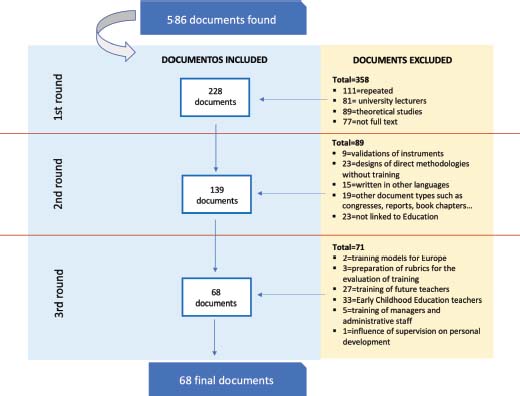
During the review process and its phases, each researcher independently codified a database in order to subsequently review and verify another colleague’s information. Consensus during the different rounds moved from an inter-observer agreement of 86.5% to full agreement, all disagreements being resolved by means of a constant reflexive process. Figure 1 represents the flowchart according to PRISMA (Page et al., 2021). Of a total 586 documents found, only 68 met the inclusion criteria.
FIGURE I. Flowchart
Source: Compiled by the authors.
The analysis of the 68 final documents was done with a codification manual composed of extrinsic variables (year of publication and origins of the authors), methodological variables (sample and research method used) and substantive variables (what teachers are trained in, characteristics of the training models received and impact) (coding manual.xlsx).
The extrinsic and methodological variables were analyzed with descriptive statistics (frequencies and percentages) and with the help of Excel, but the analysis of the substantive variables was thematic (Morgan, 2022), following the proposal of Flick (2018), which means identifying patterns of ideas, concepts or similar themes, then establishing relationships and mutually integrating the information using the theoretical fundaments of the theme. All the categories were emergent as these favor a greater understanding of the object of interest (Cypress, 2017), meeting the criterion of bottom-up inductive analysis (Bingham & Witkowsky, 2022). The triangulation between the four researchers of the study (Flick, 2018) made it possible to adjust these categories: two researchers performed the first coding independently, the third researcher was assigned with bringing both codifications together (similarities and differences) and the fourth repeated the procedure, trying to reduce the differences until reaching full agreement with the other three colleagues. These roles were interchanged for the categorization of the three research questions that guided the ST.
Results
What follows is a general description of the characteristics of the articles selected, what teachers are trained in for their PD, under what models and approaches the training is given and what its impact has been. For easier reading purposes, the final 68 studies have been identified with a number and these may be referred to Annex I.pdf
General characteristics of the articles
50% of the studies analyzed lie within the period 2019-2021 and 76.47% are from since the year 2016. An interesting increase in teacher raining can be seen between 2010 and 2021, the latter year being notable for the largest scientific production (19.12%) (Figure II).
FIGURE II. Production of articles selected by year
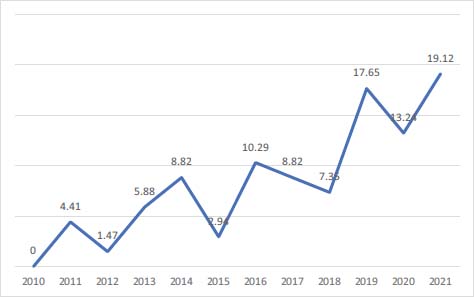
Source: Compiled by the authors. Note: this figure represents the percentage of production of articles by year.
Europe and America agglutinate 65.71% of studies related to PD training for practicing schoolteachers (Figure III).
FIGURE III. Country of origin of the articles selected
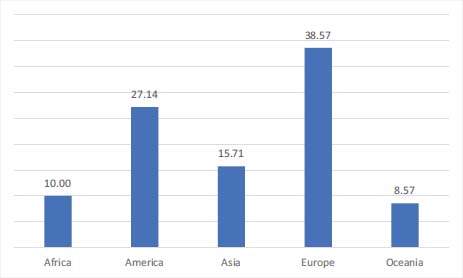
Source: Compiled by the authors. Note: this figure represents the percentage of publications per continent.
Spain is the country with the most publications, at 14.29% (26, 33, 36, 38, 41, 47, 52, 54, 55, 56), followed closely by the United States, at 10% (7, 25, 28, 43, 67, 59, 61) and then Australia (5, 20, 27, 48, 68, 57) and South Africa (1, 4, 11, 12, 13, 66), at barely 8.57%. Other countries with a lower participation are the United Kingdom (9, 19, 21, 23) and Chile (42, 46, 50, 51), at 5.71%; the Netherlands (16, 18, 24), Cyprus (29, 64, 58) and Ecuador (34, 39, 44), at 4.29%; and Jordan (8, 53), Colombia (30, 37) and Israel (2, 3), at 2.86%.
Not only have teachers received training but so have managers (8, 10, 14, 66) and administrative staff (25) along with new teachers (2), mentors (23) and teachers’ assistants (19). Some studies involved up to 410 teachers in game-based learning training (64) or 616 to examine the benefits of continuing teacher education (65).
On the other hand, most of the articles have covered Primary Education (43.42%) and Compulsory Secondary Education (30.26%), those on High-School being less frequent (2.63%), with barely two studies (2, 30). 23.68% indicate that training has been carried out in schools without offering specific results by educational phases.
What is dominant in evaluating training is qualitative research (36.76%) although 76% of these studies do not specify the method used (2, 18, 26, 30, 31, 36, 45, 48, 50, 51, 55, 57, 61, 63, 64, 68, 65, 66, 67). The case study is the most used, (5.88%) (6, 20, 22, 28, 29, 58), in combination with others such as Design-based research (29) and ethnography (58). However, regarding quantitative research (29.41%), 55% of the studies have been carried out with exploratory-descriptive designs (4, 37, 38, 40, 42, 44, 47, 53, 54, 60, 62), 20% are correlational (33, 34, 41, 49) and 10% refer to factor analysis (32, 52) and cluster (35, 46), respectively. Only seven studies have employed mixed methods (10.29%) (8, 17, 19, 21, 39, 43, 56).
What are teachers trained in for PD?
Training in schools revolves around four major categories. The dominant one is non-curricular training (45.21%), in which teachers are trained in knowledge, skills and competencies not linked to the subjects they teach; followed by collaborative training models (21.92%) based on mutual help between teachers. Likewise, but less frequently, a group of studies maps the training received and the training needs and expectations (16.44%) and another group reports specific training aimed at the subjects taught by the teachers in class (16.44%) (Table II).
TABLE II. Objectives and contexts of teacher training
Objectives and contexts of teacher training: emerging categories and codes |
|
1. Mapping: training received, training needs and expectations (16.44%) |
|
Finding out what training teachers are receiving |
- Orientation for teaching-learning policies (1) - Impact of training days on PD (21) |
Detection of training needs (continuing training, courses for training teachers, importance of continuing training) |
- Training in English for rural areas (7) - Role of managers in PD management (11) - Continuing training needs (53) - Importance of continuous training (65, 66) |
Teacher PD (cultural and social events, environment…) |
32, 33 |
Beliefs about teaching in teaching performance |
32, 35 |
2. Non-curricular training (45.21%) |
|
Mentoring, tutoring |
- Mentoring (2, 61) - Creation of shared co-learning communities (67) |
ICT, Digital competency (computerization and computer literacy) |
- Development of digital competencies (6) - Mobile phone uses (9) - ICT (12, 34, 43) - Use of synchronous videoconferencing (20) - Creation of social networks for PD (68) |
Teaching and learning |
- Attitudes towards teaching (10) - Teaching-learning process (17) - Attitudes of teacher assistants (19) |
Applied research |
18 |
Teacher leadership and coaching |
31, 42 |
Teaching innovation |
36, 38, 44, 45, 47 |
Conflict resolution |
37 |
Communication and game-based learning (gamification) |
64 |
Tutorial work or action |
54 |
School motivation |
46 |
Educational inclusion and intercultural education |
- Intercultural education (15) - Educational inclusion and attention to diversity (23, 49, 51, 55, 62, 63) |
Evaluation (techniques for improving student evaluation) |
56 |
3. Curricular training (16.44%) |
|
Orientation for life (social justice, human rights, environmental awareness…) |
13 |
Didactic knowledge (area of Nature, Science and Technology) |
40 |
Mathematics |
3,52 |
Statistics |
30 |
Economics |
4 |
English |
5, 39, 50 |
Chemistry |
22 |
Physical or sports activity |
41 |
ICT |
8 |
4. Collaborative training models (21.92%) |
|
Co-design |
27, 29 |
Co-teacher |
28, 57, 58, 59, 60 |
Peer to peer |
26 |
Peer-observation |
24, 25 |
School-university collaboration |
14 |
Validation of the 4C/ID instructional model |
This focuses on learning tasks, support information, procedural information and practice of partial tasks (16) |
Source: Compiled by the authors.
What are the training models or approaches and what do they consist in?
Cascade training models have positive effects on the attitudes and practices of secondary schoolteachers when they are accompanied by a follow-up and by periodic workshops offering continuous contact between trainers and teachers. In this way, the whole school actively participates in PD. In this kind of training, support by the managers is vital for the professional improvement of teachers (10), the manner in which they carry out their management being equally interesting (11).
When PD training is based on andragogy and favors the active and collective participation of teachers (17), the results are equally promising. The findings show that this training model improves planning, teaching methods, classroom management and cooperation between teachers as it modifies their practices and teaching styles (17).
Mathematics teaching programs with an approach oriented towards a lifelong development of competencies (16) are likewise effective and the results are equally interesting with collaborative models (Table III), but this is not always so: if the training model is imposed by the educational administrations, quality tends to decline (13,21).
TABLE III. Collaborative training model types
Collaborative model types |
Training results |
Co-design |
- Greater awareness of zone of proximal development (27) - The need to increase quantitative self-efficacy and self-reporting measures before and after training (27) - Positive effect on school culture (27) - It promotes pedagogical reflection (90.3%) (29) - Only 35.5% of the experience was disseminated at conferences (29) |
Co-teaching |
- Positive impact on teaching (58) - It stimulates joint programming (57, 60) - A positive perception of co-teaching increases with age (61) - It favors an inclusive model for students with special educational needs (55, 57, 58, 59, 61) - Strengthening of experienced and novice tutors (67) - It increases the feeling of community (31) and the relationship between teachers (communication, collaboration, trust, personal relationship, closeness) (31, 57, 59, 60) - It breaks the isolation of teachers (31) - It enhances teacher leadership (31) - It focuses on learning rather than teaching (28) |
Peer to peer |
- This guarantees the implementation of the program and its sustainability over time (26) |
Peer-observation |
- This promotes teamwork and reflection on practice (24) - It improves understanding and the application of teaching strategies (24) - It makes it possible to anticipate students’ reactions during classes (24) - It strengthens confidence (24) - Difficulties to choose which colleagues to observe due to schedule incompatibilities (25) |
School-university training |
- This promotes the design of mentoring and research programs (14) - Conditions that inhibit or promote collaborative-equitable training: (a) generating an internal commitment among the different actors involved, (b) involvement of coordinators and managers and (c) community focused on inquiry-based practices (14) |
Source: Compiled by the authors.
Finally, one of the main conditions that has positive effects on the effectiveness of training models is the number of courses received by the teachers. For example, those who have attended two or more university courses are perceived as more effective in applying methods and strategies for teaching English as a second language in comparison with those who have had less training (7). Likewise, school directors are another key condition for helping their teachers to grow professionally. Inasmuch as they participate in the training programs, positive changes in teacher performance can be seen (66). Moreover, the most effective courses are those that directly satisfy individual needs and those of the school (21) and which are concerned with attending to the most experienced teachers (1). However, quality decreases when training contains deficiencies and incoherences regarding planning, contents, financing, resources (quality-quantity ratio), follow-up, applicability (13), and temporality (e.g. classes given outside the work calendar) (21).
What has been the impact of the training received?
The impact of the training received affects six emerging categories that refer to the teaching of the curriculum subjects, digital competency, socioemotional well-being, novice teachers and teacher assistants, the educational community and professional identity.
Category 1. Impact of training on teaching. Generally speaking, training has an effect on one’s higher theoretical and didactic knowledge of the subjects taught, in favor of a positive attitudinal change with respect to the teaching-learning process. It has also been pointed out that there is a need for a training that specializes in mathematics for students with high abilities, and that there are subjects that, due to their complexity, as is the case with chemistry, require longer training over time (Table IV).
TABLE IV. Results in teaching different subjects
Subjects |
Training results |
Science, nature and technology |
- Strengthening scientific and technological thought by means of inquiry practices (40) - School gardens: (a)high level of motivation, (b)students’ awareness of the importance of active participation, (c)the need for training in technical aspects (e.g. agricultural techniques, crops, seeds, soils, etc.) and didactic aspects (e.g. school use, activities, their planning and evaluation), and (d)integration in the Natural Sciences curriculum in all areas (47) |
Mathematics and statistics |
- Little training in mathematics for teaching students with high abilities (3) - Improving attitudes towards mathematics when reflective and active activities/strategies are included (e.g. the role of mathematical problems in the classroom or the function of questions and dialogue in learning (52) - Improving attitudes towards and the teaching of statistics when thinking about one’s own experience as a student (30) |
Economics |
- Improving the attitude towards teaching economics (4) - Higher learning in contents related to contemporary economic problems (4) |
English |
- Increase learning whenever there is an effective coordination between teachers, administrators and managers (5) |
Lengua |
- Learning the potential of narratives and higher levels of meta-semiotic awareness (50) - Placing value on literature during a multimodal era (50) |
Chemistry |
- One year of training is not enough for developing competent leader teachers (22) |
Source: Compiled by the authors.
Category 2. Impact of training on digital competency. Training in digital skills has increased considerably among teachers in the wake of the COVID-19 pandemic (34), especially in relation to computer literacy, digital content development and Internet safety (34).
All in all, ICT training for teachers is linked to positive and negative effects but also to specific needs.
On the one hand, digital competency improves teachers’ knowledge and skills, especially as regards professional commitment, the use of resources, activity planning and an improvement in student assessment (6). Other positive results highlight the recognition of the educational potential of mobile phones in teaching and learning sciences (9). Similarly, teachers have proven themselves competent in combining technical, pedagogical and interpersonal skills for online teaching: communicating via the screens, establishing technology-mediated relationships with the students and designing classes that promote student participation (20).
On the downside, training has not always succeeded in making teachers digitally competent. For example, training in the use of the mini-Pat did not respond to teachers’ needs nor did it expand the repertoire of knowledge and skills in the use of ICTs (12). Although PD programs helped teachers to improve their skills and knowledge in technology, their effectiveness was negatively affected by certain factors, such as: the timing and training model (e.g. at the end of the day, courses imposed by the administrations), the lack of motivation and follow-up, a school culture that does not recognize PD and teachers’ excessive workload (8).
Regarding the needs detected, teachers need time to gain knowledge and thus improve their digital teaching practice (68). ICTs still constitute a motive for differences among the teaching staff of the same educational center and in the provision of technological spaces among different schools (44). Even if learning environment designs are generated (38), the figure of the ICT coordinator is favorably viewed (43) and the percentage of technology training is high (e.g. digital backboards) (36), it would seem that, whenever the support of schools in insufficient or inadequate (43), this generates frustration among teachers (38), which results in low-quality didactic proposals (36).
Finally, other variables to be considered and which may positively or negatively affect the development of digital competency include attitude and computer literacy, whereas marital status, educational level, specialty and professional position have no influence as neither do the training models (62).
Category 3. Impact of training on socio-emotional well-being. One can see on Table V how being trained in physical self-care and the development of socioemotional competencies also has an effect on the well-being of students and families. Teachers also demand training in inclusive education due to their positive implications on the whole educational community.
TABLE V. Results in socioemotional well-being
Training in |
Training results |
Physical well-being |
- The greater one’s physical well-being, the greater one’s motivation for practice (41) |
Management of failure and frustration |
- learning emotional methodologies focused on experience (38) |
School motivation and family |
- This is a shared responsibility and not a continuous process that falls to the teacher (46) |
Resolution of conflicts or school violence |
- Identification of factors for managing classroom conflicts: self-knowledge, self-regulation and motivation (37) - Identification of factors that determine success at school and non-violent social relationships: self-control and motivation (37) |
Inclusive education |
- Lack of training during initial training (51) and with a humanistic approach (23) - Lack of training for the transition to teaching indigenous students (48) - The need to strengthen school-family links (49, 63) - Identification of communication strategies for increasing parents’ participation in rural schools (7) |
Source: Compiled by the authors.
Category 4. Impact of training on novice teachers and teacher assistants. Although there are few studies that allude to this impact, novice teachers begin their PD with training in the tutorial function as this is a quality factor for their students’ socio-affective and cognitive support. Here, they are aware of the very nature and complexity of tutoring, the essential connection between theory-practice, and the importance of developing reflective skills that enhance critical thinking among their students (2). In contrast, the highest impact of this training on teacher assistants affects the personal sphere, but it seems to have little or no impact on the development of their careers, remuneration and job recognition (19).
Category 5. Impact of training on the educational community. When teachers are trained in research, they develop a greater awareness of the school as a complex organization, of the role played by the administrative staff and of the potential of inquiry and its benefits for innovation in the classroom (18). In the same line, manager-oriented training in leadership, dealing with the management of time and conflicts, showed signs of improvement in the handling of educational centers (42). However, training in rural schools for teaching English as a second language, failed to reach its objectives due to the communication difficulties between the teachers and the families, which hindered a more active participation (7).
Category 6. Impact on teacher identity formation. Whenever teachers may choose how to improve their PD, most of them opt for training in their field and specialty (25.7%) or in ICT (10%) or in disciplinary matters (4.8%) (32) and classroom management (4.8%) (32,35). Likewise important is the finding that PD reinforces the professional identity of teachers, which is influenced by personality traits (35), beliefs regarding one’s own performance, and the years of work experience and specialty (32). For example, teachers with many years’ experience as such feel better prepared for performing their educational functions (e.g. tasks bearing on planning and teaching) (32), which strengthens the personal and professional dimension of PD. However, a negative assessment of the job (33) causes the effectiveness of PD programs to diminish.
Discussion and conclusions
PD is an educational activity that aids the maintenance, development and improvement of knowledge, problem-solving and experience to achieve quality education. It is for this reason that an SR of scientific articles has been made in the present study to analyze the training given to practicing primary education, secondary education and high-school teachers for their PD, what characterizes these training models and what their impact has been.
Generally speaking, training in schools has increased with more than 50% of the documents analyzed between 2019 and 2021, which datum confirms the demand for training programs during the COVID-19 pandemic and is recorded in OECD reports (2021) and in research efforts from different countries (Irby et al., 2022; Lo &To, 2023; Perry, 2023; Wu et al., 2022).
Primary Education teachers are those who receive the most training (43.42%), followed by their Secondary Educations counterpart (30.26%) and then by High-School teachers, with only 2.63%, which situation is similar to that of OECD countries (2021). In Spain, 48% of teachers have been trained in the contents of the subjects, pedagogy and classroom practices, as opposed to 79% of those countries (OECD, 2021).
Regarding the question “what are teachers trained in for their PD?” (PI1), there is a predominance of digital competencies (6,9,12,20,34,43,68), which finding is also shared by other authors (Cabero-Almenara & Palacios-Rodríguez, 2020) and which has increased even more due to COVID-19 (Perry, 2023). The need for training in the area of attention to diversity (15,23,49,51,55,63) coincides with the OECD report (2021), which states that there is a challenge in relation to the fostering of more inclusive classrooms and of teachers with more experience (Wächter & Gorges, 2023). Finally, there are signs of a growing interest in collaborative training models (14, 16, 24, 25, 26, 27, 28, 29, 57, 58, 59, 60) as they favor feedback, the development of good practices (Colson et al., 2021) and shared reflection environments (Westbroek et al., 2019). For Pedroza and Reyes (2019) “… [these models] lead to a self-evaluation of continuous training, which impacts on learning success” (p.426).
On the other hand, what are the training models or approaches? (PI2). It is interesting to see how collaborative training models are themselves a subject for study as well as a type of training that is being performed at schools (14, 24, 25, 26, 27, 28, 29, 31, 55, 57, 58, 59, 60, 61, 67) and that they are becoming increasingly established as a promising line of research (Colson et al., 2021). Also, the findings that have emerged support recent research that similarly confirms the effectiveness of cascade (Savard & Cyr, 2018) and lifelong training models (Reychav et al., 2023), although both approaches are not without the difficulty entailed by training a high number of teachers.
In relation to “What has been the impact of the training received?” (PI3), the findings of the studies analyzed indicate that the impact is highly varied, even if the training is not always seen as sufficient or adequate. Whenever the training is effective –as confirmed by 83.83% of the studies analyzed–, there is initially a change in the personal sphere that is later followed by an application phase and then evaluated prior to being adopted on a more permanent basis (Basma & Savage, 2018). On the other hand, the dissatisfaction of teachers (16.17%) with the training received is due to disagreement with the planning (e.g. contents, financing, resources, follow-up) and incompatibility with the work calendar and workload (8, 13, 21, 22). To this must be added the lack of motivation as well as the need for more time to become empowered and appropriate what has been learned (8, 12, 22, 38, 64, 68). What is more, these unfavorable results increase even further with ICT training (34, 43, 36, 38).
Similarly, the needs focus on an academic and technical-professional training (OECD, 2021) that makes it possible to “strengthen the connections between education, training and research for social development” (Suárez et al., 2019, p.19), but for Barrios and Jiménez (2020), training is playing more of a palliative than a preventive role, a higher level of professionalization being desirable. The creation of effective evaluations that measure teachers’ classroom practices and capture their strengths and areas for improvement constitutes another priority (Poulou et al., 2023).
Educational implications. What is recommendable for an effective PD are formal and informal training opportunities, time for quality training, the delivery of courses during work hours, the promotion of collaborative models among peers, the increase of programs aimed at new teachers and the inclusion of management and administration staff of schools.
As regards how training must be organized, it must be delivered in modular units. The first modules must provide teachers with security and incentivize motivation. Once these bases have been laid, training could be based on participatory-research-action (Pozdeeva, 2018). The PD programs are expected to promote changes oriented towards achieving more autonomy among teachers (Choi & Mao, 2021). This entails adopting an approach based on experience with opportunities for teachers to learn, experiment and inquire about teaching practices (Choi & Mao, 2021). In teaching, it is important to work on analyzing practical cases and innovative strategies and resources (Corujo-Vélez et al., 2021). Quality training is characterized by being Dynamic, interactive and dialogic; it “addresses the human condition as a potentiality” (Nieva & Martínez, 2016, p.14).
Another educational implication is that teachers receive training from external agents to schools or that they also observe classes given by other teachers so as to eliminate didactic barriers and incorporate new strategies and procedures in their classrooms (Bonnand & Hansen, 2016). For Rojas Martínez (2023) “the education that our present society demands must be designed at universities to transform the professional culture of school centers” (p. 252). It would also be interesting for teachers to join forces to organize weekly intercycle meetings to promote integrated projects among different subjects.
Limitations and forecasts. As it was not possible to identify previous SRs exclusively covering teacher DP training within the non-university section, the findings that emerged were discussed with recent investigations that address the issue with interest. Likewise, PD is a complex construct that requires teachers to have a holistic and diverse training that is also specialized in the development of skills, knowledge and attitudes with the purpose of improving educational practice. This complexity has been present in the variability of approaches, techniques and resources, which has entailed difficulty in establishing much more limited comparisons. Future research is expected to delve further with a bibliometric analysis using specialized programs such as SciMAT, which will make it possible to identify the conceptual evolution and thematic areas gathered by the research undertaken on the subject over time. Another line might consist in focusing exclusively on the training of High-School teachers as this has been the least studied or on continuing with an overview of the training given to practicing education professionals for their PD.
Acknowledgment
This research was carried out within Adaptive Pedagogy Research Group under PROFICIENCyIn +EDU, RTI2018-096761-B-I00. MCI/AEI/FEDER, UE, PROFICIENCyIn+E, EDU 2015-63844-R. MINECO/FEDER.
Bibliographic references
Aldahmash, A. H., Alshamrani, S. M., Alshaya, F. S., & Alsarrani, N. A. (2019). Research trends in service science teacher professional development from 2012 to 2016. International Journal of Instruction, 12, 163-178. https://doi.org/10.29333/iji.2019.12211a
Alexandre, P. A. (2020). Methodological Guidance Paper: The Art and Science of Quality Systematic Reviews. Review of Educational Research, 90(1), 6-23. https://doi.org/ggwsgp
Almazroa, H. & Alotaibi, W. (2023). Teaching 21st Century Skills: Understanding the Depth and Width of the Challenges to Shape Proactive Teacher Education Programmes. Sustainability, 15(9), 7365. https://doi.org/10.3390/su15097365
Alves, E. (2003). La formación permanente del docente en la escuela. El uso universitario de la tecnología para elevar la calidad del docente en el aula. Investigación y Postgrado, 18(1), 36-45.
Barrios, C., & Jiménez, B. (2020). Formación dentro y fuera de la escuela. Antítesis o síntesis. Educar, 30, 141-157.
Bascopé, M., Perasso, P., & Reiss, K. (2019). Systematic Review of Education for Sustainable Development at an Early Stage: Cornerstones and Pedagogical Approaches for Teacher Professional Development. Sustainability, 11, 719, 1-16. https://doi.org/10.3390/su11030719
Basma, B., & Savage, R. (2018). Teacher Professional Development and Student Literacy Growth: a Systematic Review and Meta-analysis. Educ Psychol Rev, 30, 457-481. https://doi.org/10.1007/s10648-017-9416-4
Bennasar, M. I. (2020). Los modelos formación docente, un tema en debate permanente. Revista HumanArtes, 17, 1-13.
Bingham, A.J., & Witkowsky, P. (2022). Deductive and inductive approaches to qualitative data analysis. En C. Vanover, P. Mihas y J. Saldaña (Eds.), Analyzing and interpreting qualitative data: After the interview (pp. 133-146). SAGE.
Bonnand, S., & Hansen, M. A. (2016). Your device, your classroom: Creating library spaces that support teaching innovation. C&RL News, 77(6), 288-305.
Booth, A., Noyes, J., Flemming, K., Moore, G., Tunçalp, Ö., & Shakibazadeh, E. (2019). Formulating questions to explore complex interventions within qualitative evidence synthesis. BMJ Glob Heal, 4(Suppl 1), e001107.
Bramer, W. M., Rethlefsen, M., & Franco, O. (2017). Optimal database combinations for literature searches in systematic reviews: a prospective exploratory study. Systematic Reviews, 6(245), 1-12. https://doi.org/10.1186/s13643-017-0644-y
Cabero-Almenara, J., & Palacios-Rodríguez, A. (2020). Formación y competencias del profesorado en la era digital. Revista científico profesional de la pedagogía y psicopedagogía, 5, 113-127.
Choi, S., & Mao, X. (2021). Teacher autonomy for improving teacher self-efficacy in multicultural classrooms: A cross-national study of professional development in multicultural education. International Journal of Educational Research, 105, 101711. https://doi.org/10.1016/j.ijer.2020.101711
Colson, T., Xiang, Y., & Smothers, M. (2021). How professional development in co-teaching impacts self-efficacy among rural high school teachers. Rural Educator, 42(1), 20-31. https://doi.org/10.35608/ruraled.v42i1.897
Corujo-Vélez, C., Barragán-Sánchez, R., Hervás-Gómez, C., & Palacios-Rodríguez, A. (2021). Teaching innovation in the development of professional practices: Use of the collaborative blog. Education Sciences, 11(8), 1-18. https://doi.org/10.3390/educsci11080390
Cypress, B. S. (2017). Rigor or Reliability and Validity in Qualitative Research: Perspectives, Strategies, Reconceptualization, and Recommendations. Dimensions of Critical Care Nursing, 36(4), 253-263, https://doi.org/10.1097/DCC.0000000000000253
Eurydice (2017). The Teaching Profession in Europe: Practices, Perceptions, and Policies. Eurydice Report. Publications Office of the European Union.
Fernández-Sánchez, H., King, K., & Enríquez-Sánchez, C. B. (2020). Revisiones Sistemáticas Exploratorias como metodología para la síntesis del conocimiento científico. Enferm. Univ, 17(1), 87-94. https://doi.org/10.22201/eneo.23958421e.2020.1.697
Flick, U. (2018). An introduction to qualitative research. SAGE.
Gast, I., Schildkamp, K., & van der Veen, J. T. (2017). Team-Based Professional Development Interventions in Higher Education: A Systematic Review. Review of Educational Research, 87(4), 736-767. https://doi.org/10.3102/0034654317704306
Grau, S., Gómez, C., & Perandones, T. (2009). La formación del profesorado como factor decisivo de la excelencia educativa. En C. Gómez y S. Grau (Coords.) Propuestas de diseño, desarrollo e innovaciones curriculares y metodología en el EEES (pp. 7-26). Universidad de Alicante.
Hattie, J. (2015). What Doesn’t Work in Education: The Politics of Distraction. Pearson.
Ibrahim, R., Norman, H., Nordin, N., & Azwar, K. (2020). Research trends in ICT and education: A systematic review of continuous professional development courses for online educators. Journal of Physics: Conference Series, 1529, 1-7. https://doi.org/10.1088/1742-6596/1529/4/042060
Irby, B., Pashmforoosh, R., Druery, D.M., Eljaouhari, N., Tong, F., & Lara-Alecio, R. (2022). An Analysis of Virtual Professional Development for School Leaders During COVID-19. International Journal of Virtual and Personal Learning Environments, 12(1), 1–19. https://doi.org/10.4018/IJVPLE.302097
Lindvall, J., & Ryve, A. (2019). Coherence and the positioning of teachers in professional development programs. A systematic review. Educational Research Review, 27, 140-154. https://doi.org/10.1016/j.edurev.2019.03.005
Lo, N. P. K., & To, B. K. H (2023). The transformation of identity of secondary school teachers: Professional development and English language education strategies in Hong Kong during the COVID-19 pandemic. Cogent Education, 10(1), 1-32. https://doi.org/10.1080/2331186X.2022.2163790
Luo, T., Freeman, C., & Stefaniak, J. (2020). “Like, comment, and share”—professional development through social media in higher education: A systematic review. Education Tech Research Dev, 68, 1659-1683. https://doi.org/10.1007/s11423-020-09790-5
Matschiner, A. (2023). A Systematic Review of the Literature on Inservice Professional Development Explicitly Addressing Race and Racism. Review of Educational Research August, 93(4), 594-630. https://doi.org/10.3102/00346543221125245
Ministerio de Educación, Cultura y Deporte (2015). El profesorado del siglo XXI. XXI Encuentro de Consejos Escolares Autonómicos y del Estado. MECD.
Mitchell, R. (2013). What is professional development, how does it occur in individuals, and how may it be used by educational leaders and managers for the purpose of school improvement? Professional Development in Education, 39(3), 387-400. http://dx.doi.org/10.1080/19415257.2012.762721
Morgan, H. (2022). Understanding Thematic Analysis and the Debates Involving Its Use. The qualitative report, 27(10), 2079-2091. https://doi.org/10.46743/2160-3715/2022.5912
Morin, K. L., Ganz, J. B., Vannest, K. J., Haas, A. N., Nagro, S. A., Peltier, C. J., & Ura, S. K. (2019). A systematic review of single-case research on video analysis as professional development for special educators. The Journal of Special Education, 53, 3-14.
Newman, M., & Gough, D. (2020). Systematic Reviews in Educational Research: Methodology, Perspectives and Application. En O. Zawacki-Richter et al. (Eds.) Systematic Reviews in Educational Research. Methodology, Perspectives and Application (pp. 3-22). Springer.
Nieva, J. A., & Martínez, O. (2016). Una nueva mirada sobre la formación docente. Universidad y Sociedad, 8(4), 14-21.
Nunn, J., & Chang, S. (2020). What are Systematic Reviews? WikiJournal of Medicine, 7(5), 1-1. https://doi.org/10.15347/wjm/2020.005
OECD (2021). Teachers Getting the Best out of Their Students: From Primary to Upper Secondary Education, TALIS. OECD Publishing. https://doi.org/10.1787/5bc5cd4e-en
OECD (2023). Review education policies. Teacher professional development. OECD Publishing. https://gpseducation.oecd.org/revieweducationpolicies/#!node=41732&filter=all
Pamies, M. A., Cascales, A., & Gomariz, M. A. (2022). Association between conditioning factors of the transfer of lifelong learning and the application of learning in the training programmes of Pre-school and Primary Education. Revista Electrónica Interuniversitaria de Formación del Profesorado, 25, 127-40.
Page, M. et al. (2021). The PRISMA 2020 statement: an updated guideline for reporting systematic reviews. BMJ, 372(71), 1-9. https://dx.doi.org/10.1136/bmj.n71
Pedroza, R., & Reyes, A. M. (2019). Formación docente autorreflexiva para el aprendizaje en matemáticas. V Congreso Internacional sobre Aprendizaje, Innovación y Competitividad (CINAIC 2019), Universidad Politécnica de Madrid, Madrid.
Perry, E. (2023). Teacher Professional Development in Changing Circumstances: The Impact of COVID-19 on Schools’ Approaches to Professional Development. Education Sciences, 13(48). https://doi.org/10.3390/educsci13010048
Poulou, M. S., Reddy, L. A., & Dudek, C. M. (2023). Teachers and school administrators’ experiences with professional development feedback: The classroom strategies assessment system implementation. Frontiers in Psychology, 14, 1074278. https://doi.org/10.3389/fpsyg.2023.1074278
Pozdeeva, S. I. (2018). Participation of primary school teachers in educational innovations as the groundwork for their professional development: Organization and management. Advances in Intelligent Systems and Computing, 677, 28-36. https://doi.org/10.1007/978-3-319-67843-6_4
Reychav, I., Elyakim, N., & McHaney, R. (2023). Lifelong learning processes in professional development for online teachers during the Covid era. Front. Educ, 8, 1041800. https://doi.org/10.3389/feduc.2023.1041800
Rojas, N., & Martínez, O. (2023). Formación del Docente y Pedagogía de la Complejidad en el Contexto de la Educación. Revista Scientific, 1(1), 249-265. https://doi.org/10.29394/scientific.issn.2542-2987.2016.1.1.14.249-265
Santos, M. A. (2020). La formación del profesorado. Piedra angular del sistema educativo. Crónica, Revista científico profesional de la pedagogía y psicopedagogía, 5, 81-87.
Savard, A., & Cyr, S. (2018). A waterfall model for providing professional development for elementary school teachers: A pilot project to implement a competency-based approach. Global Education Review, 5(3), 165-182.
Suárez, N., Mena, D., Gómez, V., & Fernández, A.I. (2019). La formación del profesorado en Iberoamérica. Tendencias, reflexiones y experiencias. Universidad Tecnológica Indoamérica.
Surahman, E., & Wang, T-H. (2023). In-service STEM teachers professional development programmes: A systematic literature review 2018–2022. Teaching and Teacher Education, 135, 104326. https://doi.org/10.1016/j.tate.2023.104326
Vaillant, D. (2016). El fortalecimiento del desarrollo profesional docente: una mirada desde Latinoamérica. Journal of Supranational Policies of Education, 5, 5-21. http://dx.doi.org/10.15366/jospoe2016.5
Van Grieken, C. (2016). Formación docente y escuela: posibles articulaciones. Ciencia y Sociedad, 41(1), 29-43. https://doi.org/10.22206/cys.2016.v41i1.pp029-043
Wächter, T., & Gorges, J. (2023). How does inclusion come into schools? Attitude towards inclusion as a predictor of teachers’ inclusion-related motivation for professional development courses. Zeitschrift fur Erziehungswissenschaft, 26, 31-54. https://doi.org/10.1007/s11618-022-01129-5
Westbroek, H., De Vries, B., Walraven, A., Handelzalts, A., & McKenney, S. (2019). Teachers as co-designers: Scientific and colloquial evidence on teacher professional development and curriculum innovation. En J. Pieters, J. Voogt y N. Pareja (Eds.) Collaborative Curriculum Design for Sustainable Innovation and Teacher Learning (pp.35-54). Springer.
Wu, W., Hu, R., Tan, R., & Liu, H. (2022). Exploring Factors of Middle School Teachers’ Satisfaction with Online Training for Sustainable Professional Development under the Impact of COVID-19. Sustainability, 14, 1-18. https://doi.org/10.3390/su142013244
Zeng, J. (2023). A theoretical review of the role of teacher professional development in EFL students’ learning achievement. Heliyon, 9, e15806. https://doi.org/10.1016/j.heliyon.2023.e15806
Contact address: Universidad Complutense de Madrid, Facultad de Educación, Departamento de Investigación y Psicología. Calle Rector Hoyo Villanova s/n, 28040, Madrid. E-mail: ccamilli@ucm.es