Introducción: los legados de la Ilustración
DOI:
https://doi.org/10.24162/EI2023-12283Palabras clave:
Introduction, “Enlightenment Legacies”Resumen
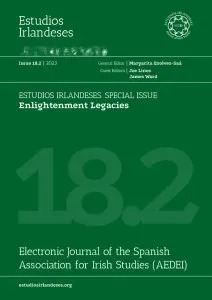
Titled “Enlightenment Legacies”, this Special Issue brings together articles, poems and discussions which address the continuing relevance to modern Irish culture of the period and movement known as “the Enlightenment”. As shown by the varied range of topics, people and debates covered by contributors, our present continues to be shaped by Enlightenment themes and values in ways both unexpected and unignorable. Not surprisingly, canonical Irish authors from this period feature extensively: these include George Farquhar, Jonathan Swift, Oliver Goldsmith and Eibhlín Dubh Ní Chonaill. They are joined here by some perhaps lesser-known figures from cultural and popular history including the “Earl Bishop”, Frederick Hervey, as well as two women remembered for their place in Irish legal history, whose cases speak to issues of gender, rationality and justice: Bridget Cleary, murdered by her husband under the claim that she was a changeling, and Mary Dunbar, accuser in Ireland’s only mass witchcraft trial. Events and shifts in the political and cultural spheres such as the interplay and conflict between oral and textual Irish literary cultures, the goal of world peace pursued via an ideal supranational union, and indeed the union between Great Britain and Ireland enacted in 1800, continue to reverberate today.
Citas
Brown, Michael (2016). The Irish Enlightenment. Cambridge, MA.: Harvard University Press.
Dwan, David (2020). “The Prejudices of Enlightenment.” Irish Literature in Transition, 1700-1780, edited by Moyra Haslett. Cambridge: Cambridge University Press. 91-109.
Erll, Astrid (2011). Memory in Culture. Basingstoke: Palgrave Macmillan.
Gamer, Michael (2015). “Assimilating the Novel: Reviews and Collections.” Oxford History of the Novel in English, vol 2: English and British Fiction 1750-1820, edited by Peter Garside and Karen O’Brien. Oxford: Oxford University Press. 531-50.
Harrison, Henrietta (2021). The Perils of Interpreting: The Extraordinary Lives of Two Translators between Qing China and the British Empire. Princeton: Princeton University Press.
Johnston, Charles (2014). The History of Arsaces, Prince of Betlis, edited by Daniel Sanjiv Roberts. Dublin: Four Courts Press.
Lines, Joe (2021). The Rogue Narrative and Irish Fiction 1660-1790. Syracuse: Syracuse University Press.
Morin, Christina (2012). “Recognisably Irish? The Diasporic Fiction of Regina Maria Roche.” Journal of Irish and Scottish Studies 5: 155-173.
_____ (2017). “‘At a distance from [my] country’: Henrietta Rouvière Mosse, the Minerva Press, and the Negotiation of Irishness in the Romantic Literary Marketplace.” European Romantic Review 28: 447-460.
Neiman, Elizabeth and Christina Morin, eds. (2020). “The Minerva Press and the Literary Marketplace.” Special Issue of Romantic Textualities 23.
Newman, Ian, and David O’Shaughnessy, eds. (2022). Charles Macklin and the Theatres of London. Liverpool: Liverpool University Press.
O’Shaughnessy, David, ed. (2015). “Networks of Aspiration: the London Irish of the Eighteenth Century.” Special Issue of Eighteenth-Century Life 39.
_____ (2019). Ireland, Enlightenment, and the English Stage, 1740-1820. Cambridge: Cambridge University Press.
Prendergast, Amy (2020). “Transnational Influence and Exchange: The Intersections between Irish and French Sentimental Novels.” Irish Literature in Transition, 1700-1780, edited by Moyra Haslett. Cambridge: Cambridge University Press. 189-206.
Roberts, Daniel Sanjiv, and Jonathan Jeffrey Wright, eds. (2019). Ireland’s Imperial Connections, 1775-1947. Cham: Palgrave Macmillan.
Yeats, W.B. (1966). The Variorum Edition of the Plays of W.B. Yeats, edited by Russell K. Alspach. New York: Macmillan.
Descargas
Publicado
Cómo citar
Número
Sección
Licencia
Derechos de autor 2023 Joe Lines, James Ward

Esta obra está bajo una licencia internacional Creative Commons Atribución-NoComercial 4.0.


