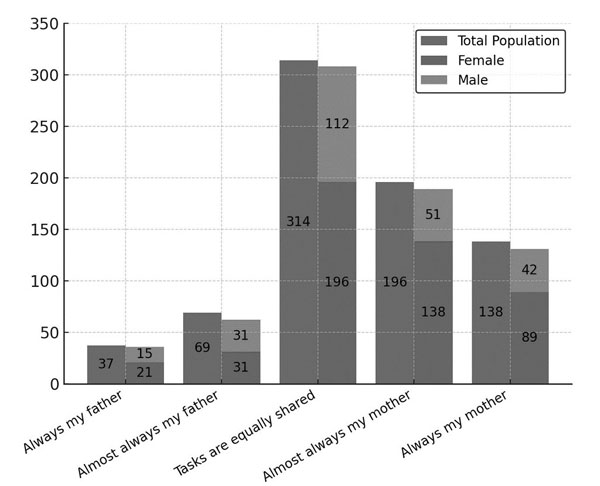
Figure 1. Results ‘Indoor Household Tasks’
IRATXE SUBERVIOLA OVEJAS Y OLAYA FERNÁNDEZ GUERRERO
Universidad de La Rioja (España)
DOI: 10.13042/Bordon.2025.116309
Fecha de recepción: 21/5/25 • Fecha de aceptación: 4/8/25
Autora de contacto / Corresponding author: Iratxe Suberviola Ovejas
E-mail: iratxe.suberviola@unirioja.es
Cómo citar este artículo: Suberviola Ovejas, I. & Fernández Guerrero, O. (2025). Quantitative analysis of university students’ perceptions of fairness in the distribution of domestic tasks and caregiving responsibilities. Bordón, Revista de Pedagogía, 77(4), 85-115. https://doi.org/10.13042/Bordon.2025.116309
INTRODUCTION. Responsibility-sharing in caregiving and domestic labour remains a critical concern in advancing gender equity. This study investigates Spanish university students’ perceptions of the distribution of household tasks and caregiving responsibilities, along with their evaluations of the fairness of this distribution. The primary aim is to explore how perceptions of fairness vary according to factors such as gender, age, exposure to gender equality education, parental employment status, family educational background, and place of residence. METHODOLOGY. The sample comprises university students from various academic disciplines across Spain (N = 1,287). Data were gathered using a structured questionnaire featuring Likert scales, validated using the Delphi method and exhibiting high internal consistency (α = .966). Initially, descriptive statistical analyses were performed, calculating the percentage distributions of responses across the entire student sample, both at the item level and within the broader categories under investigation. This provided a preliminary overview of the prevailing trends in perceptions and behaviors. Subsequently, multi-group analyses were conducted employing a range of statistical techniques to identify the significance of differences between subgroups. RESULTS. Findings indicate enduring gender asymmetries in perceived responsibility-sharing: 84% of respondents believe that mothers predominantly manage household chores, while 96.5% report that they also bear the primary responsibility for childcare. Significant differences emerged based on gender, age, and gender equality education, with male participants perceiving a more equitable distribution than female participants reported. DISCUSSION. The study concludes that, despite increased awareness of gender equity, traditional patterns in the allocation of domestic and caregiving responsibilities persist. The findings underscore the need to strengthen educational initiatives and public policies aimed at fostering more balanced household roles.
Keywords: Equal education, Gender bias, Gender equity, Household Chores.
The equitable distribution of domestic and caregiving responsibilities is a foundational component of achieving gender equality. Despite progressive shifts in societal discourse, persistent disparities remain in how domestic work is shared, especially between men and women (Sullivan, 2018Sullivan, O. (2018). The gendered division of household labor. En B. J. Risman, C. M. Froyum, & W. J. Scarborough (Eds.), Handbook of the sociology of gender (pp. 377–392). Springer International Publishing. https://doi.org/10.1007/978-3-319-76333-0_27). The European Institute for Gender Equality (EIGE, 2024European Institute for Gender Equality (EIGE). (2024). Gender Equality Index: Time in European Union. https://eige.europa.eu/gender-equality-index/2024/domain/time) reports that 79% of women are responsible for daily household chores and cooking, compared to only 34% of men, with such imbalances being particularly pronounced in Southern European countries like Spain. These discrepancies reflect not only personal or familial choices but broader cultural and structural inequalities, including policy gaps and entrenched gender norms.
Globally, studies from the International Labour Organization (2018International Labour Organization. (2018). Care work and care workers for a future with decent work. https://www.ilo.org/publications/major-publications/care-work-and-care-jobs-future-decent-work) and UN Women (2024) reveal that women devote, on average, three times more hours than men to unpaid domestic labour. This “invisible economy” accounts for up to 20% of GDP in many nations. The unequal burden persists even among women with full-time employment (Martínez-López, 2018Martínez-López, N. (2018). Estudio de la conciliación del área personal, familiar y profesional en enfermeras/os hospitalarios con cargas familiares [Tesis doctoral, Universidad de Murcia]. https://digitum.um.es/digitum/handle/10201/56120), leading to a cascade of inequalities: reduced access to higher-paying jobs, a widened gender pay gap, and diminished economic autonomy (Cerrato & Cifre, 2018Cerrato, J., & Cifre, E. (2018). Gender inequality in household chores and work-family conflict. Frontiers in Psychology, 9, Article 1330. https://doi.org/10.3389/fpsyg.2018.01330; Forste & Fox, 2012Forste, R., & Fox, K. (2012). Household labor, gender roles, and family satisfaction: A cross-national comparison. Journal of Comparative Family Studies, 43(5), 613–631. https://doi.org/10.3138/JCFS.43.5.613; Graham et al., 2024Graham, E., Aleksa, E., Dzioba, A., Madou, E., Chen, T., Strychowsky, J. E., Hu, A., Chan, Y., & Seemann, N. M. (2024). Gender differences in domestic responsibilities of otolaryngologists. A mixed-methods analysis. The Laryngoscope, 134. https://doi.org/10.1002/lary.31605; Starrels, 1994Starrels, M. (1994). Husbands’ involvement in female gender-typed household chores. Sex Roles, 31, 473–491. https://doi.org/10.1007/BF01544202; Sukumaran et al., 2024Sukumaran, S., Somasundaran, R., & Naur, I. (2024). The double burden: A study on women’s dual roles in the workplace and household responsibilities in Kerala. Journal of Women Empowerment and Studies, 45, 48–60. https://doi.org/10.55529/jwes.45.48.60). In Spain, although men’s participation in household tasks has increased slightly over recent decades (Bianchi et al., 2012Bianchi, S., Robinson, J., & Milkie, M. (2012). Changing rhythms of American family life. Russell Sage Foundation.; Craig et al., 2010Craig, L., Mullan, K., & Blaxland, M. (2010). Parenthood, policy and work–family time in Australia 1992–2006. Work, Employment & Society, 24(1), 27–45. https://doi.org/10.1177/0950017009353778; Hernández del Rosal et al., 2022Hernández del Rosal, P., Laduj, I., & Lázaro, M. (2022). Hombres, corresponsabilidad y cuidados. Guía didáctica de corresponsabilidad masculina. Dirección General de Igualdad. Gobierno de La Rioja. https://bit.ly/45codd8), the overall gender gap remains significant, reinforcing women’s time poverty and limiting their professional development and well-being (Molarius & Metsini, 2023Molarius, A., & Metsini, A. (2023). The association between time spent in domestic work and mental health among women and men. International Journal of Environmental Research and Public Health, 20. https://doi.org/10.3390/ijerph20064948).
This study focuses on the perspectives of young people within Spanish households, exploring how they perceive the sharing of domestic responsibilities and whether these perceptions reflect or challenge traditional gender norms. Youth attitudes are key to understanding intergenerational shifts in gender ideology and behaviour. While public discourse around gender equity has grown, research shows that practice lags behind belief. Although many young people endorse equal sharing of household tasks, young women still tend to shoulder a disproportionate share (Graham et al., 2024Graham, E., Aleksa, E., Dzioba, A., Madou, E., Chen, T., Strychowsky, J. E., Hu, A., Chan, Y., & Seemann, N. M. (2024). Gender differences in domestic responsibilities of otolaryngologists. A mixed-methods analysis. The Laryngoscope, 134. https://doi.org/10.1002/lary.31605; Sukumaran et al., 2024Sukumaran, S., Somasundaran, R., & Naur, I. (2024). The double burden: A study on women’s dual roles in the workplace and household responsibilities in Kerala. Journal of Women Empowerment and Studies, 45, 48–60. https://doi.org/10.55529/jwes.45.48.60; Cerrato & Cifre, 2018Cerrato, J., & Cifre, E. (2018). Gender inequality in household chores and work-family conflict. Frontiers in Psychology, 9, Article 1330. https://doi.org/10.3389/fpsyg.2018.01330). Moreover, young men are more likely to perceive the distribution as fair, indicating a gendered perception gap (Carlson & Lynch, 2013Carlson, D., & Lynch, J. (2013). Housework: Cause and consequence of gender ideology? Social Science Research, 42(6), 1505–1518. https://doi.org/10.1016/j.ssresearch.2013.07.003; Fernández-Guerrero et al., 2022Fernández-Guerrero, O., Álvarez-Terán, R., Barbed, N., Martínez-López, M., & Suberviola, I. (2022). Aspectos de la conciliación personal, familiar y laboral en La Rioja y su incidencia en los derechos de la infancia. Un estudio sobre corresponsabilidad. https://investigacion.unirioja.es/documentos/64705b2c7bb1586d2f053976; Lachance-Grzela & Bouchard, 2010Lachance-Grzela, M., & Bouchard, G. (2010). More on the gendered division of household labor: A response to commentators. Sex Roles, 63, 801–806. https://doi.org/10.1007/s11199-010-9885-0; Alonso-Martirena et al., 2023Alonso-Martirena, Y., Escudero, J. I., Monzón, J., Pellejero, L., & Suberviola, I. (2023). La corresponsabilidad en los cuidados en el contexto familiar en Navarra. Medición de la percepción del estudiantado universitario. Instituto de Igualdad de Navarra. https://bit.ly/4hOSWBy). Related to that, some scholars have highlighted that students enrolled in traditionally male-dominated fields tend to hold more conservative views regarding the division of domestic tasks compared to those in disciplines with a higher proportion of female students (Correll, 2001Correll, S. (2001). Gender and the career choice process: The role of biased self-assessments. American Journal of Sociology, 106(6), 1691–1730. https://doi.org/10.1086/321299; Charles & Bradley, 2009Charles, M., & Bradley, K. (2009). Indulging our gendered selves? Sex segregation by field of study in 44 countries. American Journal of Sociology, 114(4), 924–976. https://doi.org/10.1086/595942). Previous research has also noted that the naturalization of female domestic labour persists in many contexts, including among younger generations (Davis & Greenstein, 2009Davis, S., & Greenstein, T. (2009). Gender ideology: Components, predictors, and consequences. Annual Review of Sociology, 35, 87–105. https://doi.org/10.1146/annurev-soc-070308-115920; Kan et al., 2011Kan, M. Y., Sullivan, O., & Gershuny, J. (2011). Gender convergence in domestic work: Discerning the effects of interactional and institutional barriers from large-scale data. Sociology, 45(2), 234–251. https://doi.org/10.1177/0038038510394014).
This research builds on previous studies by the authors (Suberviola et al., 2024Suberviola, I., Barbed, N., Fernández-Guerrero, O., Martínez-López, M., & Álvarez-Terán, R. (2024). Gender micro violence: The lack of co-responsibility in the Northern Spain population. The International Journal of Interdisciplinary Cultural Studies, 20(1), 75–96. https://doi.org/10.18848/2327; Suberviola et al., 2025Suberviola, I., Barbed, N., Fernández-Guerrero, O., Martínez-López, M., & Álvarez-Terán, R. (2025). Análisis de la corresponsabilidad en los hogares y los cuidados. Una propuesta de intervención socio-educativa. iQual: Revista de Género e Igualdad, 8, 169–194. https://doi.org/10.6018/IQUAL.599311), which revealed contrasting views between men and women regarding the fairness of task sharing. Academic literature underscores how gender socialisation, shaped by family, education, and media (Subirats, 2020Subirats, M. (2020). El género masculino, entre la obsolescencia y la impostación. En A. Téllez, J. E. Martínez, & J. Sanfélix (Eds.), Hombres, género y patriarcado: reflexiones, cuerpos y representaciones (pp. 19–33). Dykinson.; Suberviola, 2020aSuberviola, I. (2020a). La socialización diferencial emocional de género como factor predictor del carácter. iQual. Revista de Género e Igualdad, 3, 80–93. http://dx.doi.org/10.6018/iqual.369611), plays a crucial role in forming expectations. Children raised in households with egalitarian domestic models tend to replicate these practices, while schools can foster coeducation that challenges stereotypical roles (Suberviola, 2020bSuberviola, I. (2020b). Aspectos básicos sobre el concepto y puesta en práctica de la coeducación emocional. Foro de educación, 18(1), 189–207. http://dx.doi.org/10.14516/fde.682; Fernández-Guerrero et al., 2022Fernández-Guerrero, O., Álvarez-Terán, R., Barbed, N., Martínez-López, M., & Suberviola, I. (2022). Aspectos de la conciliación personal, familiar y laboral en La Rioja y su incidencia en los derechos de la infancia. Un estudio sobre corresponsabilidad. https://investigacion.unirioja.es/documentos/64705b2c7bb1586d2f053976).
Conducted as part of Spain’s “Plan Corresponsables,” this study is mainly focused on analysing university students’ views on domestic responsibility-sharing and fairness. Subsequently, this research expects to contribute to the development of coeducational tools and gender-sensitive public policies aimed at promoting shared responsibilities in both the domestic and professional spheres. Ultimately, the findings offer insights into how emerging generations internalise or resist gendered norms, pointing to both the persistence of inequality and the potential for cultural transformation through targeted education and policy intervention.
Design
This study adopts a quantitative, non-experimental approach with an observational, cross-sectional design aimed at examining the characteristics and perceptions of a specific population group. The target population consists of university students randomly selected from several universities across the North of Spain. Data were collected at a single point in time to explore students’ perceptions of responsibility-sharing in household and caregiving tasks. The objective is to generate empirical evidence that can support the development of educational strategies and public policies promoting more equitable domestic arrangements.
Participants
The study was carried out with a sample of university students from various Spanish universities and academic disciplines. Participants were eligible for inclusion if they met at least one of the following criteria: residing with both parents; living with their parents and one or more siblings; being under a joint custody arrangement; or temporarily residing away from the family home for academic reasons (e.g., university studies, scholarships) while maintaining their family home as their primary residence.
Participants from blended families (involving multi-household living arrangements) and those with same-gender parents were excluded from the sample to maintain consistency in family structure across the dataset. The total population from which the sample was drawn comprised 31,837 individuals. A final sample of 1,287 students was selected, yielding a margin of error of ±2.68% at a 95% confidence level. This ensures that the results are statistically robust and representative of the target population for social science research (Krause & Gahn, 2024Krause, W., & Gahn, C. (2024). Should we include margins of error in public opinion polls? European Journal of Political Research, 63(3), 1082–1107. https://doi.org/10.1111/1475-6765.12633).
| Table 1. Sample Description | ||||||||||||||||||||||||||||||||||||||||||||||||||||||||||||||||||||||||||||||||||||||||||||||||||||||||||||||||||||||||||||||||||||||||||||||||||||||||||||||||||||||||||||||||||||||||||||||||||||||||||||||||||||||||||||||||||||||||||||||||||||||||||||||||||||||||||||||||||||||||||||||||||||||||||||||||||||||||||||||||||||||||||||||||||||||||||||||||||||||||||||||||||||||||||||||||||||||||||||||||||||||||||||||||||||||||||||||||||||||||||||||||||||||||||||||||||||||||||||||||||||||
|
||||||||||||||||||||||||||||||||||||||||||||||||||||||||||||||||||||||||||||||||||||||||||||||||||||||||||||||||||||||||||||||||||||||||||||||||||||||||||||||||||||||||||||||||||||||||||||||||||||||||||||||||||||||||||||||||||||||||||||||||||||||||||||||||||||||||||||||||||||||||||||||||||||||||||||||||||||||||||||||||||||||||||||||||||||||||||||||||||||||||||||||||||||||||||||||||||||||||||||||||||||||||||||||||||||||||||||||||||||||||||||||||||||||||||||||||||||||||||||||||||||||
The sample was drawn using a random sampling method to ensure the representativeness of the target population. The selection process accounted for key variables, including faculty of study, gender, age, place of residence, family composition, parental educational attainment, parental employment status, and prior exposure to gender equality education.
Data Collection Instrument
This study employed a self-administered, closed-ended questionnaire to examine university students’ perceptions of responsibility-sharing within the household, with a focus on gender equality. It was designed in accordance with best practices for Likert-type scales in a 1-to-5 range (DeVellis & Thorpe, 2022DeVellis, R., & Thorpe, C. (2022). Scale development: Theory and applications (5th ed.). Sage Publications.), together with two open-ended questions related to personal beliefs regarding the distribution of domestic chores.
The questionnaire enabled standardised data collection and facilitated the quantitative analysis of attitudes across diverse demographic and socio-cultural subgroups. The anonymous, self-administered format was intended to reduce social desirability bias and encourage honest responses (Díaz de Rada, 2012Díaz de Rada, V. (2012). Ventajas e inconvenientes de la encuesta por Internet. Papers, 97(1), 193–223. https://doi.org/10.5565/rev/papers/v97n1.71).
The instrument was developed through a rigorous process to ensure validity, reliability, and replicability. Questionnaire items were aligned with the study’s theoretical objectives, focusing on domestic tasks, responsibilities performed outside the home, and caregiving. These dimensions were based on prior literature addressing the complexity of domestic labour (EIGE, 2024European Institute for Gender Equality (EIGE). (2024). Gender Equality Index: Time in European Union. https://eige.europa.eu/gender-equality-index/2024/domain/time; Martínez-López, 2018Martínez-López, N. (2018). Estudio de la conciliación del área personal, familiar y profesional en enfermeras/os hospitalarios con cargas familiares [Tesis doctoral, Universidad de Murcia]. https://digitum.um.es/digitum/handle/10201/56120). An additional section assessed perceptions of fairness in task distribution, capturing participants’ subjective evaluations of justice and equity.
Overall, the questionnaire design and validation processes were carefully tailored to produce a robust measurement tool capable of generating reliable and meaningful data to inform the analysis of gendered perceptions of responsibility-sharing among university students.
Validation followed an adaptation of the Delphi method, as outlined by Cabero & Infante (2014Cabero, J., & Infante, A. (2014). Empleo del método Delphi y su empleo en la investigación en comunicación y educación. Revista Electrónica de Investigación Educativa, 48, 1–16. https://doi.org/10.21556/edutec.2014.48.187), and unfolded in three phases: preliminary expert review, exploratory feedback and refinement, and final pilot testing. The pilot study produced a high Cronbach’s alpha (α = .966), indicating excellent internal consistency. The questionnaire was structured into three main sections: (1) demographic variables (e.g., gender, faculty, family structure); (2) content variables related to task participation; and (3) perceptions of distribution and fairness. This structure allowed for nuanced analysis of both behavioural and attitudinal dimensions of domestic responsibility-sharing.
Administered online via QR code and direct link created on the Forms website, the survey ensured accessibility and ease of use. The average time to complete the survey was 6 minutes. Data were gathered during the 2023–24 academic year. The validated instrument serves as a robust tool for analysing gendered perceptions of household responsibilities and provides empirical grounding for the development of gender-sensitive educational strategies and public policy. Full details of the questionnaire are available in Suberviola & Fernández-Guerrero (2025Suberviola, I., & Fernández-Guerrero, O. (2025). Cuestionario corresponsabilidad jóvenes Rioja. Zenodo. https://doi.org/10.5281/zenodo.15008750).
| Table 2. Questionnaire Structure | ||||||||||||||||||||||||||||||||||||||||||||||||||||||
|
||||||||||||||||||||||||||||||||||||||||||||||||||||||
Data Analysis
This study employed descriptive and multi-group statistical analyses to examine university students’ perceptions of domestic and caregiving responsibility-sharing. Initial analyses provided an overview of response patterns, while subsequent tests explored differences across demographic subgroups. Variables such as gender, age, faculty of enrolment, and prior gender equality training were analysed for their influence on perceptions of fairness and task distribution.
Given the ordinal nature of the Likert-type scales employed in the questionnaire and the sample size exceeding 1,000 participants, the assumption of normality was assessed using the Shapiro-Wilk test. Results indicated that none of the key dependent variables met the criterion for normal distribution (p < 0.05), supporting the decision to apply non-parametric methods. Additionally, Levene’s test was used to evaluate the homogeneity of variances; while some categories met this assumption, heteroscedasticity was observed in others, reinforcing the need for robust techniques (Ghasemi & Zahediasl, 2012Ghasemi, A., & Zahediasl, S. (2012). Normality tests for statistical analysis: A guide for non-statisticians. International Journal of Endocrinology and Metabolism, 10(2), 486–489. https://doi.org/10.5812/ijem.3505). Consequently, multigroup comparisons were conducted using the Mann-Whitney U test for two-group comparisons (e.g., gender, age, prior gender training), and the Kruskal-Wallis H test for comparisons involving three or more groups (e.g., parental education, faculty of enrolment) (Field, 2013Field, A. (2013). Discovering statistics using IBM SPSS Statistics (4th ed.). Sage.). Statistical significance was defined at the conventional threshold of p < 0.05, consistent with widely accepted standards in the social sciences. However, in alignment with current best practices, p-values were interpreted cautiously, considering both effect sizes and sample distribution characteristics (Wasserstein & Lazar, 2016Wasserstein, R. L., & Lazar, N. A. (2016). The ASA’s statement on p-values: Context, process, and purpose. The American Statistician, 70(2), 129–133. https://doi.org/10.1080/00031305.2016.1154108).
Descriptive Percentage Analysis
This analysis offers a preliminary insight into university students’ perceptions concerning the distribution of household tasks and the fairness of such distribution within the domestic sphere. The main findings of this initial analysis are presented below, organised according to the predefined categories of investigation and disaggregated by participants’ gender.
Indoor Household Tasks
This category comprises activities carried out within the home, encompassing essential household maintenance tasks such as cleaning, organising, cooking, and ironing. It also includes responsibilities related to minor repairs, information technology issues, and managing services with telecommunications providers.
|
Figure 1. Results ‘Indoor Household Tasks’
|
The data reveal that 45% of the sample perceived these tasks to be distributed equally between parents. However, the majority of respondents consider that these responsibilities predominantly fall on the mother, with only a small proportion attributing a greater share to the father. Overall, 84% of participants reported responses ranging from “tasks are equally distributed between my father and my mother” to “my mother always does them,” with this percentage being higher among female respondents (87.8%) compared to male respondents (79.7%).
Conversely, when examining responses ranging from “equally shared between my father and my mother” to “my father always does it,” 60% of the sample fell within this interval, with 58.8% of women and 64.8% of men reporting this distribution.
Differences by task type were also apparent: tasks perceived as more frequently undertaken by the father were primarily related to IT issues and minor repairs, whereas tasks associated with cleaning and household organisation were predominantly linked to the mother, according to participants’ perceptions. Figure 2 provides a detailed breakdown of the distribution for each specific task type.
|
Figure 2. Distribution of responses across items within the ‘Indoor Household Tasks’ category 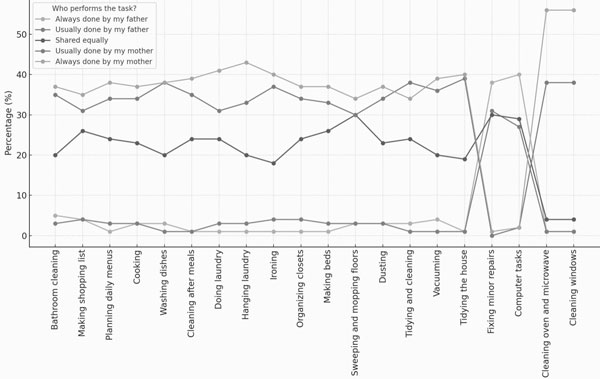
|
Outdoor Household Tasks
This category includes activities that, while essential to family functioning, are predominantly carried out outside the household. The data indicate that 55% of the sample perceived these tasks to be distributed equally between parents. Nevertheless, the prevailing trend suggests that most participants attribute these responsibilities more frequently to the father, with a considerably smaller proportion assigning them to the mother.
Overall, 65.3% of respondents placed their answers within the range from “equally shared between my father and my mother” to “my mother always does it,” with a slightly higher representation among female participants (66.6%) compared to males (61.8%). Conversely, when examining responses ranging from “equally shared between my father and my mother” to “my father always does it,” 90.3% of the sample fell within this category, with notable gender differences: 88.2% of women and 93.3% of men reported this distribution.
|
Figure 3. Results ‘Outdoor Household Tasks’ 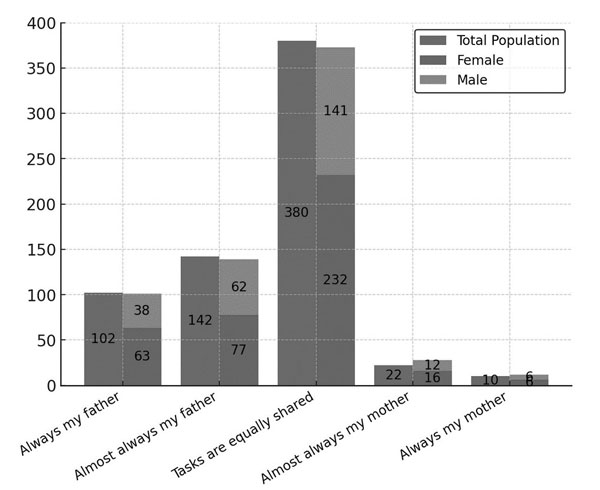
|
Figure 4 presents the results for the entire sample regarding the distribution of various tasks performed outside the home. The data indicate that car maintenance is the task most frequently assumed by the father, whereas medical appointments and related arrangements are predominantly attributed to the mother, according to participants’ perceptions.
|
Figure 4. Distribution of responses across items within the ‘Outdoor Household Tasks’ category 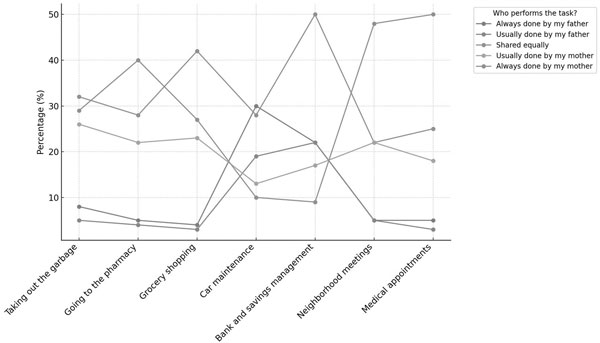
|
Childcare
This category encompasses tasks related to the care and attention of children, irrespective of whether they are performed inside or outside the home. The data indicate that slightly over 60% of the sample perceived the distribution of these responsibilities as equitable. However, a distinct pattern emerges among those who do not perceive equality: the majority report that these tasks are primarily undertaken by the mother, while significantly fewer attribute them predominantly to the father.
Overall, 96.5% of participants’ responses fall within the range from “equally shared between my father and my mother” to “my mother always does it,” with this perception being more prevalent among female respondents (98.3%) than male respondents (93.3%). Conversely, when considering responses from “equally shared between my father and my mother” to “my father always does it,” 64.2% of the sample fall within this category, with gender differences observed: 62% among women and 69.6% among men.
|
Figure 5. Results ‘Childcare’ 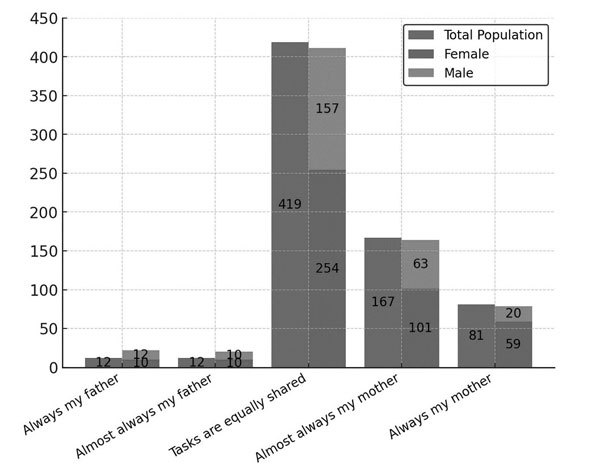
|
Figure 6 presents the overall results from the entire sample concerning various childcare tasks. While a generally equitable distribution is perceived, a more detailed examination of individual tasks reveals greater maternal involvement in the majority of activities. Notably, the task exhibiting the most balanced participation between father and mother is accompanying children to extracurricular sports activities, which contrasts with non-sport extracurricular activities, where maternal involvement is substantially higher.
|
Figure 6. Distribution of responses across items within the ‘Childcare’ category 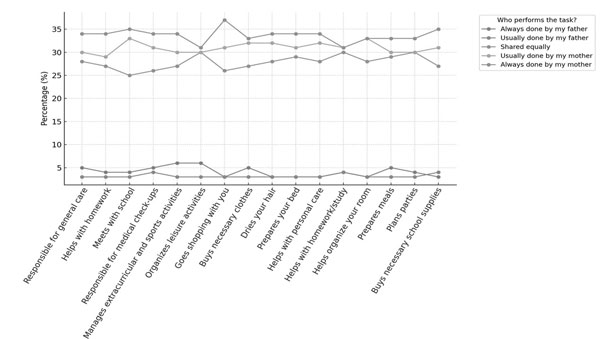
|
Perceptions of Fairness in the Distribution of Household Tasks
This section explores university students’ perceptions of fairness in the distribution of household tasks using a Net Promoter Score (NPS) scale (0–10). The overall mean score was 6.17, with significant gender differences: men reported a higher average (6.7) than women (5.8). These findings highlight a persistent gender disparity in perceived equity, consistent with existing literature indicating that men are more likely to view domestic task distribution as fair, while women demonstrate greater awareness of household inequality.
Figure 7 illustrates the distribution of students’ perceptions of fairness in household task allocation, represented on a Net Promoter Score scale ranging from -100 to 100. Responses are categorised into three groups: Critics, individuals who perceive the distribution of tasks as clearly unequal, indicating a lack of shared responsibility within the household; Neutrals, individuals who do not perceive the distribution as fully equitable but also do not consider it to be severely unequal; and Favourables, individuals who believe that household task distribution is fair and balanced.
|
Figure 7. Trend in the consideration of equitable task distribution 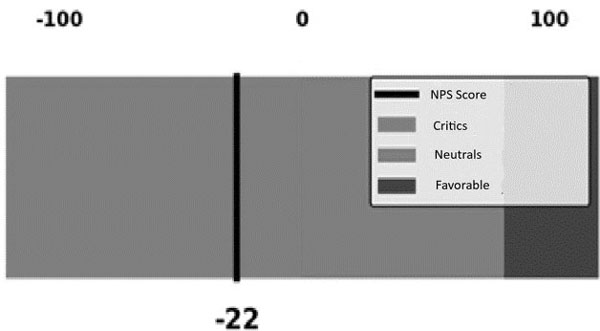
|
The final Net Promoter Score obtained is -22, indicating a prevailing perception of inequality in the distribution of household tasks. The position of the black line on the graph marks this result, situating it within the critics’ zone. This outcome suggests that a substantial proportion of students do not perceive the allocation of domestic responsibilities in their homes as equitable, highlighting the persistence of inequalities in task sharing. The gender differences previously discussed are further reflected in this score, with women tending to evaluate the inequity in task distribution more critically than men.
|
Figure 8. Trend in Perceptions of Equitable Task Distribution by Gender 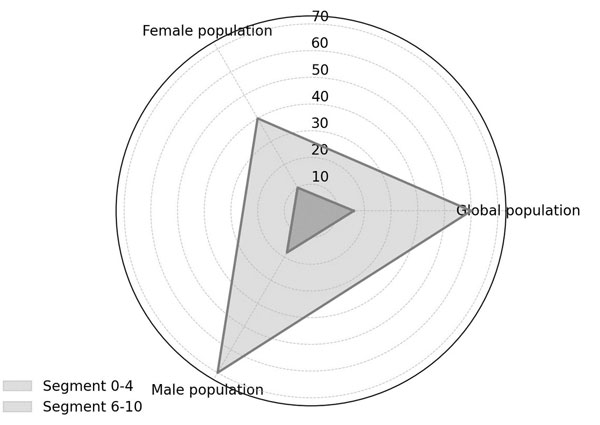
|
Furthermore, a pronounced gender disparity is apparent in these perceptions: 21.8% of male respondents assert that household tasks are shared completely equitably between father and mother, whereas only 12.9% of female respondents hold this view. Conversely, a larger proportion of women perceive the distribution to be inequitable compared to men.
To visually examine trends in perceptions of equity, responses were categorised into two groups: scores of 0–4, indicating a perception of unfair task distribution, and scores of 6–10, reflecting a perception of fair or very fair distribution; the neutral midpoint score of 5 was excluded. As illustrated in Figure 8, while the majority of responses fall within the 6–10 range, a notably higher proportion of women are positioned within the 0–4 range, suggesting a more critical view of household task distribution among female participants.
A key finding within this category is the gender disparity in perceived fairness: women report an average score of 5.98, whereas men assign a higher average rating of 7.11. The overall mean score for the entire sample is 6.41, reflecting a moderate perception of fairness in task allocation across the population.
|
Figure 9. Trend in the Assessment of Fairness in Task Distribution 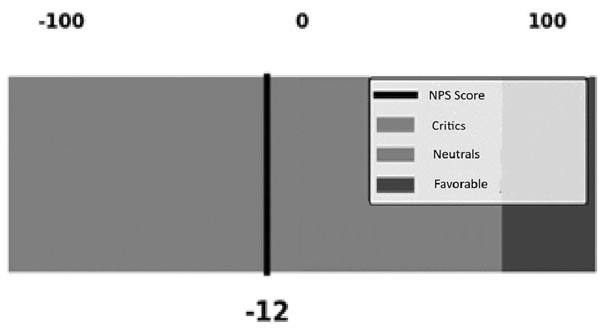
|
Figure 9 presents students’ evaluations of fairness in household task distribution, revealing a Net Promoter Score (NPS) of -12, suggesting a general perception of unfairness. Although many responses cluster around the midpoint, more students perceive the distribution as unfair than fair. However, this imbalance is less pronounced than in previous studies. For clarity, responses were grouped into two categories: scores of 0–4, indicating unfairness, and 6–10, indicating fairness, with neutral responses (score of 5) excluded. This categorisation aids in visualising overall trends in perceived domestic task equity.
Figure 10 shows that, while the majority of responses are within the 6–10 range—indicating a perception of fair task distribution—the proportion of women who perceive the distribution as unfair (scores 0–4) is notably higher than that of men. This finding underscores the persistence of gendered disparities in household and caregiving responsibilities, suggesting that, despite observable progress toward equity, women continue to experience a disproportionately greater burden, even from an early age.
|
Figure 10. Trend in the Assessment of Fairness in Task Distribution by Gender 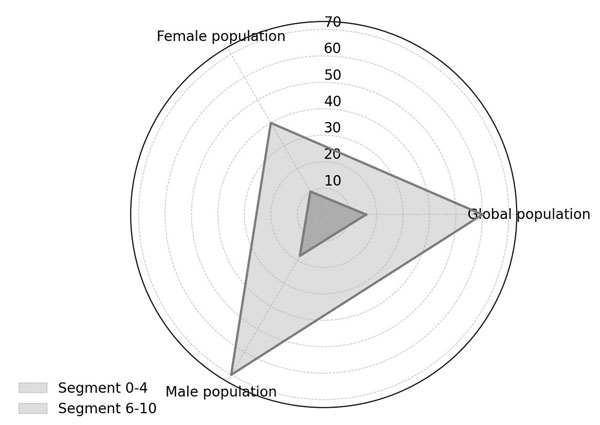
|
Multi-group Analysis
This analysis investigates whether perceptions of domestic task distribution, shared responsibility, and fairness vary across different socio-demographic groups, including gender, prior training in gender equality, employment context, and family composition. By conducting a multi-group analysis, the study aims to determine the extent to which these perceptions are consistent across subpopulations or shaped by individual and cultural factors. This approach enhances the validity and generalizability of the findings, ensuring that the analytical model captures both intra-group differences and broader social patterns.
To assess the suitability of the dataset for such comparisons, a series of preliminary statistical tests were conducted. The Shapiro-Wilk test revealed that none of the five key variables—indoor tasks, outdoor tasks, childcare, equitable distribution, and fairness—followed a normal distribution (p < 0.05), justifying the use of non-parametric methods. Levene’s test indicated homogeneity of variances for indoor tasks, outdoor tasks, and childcare (p > 0.05), while significant variance heterogeneity was found in the categories of equitable task distribution and perceived fairness (p < 0.05), warranting adjustments for heteroscedasticity in those cases.
Internal consistency was evaluated through correlation matrices, revealing moderate to high correlations among many items, suggesting an underlying latent structure. To confirm the suitability for factor analysis, Bartlett’s Test of Sphericity yielded a significant result (p < 0.05), and the Kaiser-Meyer-Olkin (KMO) measure returned a value of 0.65—acceptable for proceeding with confirmatory factor analysis (CFA), though requiring cautious interpretation.
A CFA with Varimax rotation was performed, identifying five distinct factors corresponding to the study’s conceptual categories: (1) perception of fairness in task distribution, (2) perception of equitable task distribution, (3) childcare, (4) household tasks, and (5) tasks performed outside the home. The factor structure aligned with theoretical expectations, with average loadings of 0.52 (range: 0.35–0.81), supporting the construct validity of the model.
These results validate the measurement framework and allow for a nuanced multi-group analysis of how socio-demographic variables influence perceptions of domestic responsibility-sharing.
Age
Given that the Shapiro-Wilk test yielded p-values below 0.05 for all categories, indicating non-normal distributions, the Mann-Whitney U test was employed as a non-parametric alternative to the Student’s t-test for group comparisons. It is important to note that the first three categories—household tasks, tasks outside the home, and childcare—were measured using a 5-point Likert scale, whereas the categories of equitable task distribution and perception of fairness in task distribution were measured on a 10-point scale. This difference in measurement scales was taken into consideration during the analysis and interpretation.
The multi-group analysis based on age revealed significant differences in several categories related to the perception of domestic task distribution. Participants were divided into two groups: those under 22 years old and those aged 22 or older.
| Table 3. Multi-group analysis by Age | ||||||||||||||||||||||||||||||
|
||||||||||||||||||||||||||||||
A significant difference was found in the perception of involvement in household tasks, with the older group reporting slightly higher averages. This indicates that individuals aged 22 and above perceive greater participation in indoor household responsibilities compared to their younger counterparts. In contrast, no significant differences emerged in the categories of tasks performed outside the home or childcare responsibilities, as both age groups exhibited very similar average scores in these areas.
Regarding perceptions of equitable task distribution, the younger group reported a significantly higher perception of equity compared to the older group. Similarly, in the assessment of fairness in task distribution, individuals under 22 perceived the distribution to be fairer than those aged 22 and over. Overall, these findings suggest that younger university students tend to have a more positive view of equity and fairness in household task sharing, while perceptions related to tasks outside the home and childcare remain consistent regardless of age.
Gender
In this item, the Shapiro-Wilk test yielded p-values < 0.05 for all categories, indicating non-normal data distributions. Therefore, the Mann-Whitney U test was applied as a non-parametric alternative for group comparisons. It is important to note that, due to the small sample size of participants identifying as non-binary, this group was excluded from the analysis to ensure statistical validity.
The multi-group analysis based on gender reveals significant differences across all categories examined. In the household tasks category, women report significantly greater involvement compared to men. Conversely, in tasks performed outside the home, men indicate higher participation than women. Regarding childcare, women again perceive themselves as more involved, with this difference also being statistically significant. Furthermore, men perceive the distribution of tasks as more equitable than women do, reflected in both the perception of equitable task sharing and the overall fairness of the distribution.
These findings suggest that women experience a heavier burden related to household and childcare responsibilities, whereas men tend to have a more favourable view of the equity and fairness in how these tasks are shared. This divergence highlights gender-based differences in the lived experience of domestic responsibility distribution.
| Table 4. Multi-group analysis by Gender | ||||||||||||||||||||||||||||||
|
||||||||||||||||||||||||||||||
Faculty of enrolment
Since none of the categories demonstrated a normal distribution according to the Shapiro-Wilk test, the Kruskal-Wallis test was employed as a non-parametric alternative to ANOVA. This test enables comparisons across more than two groups without the assumption of normality.
| Table 5. Multi-group analysis by Faculty of enrolment | ||||||||||||||||||||||||||||||||||||||||||||||||||||||||||||||
|
||||||||||||||||||||||||||||||||||||||||||||||||||||||||||||||
The multi-group analysis based on faculty of enrolment reveals significant differences across several evaluated categories. In the category of household indoor tasks, a significant difference was found, with students from the Faculty of Business and Social Sciences reporting the highest average perception of involvement, while those from the Higher Technical School of Engineering reported the lowest. This suggests that students’ academic background may influence their perception of participation in household chores.
No significant differences were observed in the category of tasks performed outdoors, indicating a relatively uniform perception of these responsibilities across faculties.
In the childcare category, significant differences also emerged. Students from the Faculty of Business and Social Sciences again reported the highest average perception of involvement in childcare activities, whereas those from the Higher Technical School of Engineering reported the lowest. This may reflect varying levels of awareness or emphasis on caregiving roles among different academic disciplines.
Regarding the perception of equitable task distribution, significant differences were identified. The Faculty of Arts and Education reported the lowest perception of equity in household task sharing, while the Higher Technical School of Engineering reported the highest average perception of equity. This result points to potential disciplinary differences in how students perceive gender equity in domestic responsibilities.
Similarly, significant differences were found in perceptions of fairness in task distribution, with students from the Higher Technical School of Engineering perceiving the distribution as fairest, and those from the Faculty of Legal Sciences perceiving it as least fair. These results highlight that perceptions of fairness in sharing household duties vary notably between fields of study.
However, it is important to consider the demographic composition of these faculties. The Faculty of Arts and Education tends to have a higher proportion of female students, while technical and engineering faculties are predominantly male. Therefore, gender may be a more influential factor affecting these perceptions than academic discipline alone. This intersection suggests the need for further analysis controlling for gender to disentangle its effects from those of faculty affiliation.
Father’s Educational Level
Since the Shapiro-Wilk test indicated that none of the analysed categories followed a normal distribution (p < 0.05 for all), the Kruskal-Wallis test was applied as a non-parametric alternative to ANOVA. As mentioned above, this test allows for the comparison of more than two independent groups without assuming normality of the data, making it suitable for examining differences in the various categories under study.
The multi-group analysis based on the father’s educational level reveals significant differences across all analysed categories. Children of fathers with primary education report a higher perception of involvement in household tasks, whereas those whose fathers have university degrees report the lowest average involvement. Similarly, for tasks outside the home, children of fathers with primary education perceive greater participation compared to those with university-educated fathers.
| Table 6.Multi-group analysis by Father’s educational level | ||||||||||||||||||||||||||||||||||||||||||||||||||||||
|
||||||||||||||||||||||||||||||||||||||||||||||||||||||
Regarding childcare, significant differences also emerge: children of fathers with primary education report the highest levels of perceived involvement, while those whose fathers have only basic education report the lowest. This pattern suggests that parenting models and responsibility-sharing may be influenced by the father’s educational background.
In terms of equitable task distribution, children of university-educated fathers perceive a greater degree of equity, while those whose fathers have only primary education perceive less equity. Similarly, perceptions of fairness in task distribution follow the same pattern, with children of fathers holding university degrees perceiving greater fairness compared to those whose fathers have primary education.
Overall, these results suggest that the father’s level of education significantly influences perceptions of household task distribution and fairness, with higher paternal education associated with greater perceived equity and fairness. This may reflect more shared responsibility practices in households with more highly educated fathers.
Mother’s Educational Level
As with the previous variable, none of the categories met the assumption of normality according to the Shapiro-Wilk test. Therefore, the Kruskal-Wallis test was employed as a non-parametric alternative to ANOVA to compare differences across groups.
The multi-group analysis based on the mother’s educational level reveals significant differences in several categories. Notably, significant differences are observed in the perception of household tasks, with children of mothers with basic education reporting the highest average involvement, while those whose mothers have university education report the lowest. In contrast, no significant differences were found in the perception of tasks outside the home across educational groups, indicating similar perceptions regardless of the mother’s educational level.
| Table 7.Multi-group analysis by Mother’s educational level | ||||||||||||||||||||||||||||||||||||||||||||||||||||||
|
||||||||||||||||||||||||||||||||||||||||||||||||||||||
Regarding childcare, the analysis shows no significant differences, with averages remaining consistent across all educational levels, suggesting a relatively homogeneous perception in this domain. However, significant differences emerge in the perception of equitable task distribution: children of mothers with university education perceive greater equity compared to those whose mothers have basic education, reinforcing the influence of maternal education on views of shared responsibility at home.
Finally, significant differences are also found in the perception of fairness in task distribution, with higher fairness perceived among children of mothers with university education and lower fairness reported by those whose mothers have basic education.
These results suggest that the mother’s educational level influences perceptions of task distribution and fairness in household responsibilities, with a clear trend toward greater perceived equity and fairness in households where mothers have higher educational attainment.
Population size of city/town of Residence
None of the categories exhibited a normal distribution according to the Shapiro-Wilk test; therefore, the Kruskal-Wallis test was used as a non-parametric alternative suitable for comparing groups with more than two categories.
The distribution of this category is based on the number of inhabitants. The multi-group analysis based on place of residence did not reveal significant differences across any of the evaluated categories. Overall, the perception of household tasks does not vary significantly among different residential groups, although individuals living in medium-sized towns reported the highest average involvement, possibly indicating greater participation in these tasks in such environments. Similarly, tasks outside the home showed no significant differences, though residents of smaller municipalities exhibited a slight tendency to assume greater responsibility compared to those in larger cities.
| Table 8.Multi-group analysis by size of city/town of Residence | ||||||||||||||||||||||||||||||||||||||||||||||
|
||||||||||||||||||||||||||||||||||||||||||||||
Regarding childcare, perceptions were generally homogeneous across all population groups. However, the lowest values were observed in smaller municipalities, which may reflect a more traditional division of family roles in these areas.
In terms of perceived equitable task distribution, although differences were not statistically significant, individuals residing in municipalities with populations between 2,000 and 10,000 reported a marginally higher sense of equity in household responsibility sharing.
Finally, no significant differences were found in the perception of fairness in task distribution. Notably, smaller municipalities showed the highest average fairness scores, possibly reflecting a sociocultural context in which unequal responsibility distribution is normalized rather than perceived as unfair.
These results suggest that the size of the municipality of residence does not significantly influence perceptions of task distribution or fairness in household responsibilities. However, the data hint at a trend where mothers in smaller populations may bear a greater burden in household and childcare tasks compared to those in larger communities, albeit without statistically significant differences.
Employment status
It was confirmed that this category does not follow a normal distribution according to the Shapiro-Wilk test; therefore, the Kruskal-Wallis test was applied.
The multi-group analysis based on parents’ employment status reveals significant differences in certain categories, while other areas show no statistically relevant variations. Significant differences are observed in the perception of household tasks: respondents whose father is the sole parent working outside the home report greater involvement in these tasks compared to those whose parents both stay at home or where only the mother works outside.
Regarding childcare, no statistically significant differences emerge, although there is a slight tendency for higher perceived involvement among those whose mother works outside the home. The lowest perception of involvement is found among respondents whose parents do not work outside the home.
| Table 9.Multi-group analysis by Parental Employment status | ||||||||||||||||||||||||||||||||||||||||||||||
|
||||||||||||||||||||||||||||||||||||||||||||||
In terms of equitable task distribution, significant differences are evident, with greater perceptions of equity reported by respondents whose parents both work outside the home compared to those where only the mother works outside. This suggests that the need to balance responsibilities arises more clearly in households where both parents are employed externally.
Finally, the perception of fairness in task distribution also shows significant differences. Individuals whose parents both work outside the home tend to perceive a fairer distribution of tasks compared to those whose mother is the only parent working outside. This may reflect greater awareness of shared domestic responsibilities in households with a higher external workload.
Overall, these results indicate that parental employment context influences perceptions of task distribution and fairness within the home, with greater perceived equity and fairness in households where both parents work outside. However, perceptions related to tasks outside the home and childcare do not differ significantly, implying that other factors may affect these dimensions.
Family Structure
Once again, the Shapiro-Wilk test confirmed the absence of normality in the distribution of this category. Consequently, the Kruskal-Wallis test was employed as a non-parametric alternative to analyse differences across groups.
The multi-group analysis based on family structure revealed no statistically significant differences in most of the evaluated categories, with the exception of the perception of tasks outside the home. Regarding household tasks, no significant differences were found among the groups, with very similar mean values across different family structures. Notably, the highest mean was observed in individuals living with both parents and siblings, whereas the lowest corresponded to those in shared custody arrangements.
In contrast, for tasks outside the home, a significant difference emerged: individuals living exclusively with both parents reported a lower perception of involvement in these tasks compared to those living under shared custody. Concerning childcare, no significant differences were identified, with mean values remaining comparable across all family structures. The highest mean was again found among those living with both parents and siblings, while the lowest was reported by those in shared custody.
| Table 10.Multi-group analysis by Family structure | ||||||||||||||||||||||||||||||||||||||||||||||
|
||||||||||||||||||||||||||||||||||||||||||||||
No significant differences were observed in the perception of equitable task distribution, with similar scores across all family groups. Although not statistically significant, a tendency was noted whereby those living with both parents and siblings perceived a higher degree of equity in task distribution, while the lowest perception was reported by those living with both parents and multiple siblings.
Finally, with respect to fairness in task distribution, no statistically significant differences were detected, with mean values closely aligned among the groups. A slight trend suggested a higher perception of fairness among individuals living under shared custody, and the lowest among those living as a single child with both parents.
Overall, these findings indicate that family structure does not exert a significant influence on perceptions of task distribution or equity in household responsibilities, except in the case of tasks performed outside the home, where individuals in shared custody arrangements report greater involvement. This suggests that family dynamics may affect perceptions regarding the allocation of certain domestic responsibilities.
Prior training in Gender Equality
After confirming the non-normal distribution of this category via the Shapiro-Wilk test, the Mann-Whitney U test was employed as the appropriate non-parametric method to compare two independent groups.
| Table 11.Multi-group analysis by Prior training in Gender Equality | ||||||||||||||||||||||||||||||
|
||||||||||||||||||||||||||||||
The multi-group analysis based on gender equality training indicates that, overall, no significant differences are observed across most of the evaluated categories. An exception is found in the perception of equitable task distribution, where individuals who have received gender equality training report a more equitable distribution of household responsibilities compared to those without such training. This finding suggests that gender equality training may enhance awareness of the equitable sharing of domestic duties.
Regarding the perception of fairness in task distribution, while no statistically significant differences were detected, there is a noticeable trend toward a higher perception of fairness among those who have undergone gender equality training relative to those who have not.
These results imply that gender equality training does not significantly influence perceptions of household tasks, childcare, or tasks performed outside the home. Nevertheless, it appears to positively affect perceptions of equity in task distribution and, to a lesser extent, fairness in this distribution. This supports the notion that gender equality training fosters greater sensitivity to shared responsibility within the household.
Final results from multi-group analysis
The final table summarizes the main findings across socio-demographic variables, highlighting where significant differences in perceptions of household task distribution and fairness were observed.
| Table 12.Main results per item in multi-group analysis | ||||||||||||||||||||
|
The results of this study reinforce the persistence of an unequal distribution of household and caregiving tasks within the family, corroborating previous findings on the influence of gender roles in family organization (Fernández-Guerrero et al., 2022Fernández-Guerrero, O., Álvarez-Terán, R., Barbed, N., Martínez-López, M., & Suberviola, I. (2022). Aspectos de la conciliación personal, familiar y laboral en La Rioja y su incidencia en los derechos de la infancia. Un estudio sobre corresponsabilidad. https://investigacion.unirioja.es/documentos/64705b2c7bb1586d2f053976). Despite progress in promoting shared responsibility, university students’ perceptions indicate that mothers continue to bear the majority of household duties, while fathers predominantly engage in tasks outside the home. This suggests that, although newer generations have been socialized in more egalitarian contexts, traditional patterns of task division remain entrenched within their households. As Suberviola (2020aSuberviola, I. (2020a). La socialización diferencial emocional de género como factor predictor del carácter. iQual. Revista de Género e Igualdad, 3, 80–93. http://dx.doi.org/10.6018/iqual.369611) highlights, the gender socialization experienced by young people undoubtedly contributes to the continued reproduction and sexualization of domestic responsibilities.
Descriptive analysis reveals that 84% of the sample believes mothers assume most household tasks, while 90% perceive fathers as more involved in activities outside the home. Moreover, 96.5% attribute childcare primarily to mothers. Although these figures clearly reflect inequality in responsibility distribution, university students do not perceive this situation as markedly unfair, which may be explained by the normalization of such roles throughout their lives. Previous research has similarly noted that the naturalization of female domestic labour persists in many contexts, including among younger generations (Davis & Greenstein, 2009Davis, S., & Greenstein, T. (2009). Gender ideology: Components, predictors, and consequences. Annual Review of Sociology, 35, 87–105. https://doi.org/10.1146/annurev-soc-070308-115920; Kan et al., 2011Kan, M. Y., Sullivan, O., & Gershuny, J. (2011). Gender convergence in domestic work: Discerning the effects of interactional and institutional barriers from large-scale data. Sociology, 45(2), 234–251. https://doi.org/10.1177/0038038510394014; Peña et al., 2009Peña, J. V., Rodríguez-Menéndez, M. del C., & Torío, S. (2009). Opiniones de los progenitores sobre la participación de sus hijos e hijas en las labores domésticas. Bordón. Revista De Pedagogía, 61(4), 79–92. https://recyt.fecyt.es/index.php/BORDON/article/view/28815).
The results of the multi-group analysis offer a nuanced understanding of how various factors influence perceptions of task distribution and equity within the household. Significant gender differences emerged across all evaluated categories: women reported a greater perception of burden regarding household tasks and childcare, whereas men tended to overestimate the equity of task distribution. This discrepancy suggests that men may be less attuned to the realities of domestic inequality, reflecting enduring patterns of gender socialization (Alonso-Martirena et al., 2023Alonso-Martirena, Y., Escudero, J. I., Monzón, J., Pellejero, L., & Suberviola, I. (2023). La corresponsabilidad en los cuidados en el contexto familiar en Navarra. Medición de la percepción del estudiantado universitario. Instituto de Igualdad de Navarra. https://bit.ly/4hOSWBy). These findings are consistent with prior research indicating that men generally perceive the division of domestic labour as more equitable than women do (Carlson & Lynch, 2013Carlson, D., & Lynch, J. (2013). Housework: Cause and consequence of gender ideology? Social Science Research, 42(6), 1505–1518. https://doi.org/10.1016/j.ssresearch.2013.07.003; Fernández-Guerrero et al., 2022Fernández-Guerrero, O., Álvarez-Terán, R., Barbed, N., Martínez-López, M., & Suberviola, I. (2022). Aspectos de la conciliación personal, familiar y laboral en La Rioja y su incidencia en los derechos de la infancia. Un estudio sobre corresponsabilidad. https://investigacion.unirioja.es/documentos/64705b2c7bb1586d2f053976; Lachance-Grzela & Bouchard, 2010Lachance-Grzela, M., & Bouchard, G. (2010). More on the gendered division of household labor: A response to commentators. Sex Roles, 63, 801–806. https://doi.org/10.1007/s11199-010-9885-0).
In terms of age, participants under 22 years old perceived the distribution of household tasks as more equitable and fairer compared to those over 22. This may suggest that awareness of inequality intensifies with age, potentially due to increased lived experience or a more critical social perspective (Suberviola et al., 2024Suberviola, I., Barbed, N., Fernández-Guerrero, O., Martínez-López, M., & Álvarez-Terán, R. (2024). Gender micro violence: The lack of co-responsibility in the Northern Spain population. The International Journal of Interdisciplinary Cultural Studies, 20(1), 75–96. https://doi.org/10.18848/2327). Previous studies have shown that younger individuals often idealize equity in their familial settings until first-hand exposure to unequal responsibility-sharing in adult cohabitation occurs (Sullivan, 2018Sullivan, O. (2018). The gendered division of household labor. En B. J. Risman, C. M. Froyum, & W. J. Scarborough (Eds.), Handbook of the sociology of gender (pp. 377–392). Springer International Publishing. https://doi.org/10.1007/978-3-319-76333-0_27).
Moreover, faculty affiliation was found to significantly influence perceptions of task distribution, with notable differences observed across academic disciplines. This suggests that the type of education received and the academic environment may shape how young people conceptualize equity within the home. However, these findings should be interpreted with caution, as prior research indicates that students enrolled in traditionally male-dominated fields tend to hold more conservative views regarding the division of domestic tasks compared to those in disciplines with a higher proportion of female students (Correll, 2001Correll, S. (2001). Gender and the career choice process: The role of biased self-assessments. American Journal of Sociology, 106(6), 1691–1730. https://doi.org/10.1086/321299; Charles & Bradley, 2009Charles, M., & Bradley, K. (2009). Indulging our gendered selves? Sex segregation by field of study in 44 countries. American Journal of Sociology, 114(4), 924–976. https://doi.org/10.1086/595942; Suberviola, 2025Suberviola, I. (2025). Emotional Competencies and Emotional Coeducation Amongst University Students. International journal of emotional education, 17(1), 3-20. https://doi.org/10.56300/JRCJ3584). This disparity may partly result from gender imbalances within sample populations in certain studies.
Parental educational attainment also emerged as a key factor in shaping perceptions of shared responsibility. Children of parents with university-level education reported a greater perception of equity and fairness in task distribution. This may reflect higher levels of awareness and enactment of shared responsibilities in households where parents possess greater educational attainment (Cerrato & Cifre, 2018Cerrato, J., & Cifre, E. (2018). Gender inequality in household chores and work-family conflict. Frontiers in Psychology, 9, Article 1330. https://doi.org/10.3389/fpsyg.2018.01330). These findings align with existing literature demonstrating that households with elevated educational levels tend to display more egalitarian dynamics, both in the division of domestic labour and in family decision-making processes (Hook, 2010Hook, J. (2010). Gender inequality in the welfare state: Sex segregation in housework, 1965–2003. American Journal of Sociology, 115(5), 1480–1523. https://doi.org/10.1086/651384; Kan et al., 2011Kan, M. Y., Sullivan, O., & Gershuny, J. (2011). Gender convergence in domestic work: Discerning the effects of interactional and institutional barriers from large-scale data. Sociology, 45(2), 234–251. https://doi.org/10.1177/0038038510394014).
Conversely, the analysis based on the parents’ employment context revealed that young people whose parents work outside the home perceive a more equitable distribution of household tasks compared to those where only the mother is employed. This finding suggests that the necessity to balance professional and domestic responsibilities may promote a more balanced allocation of household duties. Previous studies have similarly indicated that households with dual earners exhibit a greater propensity toward sharing domestic labour than those with a single income earner, although full parity in responsibility has yet to be realized (Bianchi et al., 2012Bianchi, S., Robinson, J., & Milkie, M. (2012). Changing rhythms of American family life. Russell Sage Foundation.; Craig et al., 2010Craig, L., Mullan, K., & Blaxland, M. (2010). Parenthood, policy and work–family time in Australia 1992–2006. Work, Employment & Society, 24(1), 27–45. https://doi.org/10.1177/0950017009353778).
In contrast, family structure and place of residence did not demonstrate significant differences in the majority of categories assessed, suggesting that these variables do not exert a decisive influence on perceptions of equity in task distribution. Nevertheless, a subtle trend toward a higher perception of fairness was noted among individuals residing in smaller municipalities, which may reflect the normalization of unequal task division within more traditional or rural settings. Research examining gender socialization in rural contexts supports this interpretation, highlighting the persistence of traditional gender role values in such environments (Rola-Rubzen et al., 2023Rola-Rubzen, M. F., Vuong, H. T., Doll, C., Rollins, C., Sarmiento, J. M., Alam, M. J., & Begum, I. A. (2023). Gender and rural transformation: A systematic literature review. Journal of Integrative Agriculture, 22(12), 3624–3637. https://doi.org/10.1016/j.jia.2023.10.035).
Finally, gender equality training was found to significantly affect perceptions of equity in task distribution, underscoring the role of education in fostering values of shared responsibility. However, no significant differences emerged concerning perceptions of the actual performance of household tasks, indicating that although gender equality education may enhance awareness regarding equitable practices, its influence on concrete behavioural changes remains limited. This observation is consistent with prior research emphasizing that awareness-raising initiatives, while critical, do not invariably lead to modifications in everyday domestic practices (Organisation for Economic Co-operation and Development – OECD, 2014Organisation for Economic Co-operation and Development (OECD). (2014). Unpaid care work: The missing link in the analysis of gender gaps in labour outcomes. https://bit.ly/44RrCz4; Flood, 2019Flood, M. (2019). Engaging men and boys in violence prevention. Palgrave MacMillan. https://doi.org/10.1057/978-1-137-44208-6).
These findings underscore the imperative to continue advancing educational strategies aimed at fostering genuine shared responsibility within households. Integrating a gender perspective into educational curricula, organizing workshops focused on domestic equity, and promoting awareness initiatives within training institutions may contribute to narrowing the perceptual gap regarding fairness in task distribution. Additionally, it is essential to advocate structural reforms that facilitate an effective work-life balance, thereby ensuring that principles of gender equity extend beyond educational settings to shape everyday domestic practices. Recent research highlights that legislative and policy changes supporting work-life balance are pivotal in transforming both the perception and reality of responsibility sharing within the home (Goldscheider et al., 2015Goldscheider, F., Bernhardt, E., & Lappegård, T. (2015). The gender revolution: A framework for understanding changing family and demographic behavior. Population and Development Review, 41(2), 207–239. https://doi.org/10.1111/j.1728-4457.2015.00045.x).
This study is subject to certain limitations that merit consideration. Primarily, its cross-sectional design restricts the ability to infer causal relationships among the variables examined. Future research would benefit from employing longitudinal methodologies to explore how perceptions of equity in task distribution develop and change over time.
Secondly, the sample is composed exclusively of university students, which limits the generalizability of the findings to other population groups with differing educational backgrounds and life experiences. Further research should strive to include more diverse samples that encompass a wider range of socioeconomic and demographic characteristics to enhance the external validity of the results.
Additionally, the reliance on self-reported data introduces the potential for social desirability bias, as participants may have responded in ways that conform to socially accepted norms rather than reflecting their true experiences. Incorporating qualitative approaches or observational methods in future studies could complement the quantitative data and offer a more nuanced and comprehensive understanding of task distribution within households.
Finally, this study does not account for the influence of broader cultural factors on perceptions of equity in the domestic sphere. Given that gender socialization processes vary significantly across cultural contexts, cross-cultural comparative research would be valuable to elucidate how different societies shape attitudes toward shared household responsibilities.
The findings of this study confirm that, despite advances in gender equality awareness, young people continue to perceive an unequal distribution of household and caregiving tasks within their homes. Perceptions of responsibility distribution are influenced by factors such as gender, age, prior training in gender equality, parental educational attainment, and the family’s employment context. While men tend to overestimate the equity of task distribution, women report a greater burden of domestic and caregiving work. Gender equality education appears to play a key role in fostering awareness of shared responsibility, although its impact on everyday practices remains limited.
The study further reveals that models of shared responsibility are more prevalent in households where parents have higher educational attainment and both are employed outside the home. Conversely, in households where only the mother works, perceptions of equity are notably lower, indicating the persistence of traditional gender roles in the allocation of domestic responsibilities.
These results underscore the need to advance educational and social policies that promote equity in the division of household and caregiving tasks. Integrating a gender perspective into educational curricula and reinforcing work-life balance policies can contribute to greater equality in the daily functioning of households. Furthermore, ongoing research into family dynamics and their evolution is essential for deepening our understanding of how sociocultural factors shape both the perception and reality of responsibility distribution within the home.
| ○ | Alonso-Martirena, Y., Escudero, J. I., Monzón, J., Pellejero, L., & Suberviola, I. (2023). La corresponsabilidad en los cuidados en el contexto familiar en Navarra. Medición de la percepción del estudiantado universitario. Instituto de Igualdad de Navarra. https://bit.ly/4hOSWBy |
| ○ | Bianchi, S., Robinson, J., & Milkie, M. (2012). Changing rhythms of American family life. Russell Sage Foundation. |
| ○ | Cabero, J., & Infante, A. (2014). Empleo del método Delphi y su empleo en la investigación en comunicación y educación. Revista Electrónica de Investigación Educativa, 48, 1–16. https://doi.org/10.21556/edutec.2014.48.187 |
| ○ | Carlson, D., & Lynch, J. (2013). Housework: Cause and consequence of gender ideology? Social Science Research, 42(6), 1505–1518. https://doi.org/10.1016/j.ssresearch.2013.07.003 |
| ○ | Charles, M., & Bradley, K. (2009). Indulging our gendered selves? Sex segregation by field of study in 44 countries. American Journal of Sociology, 114(4), 924–976. https://doi.org/10.1086/595942 |
| ○ | Craig, L., Mullan, K., & Blaxland, M. (2010). Parenthood, policy and work–family time in Australia 1992–2006. Work, Employment & Society, 24(1), 27–45. https://doi.org/10.1177/0950017009353778 |
| ○ | Cerrato, J., & Cifre, E. (2018). Gender inequality in household chores and work-family conflict. Frontiers in Psychology, 9, Article 1330. https://doi.org/10.3389/fpsyg.2018.01330 |
| ○ | Correll, S. (2001). Gender and the career choice process: The role of biased self-assessments. American Journal of Sociology, 106(6), 1691–1730. https://doi.org/10.1086/321299 |
| ○ | Davis, S., & Greenstein, T. (2009). Gender ideology: Components, predictors, and consequences. Annual Review of Sociology, 35, 87–105. https://doi.org/10.1146/annurev-soc-070308-115920 |
| ○ | DeVellis, R., & Thorpe, C. (2022). Scale development: Theory and applications (5th ed.). Sage Publications. |
| ○ | Díaz de Rada, V. (2012). Ventajas e inconvenientes de la encuesta por Internet. Papers, 97(1), 193–223. https://doi.org/10.5565/rev/papers/v97n1.71 |
| ○ | European Institute for Gender Equality (EIGE). (2024). Gender Equality Index: Time in European Union. https://eige.europa.eu/gender-equality-index/2024/domain/time |
| ○ | Organisation for Economic Co-operation and Development (OECD). (2014). Unpaid care work: The missing link in the analysis of gender gaps in labour outcomes. https://bit.ly/44RrCz4 |
| ○ | Fernández-Guerrero, O., Álvarez-Terán, R., Barbed, N., Martínez-López, M., & Suberviola, I. (2022). Aspectos de la conciliación personal, familiar y laboral en La Rioja y su incidencia en los derechos de la infancia. Un estudio sobre corresponsabilidad. https://investigacion.unirioja.es/documentos/64705b2c7bb1586d2f053976 |
| ○ | Field, A. (2013). Discovering statistics using IBM SPSS Statistics (4th ed.). Sage. |
| ○ | Flood, M. (2019). Engaging men and boys in violence prevention. Palgrave MacMillan. https://doi.org/10.1057/978-1-137-44208-6 |
| ○ | Forste, R., & Fox, K. (2012). Household labor, gender roles, and family satisfaction: A cross-national comparison. Journal of Comparative Family Studies, 43(5), 613–631. https://doi.org/10.3138/JCFS.43.5.613 |
| ○ | Ghasemi, A., & Zahediasl, S. (2012). Normality tests for statistical analysis: A guide for non-statisticians. International Journal of Endocrinology and Metabolism, 10(2), 486–489. https://doi.org/10.5812/ijem.3505 |
| ○ | Graham, E., Aleksa, E., Dzioba, A., Madou, E., Chen, T., Strychowsky, J. E., Hu, A., Chan, Y., & Seemann, N. M. (2024). Gender differences in domestic responsibilities of otolaryngologists. A mixed-methods analysis. The Laryngoscope, 134. https://doi.org/10.1002/lary.31605 |
| ○ | Goldscheider, F., Bernhardt, E., & Lappegård, T. (2015). The gender revolution: A framework for understanding changing family and demographic behavior. Population and Development Review, 41(2), 207–239. https://doi.org/10.1111/j.1728-4457.2015.00045.x |
| ○ | Hernández del Rosal, P., Laduj, I., & Lázaro, M. (2022). Hombres, corresponsabilidad y cuidados. Guía didáctica de corresponsabilidad masculina. Dirección General de Igualdad. Gobierno de La Rioja. https://bit.ly/45codd8 |
| ○ | Hook, J. (2010). Gender inequality in the welfare state: Sex segregation in housework, 1965–2003. American Journal of Sociology, 115(5), 1480–1523. https://doi.org/10.1086/651384 |
| ○ | International Labour Organization. (2018). Care work and care workers for a future with decent work. https://www.ilo.org/publications/major-publications/care-work-and-care-jobs-future-decent-work |
| ○ | Kan, M. Y., Sullivan, O., & Gershuny, J. (2011). Gender convergence in domestic work: Discerning the effects of interactional and institutional barriers from large-scale data. Sociology, 45(2), 234–251. https://doi.org/10.1177/0038038510394014 |
| ○ | Krause, W., & Gahn, C. (2024). Should we include margins of error in public opinion polls? European Journal of Political Research, 63(3), 1082–1107. https://doi.org/10.1111/1475-6765.12633 |
| ○ | Lachance-Grzela, M., & Bouchard, G. (2010). More on the gendered division of household labor: A response to commentators. Sex Roles, 63, 801–806. https://doi.org/10.1007/s11199-010-9885-0 |
| ○ | Martínez-López, N. (2018). Estudio de la conciliación del área personal, familiar y profesional en enfermeras/os hospitalarios con cargas familiares [Tesis doctoral, Universidad de Murcia]. https://digitum.um.es/digitum/handle/10201/56120 |
| ○ | Molarius, A., & Metsini, A. (2023). The association between time spent in domestic work and mental health among women and men. International Journal of Environmental Research and Public Health, 20. https://doi.org/10.3390/ijerph20064948 |
| ○ | Peña, J. V., Rodríguez-Menéndez, M. del C., & Torío, S. (2009). Opiniones de los progenitores sobre la participación de sus hijos e hijas en las labores domésticas. Bordón. Revista De Pedagogía, 61(4), 79–92. https://recyt.fecyt.es/index.php/BORDON/article/view/28815 |
| ○ | Rola-Rubzen, M. F., Vuong, H. T., Doll, C., Rollins, C., Sarmiento, J. M., Alam, M. J., & Begum, I. A. (2023). Gender and rural transformation: A systematic literature review. Journal of Integrative Agriculture, 22(12), 3624–3637. https://doi.org/10.1016/j.jia.2023.10.035 |
| ○ | Suberviola, I. (2020a). La socialización diferencial emocional de género como factor predictor del carácter. iQual. Revista de Género e Igualdad, 3, 80–93. http://dx.doi.org/10.6018/iqual.369611 |
| ○ | Suberviola, I. (2020b). Aspectos básicos sobre el concepto y puesta en práctica de la coeducación emocional. Foro de educación, 18(1), 189–207. http://dx.doi.org/10.14516/fde.682 |
| ○ | Suberviola, I., Barbed, N., Fernández-Guerrero, O., Martínez-López, M., & Álvarez-Terán, R. (2024). Gender micro violence: The lack of co-responsibility in the Northern Spain population. The International Journal of Interdisciplinary Cultural Studies, 20(1), 75–96. https://doi.org/10.18848/2327 |
| ○ | Suberviola, I. (2025). Emotional Competencies and Emotional Coeducation Amongst University Students. International journal of emotional education, 17(1), 3-20. https://doi.org/10.56300/JRCJ3584 |
| ○ | Suberviola, I., Barbed, N., Fernández-Guerrero, O., Martínez-López, M., & Álvarez-Terán, R. (2025). Análisis de la corresponsabilidad en los hogares y los cuidados. Una propuesta de intervención socio-educativa. iQual: Revista de Género e Igualdad, 8, 169–194. https://doi.org/10.6018/IQUAL.599311 |
| ○ | Suberviola, I., & Fernández-Guerrero, O. (2025). Cuestionario corresponsabilidad jóvenes Rioja. Zenodo. https://doi.org/10.5281/zenodo.15008750 |
| ○ | Subirats, M. (2020). El género masculino, entre la obsolescencia y la impostación. En A. Téllez, J. E. Martínez, & J. Sanfélix (Eds.), Hombres, género y patriarcado: reflexiones, cuerpos y representaciones (pp. 19–33). Dykinson. |
| ○ | Starrels, M. (1994). Husbands’ involvement in female gender-typed household chores. Sex Roles, 31, 473–491. https://doi.org/10.1007/BF01544202 |
| ○ | Sukumaran, S., Somasundaran, R., & Naur, I. (2024). The double burden: A study on women’s dual roles in the workplace and household responsibilities in Kerala. Journal of Women Empowerment and Studies, 45, 48–60. https://doi.org/10.55529/jwes.45.48.60 |
| ○ | Sullivan, O. (2018). The gendered division of household labor. En B. J. Risman, C. M. Froyum, & W. J. Scarborough (Eds.), Handbook of the sociology of gender (pp. 377–392). Springer International Publishing. https://doi.org/10.1007/978-3-319-76333-0_27 |
| ○ | Wasserstein, R. L., & Lazar, N. A. (2016). The ASA’s statement on p-values: Context, process, and purpose. The American Statistician, 70(2), 129–133. https://doi.org/10.1080/00031305.2016.1154108 |
Análisis cuantitativo de las percepciones del alumnado universitario sobre la equidad en la distribución de tareas domésticas y de cuidados
INTRODUCCIÓN. El reparto de tareas domésticas y de cuidados continúa siendo un aspecto clave para el avance en la igualdad de género. Este estudio investiga las percepciones de alumnado universitario de España sobre la distribución de tareas domésticas y de cuidados, junto con su valoración de la justicia en esa distribución. El objetivo principal es explorar cómo esas percepciones varían en función de factores como el género, la edad, la participación en actividades educativas sobre igualdad de género, la situación laboral de los progenitores, el nivel educativo de la familia, y el lugar de residencia. METODOLOGÍA. La muestra comprende alumnado universitario español de diversas disciplinas (N=1,287). Los datos fueron recopilados mediante un cuestionario estructurado con escalas tipo Likert, validado mediante el método Delphi y una prueba piloto, obteniéndose una alta consistencia interna (α = .966). Inicialmente se realizaron análisis estadísticos descriptivos, calculando las distribuciones porcentuales de respuestas a lo largo de toda la muestra, tanto al nivel de los ítems analizados como bajo las categorías investigadas. Esto proporcionó una perspectiva preliminar de las tendencias predominantes en cuanto a percepciones y conductas. Posteriormente se desarrollaron análisis multigrupo que se realizaron empleando diversas técnicas estadísticas para identificar la significatividad de las diferencias entre subgrupos. RESULTADOS. Los hallazgos indican desigualdades persistentes por razón de género en la percepción de la corresponsabilidad: el 84% de la muestra considera que las madres asumen la mayoría de las tareas domésticas, y el 96,5% señala que también son ellas quienes se ocupan principalmente del cuidado infantil. Se identificaron diferencias estadísticamente significativas según el género, la edad y la formación en igualdad, y los hombres perciben una distribución más justa que las mujeres, quienes reportan mayores niveles de desigualdad. DISCUSIÓN. El estudio concluye que, a pesar de la creciente concienciación en cuanto a la igualdad de género, persisten los patrones tradicionales en cuanto a la distribución de tareas domésticas y de cuidados. Los hallazgos recalcan la necesidad de reforzar iniciativas educativas y políticas públicas enfocadas a promover roles domésticos más equilibrados.
Palabras clave: Coeducación, Sesgos de género, Igualdad de género, Tareas domésticas.
Analyse quantitative des perceptions des étudiantes et étudiants universitaires concernant l´équité dans la répartition des tâches domestiques et des soins
INTRODUCTION. La répartition des tâches domestiques et des soins demeure un enjeu central pour faire progresser l’égalité entre les genres. Cette étude examine les perceptions des étudiantes et étudiants universitaires espagnols concernant la répartition des tâches domestiques et de soins, ainsi que leur évaluation de la justice de cette répartition. L’objectif principal est d’explorer la manière dont ces perceptions varient en fonction de facteurs tels que le genre, l’âge, la participation à des activités éducatives sur l’égalité entre les genres, la situation professionnelle des parents, le niveau d’éducation familial et le lieu de résidence. MÉTHODOLOGIE. L’échantillon est composé d’étudiantes et étudiantes universitaires espagnoles issus de différentes disciplines (N = 1,287). Les données ont été recueillies à l’aide d’un questionnaire structuré, utilisant des échelles de type Likert, validé par la méthode Delphi et un test pilote, ce qui a permis d’obtenir une forte cohérence interne (α = 0,966). Une première analyse descriptive a été réalisée, calculant les distributions en pourcentage des réponses pour l’ensemble de l’échantillon, tant pour les items individuels que pour les catégories d’analyse. Cette étape a permis d’identifier les tendances générales en matière de perceptions et de comportements. Ensuite, des analyses multigroupes ont été menées à l’aide de différentes techniques statistiques pour examiner la signification des différences entre sous-groupes. RÉSULTATS. Les résultats révèlent des inégalités persistantes entre les genres en ce qui concerne la perception de la coresponsabilité : 84% de l’échantillon estime que les mères prennent en charge la majeure partie des tâches domestiques, et 96,5% indiquent qu’elles sont également principalement responsables des soins aux enfants. Des différences statistiquement significatives ont été observées selon le genre, l’âge et le niveau de formation en matière d’égalité. Les hommes perçoivent une répartition plus juste que les femmes, lesquelles rapportent des injustices. DISCUSSION. L’étude conclut que, malgré une sensibilisation croissante à l’égalité entre les genres, les schémas traditionnels de répartition des tâches domestiques et des soins perdurent. Ces résultats soulignent la nécessité de renforcer les initiatives éducatives et les politiques publiques pour promouvoir des rôles domestiques plus équitables.
Mots-clés : Éducation à l’égalité, Biais de genre, Égalité de genre, Tâches domestiques.
Iratxe Suberviola Ovejas (Autora de contacto)
Doctora en Ciencias de la Educación, licenciada en psicopedagogía y diplomada en magisterio en la especialidad de educación infantil. Profesora Permanente Laboral la Universidad de La Rioja, en el Departamento de Ciencias de la educación, en el área de Didáctica y Organización escolar. Miembro del grupo de investigación “igualdad y género”.Directora de la microcredencial “Educar en y para la igualdad en ámbitos educativos y sociales”.
ORCID ID: https://orcid.org/0000-0001-6368-3732.
Email de contacto: iratxe.suberviola@unirioja.es.
Dirección para la correspondencia: c/ Luis de Ulloa. Edificio Vives. Despacho 228. CP26004 Logroño (La Rioja).
Olaya Fernández Guerrero
Doctora en Filosofía y Licenciada en Filosofía y en Ciencias de la Información. Profesora Contratada Doctora de Filosofía Moral en la Universidad de La Rioja, Departamento de Ciencias Humanas. Investigadora principal del grupo de investigación Igualdad y Género de la Universidad de La Rioja.
ORCID ID: https://orcid.org/0000-0001-8795-0858.
Email de contacto: olaya.fernandez@unirioja.es