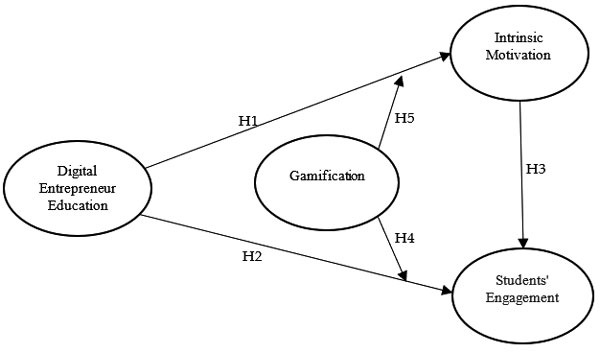
Figure 1. Theoretical Framework
CHENG-WEN LEE1 AND ROMI ILHAM1,2
1 Chung Yuan Christian University (Taiwan)
2 Universitas Hayam Wuruk Perbanas (Indonesia)
DOI: 10.13042/Bordon.2025.1114626
Fecha de recepción: 21/5/25 • Fecha de aceptación: 4/8/25
Autor de contacto / Corresponding author: Romi Ilham E-mail: romi_ilham@perbanas.ac.id
Cómo citar este artículo: Lee, C.-W & Ilham, R. (2025). Digital entrepreneurship education and gamification: a mixed-methods study on intrinsic motivation and student engagement. Bordón, Revista de Pedagogía, 77(4), 35-67. https://doi.org/10.13042/Bordon.2025.1114626
INTRODUCTION. The rapid advancement of technology and the evolution of the digital economy have emphasized the importance of learning systems in digital entrepreneurship education. This study explores the moderating effect of gamification on intrinsic motivation and student engagement within digital entrepreneurship education, aiming to address the gap in understanding how gamification influences student learning outcomes. METHODS. A sequential explanatory mixed methods approach was employed. The quantitative phase involved 630 students, using Structural Equation Modeling-Partial Least Squares (SEM-PLS) to examine the relationships between digital entrepreneurial education, intrinsic motivation, and student engagement. The qualitative phase involved 15 participants, where semi-structured interviews were conducted and analyzed through thematic analysis to provide deeper insights into the quantitative results. RESULTS. The quantitative analysis revealed a significant relationship between digital entrepreneurial education and both intrinsic motivation and student engagement. However, the moderating effect of gamification was found to be significantly weakened. The qualitative phase further indicated that gamification elements, such as extrinsic rewards, competition, and reduced autonomy, may undermine intrinsic motivation. DISCUSSION. The findings challenge the prevailing assumption that gamification inherently enhances motivation. While gamification can improve student engagement, it may inadvertently lower intrinsic motivation by over-relying on extrinsic rewards and competition. These results not only challenge the prevailing assumption that gamification inherently enhances motivation but also contribute to the theoretical understanding of gamification’s impact on intrinsic motivation and engagement. Practically, the findings suggest that educators should adopt a more balanced approach to gamification, carefully integrating extrinsic rewards and competition to better foster intrinsic motivation alongside student engagement.
Keywords:Entrepreneurship, Gamification, Intrinsic Motivation, Student Engagement
Digital entrepreneurship education in higher education has recently gained importance as economies worldwide continue transitioning towards digitally integrated models (Malhotra et al., 2023Malhotra, S., Anil, K., & Kaur, A. (2023). Impact of Social Entrepreneurship on Digital Technology and Students’ Skill Set in Higher Education Institutions: A Structured Equation Model. International Journal of Experimental Research and Review, 35, 54–61. https://doi.org/10.52756/ijerr.2023.v35spl.006). This shift emphasizes the need for skills that foster resilience and adaptability, especially within entrepreneurial contexts (Sahrah et al., 2023Sahrah, A., Guritno, P. D., Rengganis, R. P., & Dewi, R. P. (2023). Subjective Well-Being and Psychological Resilience as the Antecedents of Digital Entrepreneurship Intention. Journal of Educational and Social Research, 13(4), 54–65. https://doi.org/10.36941/jesr-2023-0089). Despite the critical importance of these competencies, a recurring issue in entrepreneurship education is the low levels of student motivation and engagement (Mónico et al., 2021Mónico, L., Carvalho, C., Nejati, S., Arraya, M., & Parreira, P. (2021). Entrepreneurship Education and its Influence on Higher Education Students’ Entrepreneurial Intentions and Motivation in Portugal. BAR - Brazilian Administration Review, 18(3). https://doi.org/10.1590/1807-7692bar2021190088). The presence of a supportive entrepreneurial ecosystem—comprising resources such as mentorship, funding access, and business incubators—has been posited as a means to foster motivation among students (Isabelle, 2020Isabelle, D. A. (2020). Gamification of Entrepreneurship Education. Decision Sciences Journal of Innovative Education, 18(2), 203–223. https://doi.org/10.1111/dsji.12203). Additionally, gamification elements, like points, leaderboards, and rewards, make educational experiences more engaging and enjoyable, potentially encouraging students to participate actively in entrepreneurship programs (Grivokostopoulou et al., 2019Grivokostopoulou, F., Kovas, K., & Perikos, I. (2019). Examining the impact of a gamified entrepreneurship education framework in higher education. Sustainability (Switzerland), 11(20). https://doi.org/10.3390/su11205623). However, while there is extensive research on each approach individually, the combined impact of these two factors on student engagement remains an underexplored area, especially in digital entrepreneurship contexts.
Despite existing strategies, the challenge of maintaining student engagement and motivation in digital entrepreneurship programs persists (Fan & Tang, 2021Fan, W., & Tang, T. L.-P. (2021). Teaching Entrepreneurship In China: Business Simulation And Games (Sandg)- A New Theoretical Model Of Experiential Learning. In Organizational Science: A Global Perspective (pp. 21–38). https://www.scopus.com/inward/record.uri?eid=2-s2.0-85144950672&partnerID=40&md5=6dfdc5ef5af04fc43d2c1ee0985d6f80). Research has yet to determine whether the integration of gamification within digital entrepreneurial education could provide a viable solution. Specifically, it is unclear how the combination of these two elements— digital entrepreneurial education support and gamification—might enhance intrinsic motivation and engagement among students in ways that could positively impact learning outcomes (Deny, 2021Deny, J. (2021). Creating entrepreneurial ecosystem in higher education institutes: A case study. Journal of Engineering Education Transformations, 34(Special Issue), 494–498. https://doi.org/10.16920/jeet/2021/v34i0/157201; Jie et al., 2022Jie, K. W., Musa, R., Shwu Chyi, Y., & Lee Yong, P. (2022). From School to Business: A Study of Private University Student’s Motivation Determinant and Intention to be an entrepreneur. Journal of Entrepreneurship and Business, 10(2), 55–68. https://doi.org/10.17687/jeb.v10i2.927). Furthermore, understanding whether gamification moderates the relationship between digital entrepreneurial education and student motivation remains unexplored (Isabelle, 2020Isabelle, D. A. (2020). Gamification of Entrepreneurship Education. Decision Sciences Journal of Innovative Education, 18(2), 203–223. https://doi.org/10.1111/dsji.12203). This gap in the literature calls for an in-depth analysis to determine the potential synergies between these approaches; therefore, this research investigates the combined effects of digital entrepreneurial education and gamification on student motivation and engagement in digital entrepreneurship education. This study aims to identify the influence of digital entrepreneurial education on students’ intrinsic motivation using Self-Determination Theory (SDT) and student engagement, test the influence of students’ intrinsic motivation on student engagement, and analyze whether gamification acts as a moderator in the relationship between digital entrepreneurial education support on students’ intrinsic motivation and engagement.
This study focuses on students who have taken digital entrepreneurship courses at universities in Indonesia that implement game-based learning environments. This regional focus may limit the generalizability of the findings to a broader context, but it provides valuable insights into student motivation in an academic setting, particularly in developing countries. In addition, this research goes beyond analyzing the results of intrinsic motivation and student engagement to measure the long-term relationship between gamification elements of digital entrepreneurial education relationship toand intrinsic motivation for entrepreneurial success after graduation. This research used an explanatory sequential mixed -methods approach, combining quantitative data from the questionnairequestionnaires with qualitative insights from student testimonials. The quantitative analysis evaluatingevaluated the correlation between gamification moderation of digital entrepreneurial education relationships on intrinsic motivation and student engagement. In contrast, the qualitative analysis provided more profounddeeper insights into student perceptions of gamification and the structure of digital entrepreneurial education structure within their programprograms. This dual approach provides a comprehensive understanding of the factors influencing student motivation and engagement.
Given the urgent need to improve the effectiveness of digital entrepreneurship education in Indonesia —particularly in the digital business study programs launched in 2020— this research is timely and essential. Based on data from the Central Statistics Agency (BPS) from 2020 to 2023, there is an alarming decline in the number of young entrepreneurs in Indonesia. This research, therefore, holds significant value in understanding how to enhance the quality and effectiveness of learning by integrating gamification and digital entrepreneurial education. The findings are expected to contribute to entrepreneurship education and educational technology by providing empirical evidence on the moderating effect of gamification in enhancing intrinsic motivation and student engagement within digital entrepreneurial education. For educators, these insights can inform the development of a more engaging curriculum. Policymakers will also benefit from these findings, which highlight the importance of supporting digital entrepreneurial education that combines structured resources with interactive gamification elements.
Digital Entrepreneur Education
The ecosystem is a dynamic environment of interrelated actors, resources, and processes that create a conducive atmosphere to support startups and innovation (Ilie & Budac, 2023Ilie, L., & Budac, C. (2023). Entrepreneurial Ecosystems and the Catalytic Role of Universities. Studies in Business and Economics, 18(3), 163–175. https://doi.org/10.2478/sbe-2023-0052). Factors such as access to resources, mentor support, entrepreneurship programs, and collaboration with industry can form an ecosystem that encourages the growth of student entrepreneurship (Guerrero et al., 2020Guerrero, M., Urbano, D., & Gajón, E. (2020). Entrepreneurial university ecosystems and graduates’ career patterns: do entrepreneurship education programmes and university business incubators matter? Journal of Management Development, 39(5), 753–775. https://doi.org/10.1108/JMD-10-2019-0439). Previous research shows that the digital entrepreneurial education significantly influences students’ intrinsic motivation (Ryan & Deci, 2000Ryan, R. M., & Deci, E. L. (2000). Self-determination theory and the facilitation of intrinsic motivation, social development, and well-being. American Psychologist, 55(1), 68–78. https://doi.org/10.1037/0003-066X.55.1.68). In higher education, students tend to be intrinsically motivated when they feel supported by an environment that offers opportunities to learn, develop, and face challenges (Deci & Ryan, 1985Deci, E. L., & Ryan, R. M. (1985). Intrinsic Motivation and Self-Determination in Human Behavior. Springer US. https://doi.org/10.1007/978-1-4899-2271-7). A positive entrepreneurial environment helps fulfill three basic psychological needs-competence, autonomy, and relatedness-that are important for enhancing intrinsic motivation (Ryan & Deci, 2000Ryan, R. M., & Deci, E. L. (2000). Self-determination theory and the facilitation of intrinsic motivation, social development, and well-being. American Psychologist, 55(1), 68–78. https://doi.org/10.1037/0003-066X.55.1.68). For example, access to entrepreneurship mentors, resources, and collaboration opportunities with fellow students or professionals can increase students’ confidence and interest in entrepreneurship (Guerrero et al., 2024Guerrero, M., Fayolle, A., Di Guardo, M. C., Lamine, W., & Mian, S. (2024). Re-viewing the entrepreneurial university: strategic challenges and theory building opportunities. Small Business Economics, 63(2), 527–548. https://doi.org/10.1007/s11187-023-00858-z). Empirical studies show that students who are exposed to supportive entrepreneurship programs and environments have higher levels of intrinsic motivation than students who are not involved in such ecosystems (Jie et al., 2022Jie, K. W., Musa, R., Shwu Chyi, Y., & Lee Yong, P. (2022). From School to Business: A Study of Private University Student’s Motivation Determinant and Intention to be an entrepreneur. Journal of Entrepreneurship and Business, 10(2), 55–68. https://doi.org/10.17687/jeb.v10i2.927). Programs such as business idea competitions, hands-on mentorship from entrepreneurs, and practical learning experiences have been shown to increase students’ interest in entrepreneurship (Deny, 2021Deny, J. (2021). Creating entrepreneurial ecosystem in higher education institutes: A case study. Journal of Engineering Education Transformations, 34(Special Issue), 494–498. https://doi.org/10.16920/jeet/2021/v34i0/157201; Galvão et al., 2020Galvão, A. R., Mascarenhas, C., Marques, C. S. E., Braga, V., & Ferreira, M. (2020). Mentoring entrepreneurship in a rural territory – A qualitative exploration of an entrepreneurship program for rural areas. Journal of Rural Studies, 78, 314–324. https://doi.org/10.1016/j.jrurstud.2020.06.038; Lv et al., 2022Lv, M., Zhang, H., Georgescu, P., Li, T., & Zhang, B. (2022). Improving Education for Innovation and Entrepreneurship in Chinese Technical Universities: A Quest for Building a Sustainable Framework. Sustainability (Switzerland), 14(2). https://doi.org/10.3390/su14020595). With higher intrinsic motivation, students are more likely to take risks, learn from failure, and develop the skills needed to become successful entrepreneurs (Liguori & Winkler, 2020Liguori, E., & Winkler, C. (2020). From Offline to Online: Challenges and Opportunities for Entrepreneurship Education Following the COVID-19 Pandemic. Entrepreneurship Education and Pedagogy, 3(4), 346–351. https://doi.org/10.1177/2515127420916738).
Research has shown that environments that provide support, resources, and opportunities for collaboration increase individuals’ sense of competence and autonomy, thereby fostering intrinsic motivation (Al-Jubari, Hassan et al., 2019Al-Jubari, I., Hassan, A., & Liñán, F. (2019). Entrepreneurial intention among University students in Malaysia: integrating self-determination theory and the theory of planned behavior. International Entrepreneurship and Management Journal, 15(4), 1323–1342. https://doi.org/10.1007/s11365-018-0529-0; Al-Jubari, Mosbah et al., 2019Al-Jubari, I., Mosbah, A., & Talib, Z. (2019). Do intrinsic and extrinsic motivation relate to entrepreneurial intention differently? A self-determination theory perspective. Academy of Entrepreneurship Journal, 25(Special Issue 2), 1–14.). For instance, educational environments that emphasize experiential learning and mentorship in digital entrepreneurial education have been shown to significantly increase students’ intrinsic motivation to engage in entrepreneurial activities (Al-Jubari, Mosbah et al., 2019Al-Jubari, I., Mosbah, A., & Talib, Z. (2019). Do intrinsic and extrinsic motivation relate to entrepreneurial intention differently? A self-determination theory perspective. Academy of Entrepreneurship Journal, 25(Special Issue 2), 1–14.). In addition, the presence of supportive networks and resources in digital entrepreneurial education can increase self-efficacy, which is closely related to intrinsic motivation. When individuals perceive their ability to succeed in entrepreneurial ventures, their intrinsic motivation to pursue this goal is likely to increase (Al-Jubari, Hassan et al., 2019Al-Jubari, I., Hassan, A., & Liñán, F. (2019). Entrepreneurial intention among University students in Malaysia: integrating self-determination theory and the theory of planned behavior. International Entrepreneurship and Management Journal, 15(4), 1323–1342. https://doi.org/10.1007/s11365-018-0529-0; De Bruyckere & Everaert, 2021De Bruyckere, S., & Everaert, P. (2021). The role of the external accountant in business planning for starters: Perspective of the self-determination theory. Sustainability (Switzerland), 13(6). https://doi.org/10.3390/su13063014). Therefore, we hypothesize:
Intrinsic motivation
Self-determination theory (SDT) tenets emphasize the significance of fundamental psychological needs, including autonomy, competence, and relatedness, in fostering intrinsic motivation (Ryan & Deci, 2000Ryan, R. M., & Deci, E. L. (2000). Self-determination theory and the facilitation of intrinsic motivation, social development, and well-being. American Psychologist, 55(1), 68–78. https://doi.org/10.1037/0003-066X.55.1.68). This, in turn, can enhance student engagement in the learning process and intrinsic motivation has been demonstrated to be a pivotal factor in enhancing student engagement. Empirical evidence indicates that when students experience intrinsic motivation, they are more inclined to engage actively in learning activities and participate in their educational experiences (Effendi & Multahada, 2017Effendi, D., & Multahada, E. (2017). Influence of Intrinsic and Extrinsic Learning Motivation in College Students on Choice of Majors at State Universities. Jurnal Pendidikan Humaniora, 5(1), 15–20. https://doi.org/10.17977/um030v5i12017p015). Hsieh & Maritz, (2023Hsieh, H.-M., & Maritz, A. (2023). Effects of flipped teaching on entrepreneurship professional student’ learning motivation, self-directed learning, and learning outcome. Contemporary Educational Technology, 15(4). https://doi.org/10.30935/cedtech/13649) underscored the significance of high motivation in fostering students’ engagement in more profound learning processes, which ultimately leads to enhanced learning outcomes. Moreover, research conducted by Al-Jubari, Mosbah, et al., (2019Al-Jubari, I., Mosbah, A., & Talib, Z. (2019). Do intrinsic and extrinsic motivation relate to entrepreneurial intention differently? A self-determination theory perspective. Academy of Entrepreneurship Journal, 25(Special Issue 2), 1–14.) indicated that the fulfilment of basic psychological needs, which is the fundamental tenet of SDT, is positively correlated with students’ entrepreneurial intentions, reflecting their engagement in academic activities.
Raysharie et al., (2023Raysharie, P. I., Harinie, L. T., Inglesia, N., Vita, V., Wati, S., Sianipar, B., Ongki, O., Pash, R., Abdurrahman, M., Fadilla, K. A., & Putri, F. (2023). The Effect of Student’s Motivation on Academic Achievement. Journal Pendidikan Ilmu Pengetahuan Sosial, 15(1), 168–175. https://doi.org/10.37304/jpips.v15i1.9552) demonstrated a positive correlation between students’ motivation levels and academic achievement, indicating that intrinsically motivated students are more likely to engage actively in their learning. Additionally, research by Erniyati & Putra, (2022Erniyati, Y., & Putra, P. H. (2022). EFL students’ motivation on learning English: What can we learn from them? JOALL (Journal of Applied Linguistics and Literature), 7(1), 215–231. https://doi.org/10.33369/joall.v7i1.19867) corroborates this assertion, indicating that students who possess personal goals and a robust interest in learning tend to exhibit heightened engagement in their learning process. Moreover, research by Cheah et al., (2023Cheah, J. S. S., Loh, S., & Gunasekaran, A. (2023). Motivational catalysts: the dominant role between prosocial personality and social entrepreneurial intentions among university students. Social Enterprise Journal, 19(5), 555–574. https://doi.org/10.1108/SEJ-04-2023-0036) indicates that intrinsic motivation can serve as a link between prosocial personality and students’ entrepreneurial intentions. This indicates that intrinsically motivated students are more engaged in their learning and are more likely to pursue long-term goals, such as entrepreneurship, that require a high level of engagement (Fan & Tang, 2021Fan, W., & Tang, T. L.-P. (2021). Teaching Entrepreneurship In China: Business Simulation And Games (Sandg)- A New Theoretical Model Of Experiential Learning. In Organizational Science: A Global Perspective (pp. 21–38). https://www.scopus.com/inward/record.uri?eid=2-s2.0-85144950672&partnerID=40&md5=6dfdc5ef5af04fc43d2c1ee0985d6f80). Students who have high intrinsic motivation tend to be more engaged in their learning process, which can subsequently enhance academic achievement and skill development. Therefore, we hypothesize:
Gamification as moderator
Gamification can be defined as the application of game elements in a non-game environment with the objective of increasing participation, motivation, and engagement (Deterding et al., 2011Deterding, S., Khaled, R., Nacke, L., & Dixon, D. (2011). Gamification: toward a definition. Chi 2011, 12–15. https://doi.org/978-1-4503-0268-5/11/0). In the context of higher education, particularly in the domain of entrepreneurship, gamification has been employed as a pedagogical tool to enhance student motivation and engagement in the process of learning and training entrepreneurship (Hamari et al., 2014Hamari, J., Koivisto, J., & Sarsa, H. (2014). Does gamification work? - A literature review of empirical studies on gamification. Proceedings of the Annual Hawaii International Conference on System Sciences, 3025–3034. https://doi.org/10.1109/HICSS.2014.377). The incorporation of elements such as points, badges, challenges, and leaderboards serves to provide students with additional incentives to participate and remain motivated in entrepreneurial activities.
The extant literature indicates that the implementation of gamification can serve to reinforce the nexus between the digital entrepreneurial education and intrinsic motivation, thereby engendering a more gratifying and engaging learning experience (Stolze & Sailer, 2021Stolze, A., & Sailer, K. (2021). An international foresight reflection on entrepreneurial pathways for higher education institutions. Industry and Higher Education, 35(6), 700–712. https://doi.org/10.1177/0950422220981814). In the context of the digital entrepreneurial education, the incorporation of game elements can foster greater student interest in actively engaging, experimenting, and developing their entrepreneurial skills in depth (Landers, 2014Landers, R. N. (2014). Developing a Theory of Gamified Learning: Linking Serious Games and Gamification of Learning. Simulation & Gaming, 45(6), 752–768. https://doi.org/10.1177/1046878114563660). A study conducted by Toda et al. (2018Toda, A. M., Valle, P. H. D., & Isotani, S. (2018). The Dark Side of Gamification: An Overview of Negative Effects of Gamification in Education. In A. I. Cristea, I. I. Bittencourt, & F. Lima (Eds.), Higher Education for All. From Challenges to Novel Technology-Enhanced (pp. 143–156). Springer Nature. https://doi.org/10.1007/978-3-319-97934-2_9) revealed that the incorporation of gamified elements into entrepreneurship programs led to a notable increase in students’ intrinsic motivation, as they reported feeling more engaged and challenged by the game-based activities. Moreover, the integration of gamification with entrepreneurship elements, such as business simulations and innovation competitions, has been demonstrated to foster a challenging learning environment and support students’ intrinsic motivation to achieve their personal goals (Hamari et al., 2014Hamari, J., Koivisto, J., & Sarsa, H. (2014). Does gamification work? - A literature review of empirical studies on gamification. Proceedings of the Annual Hawaii International Conference on System Sciences, 3025–3034. https://doi.org/10.1109/HICSS.2014.377).
While gamification is frequently regarded as a beneficial practice, numerous studies have demonstrated that its excessive or misguided implementation can potentially diminish intrinsic motivation, particularly when students prioritize rewards or competitive aspects over learning objectives (Deci et al., 1999Deci, E. L., Ryan, R. M., & Koestner, R. (1999). A meta-analytic review of experiments examining the effects of extrinsic rewards on intrinsic motivation. Psychological Bulletin, 125(6), 627–668. https://doi.org/10.1037/0033-2909.125.6.627). For example, if gamification in the digital entrepreneurial education places an excessive emphasis on elements such as points or leaderboards, students may be more motivated by external rewards than by the intrinsic interest or enjoyment derived from entrepreneurship (Hanus & Fox, 2015Hanus, M. D., & Fox, J. (2015). Assessing the effects of gamification in the classroom: A longitudinal study on intrinsic motivation, social comparison, satisfaction, effort, and academic performance. Computers & Education, 80, 152–161. https://doi.org/10.1016/j.compedu.2014.08.019). This has the potential to shift students’ focus from substantial learning to achieving rewards, which can ultimately weaken the relationship between the digital entrepreneurial education and their intrinsic motivation. A study by Mekler et al., (2017Mekler, E. D., Brühlmann, F., Tuch, A. N., & Opwis, K. (2017). Towards understanding the effects of individual gamification elements on intrinsic motivation and performance. Computers in Human Behavior, 71, 525–534. https://doi.org/10.1016/j.chb.2015.08.048) revealed that the introduction of external rewards in gamification can diminish intrinsic motivation, particularly when the external rewards are perceived as the primary objective. When students prioritize the attainment of game elements over entrepreneurial activities, their engagement in the latter may diminish. Consequently, the implementation of gamification in certain contexts may potentially result in a decline in students’ intrinsic motivation, which was initially high due to the support of digital entrepreneurial education.
The incorporation of gamification can enhance student engagement in entrepreneurial activities by introducing engaging and competitive elements to the learning environment (Buckley & Doyle, 2017Buckley, P., & Doyle, E. (2017). Individualising gamification: An investigation of the impact of learning styles and personality traits on the efficacy of gamification using a prediction market. Computers & Education, 106, 43–55. https://doi.org/10.1016/j.compedu.2016.11.009). Furthermore, the integration of gamification programs with digital entrepreneurial education has been demonstrated to facilitate the activation of diverse engagement aspects, including cognitive, emotional, and behavioral engagement (Fredricks et al., 2004Fredricks, J. A., Blumenfeld, P. C., & Paris, A. H. (2004). School Engagement: Potential of the Concept, State of the Evidence. Review of Educational Research, 74(1), 59–109. https://doi.org/10.3102/00346543074001059). In the context of digital entrepreneurial education, this enables students to experience first-hand the challenges and dynamics of the business world, which ultimately serves to reinforce the positive relationship between the ecosystem and their engagement in entrepreneurial activities. Nevertheless, several studies have indicated that the implementation of gamification may potentially lead to a reduction in engagement levels among students if they are primarily driven by competitive elements and external rewards rather than a genuine interest in and commitment to the learning process (Hanus & Fox, 2015Hanus, M. D., & Fox, J. (2015). Assessing the effects of gamification in the classroom: A longitudinal study on intrinsic motivation, social comparison, satisfaction, effort, and academic performance. Computers & Education, 80, 152–161. https://doi.org/10.1016/j.compedu.2014.08.019). Research by Nicholson (2015Nicholson, S. (2015). A Recipe for Meaningful Gamification. In Gamification in Education and Business (pp. 1–20). Springer International Publishing. https://doi.org/10.1007/978-3-319-10208-5_1) demonstrated that an excessive emphasis on competitive elements or rewards in gamification can result in a decline in student engagement. In this study, teachers often provide added value for those who can complete tasks quickly, focusing on the leaderboard so as to put pressure on students and create a social gap. In addition, there are indications of a lack of freedom to explore where students must follow a certain path or complete tasks in a certain order which can reduce their autonomy and creativity. In the digital entrepreneurial education, students may perceive the activity as a mere game challenge rather than a meaningful learning opportunity. Consequently, gamification may weaken the positive correlation between the digital entrepreneurial education and student engagement in certain circumstances, particularly if the game elements promote extrinsic motivation rather than intrinsic engagement.
Based on the literature above, the following is the theoretical framework (Figure 1) in this study:
|
Figure 1. Theoretical Framework
|
Research design
A sequential explanatory mixed methods approach was used in this study to implement integration at the research design level. This study intended to investigate how gamification dimensions moderate the relationship between the digital entrepreneurial education on intrinsic motivation and student engagement, using structural equation modelling (SEM) and thematic analysis with student participants taking digital entrepreneurship courses. The design involved a two-phase design (Figure 2) where quantitative data were collected and analyzed, followed by subsequent qualitative data collection and analysis (Fetters et al., 2013Fetters, M. D., Curry, L. A., & Creswell, J. W. (2013). Achieving Integration in Mixed Methods Designs—Principles and Practices. Health Services Research, 48(6pt2), 2134–2156. https://doi.org/10.1111/1475-6773.12117; McCrudden & McTigue, 2019McCrudden, M. T., & McTigue, E. M. (2019). Implementing Integration in an Explanatory Sequential Mixed Methods Study of Belief Bias About Climate Change With High School Students. Journal of Mixed Methods Research, 13(3), 381–400. https://doi.org/10.1177/1558689818762576).
In the quantitative stage, a purposive sampling survey research design with cross-sectional data was employed. Questionnaires were distributed, and the data were then analyzed statistically to examine response patterns and test the research questions or hypotheses (Creswell, 2014Creswell, J. W. (2014). Research Design: Qualitative, Quantitative and Mixed Methods Approaches (4th ed.). SAGE Publications.). The questionnaire was developed to measure four main variables: digital entrepreneurial education, intrinsic motivation, gamification, and student engagement, and it was administered to participating students.
The subsequent qualitative phase was conducted to explore the quantitative findings in greater depth. This phase aimed to interpret how qualitative data could further clarify the results obtained quantitatively. Semi-structured interviews were employed to collect qualitative data. A notable aspect of this study is the use of semi-structured interviews, which facilitate open-ended responses, offer flexibility, and enable in-depth analysis. This method supports a deeper understanding by uncovering nuances that emerge during interviews and complements the insights gathered from the questionnaires (Bogdan & Biklen, 2011Bogdan, R., & Biklen, S. K. (2011). Qualitative Research for Education: An Introduction to Theories and Methods (International Edition). Prentice Hall.).
|
Figure 2. Illustration of Explanatory Sequential Study Desain Procedure 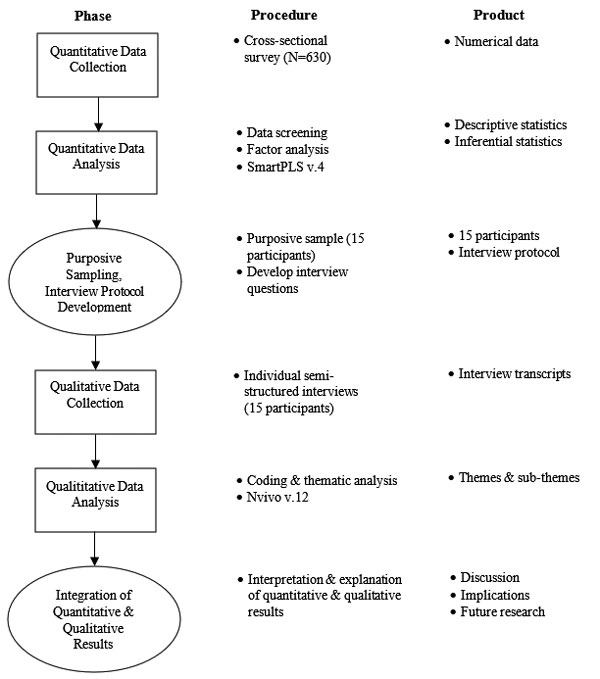
|
Quantitative phase
Data collected and the participant
A closed questionnaire design was employed, consisting of four sections: a brief survey introduction, screening questions, key measurement questions, and demographic questions. Specific protocols were implemented in the questionnaire to reduce potential common method bias (CMB) and non-response bias. To control for CMB, the questionnaire was kept concise, demographic questions were placed at the end, respondents were allowed to answer anonymously, diverse scale types were used, and a pilot test was conducted (Podsakoff et al., 2003Podsakoff, P. M., MacKenzie, S. B., Lee, J.-Y., & Podsakoff, N. P. (2003). Common method biases in behavioral research: A critical review of the literature and recommended remedies. Journal of Applied Psychology, 88(5), 879–903. https://doi.org/10.1037/0021-9010.88.5.879; Reio, 2010Reio, T. G. (2010). The Threat of Common Method Variance Bias to Theory Building. Human Resource Development Review, 9(4), 405–411. https://doi.org/10.1177/1534484310380331).
Data collection was carried out via a self-administered questionnaire comprising 71 items, using a 5-point Likert scale with response options ranging from 1 to 5, where 1 indicated a negative response and 5 indicated a positive response. The questionnaire was created using Google Forms and distributed online through social media and WhatsApp.
The target population consisted of undergraduate students who had taken digital entrepreneurship courses in the digital business department at campuses with a minimum accreditation of B. The sample size of 630 respondents was determined based on guidelines for Structural Equation Modeling – Partial Least Squares (SEM-PLS) analysis. Hair et al. (2019Hair, J. F., Risher, J. J., Sarstedt, M., & Ringle, C. M. (2019). When to use and how to report the results of PLS-SEM. In European Business Review (Vol. 31, Issue 1). https://doi.org/10.1108/EBR-11-2018-0203) recommend a minimum sample size of 200 respondents for SEM-PLS studies, particularly when dealing with complex structural models. Since this study involved multiple constructs and indicators, a sample size of 630 was considered appropriate to ensure the reliability and robustness of the SEM-PLS analysis. The sample was drawn from both state and private campuses across Indonesia, resulting in a total of 630 respondents participating in the study.
Data analysis
The digital entrepreneurial education is measured include digital skill (2 items; Stam, 2015Stam, E. (2015). Entrepreneurial Ecosystems and Regional Policy: A Sympathetic Critique. European Planning Studies, 23(9), 1759–1769. https://doi.org/10.1080/09654313.2015.1061484); digital motivation (2 items; Isenberg, 2010Isenberg, D. J. (2010). How to start an entrepreneurial revolution. Harvard Business Review, 88(6), 40–50.); digital business model (2 items; Spigel, 2017Spigel, B. (2017). The Relational Organization of Entrepreneurial Ecosystems. Entrepreneurship Theory and Practice, 41(1), 49–72. https://doi.org/10.1111/etap.12167); digital policy, measured by two items (2 items; Feld, 2020Feld, B. (2020). Startup Communities: Building an Entrepreneurial Ecosystem in Your City 2nd Edition. Wiley.), application of digital knowledge in entrepreneur practice (2 items; Ács et al., 2014Ács, Z. J., Autio, E., & Szerb, L. (2014). National Systems of Entrepreneurship: Measurement issues and policy implications. Research Policy, 43(3), 476–494. https://doi.org/10.1016/j.respol.2013.08.016); digital ability (2 items; Stam & van de Ven, 2021Stam, E., & van de Ven, A. (2021). Entrepreneurial ecosystem elements. Small Business Economics, 56(2), 809–832. https://doi.org/10.1007/s11187-019-00270-6); digital trend (2items; Malecki, 2018Malecki, E. J. (2018). Entrepreneurship and entrepreneurial ecosystems. Geography Compass, 12(3). https://doi.org/10.1111/gec3.12359); digital resource (2 items; Neck et al., 2004Neck, H. M., Meyer, G. D., Cohen, B., & Corbett, A. C. (2004). An Entrepreneurial System View of New Venture Creation. Journal of Small Business Management, 42(2), 190–208. https://doi.org/10.1111/j.1540-627X.2004.00105.x); digital innovation (2 items; Thomas & Autio, 2020Thomas, L. D. W., & Autio, E. (2020). Innovation Ecosystems in Management: An Organizing Typology. In Oxford Research Encyclopedia of Business and Management. Oxford University Press. https://doi.org/10.1093/acrefore/9780190224851.013.203), and digital collaboration (2 items; Brown & Mason, 2014Brown, R. C., & Mason, C. (2014). Entrepreneurial Ecosystems and Growth-Oriented Entrepreneurship (pp. 1-38 BT-Entrepreneurial Ecosystems and Growth-Or). Organisation for Economic Cooperation & Development. http://www.oecd.org/cfe/leed/Entrepreneurial-ecosystems.pdf). Intrinsic motivation in this study was measured based on the principles of Self-Determination Theory (SDT), which states that intrinsic motivation is driven by fulfilling three vital psychological needs: autonomy, competence, and relatedness. Autonomy (7 items; McCartan et al., 2023McCartan, A., Cummins, D., Morgan, M., & Joseph-Richard, P. (2023). Exploring Students’ Motivation to Participate in Entrepreneurial Marketing Education. Journal of Marketing Education, 45(3), 278–295. https://doi.org/10.1177/02734753231178501) evaluates the extent to which individuals feel self-directed and in control of their actions. Competence (6 items; Cerasoli et al., 2014Cerasoli, C. P., Nicklin, J. M., & Ford, M. T. (2014). Intrinsic motivation and extrinsic incentives jointly predict performance: A 40-year meta-analysis. Psychological Bulletin, 140(4), 980–1008. https://doi.org/10.1037/a0035661; Shillingford & Karlin, 2013Shillingford, S., & Karlin, N. J. (2013). The role of intrinsic motivation in the academic pursuits of nontraditional students. New Horizons in Adult Education and Human Resource Development, 25(3), 91–102. https://doi.org/10.1002/nha3.20033), focuses on individuals’ perceptions of their ability to effectively handle tasks and challenges, reflecting a sense of mastery and efficacy. Relatedness (8 items; Chen et al., 2020Chen, M.-H., Tseng, M., & Teng, M.-J. (2020). Creative Entrepreneurs’ Well-Being, Opportunity Recognition and Absorptive Capacity: Self-Determination Theory Perspective. Entrepreneurship Research Journal, 10(1). https://doi.org/10.1515/erj-2018-0171; He et al., 2023He, Z., Liu, Y., Wang, X., Li, R., & Lv, N. (2023). Gamified Entrepreneurship Courses Motivate College Students’ Satisfaction: An Integrated Flow Framework. SAGE Open, 13(2). https://doi.org/10.1177/21582440231177029) examines how individuals feel connected and valued in their social context, emphasizing the importance of meaningful relationships in fostering intrinsic motivation.
Gamification in this study is measured using a set of questions that address various dimensions essential for understanding user engagement and motivation. These dimensions are each represented by two items based on validated literature sources. Engagement and Motivation (Deterding et al., 2011Deterding, S., Khaled, R., Nacke, L., & Dixon, D. (2011). Gamification: toward a definition. Chi 2011, 12–15. https://doi.org/978-1-4503-0268-5/11/0); Achievement and Progress (Ryan & Deci, 2000Ryan, R. M., & Deci, E. L. (2000). Self-determination theory and the facilitation of intrinsic motivation, social development, and well-being. American Psychologist, 55(1), 68–78. https://doi.org/10.1037/0003-066X.55.1.68); Competence and Mastery (Hamari et al., 2014Hamari, J., Koivisto, J., & Sarsa, H. (2014). Does gamification work? - A literature review of empirical studies on gamification. Proceedings of the Annual Hawaii International Conference on System Sciences, 3025–3034. https://doi.org/10.1109/HICSS.2014.377); Social Interaction and Collaboration (Landers, 2014Landers, R. N. (2014). Developing a Theory of Gamified Learning: Linking Serious Games and Gamification of Learning. Simulation & Gaming, 45(6), 752–768. https://doi.org/10.1177/1046878114563660); Autonomy and Choice (Buckley & Doyle, 2017Buckley, P., & Doyle, E. (2017). Individualising gamification: An investigation of the impact of learning styles and personality traits on the efficacy of gamification using a prediction market. Computers & Education, 106, 43–55. https://doi.org/10.1016/j.compedu.2016.11.009); Rewards and Recognition (Domínguez et al., 2013Domínguez, A., Saenz-de-Navarrete, J., De-Marcos, L., Fernández-Sanz, L., Pagés, C., & Martínez-Herráiz, J.-J. (2013). Gamifying learning experiences: Practical implications and outcomes. Computers & Education, 63, 380–392. https://doi.org/10.1016/j.compedu.2012.12.020); Cognitive Engagement and Deep Learning (Kapp, 2013Kapp, K. M. (2013). The Gamification of Learning and Instruction Fieldbook: Ideas into Practice. Wiley Online Library.), while Satisfaction and Overall Experience (Mekler et al., 2017Mekler, E. D., Brühlmann, F., Tuch, A. N., & Opwis, K. (2017). Towards understanding the effects of individual gamification elements on intrinsic motivation and performance. Computers in Human Behavior, 71, 525–534. https://doi.org/10.1016/j.chb.2015.08.048). Student engagement in this study is measured through a series of questions encompassing six key dimensions. Behavioral Engagement (Masri et al., 2021Masri, N., Abdullah, A., Asimiran, S., & Zaremohzzabieh, Z. (2021). Relationship between engagement in learning entrepreneurship education and entrepreneurial intention among vocational college students. Pertanika Journal of Social Sciences and Humanities, 29, 19–38. https://doi.org/10.47836/pjssh.29.s1.02); Emotional Engagement (Kanaparan et al., 2019Kanaparan, G., Cullen, R., & Mason, D. (2019). Effect of Self-efficacy and Emotional Engagement on Introductory Programming Students. Australasian Journal of Information Systems, 23. https://doi.org/10.3127/ajis.v23i0.1825); Cognitive Engagement (Tadesse & Edo, 2020Tadesse, T., & Edo, B. (2020). The relationships between student engagement and learning outcome in the undergraduate sports science program in Ethiopia. Journal of Applied Research in Higher Education, 13(1), 48–62. https://doi.org/10.1108/JARHE-01-2019-0017); Social Engagement (Bowden et al., 2021Bowden, J. L.-H., Tickle, L., & Naumann, K. (2021). The four pillars of tertiary student engagement and success: a holistic measurement approach. Studies in Higher Education, 46(6), 1207–1224. https://doi.org/10.1080/03075079.2019.1672647); Technological Engagement (Licorish et al., 2018Licorish, S. A., Owen, H. E., Daniel, B., & George, J. L. (2018). Students’ perception of Kahoot!’s influence on teaching and learning. Research and Practice in Technology Enhanced Learning, 13(1), 9. https://doi.org/10.1186/s41039-018-0078-8). Lastly, Institutional Engagement (Schaufeli et al., 2002Schaufeli, W. B., Salanova, M., González-romá, V., & Bakker, A. B. (2002). The Measurement of Engagement and Burnout: A Two Sample Confirmatory Factor Analytic Approach. Journal of Happiness Studies, 3(1), 71–92. https://doi.org/10.1023/A:1015630930326).
The analysis technique uses the Partial Least Square -Structural Equation Model (PLS-SEM) which is a method suitable for complex structural models with latent variables (Hair et al., 2019Hair, J. F., Risher, J. J., Sarstedt, M., & Ringle, C. M. (2019). When to use and how to report the results of PLS-SEM. In European Business Review (Vol. 31, Issue 1). https://doi.org/10.1108/EBR-11-2018-0203), and this study develops a structural model where gamification acts as a moderating variable. The research variables consist of several categories, namely demographic variables, which include basic characteristics of respondents such as gender, age, academic level, and institutional accreditation; exogenous latent variables, namely digital entrepreneurial education; endogenous latent variables, namely intrinsic motivation and student engagement, and moderating variables namely gamification which are hypothesized to strengthen the relationship between latent variables. Data analysis using SmartPLS version 4 to evaluate the model in PLS consists of a measurement model, a structural model, and a goodness and fit model.
Qualitative Phase
Data collected and the participant
The participants in this phase of the study had consented to participate in follow-up interviews. Standardized open-ended interviews were conducted with 15 participants, selected from respondents who had participated in the quantitative study but expressed negative perceptions of gamification. The findings from the initial phase of the study were used to inform the development of the semi-structured interview guide. The following are illustrative questions: “What is your opinion of the use of competitive elements such as leaderboards in entrepreneurship learning? Do you believe that gamification facilitates or impedes your creativity in developing business ideas?” The objective of this study is to ascertain whether rewards such as points and levels affect the way in which participants perceive the learning process. In addition, the impact of the use of badges or other visual rewards on motivation to learn more about entrepreneurship is to be evaluated.
Furthermore, the frequency with which gamification affects the completion of entrepreneurial tasks is to be determined. Finally, the focus of participants is to be gauged: are they more focused on earning points or on the learning outcomes themselves? Although the survey results informed the structure of the interview questions, they remained open-ended to allow respondents to direct their responses as they saw fit.
Data analysis
Firstly, the interviews were recorded and transcribed, and the resulting transcripts were then emailed to the respondents for checking and confirmation. In the second phase of the qualitative study, the semi-structured interview data was analyzed using NVivo version 12. Descriptive coding was employed to facilitate the identification and classification of data pertaining to the primary constructs under investigation. Concurrently, accounts and sections were grouped in a manner consistent with the descriptive codes and mapped to ascertain existing relationships. To facilitate the synthesis of impulsive ideas and thoughts about the data during coding and pattern mapping, memos were employed (Schindler & Burkholder, 2016Schindler, L. A., & Burkholder, G. J. (2016). A Mixed Methods Examination of the Influence of Dimensions of Support on Training Transfer. Journal of Mixed Methods Research, 10(3), 292–310. https://doi.org/10.1177/1558689814557132Schindler, L. A., & Burkholder, G. J. (2016). A Mixed Methods Examination of the Influence of Dimensions of Support on Training Transfer. Journal of Mixed Methods Research, 10(3), 292–310. https://doi.org/10.1177/1558689814557132). Additionally, we constructed individualized accounts comprising the structure, significance, and gist of each opinion, delineating the respondents’ perceptions. These accounts were then forwarded to the respondents for review and validation (Schindler & Burkholder, 2016Schindler, L. A., & Burkholder, G. J. (2016). A Mixed Methods Examination of the Influence of Dimensions of Support on Training Transfer. Journal of Mixed Methods Research, 10(3), 292–310. https://doi.org/10.1177/1558689814557132). The themes derived from the coding patterns, mappings, and memos were employed to construct an effect matrix, elucidating the manner and rationale by which the gamification dimension modulates students’ intrinsic motivation.
Quantitative Results
Respondent characteristic
Of the 630 business school students who had completed a digital entrepreneurship course, 57.3% were male. The largest group represented in the survey was that of third-year students, comprising 42.9% of the total sample. This was followed by almost equal percentages of final-year students (37.5%) and second-year students (19.7%). This aligns with the distribution of age groups among the participants. The largest cohort was individuals between the ages of 21 and 23, comprising 46.7% of the total sample. The next largest group was those over 23 years of age, representing 35.1% of the sample. The youngest cohort, under 21 years of age, constituted 18.3% of the sample. For public campuses, 64.9% and for private campuses, 35.1%; while from the distribution of locations, Java island (61.3%), Bali island (19.5%), Kalimantan island (10.2%) and other islands (9%).
Measurement model analysis
This research is a reflective measurement model. In Hair et al. (2021Hair, J. F., Hult, G. T. M., Ringle, C. M., Sarstedt, M., Danks, N. P., & Ray, S. (2021). Partial Least Squares Structural Equation Modeling (PLS-SEM) Using R. In Practical Assessment, Research and Evaluation (Vol. 21, Issue 1). http://www.), the evaluation of the reflective measurement model consists of indicator reliability with a loading factor value above 0.7; in this study, five indicator items have a value below 0.7, namely EE1, EE6, GM14, IM13, and IM21. These invalid items have been removed from the model and re-estimated so that the loading results are above 0.7. The internal consistency includes composite reliability (rho_c), Cronbach’s alpha (α), and reliability coefficient (rho_a), which are each above 0.7, and our assessment shows that these statistics are above 0.7. Regarding convergent validity, the average variance extracted (AVE) was observed to be above 0.5, implying the establishment of convergent validity of the constructs. Factor loading, reliability, and convergent validity estimate values are presented in Table 1 .
The highest factor loadings for Digital Entrepreneurial Education is “I have access to mentors who provide guidance in my entrepreneurial journey”, the access to mentors underscores the importance of guidance and personalized support, which can significantly boost students’ confidence and capabilities in navigating the entrepreneurial landscape (Isabelle, 2020Isabelle, D. A. (2020). Gamification of Entrepreneurship Education. Decision Sciences Journal of Innovative Education, 18(2), 203–223. https://doi.org/10.1111/dsji.12203), For Gamification is “I believe gamification adds value to my learning experience”, this aligns with the notion that mentorship is a key driver of entrepreneurial motivation and knowledge acquisition (Sahrah et al., 2023Sahrah, A., Guritno, P. D., Rengganis, R. P., & Dewi, R. P. (2023). Subjective Well-Being and Psychological Resilience as the Antecedents of Digital Entrepreneurship Intention. Journal of Educational and Social Research, 13(4), 54–65. https://doi.org/10.36941/jesr-2023-0089). In the case of Gamification, the belief that gamification adds value to the learning experience emphasizes its role in making learning engaging and enjoyable, which aligns with findings in educational technology that suggest gamification enhances motivation and participation (Grivokostopoulou et al., 2019Grivokostopoulou, F., Kovas, K., & Perikos, I. (2019). Examining the impact of a gamified entrepreneurship education framework in higher education. Sustainability (Switzerland), 11(20). https://doi.org/10.3390/su11205623). Then Intrinsic Motivation is “I am encouraged to express my opinions and ideas in class”, being encouraged to express opinions and ideas in class is a critical element, as autonomy and the ability to voice one’s thoughts foster a deeper sense of ownership and intrinsic motivation in learning, as highlighted by Self-Determination Theory (Deci & Ryan, 1985Deci, E. L., & Ryan, R. M. (1985). Intrinsic Motivation and Self-Determination in Human Behavior. Springer US. https://doi.org/10.1007/978-1-4899-2271-7). Finally Student Engagement is “I often engage in discussions with my peers to better understand course material”, a behavior that not only deepens understanding but also reinforces active learning, as peer interaction promotes cognitive engagement and critical thinking (Tadesse & Edo, 2020Tadesse, T., & Edo, B. (2020). The relationships between student engagement and learning outcome in the undergraduate sports science program in Ethiopia. Journal of Applied Research in Higher Education, 13(1), 48–62. https://doi.org/10.1108/JARHE-01-2019-0017). Each of these indicators plays a fundamental role in their respective constructs by directly influencing student involvement, motivation, and learning outcomes, creating a comprehensive framework that highlights the synergy between mentorship, gamified learning, intrinsic motivation, and engagement in academic settings.
| Table 1. Factor Loading, Reliability, and Convergent Validity Estimates | |||||||||||||||||||||||||||||||||||||||||||||||||||||||||||||||||||||||||||||||||||||||||||||||||||||||||||||||||||||||||||||||||||||||||||||||||||||||||||||||||||||||||||||||||||||||||||||||||||||||||||||||||||||||||||||||||||||||||||||||||||||||||||||||||||||||||||||||||||||||||||||||||||||||||||||||||||||||||||||||||||||||||||||||||||||||||||||||||||||||||||||||||||||||||||||||||||||||||||||||||||||||||||||||||||||||||||||||||||||||||||||||||||||||||||||||||||||||||||||||||||||||||||||||||||||||||||||||
|
|||||||||||||||||||||||||||||||||||||||||||||||||||||||||||||||||||||||||||||||||||||||||||||||||||||||||||||||||||||||||||||||||||||||||||||||||||||||||||||||||||||||||||||||||||||||||||||||||||||||||||||||||||||||||||||||||||||||||||||||||||||||||||||||||||||||||||||||||||||||||||||||||||||||||||||||||||||||||||||||||||||||||||||||||||||||||||||||||||||||||||||||||||||||||||||||||||||||||||||||||||||||||||||||||||||||||||||||||||||||||||||||||||||||||||||||||||||||||||||||||||||||||||||||||||||||||||||||
Table 2 presents the Heterotrait-Monotrait ratio (HTMT) and Fornell-Larcker criterion results for assessing discriminant validity among reflective constructs, including EE, GM, IM, SE, and GM x EE. for HTMT values, which indicate discriminant validity all inter-variable values remain below the recommended threshold of 0.9, supporting discriminant validity across constructs (Henseler et al., 2015Henseler, J., Ringle, C. M., & Sarstedt, M. (2015). A new criterion for assessing discriminant validity in variance-based structural equation modeling. Journal of the Academy of Marketing Science, 43(1), 115–135. https://doi.org/10.1007/s11747-014-0403-8). The Fornell-Larcker criterion confirms this by showing that each construct’s AVE square root (diagonal values) is higher than the correlations with other constructs, reaffirming adequate discriminant validity (Hair et al., 2019Hair, J. F., Risher, J. J., Sarstedt, M., & Ringle, C. M. (2019). When to use and how to report the results of PLS-SEM. In European Business Review (Vol. 31, Issue 1). https://doi.org/10.1108/EBR-11-2018-0203). This combination of HTMT and Fornell-Larcker criteria strengthens the construct validity within this model.
| Table 2. The HTMT and Fornell Lacker criterion test results of reflective constructs | |||||||||||||||||||||||||||||||||||||||||||||||||||||||||||||||||||||
|
|||||||||||||||||||||||||||||||||||||||||||||||||||||||||||||||||||||
Structural model analysis
Structural model evaluation is related to hypothesis testing of the influence between research variables. The structural model evaluation check is carried out in three stages, namely first checking the absence of multicollinearity between variables with the Inner VIF (Variance Inflated Factor) measure. Inner VIF values below 5 indicate no multicollinearity between variables (Hair et al., 2021Hair, J. F., Hult, G. T. M., Ringle, C. M., Sarstedt, M., Danks, N. P., & Ray, S. (2021). Partial Least Squares Structural Equation Modeling (PLS-SEM) Using R. In Practical Assessment, Research and Evaluation (Vol. 21, Issue 1). http://www.). The second is hypothesis testing between variables by looking at the t-statistical value or p-value (Hair et al., 2021Hair, J. F., Hult, G. T. M., Ringle, C. M., Sarstedt, M., Danks, N. P., & Ray, S. (2021). Partial Least Squares Structural Equation Modeling (PLS-SEM) Using R. In Practical Assessment, Research and Evaluation (Vol. 21, Issue 1). http://www.). Suppose the t statistic calculated is greater than 1.96 (t table), or the p-value of the test results is less than 0.05. In that case, there is a significant influence between the variables. In addition, it is necessary to convey the results and 95% confidence interval of the estimated path coefficient parameter. The third is the ⨍2 value, namely the effect of variables at the structural level with criteria (⨍2 0.02 is low, 0.15 is moderate and 0.35 is high) (Hair et al., 2021Hair, J. F., Hult, G. T. M., Ringle, C. M., Sarstedt, M., Danks, N. P., & Ray, S. (2021). Partial Least Squares Structural Equation Modeling (PLS-SEM) Using R. In Practical Assessment, Research and Evaluation (Vol. 21, Issue 1). http://www.).
| Table 3. Structural model results | |||||||||||||||||||||||||||||||||||||||||||||||||||||||||||||||||||||||||||||||||||
|
|||||||||||||||||||||||||||||||||||||||||||||||||||||||||||||||||||||||||||||||||||
Table 3 shows a significant effect of the entrepreneurial education on intrinsic motivation and student engagement, with t-statistics of 13.09, 4.50, and p value of 0.00. The existence of the entrepreneurial education in enhancing intrinsic motivation has a large effect at the structural level with a value of ⨍2 = 0.728. While student engagement has a low influence with a structural level ⨍2 = 0.117. In the 95% confidence interval, the effect of the entrepreneurial education in increasing intrinsic motivation is between 0.539 and 0.730, while the increase in student engagement is between 0.179 and 0.457. Therefore, it can be inferred that hypotheses 1 and 2 are supported by the evidence. Hypotheses 3 shows a positive relationship between intrinsic motivation and student engagement, with a t-statistic of 4.433 and a p-value of 0.00. In the 95% confidence interval, the effect of intrinsic motivation on student engagement is in the range of 0.164 to 0.430. The existence of intrinsic motivation in increasing student engagement has a small to medium effect at the structural level ⨍2 = 0.102. Therefore, it can be inferred that hypothesis 3 is accepted.
Furthermore, hypothesis 4 shows the moderating significance of the relationship between digital entrepreneur education and intrinsic motivation negatively with path coefficient -0.079, t statistic 2.628, and p value 0.009. Within the 95% confidence interval, the magnitude of this negative effect is within the range of -0.145 to -0.027. Although this negative effect is small (⨍2 = 0.020), the presence of inappropriate gamification in the digital entrepreneur education can reduce students’ intrinsic motivation. Therefore, the implementation of gamification should be carefully designed to minimize the negative impact on student motivation. And finally, the interaction between gamification as moderating the relationship between digital entrepreneur education and student engagement is positive with a path coefficient of 0.102, t-statistic of 2.553, and a p-value of 0.011. In the 95% confidence interval, the magnitude of this positive effect is in the range of 0.016 to 0.171. The existence of the interaction between gamification and digital entrepreneur education in increasing student engagement has a small effect at the structural level ⨍2 = 0.036). Therefore, it can be concluded that hypotheses 4 and 5 are supported.
All hypotheses were supported as the p-value was below 0.05, with positive or negative relationships as hypothesized. The effect of the digital entrepreneur education on intrinsic motivation (H1) had the largest effect (⨍² = 0.728), indicating the important role of the entrepreneurial environment. However, the interaction between gamification and the digital entrepreneur education provided interesting results: a negative effect on intrinsic motivation (H4) but a positive effect on student engagement (H5), which needs further exploration. Following the present, Figure 3 shows the path coefficient diagram, t statistics, and R2 values of the endogenous constructs within the model.
|
Figure 3. Diagram Path Coefficient and P-value 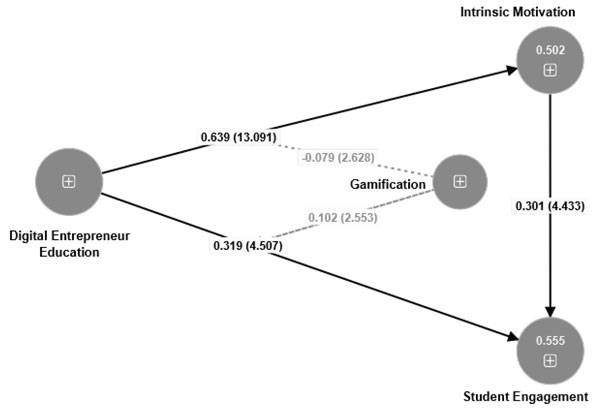
|
Evaluation of Goodness and Fit of the Model
PLS is a variance-based SEM analysis with the aim of testing model theory that focuses on prediction studies. Therefore, several measures were developed to declare the proposed model acceptable, such as R2, Q2, and SRMR (Hair et al., 2019Hair, J. F., Risher, J. J., Sarstedt, M., & Ringle, C. M. (2019). When to use and how to report the results of PLS-SEM. In European Business Review (Vol. 31, Issue 1). https://doi.org/10.1108/EBR-11-2018-0203). The R2 statistical measure illustrates the variation in endogenous variables that can be explained by other exogenous/endogenous variables in the model. According to Chin (1998Chin, W. W. (1998). The partial least squares approach for structural equation modeling. In Modern methods for business research. (pp. 295–336). Lawrence Erlbaum Associates Publishers.), the qualitative interpretation value of R2 is 0.19 (low influence), 0.33 (moderate influence), and 0.66 (high influence). Based on Table 3, the magnitude of the influence of intrinsic motivation and student engagement has a moderate influence with a value of 0.502 (50.2%), and 0.555 (55.5%).
|
Figure 4. Simple slope analysis 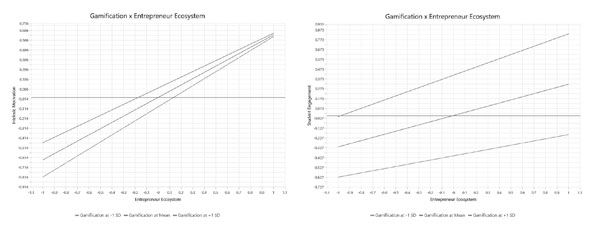
|
Q2 describes a measure of predictive accuracy, namely how well each change in exogenous/endogenous variables can predict endogenous variables. This measure is a form of validation in PLS to state the suitability of model predictions (predictive relevance). The Q2 value above 0 states that the model has predictive relevance, but in Hair et al. (2019Hair, J. F., Risher, J. J., Sarstedt, M., & Ringle, C. M. (2019). When to use and how to report the results of PLS-SEM. In European Business Review (Vol. 31, Issue 1). https://doi.org/10.1108/EBR-11-2018-0203) the qualitative Q2 interpretation value is 0 (low influence), 0.25 (moderate influence), and 0.50 (high influence). Based on Table 3, the Q2 value of the intrinsic motivation 0.482 (moderate influence) and student engagement 0.50 (high influence) indicating that these two variables highly influence in the prediction model, strengthens the reliability of the model in explaining the relationship between variables in the context of this study. Regarding the Standardized Root Mean Square Residual (SRMR) value of the resulting model is quite good with SRMR (0.085 <0.10). The resulting model fit / close to empirical data.
The interaction between gamification and digital entrepreneur education shows a significant effect on intrinsic motivation and student engagement. Based on Figure 4, simple slope graphs indicate that the better the digital entrepreneur education, the stronger the impact of gamification in increasing motivation and engagement. This effect is seen to be consistent across different levels of gamification, with the effect being greatest at higher levels of gamification (+1 SD). These results confirm that a combination of gamification strategies and a supportive digital entrepreneur education can effectively improve learning outcomes.
Qualitative Results
Based on the quantitative results in hypothesis 4, the aim of the qualitative phase is to dig deeper into the finding that gamification elements weaken the relationship between the digital entrepreneur education and students’ intrinsic motivation. The following are the results of the qualitative analysis.
Participant characteristics
A qualitative approach was employed through the use of semi-structured interviews to elicit students’ perspectives on the integration of gamification elements into the learning environment. A total of 15 students were selected to participate in the study. These students had previously participated in the quantitative study but had expressed negative perceptions of gamification. The participants were predominantly male (73%), with four female students (27%). The majority of participants were between the ages of 21 and 23 (60%), while the remaining 40% were above the age of 23. The distribution of participants by university type revealed that 10 (67%) were from public universities and 5 (33%) from private universities. With regard to location, Java Island had the highest number of participants, at 8 (53%), followed by Bali Island with 3 (20%), and then Sumatra Island and Kalimantan Island with 2 (13%) each.
Data analysis
Following the interview, the next step was to identify themes through the use of a thematic analysis. This allowed for the summarization of themes, sub-themes, frequency, meaning, and sample quotations related to gamification and its impact on the relationship between digital entrepreneur education and students’ intrinsic motivation. These findings are presented in Appendix A. Finally, the researchers will integrate the results of the quantitative and qualitative phases to provide a comprehensive interpretation of the results. This approach will enhance the understanding of the phenomenon of gamification and its influence on the relationship between digital entrepreneur education and students’ intrinsic motivation.
Interpretation of Results from the Quantitative Phase
The results of this study highlight the significant positive influence of digital entrepreneurship education on both intrinsic motivation (Hypothesis 1) and student engagement (Hypothesis 2), directly addressing the research question regarding the impact of digital entrepreneurship education on these factors. The findings reveal that key educational elements such as access to mentors, supportive communities, and effective training programs, play a crucial role in enhancing students’ intrinsic motivation within the entrepreneurial context. For instance, the indicator “I am encouraged to express my opinions and ideas in class” illustrates how students who are encouraged to share their thoughts feel more in control of their learning, which strengthens their intrinsic motivation. This aligns with Self-Determination Theory (SDT), which posits that autonomy and the ability to express oneself deepen the sense of ownership and intrinsic motivation in learning (Al-Jubari, Hassan et al., 2019Al-Jubari, I., Hassan, A., & Liñán, F. (2019). Entrepreneurial intention among University students in Malaysia: integrating self-determination theory and the theory of planned behavior. International Entrepreneurship and Management Journal, 15(4), 1323–1342. https://doi.org/10.1007/s11365-018-0529-0; Guerrero et al., 2024Guerrero, M., Fayolle, A., Di Guardo, M. C., Lamine, W., & Mian, S. (2024). Re-viewing the entrepreneurial university: strategic challenges and theory building opportunities. Small Business Economics, 63(2), 527–548. https://doi.org/10.1007/s11187-023-00858-z; Ryan & Deci, 2000Ryan, R. M., & Deci, E. L. (2000). Self-determination theory and the facilitation of intrinsic motivation, social development, and well-being. American Psychologist, 55(1), 68–78. https://doi.org/10.1037/0003-066X.55.1.68). Thus, digital entrepreneurship education fosters not only technical skills but also the psychological aspects of learning, particularly the intrinsic drive to innovate and engage with entrepreneurial challenges.
Moreover, the study finds that student engagement is positively influenced by digital entrepreneurship education, supporting Hypothesis 2. Students who have access to mentors, networking opportunities, and community support are more motivated to actively participate in entrepreneurship activities. A key indicator of student engagement—”I often engage in discussions with my peers to better understand course material”—highlights the importance of peer interaction in enhancing understanding and fostering active learning. This behavior not only enriches students’ comprehension of course content but also promotes cognitive engagement and critical thinking (Tadesse & Edo, 2020Tadesse, T., & Edo, B. (2020). The relationships between student engagement and learning outcome in the undergraduate sports science program in Ethiopia. Journal of Applied Research in Higher Education, 13(1), 48–62. https://doi.org/10.1108/JARHE-01-2019-0017). These results emphasize the importance of a comprehensive digital entrepreneurship education model that enhances both intrinsic motivation and student engagement, ultimately contributing to better learning outcomes and more effective entrepreneurship development (Al-Jubari, Hassan et al., 2019Al-Jubari, I., Hassan, A., & Liñán, F. (2019). Entrepreneurial intention among University students in Malaysia: integrating self-determination theory and the theory of planned behavior. International Entrepreneurship and Management Journal, 15(4), 1323–1342. https://doi.org/10.1007/s11365-018-0529-0; De Bruyckere & Everaert, 2021De Bruyckere, S., & Everaert, P. (2021). The role of the external accountant in business planning for starters: Perspective of the self-determination theory. Sustainability (Switzerland), 13(6). https://doi.org/10.3390/su13063014; Ryan & Deci, 2000Ryan, R. M., & Deci, E. L. (2000). Self-determination theory and the facilitation of intrinsic motivation, social development, and well-being. American Psychologist, 55(1), 68–78. https://doi.org/10.1037/0003-066X.55.1.68).
The third research question, “Does gamification moderate the relationship between digital entrepreneurial education and intrinsic motivation and student engagement?” was directly addressed in this study, which also examined the moderating role of gamification in these relationships in addition to the beneficial effects of digital entrepreneurship education on motivation and engagement. The results show that, although it has a negative effect, gamification considerably moderates the association between intrinsic motivation and digital entrepreneurship education (Hypothesis 4). While digital entrepreneurial education alone positively influences intrinsic motivation, the introduction of gamification, with its extrinsic rewards and competitive elements, appears to shift the focus from internal satisfaction to external incentives. This result challenges the common assumption that gamification universally enhances motivation, suggesting that gamification may have a complex and context-dependent effect. Thus, a more balanced approach to gamification is needed, one that carefully considers its impact on students’ intrinsic motivation. Gamification was expected to positively moderate the relationship between digital entrepreneurial education and intrinsic motivation, as many studies suggest a positive effect (Grivokostopoulou et al., 2019Grivokostopoulou, F., Kovas, K., & Perikos, I. (2019). Examining the impact of a gamified entrepreneurship education framework in higher education. Sustainability (Switzerland), 11(20). https://doi.org/10.3390/su11205623; Hanus & Fox, 2015Hanus, M. D., & Fox, J. (2015). Assessing the effects of gamification in the classroom: A longitudinal study on intrinsic motivation, social comparison, satisfaction, effort, and academic performance. Computers & Education, 80, 152–161. https://doi.org/10.1016/j.compedu.2014.08.019; Luarn et al., 2023Luarn, P., Chen, C.-C., & Chiu, Y.-P. (2023). Enhancing Intrinsic Learning Motivation Through Gamification: A self-Determination Theory Perspective. 40(5), 413–424. https://doi.org/10.1108/ijilt-07-2022-0145; Okariz et al., 2023Okariz, A., Huebra, M., Sarasola, A., Ibarretxe, J., Bidegain, G., & Zubimendi, J. L. (2023). Gamifying Physics Laboratory Work Increases Motivation and Enhances Acquisition of the Skills Required for Application of the Scientific Method. Education Sciences, 13(3), 302. https://doi.org/10.3390/educsci13030302). However, this study found that gamification negatively moderated this relationship, which contradicts previous research findings.
In contrast, gamification was found to have a significantly positive moderating effect on the relationship between digital entrepreneurial education and student engagement (Hypothesis 5). This finding supports the notion that gamification can increase student engagement, particularly when designed to foster interaction and provide constructive feedback. Literature suggests that well-designed gamified learning environments, which incorporate elements like progress tracking and rewards, can enhance participation and motivation (Fredricks et al., 2004Fredricks, J. A., Blumenfeld, P. C., & Paris, A. H. (2004). School Engagement: Potential of the Concept, State of the Evidence. Review of Educational Research, 74(1), 59–109. https://doi.org/10.3102/00346543074001059; Hanus & Fox, 2015Hanus, M. D., & Fox, J. (2015). Assessing the effects of gamification in the classroom: A longitudinal study on intrinsic motivation, social comparison, satisfaction, effort, and academic performance. Computers & Education, 80, 152–161. https://doi.org/10.1016/j.compedu.2014.08.019; Nicholson, 2015Nicholson, S. (2015). A Recipe for Meaningful Gamification. In Gamification in Education and Business (pp. 1–20). Springer International Publishing. https://doi.org/10.1007/978-3-319-10208-5_1). The belief that gamification adds value to the learning experience emerged as a central motivator, indicating that gamified environments can stimulate both motivation and active engagement. These findings emphasize the importance of carefully integrating gamification into digital entrepreneurship education to maximize student participation and involvement.
Overall, these results provide direct answers to the research questions and reveal the nuanced, context-dependent effects of gamification on motivation and engagement. They underscore the importance of designing digital entrepreneurship programs that thoughtfully balance educational support and gamification elements to foster meaningful and effective learning experiences.
Insights from the Qualitative Phase
Based on the qualitative phase, gamification in digital entrepreneur education can create a misalignment between external elements, such as leaderboards and point systems, and the deeper, creative learning objectives. Many students expressed that gamification shifted their focus from intrinsic satisfaction in learning to the pursuit of external rewards, which hindered their engagement with entrepreneurial content. This aligns with Cognitive Evaluation Theory (CET), which suggests that external rewards, when perceived as controlling, can reduce intrinsic motivation by diminishing autonomy (Seun et al., 2017Seun, A. O., Kalsom, A. W., Bilkis, A., & Raheem, A. I. (2017). What motivates youth enterprenuership? Born or made. Pertanika Journal of Social Sciences and Humanities, 25(3), 1419–1448.). Additionally, the over-justification effect, where students’ motivation becomes more driven by rewards than the content itself, was evident in participants’ experiences, with several noting that they became more focused on collecting points and badges than exploring entrepreneurial ideas.
Additionally, the over-justification effect, where students’ motivation becomes more driven by rewards than the content itself, was evident in participants’ experiences. Several students noted that they became more focused on collecting points and badges than exploring entrepreneurial ideas, which diminished the intrinsic value of the learning process (Emilio López-Navarro et al., 2023Emilio López-Navarro, E., Giorgetti, D., Isern-Mas, C., & Barone, P. (2023). Gamification improves extrinsic but not intrinsic motivation to learning in undergraduate students: a counterbalanced study. European Journal of Education and Psychology, 16(1), 1–18. https://doi.org/10.32457/ejep.v16i1.2007). Furthermore, the competitive nature of gamification introduced unintended pressure, impacting collaboration and creativity in entrepreneurial learning. Many participants reported feeling anxious about maintaining a high rank on the leaderboard, which detracted from positive interaction with peers and hindered collaborative learning. As one respondent stated, “The pressure from the rankings was so great, I felt stressed and started to lose interest” (Respondent 13). This finding suggests that the excessive competition created by gamification elements, such as leaderboards, can reduce motivation by fostering unhealthy competitive pressure, which decreases engagement and creativity (Nicholson, 2012Nicholson, S. (2012). A User-Centered Theoretical Framework for Meaningful Gamification. Games+ Learning+ Society, 1–7. https://doi.org/10.1007/978-3-319-10208-5_1). Moreover, participants expressed concerns about the perceived mismatch between gamification elements and the open-ended nature of entrepreneurial education, which calls for real-world feedback rather than structured reward systems. As one respondent noted, “I think gamification works for some people, but for me, this system is not relevant to the main purpose of learning entrepreneurship” (Respondent 10). This points to the need for a more nuanced application of gamification in entrepreneurship education that better supports the development of creativity, problem-solving, and innovation—skills essential for entrepreneurial success. In contrast, when discussing student engagement, the findings suggest that gamification can also enhance involvement, particularly when integrated with more interactive elements such as peer feedback and collaboration. Some respondents indicated that certain aspects of gamification, such as rewards tied to group activities, encouraged them to interact more with peers and participate actively in learning tasks. This highlights the potential of gamified learning environments to increase engagement if carefully designed to align with the learning objectives. However, as Nicholson (2015Nicholson, S. (2015). A Recipe for Meaningful Gamification. In Gamification in Education and Business (pp. 1–20). Springer International Publishing. https://doi.org/10.1007/978-3-319-10208-5_1) points out, excessive focus on extrinsic rewards can undermine the engagement process if it shifts the focus away from intrinsic interest. Therefore, the findings advocate for a balanced approach, where gamification is used to complement rather than replace intrinsic motivation, fostering a deeper, more creative engagement with the content. These insights contribute to the broader conversation on the negative effects of gamification in education. While gamification can be a powerful tool for increasing engagement and motivation, its application in entrepreneurial education should be carefully considered. A more balanced use of gamification that aligns with the self-determined nature of entrepreneurial learning, focusing on intrinsic motivation and creativity, could prevent the negative consequences observed in this study. As Emilio López-Navarro et al. (2023Emilio López-Navarro, E., Giorgetti, D., Isern-Mas, C., & Barone, P. (2023). Gamification improves extrinsic but not intrinsic motivation to learning in undergraduate students: a counterbalanced study. European Journal of Education and Psychology, 16(1), 1–18. https://doi.org/10.32457/ejep.v16i1.2007) suggests, the key to effective gamification lies in integrating game elements that enhance, rather than replace, students’ intrinsic motivation and engagement with the subject matter.
Integrating Quantitative and Qualitative Findings: A Deeper Insight
The integration of quantitative and qualitative findings in this study provides a comprehensive understanding of how gamification moderates the relationship between digital entrepreneur education and intrinsic motivation. The quantitative phase revealed a significant but negative moderating effect of gamification on this relationship, which was particularly puzzling, as gamification is traditionally seen as a tool to enhance motivation and engagement (Deci & Ryan, 1985Deci, E. L., & Ryan, R. M. (1985). Intrinsic Motivation and Self-Determination in Human Behavior. Springer US. https://doi.org/10.1007/978-1-4899-2271-7; Ryan & Deci, 2000Ryan, R. M., & Deci, E. L. (2000). Self-determination theory and the facilitation of intrinsic motivation, social development, and well-being. American Psychologist, 55(1), 68–78. https://doi.org/10.1037/0003-066X.55.1.68). However, the qualitative phase provided deeper insights into the nuances behind this finding, offering an explanation for why gamification, in this context, may have had the opposite effect.
Linking Quantitative and Qualitative Findings
The negative moderating effect of gamification on intrinsic motivation, as highlighted in both the quantitative analysis and qualitative findings, underscores a complex tension between external controls and autonomy in the context of entrepreneurial education. According to Cognitive Evaluation Theory (CET), rewards and external controls can undermine intrinsic motivation, particularly when they restrict the learner’s autonomy (Ryan & Deci, 2000Ryan, R. M., & Deci, E. L. (2000). Self-determination theory and the facilitation of intrinsic motivation, social development, and well-being. American Psychologist, 55(1), 68–78. https://doi.org/10.1037/0003-066X.55.1.68). The qualitative phase of this study revealed that gamification elements, such as leaderboards and point systems, shifted students’ focus toward earning external rewards, such as badges and points, rather than deeply engaging with the content. This aligns with the over-justification effect, where external incentives reduce intrinsic interest in the task (Hamdallah et al., 2021Hamdallah, M. E., Srouji, A. F., & Mahadin, B. K. (2021). Intrinsic and extrinsic motivations on business school students’ aspirations: The gender role models perspective. Journal of Governance and Regulation, 10(4), 164–174. https://doi.org/10.22495/JGRV10I4ART15). Many participants noted that they became more focused on collecting rewards than on exploring entrepreneurial ideas, which diminished the intrinsic value of the learning process. This observation is consistent with previous research, which shows that external rewards can detract from intrinsic motivation, especially when gamification elements prioritize competition over collaboration and creativity (Koivisto & Hamari, 2019Koivisto, J., & Hamari, J. (2019). The rise of motivational information systems: A review of gamification research. International Journal of Information Management, 45, 191–210. https://doi.org/10.1016/j.ijinfomgt.2018.10.013).
Further, the competitive nature of gamification, as highlighted by students’ experiences, exacerbated stress and detracted from essential components of entrepreneurial learning such as collaboration and creativity. Several participants expressed anxiety over maintaining a high rank on the leaderboard, which hindered their ability to focus on the learning process or creative problem-solving. One participant mentioned, “The pressure from the rankings was so great, I felt stressed and started to lose interest” (Respondent 13). This finding resonates with existing literature that links excessive competition to reduced intrinsic motivation and increased stress, particularly in collaborative contexts (Henslee et al., 2021Henslee, E. A., Lowman, L., Gross, M. D., & McCauley, A. K. (2021). Student Motivation and Self-efficacy in Entrepreneurial-minded Learning (EML): What These Mean for Diversity and Inclusion in Engineering Classrooms. ASEE Annual Conference and Exposition, Conference Proceedings. https://www.scopus.com/inward/record.uri?eid=2-s2.0-85124567418&partnerID=40&md5=8064147c5e517fcde961761060c95706; Ohashi et al., 2023Ohashi, T., Kusu, H., Inoue, M., Tsukagoshi, H., Takeda, R., & Saijo, M. (2023). Enhancing Graduate Student Entrepreneurial Intention: A Designed Workshop Based on Exploratory Factor Analysis. Lecture Notes in Networks and Systems, 488, 839–855. https://doi.org/10.1007/978-3-031-08090-6_54). In the context of digital entrepreneurship education, where creativity, problem-solving, and autonomy are central to success, the emphasis on extrinsic rewards, such as points and badges, may conflict with the core goals of the curriculum, which prioritize real-world application, innovation, and independent thinking (Lee & Zhou, 2020Lee, J., & Zhou, M. (2020). The reigning misperception about culture and Asian American achievement. Ethnic and Racial Studies, 43(3), 508–515. https://doi.org/10.1080/01419870.2020.1678760; Raysharie et al., 2023Raysharie, P. I., Harinie, L. T., Inglesia, N., Vita, V., Wati, S., Sianipar, B., Ongki, O., Pash, R., Abdurrahman, M., Fadilla, K. A., & Putri, F. (2023). The Effect of Student’s Motivation on Academic Achievement. Journal Pendidikan Ilmu Pengetahuan Sosial, 15(1), 168–175. https://doi.org/10.37304/jpips.v15i1.9552). Moreover, students in this study perceived a mismatch between gamification elements and the open-ended nature of entrepreneurial education, which requires creativity and real-world feedback rather than rigid, structured reward systems. As one respondent observed, “I think gamification works for some people, but for me, this system is not relevant to the main purpose of learning entrepreneurship” (Respondent 10). This suggests that while gamification may be effective in certain learning environments, such as those focused on technical subjects, its application in entrepreneurship education needs to be carefully reevaluated. Entrepreneurship, by its nature, values creative problem-solving and critical thinking, and the over-reliance on external rewards could limit these essential skills (Fan & Tang, 2021Fan, W., & Tang, T. L.-P. (2021). Teaching Entrepreneurship In China: Business Simulation And Games (Sandg)- A New Theoretical Model Of Experiential Learning. In Organizational Science: A Global Perspective (pp. 21–38). https://www.scopus.com/inward/record.uri?eid=2-s2.0-85144950672&partnerID=40&md5=6dfdc5ef5af04fc43d2c1ee0985d6f80; Hamari et al., 2014Hamari, J., Koivisto, J., & Sarsa, H. (2014). Does gamification work? - A literature review of empirical studies on gamification. Proceedings of the Annual Hawaii International Conference on System Sciences, 3025–3034. https://doi.org/10.1109/HICSS.2014.377). This finding also speaks to the broader cultural context of Indonesia, where collectivist values often emphasize collaboration, support, and group achievement over individual competition (Mursitama et al., 2021Mursitama, T. N., Asnan Furinto, M., & Wijanto, S. H. (2021). Gamified Entrepreneurial Training, Maturity of E-Commerce Adoption in Enhancing Small Business Performance. Academy of Entrepreneurship Journal, 27(3), 1–7. https://www.scopus.com/inward/record.uri?eid=2-s2.0-85109455343&partnerID=40&md5=4f447ec53e9e5ad07621899f1a8a2003; Wangi et al., 2021Wangi, N. B. S., Setyosari, P., Kuswandi, D., & Dwiyogo, W. D. (2021). Integrating gamification in a blended learning entrepreneurship course: Discussing student learning and achievement motivation. International Journal of Innovation and Learning, 30(1), 91–113. https://doi.org/10.1504/IJIL.2021.116574). In Indonesian culture, students may be more inclined to value collaborative efforts and group success over personal rankings, which could explain the adverse effects of gamification in this context. On the other hand, when discussing student engagement, the findings suggest that gamification can positively enhance involvement when integrated with more interactive elements such as peer feedback and collaboration. Several respondents noted that gamified elements, such as group challenges or rewards tied to collaborative activities, encouraged them to engage more with peers and actively participate in learning tasks. This highlights the potential of gamified learning environments to increase engagement if designed to promote teamwork and shared problem-solving, which are central to the goals of entrepreneurial education. As Nicholson, (2015Nicholson, S. (2015). A Recipe for Meaningful Gamification. In Gamification in Education and Business (pp. 1–20). Springer International Publishing. https://doi.org/10.1007/978-3-319-10208-5_1) notes, gamification can be beneficial if it focuses on social interaction and collective learning, rather than reinforcing individual competition. This aligns with research suggesting that peer-based rewards and group challenges can encourage collaborative learning and enhance engagement in entrepreneurial education (Dodoo & Yawson, 2024Dodoo, P. D., & Yawson, D. E. (2024). Towards an understanding of multi-generational higher education cohorts in gamified entrepreneurship education. Heliyon, 10(11). https://doi.org/10.1016/j.heliyon.2024.e31689; Padilla-Zea et al., 2019Padilla-Zea, N., Aceto, S., & Burgos, D. (2019). Social Seducement: Empowering Social Economy Entrepreneurship. The Training Approach. International Journal of Interactive Multimedia and Artificial Intelligence, 5(7), 135–150. https://doi.org/10.9781/ijimai.2019.09.001).
The findings from both the quantitative and qualitative phases emphasize the need for a balanced approach to gamification in digital entrepreneurship education, one that carefully integrates gamification to complement, rather than replace, intrinsic motivation. While gamification has the potential to increase engagement, it is crucial to design it in a way that aligns with the core values of entrepreneurship—creativity, innovation, and collaboration. This insight underscores the importance of a context-sensitive application of gamification that recognizes cultural factors such as the collectivist nature of Indonesian society and the pedagogical objectives of entrepreneurial education. The study suggests that collaborative gamification, where students work together to solve problems and earn rewards as a team, could enhance both engagement and intrinsic motivation, without the negative consequences of excessive competition. These insights contribute to the broader conversation about the negative effects of gamification in education, particularly in fields that require creativity and collaboration. To maximize the benefits of gamification, educational systems should tailor game elements to support intrinsic motivation and self-determined learning, which are essential for fostering entrepreneurial skills in students (Emilio López-Navarro et al., 2023Emilio López-Navarro, E., Giorgetti, D., Isern-Mas, C., & Barone, P. (2023). Gamification improves extrinsic but not intrinsic motivation to learning in undergraduate students: a counterbalanced study. European Journal of Education and Psychology, 16(1), 1–18. https://doi.org/10.32457/ejep.v16i1.2007).
The findings of this study indicate that digital entrepreneurship education significantly influences both intrinsic motivation and student engagement. This supports the idea that elements such as access to mentors, supportive communities, and effective training programs enhance students’ motivation and involvement in entrepreneurial activities. Additionally, intrinsic motivation is shown to have a positive impact on student engagement, suggesting that motivated students are more likely to engage actively in their learning. In terms of the moderating role of gamification, the results reveal a complex, context-dependent effect. While gamification negatively moderates the relationship between digital entrepreneurship education and intrinsic motivation, it has a positive moderating effect on the relationship between digital entrepreneurship education and student engagement. These findings highlight the need for a balanced approach to gamification in educational settings, where its potential to enhance engagement is maximized while minimizing the risks of undermining intrinsic motivation.
Implications for theory
The negative moderating effect of gamification in this study suggests that not all gamification strategies are suitable for fostering intrinsic motivation in digital entrepreneur education. The application of gamification in such contexts requires a careful consideration of how external rewards are framed and whether they align with the educational goals of fostering creativity, autonomy, and innovation. From a theoretical perspective, this study contributes to the growing body of research on the dark side of gamification, particularly in complex learning environments like entrepreneurship. While previous research has largely focused on the positive effects of gamification, this study highlights the potential for unintended consequences when gamification is perceived as controlling or irrelevant to the learning context.
Practice and policy
From a practical standpoint, educators and instructional designers should be mindful of how gamification is integrated into digital entrepreneur education. Instead of focusing solely on external rewards, gamification can be enhanced by incorporating elements that emphasize collaboration, self-directed learning, and real-world problem-solving. This could include incorporating project-based gamification or peer-feedback mechanisms that align more closely with the goals of digital entrepreneur education. The quantitative results showed that gamification negatively moderated the relationship between digital entrepreneur education and intrinsic motivation, the qualitative data provided valuable insights into why this might be the case: gamification elements, such as leaderboards and point systems, were perceived as controlling and mismatched with the creative, collaborative goals of entrepreneurial learning
Limitation and future research
This study has several limitations. First, the qualitative data is based on a relatively small sample, and further research with a larger and more diverse cohort of students is needed to validate these findings. Second, the study only examined the moderating effects of gamification without considering other potential moderators, such as the individual characteristics of students (e.g., intrinsic motivation levels or prior entrepreneurial experience). Future research could explore how individual differences influence the effectiveness of gamification in entrepreneurial education.
| ○ | Ács, Z. J., Autio, E., & Szerb, L. (2014). National Systems of Entrepreneurship: Measurement issues and policy implications. Research Policy, 43(3), 476–494. https://doi.org/10.1016/j.respol.2013.08.016 |
| ○ | Al-Jubari, I., Hassan, A., & Liñán, F. (2019). Entrepreneurial intention among University students in Malaysia: integrating self-determination theory and the theory of planned behavior. International Entrepreneurship and Management Journal, 15(4), 1323–1342. https://doi.org/10.1007/s11365-018-0529-0 |
| ○ | Al-Jubari, I., Mosbah, A., & Talib, Z. (2019). Do intrinsic and extrinsic motivation relate to entrepreneurial intention differently? A self-determination theory perspective. Academy of Entrepreneurship Journal, 25(Special Issue 2), 1–14. |
| ○ | Bogdan, R., & Biklen, S. K. (2011). Qualitative Research for Education: An Introduction to Theories and Methods (International Edition). Prentice Hall. |
| ○ | Bowden, J. L.-H., Tickle, L., & Naumann, K. (2021). The four pillars of tertiary student engagement and success: a holistic measurement approach. Studies in Higher Education, 46(6), 1207–1224. https://doi.org/10.1080/03075079.2019.1672647 |
| ○ | Brown, R. C., & Mason, C. (2014). Entrepreneurial Ecosystems and Growth-Oriented Entrepreneurship (pp. 1-38 BT-Entrepreneurial Ecosystems and Growth-Or). Organisation for Economic Cooperation & Development. http://www.oecd.org/cfe/leed/Entrepreneurial-ecosystems.pdf |
| ○ | Buckley, P., & Doyle, E. (2017). Individualising gamification: An investigation of the impact of learning styles and personality traits on the efficacy of gamification using a prediction market. Computers & Education, 106, 43–55. https://doi.org/10.1016/j.compedu.2016.11.009 |
| ○ | Cerasoli, C. P., Nicklin, J. M., & Ford, M. T. (2014). Intrinsic motivation and extrinsic incentives jointly predict performance: A 40-year meta-analysis. Psychological Bulletin, 140(4), 980–1008. https://doi.org/10.1037/a0035661 |
| ○ | Cheah, J. S. S., Loh, S., & Gunasekaran, A. (2023). Motivational catalysts: the dominant role between prosocial personality and social entrepreneurial intentions among university students. Social Enterprise Journal, 19(5), 555–574. https://doi.org/10.1108/SEJ-04-2023-0036 |
| ○ | Chen, M.-H., Tseng, M., & Teng, M.-J. (2020). Creative Entrepreneurs’ Well-Being, Opportunity Recognition and Absorptive Capacity: Self-Determination Theory Perspective. Entrepreneurship Research Journal, 10(1). https://doi.org/10.1515/erj-2018-0171 |
| ○ | Chin, W. W. (1998). The partial least squares approach for structural equation modeling. In Modern methods for business research. (pp. 295–336). Lawrence Erlbaum Associates Publishers. |
| ○ | Creswell, J. W. (2014). Research Design: Qualitative, Quantitative and Mixed Methods Approaches (4th ed.). SAGE Publications. |
| ○ | De Bruyckere, S., & Everaert, P. (2021). The role of the external accountant in business planning for starters: Perspective of the self-determination theory. Sustainability (Switzerland), 13(6). https://doi.org/10.3390/su13063014 |
| ○ | Deci, E. L., & Ryan, R. M. (1985). Intrinsic Motivation and Self-Determination in Human Behavior. Springer US. https://doi.org/10.1007/978-1-4899-2271-7 |
| ○ | Deci, E. L., Ryan, R. M., & Koestner, R. (1999). A meta-analytic review of experiments examining the effects of extrinsic rewards on intrinsic motivation. Psychological Bulletin, 125(6), 627–668. https://doi.org/10.1037/0033-2909.125.6.627 |
| ○ | Deny, J. (2021). Creating entrepreneurial ecosystem in higher education institutes: A case study. Journal of Engineering Education Transformations, 34(Special Issue), 494–498. https://doi.org/10.16920/jeet/2021/v34i0/157201 |
| ○ | Deterding, S., Khaled, R., Nacke, L., & Dixon, D. (2011). Gamification: toward a definition. Chi 2011, 12–15. https://doi.org/978-1-4503-0268-5/11/0 |
| ○ | Dodoo, P. D., & Yawson, D. E. (2024). Towards an understanding of multi-generational higher education cohorts in gamified entrepreneurship education. Heliyon, 10(11). https://doi.org/10.1016/j.heliyon.2024.e31689 |
| ○ | Domínguez, A., Saenz-de-Navarrete, J., De-Marcos, L., Fernández-Sanz, L., Pagés, C., & Martínez-Herráiz, J.-J. (2013). Gamifying learning experiences: Practical implications and outcomes. Computers & Education, 63, 380–392. https://doi.org/10.1016/j.compedu.2012.12.020 |
| ○ | Effendi, D., & Multahada, E. (2017). Influence of Intrinsic and Extrinsic Learning Motivation in College Students on Choice of Majors at State Universities. Jurnal Pendidikan Humaniora, 5(1), 15–20. https://doi.org/10.17977/um030v5i12017p015 |
| ○ | Emilio López-Navarro, E., Giorgetti, D., Isern-Mas, C., & Barone, P. (2023). Gamification improves extrinsic but not intrinsic motivation to learning in undergraduate students: a counterbalanced study. European Journal of Education and Psychology, 16(1), 1–18. https://doi.org/10.32457/ejep.v16i1.2007 |
| ○ | Erniyati, Y., & Putra, P. H. (2022). EFL students’ motivation on learning English: What can we learn from them? JOALL (Journal of Applied Linguistics and Literature), 7(1), 215–231. https://doi.org/10.33369/joall.v7i1.19867 |
| ○ | Fan, W., & Tang, T. L.-P. (2021). Teaching Entrepreneurship In China: Business Simulation And Games (Sandg)- A New Theoretical Model Of Experiential Learning. In Organizational Science: A Global Perspective (pp. 21–38). https://www.scopus.com/inward/record.uri?eid=2-s2.0-85144950672&partnerID=40&md5=6dfdc5ef5af04fc43d2c1ee0985d6f80 |
| ○ | Feld, B. (2020). Startup Communities: Building an Entrepreneurial Ecosystem in Your City 2nd Edition. Wiley. |
| ○ | Fetters, M. D., Curry, L. A., & Creswell, J. W. (2013). Achieving Integration in Mixed Methods Designs—Principles and Practices. Health Services Research, 48(6pt2), 2134–2156. https://doi.org/10.1111/1475-6773.12117 |
| ○ | Fredricks, J. A., Blumenfeld, P. C., & Paris, A. H. (2004). School Engagement: Potential of the Concept, State of the Evidence. Review of Educational Research, 74(1), 59–109. https://doi.org/10.3102/00346543074001059 |
| ○ | Galvão, A. R., Mascarenhas, C., Marques, C. S. E., Braga, V., & Ferreira, M. (2020). Mentoring entrepreneurship in a rural territory – A qualitative exploration of an entrepreneurship program for rural areas. Journal of Rural Studies, 78, 314–324. https://doi.org/10.1016/j.jrurstud.2020.06.038 |
| ○ | Grivokostopoulou, F., Kovas, K., & Perikos, I. (2019). Examining the impact of a gamified entrepreneurship education framework in higher education. Sustainability (Switzerland), 11(20). https://doi.org/10.3390/su11205623 |
| ○ | Guerrero, M., Fayolle, A., Di Guardo, M. C., Lamine, W., & Mian, S. (2024). Re-viewing the entrepreneurial university: strategic challenges and theory building opportunities. Small Business Economics, 63(2), 527–548. https://doi.org/10.1007/s11187-023-00858-z |
| ○ | Guerrero, M., Urbano, D., & Gajón, E. (2020). Entrepreneurial university ecosystems and graduates’ career patterns: do entrepreneurship education programmes and university business incubators matter? Journal of Management Development, 39(5), 753–775. https://doi.org/10.1108/JMD-10-2019-0439 |
| ○ | Hair, J. F., Hult, G. T. M., Ringle, C. M., Sarstedt, M., Danks, N. P., & Ray, S. (2021). Partial Least Squares Structural Equation Modeling (PLS-SEM) Using R. In Practical Assessment, Research and Evaluation (Vol. 21, Issue 1). http://www. |
| ○ | Hair, J. F., Risher, J. J., Sarstedt, M., & Ringle, C. M. (2019). When to use and how to report the results of PLS-SEM. In European Business Review (Vol. 31, Issue 1). https://doi.org/10.1108/EBR-11-2018-0203 |
| ○ | Hamari, J., Koivisto, J., & Sarsa, H. (2014). Does gamification work? - A literature review of empirical studies on gamification. Proceedings of the Annual Hawaii International Conference on System Sciences, 3025–3034. https://doi.org/10.1109/HICSS.2014.377 |
| ○ | Hamdallah, M. E., Srouji, A. F., & Mahadin, B. K. (2021). Intrinsic and extrinsic motivations on business school students’ aspirations: The gender role models perspective. Journal of Governance and Regulation, 10(4), 164–174. https://doi.org/10.22495/JGRV10I4ART15 |
| ○ | Hanus, M. D., & Fox, J. (2015). Assessing the effects of gamification in the classroom: A longitudinal study on intrinsic motivation, social comparison, satisfaction, effort, and academic performance. Computers & Education, 80, 152–161. https://doi.org/10.1016/j.compedu.2014.08.019 |
| ○ | He, Z., Liu, Y., Wang, X., Li, R., & Lv, N. (2023). Gamified Entrepreneurship Courses Motivate College Students’ Satisfaction: An Integrated Flow Framework. SAGE Open, 13(2). https://doi.org/10.1177/21582440231177029 |
| ○ | Henseler, J., Ringle, C. M., & Sarstedt, M. (2015). A new criterion for assessing discriminant validity in variance-based structural equation modeling. Journal of the Academy of Marketing Science, 43(1), 115–135. https://doi.org/10.1007/s11747-014-0403-8 |
| ○ | Henslee, E. A., Lowman, L., Gross, M. D., & McCauley, A. K. (2021). Student Motivation and Self-efficacy in Entrepreneurial-minded Learning (EML): What These Mean for Diversity and Inclusion in Engineering Classrooms. ASEE Annual Conference and Exposition, Conference Proceedings. https://www.scopus.com/inward/record.uri?eid=2-s2.0-85124567418&partnerID=40&md5=8064147c5e517fcde961761060c95706 |
| ○ | Hsieh, H.-M., & Maritz, A. (2023). Effects of flipped teaching on entrepreneurship professional student’ learning motivation, self-directed learning, and learning outcome. Contemporary Educational Technology, 15(4). https://doi.org/10.30935/cedtech/13649 |
| ○ | Ilie, L., & Budac, C. (2023). Entrepreneurial Ecosystems and the Catalytic Role of Universities. Studies in Business and Economics, 18(3), 163–175. https://doi.org/10.2478/sbe-2023-0052 |
| ○ | Isabelle, D. A. (2020). Gamification of Entrepreneurship Education. Decision Sciences Journal of Innovative Education, 18(2), 203–223. https://doi.org/10.1111/dsji.12203 |
| ○ | Isenberg, D. J. (2010). How to start an entrepreneurial revolution. Harvard Business Review, 88(6), 40–50. |
| ○ | Jie, K. W., Musa, R., Shwu Chyi, Y., & Lee Yong, P. (2022). From School to Business: A Study of Private University Student’s Motivation Determinant and Intention to be an entrepreneur. Journal of Entrepreneurship and Business, 10(2), 55–68. https://doi.org/10.17687/jeb.v10i2.927 |
| ○ | Kanaparan, G., Cullen, R., & Mason, D. (2019). Effect of Self-efficacy and Emotional Engagement on Introductory Programming Students. Australasian Journal of Information Systems, 23. https://doi.org/10.3127/ajis.v23i0.1825 |
| ○ | Kapp, K. M. (2013). The Gamification of Learning and Instruction Fieldbook: Ideas into Practice. Wiley Online Library. |
| ○ | Koivisto, J., & Hamari, J. (2019). The rise of motivational information systems: A review of gamification research. International Journal of Information Management, 45, 191–210. https://doi.org/10.1016/j.ijinfomgt.2018.10.013 |
| ○ | Landers, R. N. (2014). Developing a Theory of Gamified Learning: Linking Serious Games and Gamification of Learning. Simulation & Gaming, 45(6), 752–768. https://doi.org/10.1177/1046878114563660 |
| ○ | Lee, J., & Zhou, M. (2020). The reigning misperception about culture and Asian American achievement. Ethnic and Racial Studies, 43(3), 508–515. https://doi.org/10.1080/01419870.2020.1678760 |
| ○ | Licorish, S. A., Owen, H. E., Daniel, B., & George, J. L. (2018). Students’ perception of Kahoot!’s influence on teaching and learning. Research and Practice in Technology Enhanced Learning, 13(1), 9. https://doi.org/10.1186/s41039-018-0078-8 |
| ○ | Liguori, E., & Winkler, C. (2020). From Offline to Online: Challenges and Opportunities for Entrepreneurship Education Following the COVID-19 Pandemic. Entrepreneurship Education and Pedagogy, 3(4), 346–351. https://doi.org/10.1177/2515127420916738 |
| ○ | Luarn, P., Chen, C.-C., & Chiu, Y.-P. (2023). Enhancing Intrinsic Learning Motivation Through Gamification: A self-Determination Theory Perspective. 40(5), 413–424. https://doi.org/10.1108/ijilt-07-2022-0145 |
| ○ | Lv, M., Zhang, H., Georgescu, P., Li, T., & Zhang, B. (2022). Improving Education for Innovation and Entrepreneurship in Chinese Technical Universities: A Quest for Building a Sustainable Framework. Sustainability (Switzerland), 14(2). https://doi.org/10.3390/su14020595 |
| ○ | Malecki, E. J. (2018). Entrepreneurship and entrepreneurial ecosystems. Geography Compass, 12(3). https://doi.org/10.1111/gec3.12359 |
| ○ | Malhotra, S., Anil, K., & Kaur, A. (2023). Impact of Social Entrepreneurship on Digital Technology and Students’ Skill Set in Higher Education Institutions: A Structured Equation Model. International Journal of Experimental Research and Review, 35, 54–61. https://doi.org/10.52756/ijerr.2023.v35spl.006 |
| ○ | Masri, N., Abdullah, A., Asimiran, S., & Zaremohzzabieh, Z. (2021). Relationship between engagement in learning entrepreneurship education and entrepreneurial intention among vocational college students. Pertanika Journal of Social Sciences and Humanities, 29, 19–38. https://doi.org/10.47836/pjssh.29.s1.02 |
| ○ | McCartan, A., Cummins, D., Morgan, M., & Joseph-Richard, P. (2023). Exploring Students’ Motivation to Participate in Entrepreneurial Marketing Education. Journal of Marketing Education, 45(3), 278–295. https://doi.org/10.1177/02734753231178501 |
| ○ | McCrudden, M. T., & McTigue, E. M. (2019). Implementing Integration in an Explanatory Sequential Mixed Methods Study of Belief Bias About Climate Change With High School Students. Journal of Mixed Methods Research, 13(3), 381–400. https://doi.org/10.1177/1558689818762576 |
| ○ | Mekler, E. D., Brühlmann, F., Tuch, A. N., & Opwis, K. (2017). Towards understanding the effects of individual gamification elements on intrinsic motivation and performance. Computers in Human Behavior, 71, 525–534. https://doi.org/10.1016/j.chb.2015.08.048 |
| ○ | Mónico, L., Carvalho, C., Nejati, S., Arraya, M., & Parreira, P. (2021). Entrepreneurship Education and its Influence on Higher Education Students’ Entrepreneurial Intentions and Motivation in Portugal. BAR - Brazilian Administration Review, 18(3). https://doi.org/10.1590/1807-7692bar2021190088 |
| ○ | Mursitama, T. N., Asnan Furinto, M., & Wijanto, S. H. (2021). Gamified Entrepreneurial Training, Maturity of E-Commerce Adoption in Enhancing Small Business Performance. Academy of Entrepreneurship Journal, 27(3), 1–7. https://www.scopus.com/inward/record.uri?eid=2-s2.0-85109455343&partnerID=40&md5=4f447ec53e9e5ad07621899f1a8a2003 |
| ○ | Neck, H. M., Meyer, G. D., Cohen, B., & Corbett, A. C. (2004). An Entrepreneurial System View of New Venture Creation. Journal of Small Business Management, 42(2), 190–208. https://doi.org/10.1111/j.1540-627X.2004.00105.x |
| ○ | Nicholson, S. (2012). A User-Centered Theoretical Framework for Meaningful Gamification. Games+ Learning+ Society, 1–7. https://doi.org/10.1007/978-3-319-10208-5_1 |
| ○ | Nicholson, S. (2015). A Recipe for Meaningful Gamification. In Gamification in Education and Business (pp. 1–20). Springer International Publishing. https://doi.org/10.1007/978-3-319-10208-5_1 |
| ○ | Ohashi, T., Kusu, H., Inoue, M., Tsukagoshi, H., Takeda, R., & Saijo, M. (2023). Enhancing Graduate Student Entrepreneurial Intention: A Designed Workshop Based on Exploratory Factor Analysis. Lecture Notes in Networks and Systems, 488, 839–855. https://doi.org/10.1007/978-3-031-08090-6_54 |
| ○ | Okariz, A., Huebra, M., Sarasola, A., Ibarretxe, J., Bidegain, G., & Zubimendi, J. L. (2023). Gamifying Physics Laboratory Work Increases Motivation and Enhances Acquisition of the Skills Required for Application of the Scientific Method. Education Sciences, 13(3), 302. https://doi.org/10.3390/educsci13030302 |
| ○ | Padilla-Zea, N., Aceto, S., & Burgos, D. (2019). Social Seducement: Empowering Social Economy Entrepreneurship. The Training Approach. International Journal of Interactive Multimedia and Artificial Intelligence, 5(7), 135–150. https://doi.org/10.9781/ijimai.2019.09.001 |
| ○ | Podsakoff, P. M., MacKenzie, S. B., Lee, J.-Y., & Podsakoff, N. P. (2003). Common method biases in behavioral research: A critical review of the literature and recommended remedies. Journal of Applied Psychology, 88(5), 879–903. https://doi.org/10.1037/0021-9010.88.5.879 |
| ○ | Raysharie, P. I., Harinie, L. T., Inglesia, N., Vita, V., Wati, S., Sianipar, B., Ongki, O., Pash, R., Abdurrahman, M., Fadilla, K. A., & Putri, F. (2023). The Effect of Student’s Motivation on Academic Achievement. Journal Pendidikan Ilmu Pengetahuan Sosial, 15(1), 168–175. https://doi.org/10.37304/jpips.v15i1.9552 |
| ○ | Reio, T. G. (2010). The Threat of Common Method Variance Bias to Theory Building. Human Resource Development Review, 9(4), 405–411. https://doi.org/10.1177/1534484310380331 |
| ○ | Ryan, R. M., & Deci, E. L. (2000). Self-determination theory and the facilitation of intrinsic motivation, social development, and well-being. American Psychologist, 55(1), 68–78. https://doi.org/10.1037/0003-066X.55.1.68 |
| ○ | Sahrah, A., Guritno, P. D., Rengganis, R. P., & Dewi, R. P. (2023). Subjective Well-Being and Psychological Resilience as the Antecedents of Digital Entrepreneurship Intention. Journal of Educational and Social Research, 13(4), 54–65. https://doi.org/10.36941/jesr-2023-0089 |
| ○ | Schaufeli, W. B., Salanova, M., González-romá, V., & Bakker, A. B. (2002). The Measurement of Engagement and Burnout: A Two Sample Confirmatory Factor Analytic Approach. Journal of Happiness Studies, 3(1), 71–92. https://doi.org/10.1023/A:1015630930326 |
| ○ | Schindler, L. A., & Burkholder, G. J. (2016). A Mixed Methods Examination of the Influence of Dimensions of Support on Training Transfer. Journal of Mixed Methods Research, 10(3), 292–310. https://doi.org/10.1177/1558689814557132 |
| ○ | Seun, A. O., Kalsom, A. W., Bilkis, A., & Raheem, A. I. (2017). What motivates youth enterprenuership? Born or made. Pertanika Journal of Social Sciences and Humanities, 25(3), 1419–1448. |
| ○ | Shillingford, S., & Karlin, N. J. (2013). The role of intrinsic motivation in the academic pursuits of nontraditional students. New Horizons in Adult Education and Human Resource Development, 25(3), 91–102. https://doi.org/10.1002/nha3.20033 |
| ○ | Spigel, B. (2017). The Relational Organization of Entrepreneurial Ecosystems. Entrepreneurship Theory and Practice, 41(1), 49–72. https://doi.org/10.1111/etap.12167 |
| ○ | Stam, E. (2015). Entrepreneurial Ecosystems and Regional Policy: A Sympathetic Critique. European Planning Studies, 23(9), 1759–1769. https://doi.org/10.1080/09654313.2015.1061484 |
| ○ | Stam, E., & van de Ven, A. (2021). Entrepreneurial ecosystem elements. Small Business Economics, 56(2), 809–832. https://doi.org/10.1007/s11187-019-00270-6 |
| ○ | Stolze, A., & Sailer, K. (2021). An international foresight reflection on entrepreneurial pathways for higher education institutions. Industry and Higher Education, 35(6), 700–712. https://doi.org/10.1177/0950422220981814 |
| ○ | Tadesse, T., & Edo, B. (2020). The relationships between student engagement and learning outcome in the undergraduate sports science program in Ethiopia. Journal of Applied Research in Higher Education, 13(1), 48–62. https://doi.org/10.1108/JARHE-01-2019-0017 |
| ○ | Thomas, L. D. W., & Autio, E. (2020). Innovation Ecosystems in Management: An Organizing Typology. In Oxford Research Encyclopedia of Business and Management. Oxford University Press. https://doi.org/10.1093/acrefore/9780190224851.013.203 |
| ○ | Toda, A. M., Valle, P. H. D., & Isotani, S. (2018). The Dark Side of Gamification: An Overview of Negative Effects of Gamification in Education. In A. I. Cristea, I. I. Bittencourt, & F. Lima (Eds.), Higher Education for All. From Challenges to Novel Technology-Enhanced (pp. 143–156). Springer Nature. https://doi.org/10.1007/978-3-319-97934-2_9 |
| ○ | Wangi, N. B. S., Setyosari, P., Kuswandi, D., & Dwiyogo, W. D. (2021). Integrating gamification in a blended learning entrepreneurship course: Discussing student learning and achievement motivation. International Journal of Innovation and Learning, 30(1), 91–113. https://doi.org/10.1504/IJIL.2021.116574 |
| Apendix A. Themes and sample quotations | |||||||||||||||||||||||||||||||||||||||||||||||||||||||||
|
Emprendimiento digital y gamificación: un estudio de métodos mixtos sobre la motivación intrínseca y la participación de los estudiantes
INTRODUCCIÓN. El rápido avance de la tecnología y la evolución de la economía digital han puesto de relieve la importancia de los sistemas de aprendizaje en la educación para el emprendimiento digital. Este estudio explora el efecto moderador de la gamificación en la motivación intrínseca y la participación de los estudiantes en la educación para el emprendimiento digital, con el objetivo de abordar la laguna existente en la comprensión de cómo la gamificación influye en los resultados del aprendizaje de los estudiantes. MÉTODOS. Se empleó un enfoque secuencial explicativo de métodos mixtos. La fase cuantitativa contó con la participación de 630 estudiantes y utilizó el modelo de ecuaciones estructurales-mínimos cuadrados parciales (SEM-PLS) para examinar las relaciones entre la educación en emprendimiento digital, la motivación intrínseca y la participación de los estudiantes. La fase cualitativa contó con la participación de 15 personas, a las que se realizaron entrevistas semiestructuradas que se analizaron mediante un análisis temático para obtener una visión más profunda de los resultados cuantitativos. RESULTADOS. El análisis cuantitativo reveló una relación significativa entre la educación empresarial digital y la motivación intrínseca y la participación de los estudiantes. Sin embargo, se observó que el efecto moderador de la gamificación se veía significativamente debilitado. La fase cualitativa indicó además que los elementos de gamificación, como las recompensas extrínsecas, la competencia y la reducción de la autonomía, pueden socavar la motivación intrínseca. DISCUSIÓN. Los resultados cuestionan la hipótesis predominante de que la gamificación mejora intrínsecamente la motivación. Si bien la gamificación puede mejorar la participación de los estudiantes, también puede reducir inadvertidamente la motivación intrínseca al depender excesivamente de las recompensas extrínsecas y la competencia. Estos resultados no solo cuestionan la suposición predominante de que la gamificación mejora inherentemente la motivación, sino que también contribuyen a la comprensión teórica del impacto de la gamificación en la motivación intrínseca y la participación. En la práctica, los resultados sugieren que los educadores deben adoptar un enfoque más equilibrado de la gamificación, integrando cuidadosamente las recompensas extrínsecas y la competencia para fomentar mejor la motivación intrínseca junto con la participación de los estudiantes.
Palabras clave: Emprendimiento, Gamificación, Motivación intrínseca, Participación de los estudiantes.
Éducation à l’entrepreneuriat numérique et ludification : une étude à méthodes mixtes sur la motivation intrinsèque et l’engagement des étudiants
INTRODUCTION. Les progrès rapides de la technologie et l’évolution de l’économie numérique ont mis en évidence l’importance des systèmes d’apprentissage dans le cadre de l’éducation à l’entrepreneuriat numérique. Cette étude explore l’effet modérateur de la ludification sur la motivation intrinsèque et l’engagement des étudiants dans le cadre de cette éducation, afin de pallier le manque de compréhension concernant l’influence de la ludification dans ce contexte d’apprentissage. METHODES. Une approche séquentielle explicative à méthodes mixtes a été employée. La phase quantitative, menée auprès de 630 étudiants, a utilisé la modélisation par équations structurelles avec la méthode des moindres carrés partiels (SEM-PLS) pour examiner les relations entre l’éducation à l’entrepreneuriat numérique, la motivation intrinsèque et l’engagement des étudiants. La phase qualitative, menée auprès de 15 participants, a consisté en des entretiens semi-structurés et analysés à l’aide d’une analyse thématique afin d’approfondir les résultats quantitatifs. RESULTATS. L’analyse quantitative a révélé des relations significatives entre l’éducation à l’entrepreneuriat numérique et, d’une part, la motivation intrinsèque et, d’autre part, l’engagement des étudiants. Cependant, l’effet modérateur de la ludification s’est avéré considérablement affaibli. La phase qualitative a par ailleurs mis en évidence que certains éléments de ludification, tels que les récompenses extérieures, la compétition et la réduction de l’autonomie, peuvent avoir un effet négatif sur la motivation intrinsèque. DISCUSSION. Les résultats remettent en question l’idée reçue selon laquelle la ludification améliore intrinsèquement la motivation. Si la ludification peut accroître l’engagement des étudiants, elle peut également réduire involontairement la motivation intrinsèque en s’appuyant de manière excessive sur les récompenses extérieures et la compétition. Ces résultats ne remettent pas seulement en question l’hypothèse courante selon laquelle la ludification renforcerait intrinsèquement la motivation, mais ils contribuent également à la compréhension théorique de son impact sur la motivation intrinsèque et l’engagement. Sur le plan pratique, ces résultats suggèrent que les enseignants devraient adopter une approche plus équilibrée de la gamification, en intégrant avec soin les récompenses extrinsèques et la compétition afin de favoriser à la fois la motivation intrinsèque et l’engagement des élèves.
Mots-clés : Entrepreneuriat, Gamification, Motivation intrinsèque, Engagement des élèves.
Cheng-Wen Lee
Professor of International Business and serves as Dean of Academic Affairs at Chung Yuan Christian University in Taiwan (CYCU). She received her Ph.D. from Waseda University, Japan. Her present areas of interest in research are international business, global logistics, and environmental management, with particular emphasis on ESG, CSR, green supply chains, greenhouse gas management, knowledge management and technological innovation, She leads university-wide AoL and AACSB accreditation initiatives, develops AI–FinTech–Big Data micro-credential programs, and mentors graduate research integrating analytical rigor with practical sustainability impact.
ORCID: https://orcid.org/0000-0002-4811-7000
Romi Ilham (corresponding author)
Assistant professor in the Faculty of Economics and Business at Universitas Hayam Wuruk Perbanas, Surabaya, Indonesia. He is currently pursuing a Ph.D. in Management Information Systems at the Department of Business, Chung Yuan Christian University. His current research focuses on education technology management, data science, and digital marketing. He has published several academic articles and received several research grants from the Indonesian Ministry of Education related to learning methods technology. In addition, he also holds several copyrights for computer software in the field of learning that has been developed and used by the Indonesian public.
Email: romi_ilham@perbanas.ac.id